AI Vision for Aerospace Fastener & Rivet Inspection
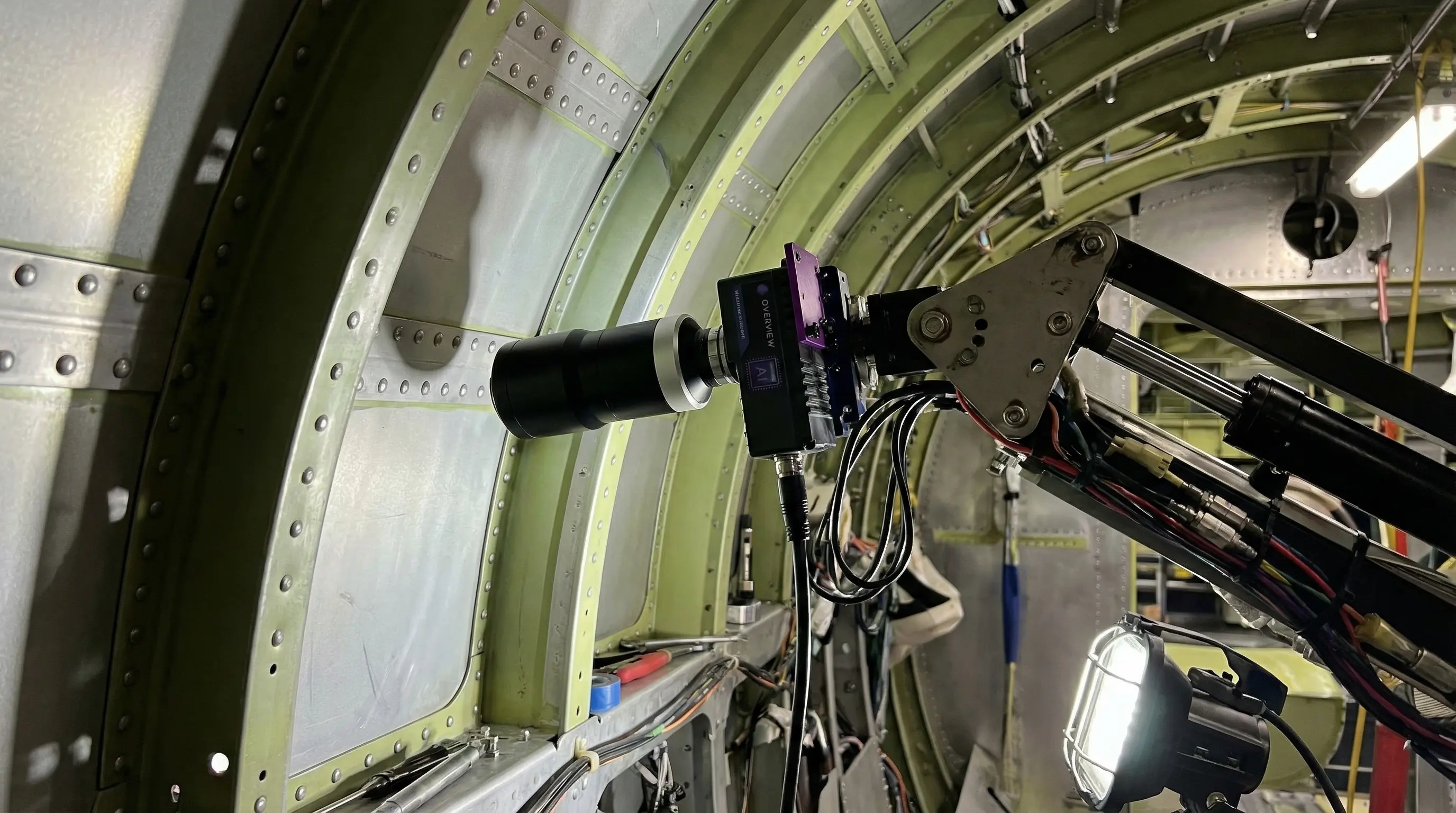
In recent years, multiple aircraft incidents have traced back to improperly secured fasteners. A single missed defect during assembly can cause catastrophic failures at altitude. For aerospace manufacturers and their Tier-1 suppliers, AI-powered fastener inspection isn't a competitive advantage. It's a moral imperative.
When Every Fastener is Flight-Critical
A modern commercial aircraft contains over 1.5 million fasteners. Each one must be the correct type, installed to specification, and properly secured. The consequences of failure extend far beyond the factory floor:
Structural Integrity
Improperly seated rivets create stress concentrations that propagate into fatigue cracks. What starts as a 0.5mm seating deviation can become a catastrophic structural failure after 10,000 pressurization cycles.
Fleet Groundings
When a fastener defect is discovered in service, the entire fleet may be grounded for inspection. The 737 MAX door plug incident resulted in worldwide groundings, airline disruptions, and billions in economic impact.
Regulatory Consequences
FAA and EASA enforcement actions can include production rate limitations, enhanced oversight, and consent decrees that persist for years. Recent industry quality challenges trace directly to assembly inspection gaps.
Critical Fastener Inspection Points
AI vision systems can inspect every fastener on every assembly, something physically impossible with manual inspection at production rates. The technology addresses the full range of fastener quality concerns:
Presence & Count Verification
Every hole must contain a fastener. AI verifies complete installation by comparing actual fastener patterns against CAD-derived requirements, catching missing hardware before the panel moves to the next station.
Seating Depth & Flush
Countersunk fasteners must sit flush with the aerodynamic surface within tight tolerances (typically ±0.005"). AI with structured lighting detects proud or recessed fasteners that would create drag or stress risers.
Head Condition
Tool marks, drive recess damage, and head cracks indicate installation issues that may have compromised the fastener. AI models learn the difference between cosmetic marks and structural damage.
Sealant Application
Fuel tank and pressure vessel fasteners require proper sealant coverage. AI verifies fillet presence, coverage area, and absence of voids that would create leak paths or corrosion sites.
Type Verification
Wrong fastener type, even with identical dimensions, can have catastrophic consequences due to material or strength differences. AI identifies head markings and distinguishes between similar-looking hardware.
Why Aerospace Fastener Inspection is Uniquely Challenging
Traditional machine vision fails in aerospace environments due to factors that don't exist in typical manufacturing:
Complex Geometries
Fuselage curvature, wing contours, and internal structures create inspection challenges impossible to address with fixed cameras. AI compensates for perspective distortion and normalizes measurements across curved surfaces.
Reflective Surfaces
Bare aluminum, anodized finishes, and primer coatings create wildly different reflectivity. AI vision handles these variations without requiring surface treatment or controlled lighting environments.
Access Constraints
Many fasteners are installed in confined spaces: inside wing boxes, behind brackets, or in bilge areas. Compact AI cameras on articulating arms can reach locations impossible for human inspectors.
Implementing AI Inspection in Aerospace Production
Aerospace AI inspection deployment requires careful integration with existing quality systems and production flow:
Deployment Architecture
- •Station-Based: Fixed cameras at assembly stations inspect work as completed, providing immediate feedback to installers
- •End-of-Line: Robotic scanning systems perform comprehensive final inspection before structural closeout
- •Portable: Handheld or arm-mounted cameras for in-situ inspection of confined areas
- •MES Integration: Results linked to work orders, serial numbers, and operator IDs for complete traceability
The OV20i smart camera ($9,450) is ideally suited for aerospace applications. Its compact form factor with integrated LED lighting reaches confined spaces, while the onboard NVIDIA Xavier NX (21 TOPS) provides sub-10ms inference without network dependencies in large assembly buildings. For higher resolution fastener head marking verification, the OV80i delivers 8.3MP at 30 FPS.
The Business Case for Aerospace AI Inspection
Beyond safety imperatives, AI inspection delivers compelling economics for aerospace manufacturers:
Cost Impact Analysis
- Cost to rework fastener at assembly$50-200
- Cost to rework after structural closeout$5,000-20,000
- Cost of in-service discovery$500,000+
- Inspection cost ratio (early vs. late)100:1 to 10,000:1
Add the value of preventing a single grounding event, which can exceed $1 billion in direct and indirect costs, and AI inspection becomes one of the highest-ROI investments in aerospace manufacturing.
Common Questions About Aerospace AI Inspection
Q: Can AI inspection replace NDT methods?
A: AI vision complements rather than replaces NDT. It excels at surface condition and installation verification, while ultrasonic and eddy current methods remain essential for subsurface defect detection.
Q: How does the system handle different fastener types?
A: AI models can be trained to recognize hundreds of fastener types simultaneously. The system cross-references expected fastener callouts from the MES against what it observes, flagging mismatches.
Q: What about ITAR/export control compliance?
A: Overview systems process 100% on-premise with no cloud dependency. The edge AI architecture means all data remains on-premises under your security controls, supporting ITAR and other export control requirements. No subscription fees or external data transmission.
Make Every Fastener Flight-Ready
Join the aerospace leaders implementing AI inspection to ensure structural integrity and protect passengers. See how Overview can integrate with your AS9100 quality system.
Schedule a Demo