AI Inspection for Gigafactory Battery Cell Production
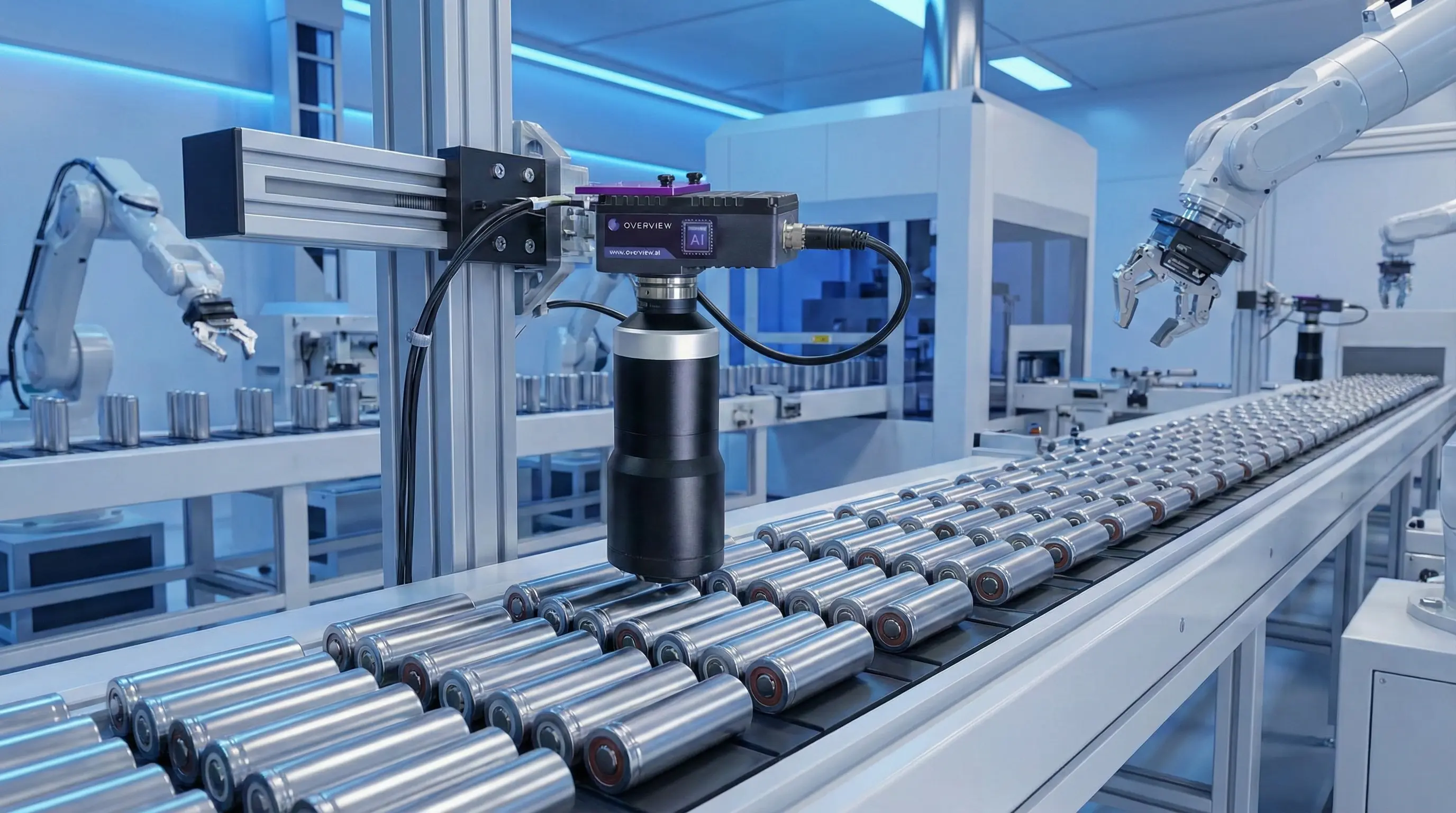
A single defective battery cell can trigger thermal runaway, turning a $50,000 electric vehicle into a fireball. For gigafactory operations producing millions of cells monthly, AI-powered vision inspection isn't optional. It's the difference between market leadership and billion-dollar recalls.
The Stakes: Why Battery Quality is Non-Negotiable
The EV battery industry learned its lessons the hard way. Major EV recalls have cost manufacturers billions of dollars. In every case, the root cause traced back to manufacturing defects that escaped detection: contamination particles, electrode damage, or compromised welds that created internal short circuits.
At gigafactory scale, the challenge is staggering:
Volume vs. Vigilance
A single gigafactory produces over 1 million battery cells per day. Traditional sampling-based inspection, checking 1 in 1,000, means 999 potential defects pass uninspected every minute.
Microscopic Defects, Catastrophic Consequences
A 20-micron metal particle, invisible to the naked eye, can pierce the separator layer and cause thermal runaway years after installation. These defects must be caught at the source.
Traceability Requirements
When a field failure occurs, manufacturers need to trace the defect back to the exact production batch, machine, and timestamp. This requires 100% inspection with full data logging.
Critical Inspection Points in Battery Cell Manufacturing
Battery cell production involves dozens of precision processes, each with unique failure modes. AI vision systems must be deployed at critical control points throughout the line:
Electrode Coating Inspection
As slurry is coated onto copper/aluminum foils at speeds exceeding 50 meters per minute, AI detects coating thickness variations, pinholes, edge defects, and foreign particle contamination that would cause capacity loss or shorts.
Calendering & Slitting
Compression and cutting processes can introduce cracks, wrinkles, and burrs. AI vision identifies electrode damage that compromises cell performance and safety.
Cell Assembly & Tab Welding
Laser weld quality on tabs and current collectors is critical. AI detects weld position deviation, incomplete fusion, spatter, and porosity that would cause resistance heating.
Can Sealing & Final Inspection
The final seal determines whether electrolyte remains contained for the cell's 15-year lifespan. AI inspects crimp quality, seal integrity, and external cosmetic defects before cells ship to pack assembly.
Why AI Vision is Essential for Battery Inspection
Traditional machine vision struggles in battery manufacturing due to the unique challenges of the environment and materials:
Reflective Metal Surfaces
Copper and aluminum foils create specular reflections that confuse rule-based vision systems. AI models learn to see through glare and identify actual defects versus lighting artifacts.
Low-Contrast Defects
Coating defects on black electrode material, or contamination on silver foils, present minimal contrast. Deep learning models detect subtle texture and color variations invisible to threshold-based systems.
Process Variation
Lot-to-lot material variations, temperature fluctuations, and equipment wear cause "normal" appearance to drift over time. AI adapts to these variations while maintaining defect sensitivity.
Implementing AI Inspection in Gigafactory Operations
Successful gigafactory deployment requires a systematic approach that balances coverage, speed, and integration:
Deployment Architecture
- •Edge Processing: On-camera AI inference eliminates network latency, enabling real-time reject decisions at line speed
- •Multi-Camera Arrays: High-resolution coverage of wide electrode webs requires coordinated multi-camera systems with stitched inspection zones
- •Centralized Training: OV Fleet enables model updates to propagate across hundreds of cameras simultaneously
- •MES Integration: Every inspection result links to cell serial numbers for complete traceability from raw material to finished pack
The OV80i vision system ($13,450) with its 8.3MP Sony IMX334 sensor and 70 TOPS NVIDIA Orin NX processor is particularly suited for battery inspection. The C-mount lens system allows teams to optimize for both macro defects on electrode sheets and micro defects on weld joints. For simpler inspection points, the OV20i ($9,450) provides an integrated all-in-one solution with IP67 protection.
The Economics of Battery Inspection
For gigafactory operations, AI inspection ROI comes from multiple sources:
Cost Avoidance Analysis
- Recall cost per defective cell reaching field$10,000+
- Scrap cost catching defect at production$5-15
- Cost ratio (field vs. factory)1000:1
- Defects caught to justify system<10 per year
Beyond recall prevention, AI inspection improves yield by catching process drift early, reduces warranty reserves, and provides the quality documentation increasingly required by OEM customers.
Common Questions About Gigafactory AI Inspection
Q: How small a defect can AI detect?
A: With appropriate optics, AI vision systems detect defects down to 20 microns, smaller than a human hair. The OV80i's 3840x2160 resolution and C-mount lens compatibility (including telecentric and borescope options) allow optimization for the specific defect sizes relevant to each inspection point.
Q: Can the system handle dry room environments?
A: Yes. Overview cameras are designed for industrial environments including the low-humidity conditions required for battery manufacturing. Sealed enclosures prevent moisture intrusion that would compromise electrode materials.
Q: How quickly can models be updated for new cell formats?
A: New cell formats typically require 2-4 hours of training data collection and model refinement. Browser-based training means your team can iterate without external integrators.
Protect Your Battery Investment
Don't let a single defective cell become a billion-dollar recall. See how Overview AI is helping the world's leading battery manufacturers achieve zero-escape quality.
Schedule a Demo