AI Vision for Medical Device Assembly Inspection
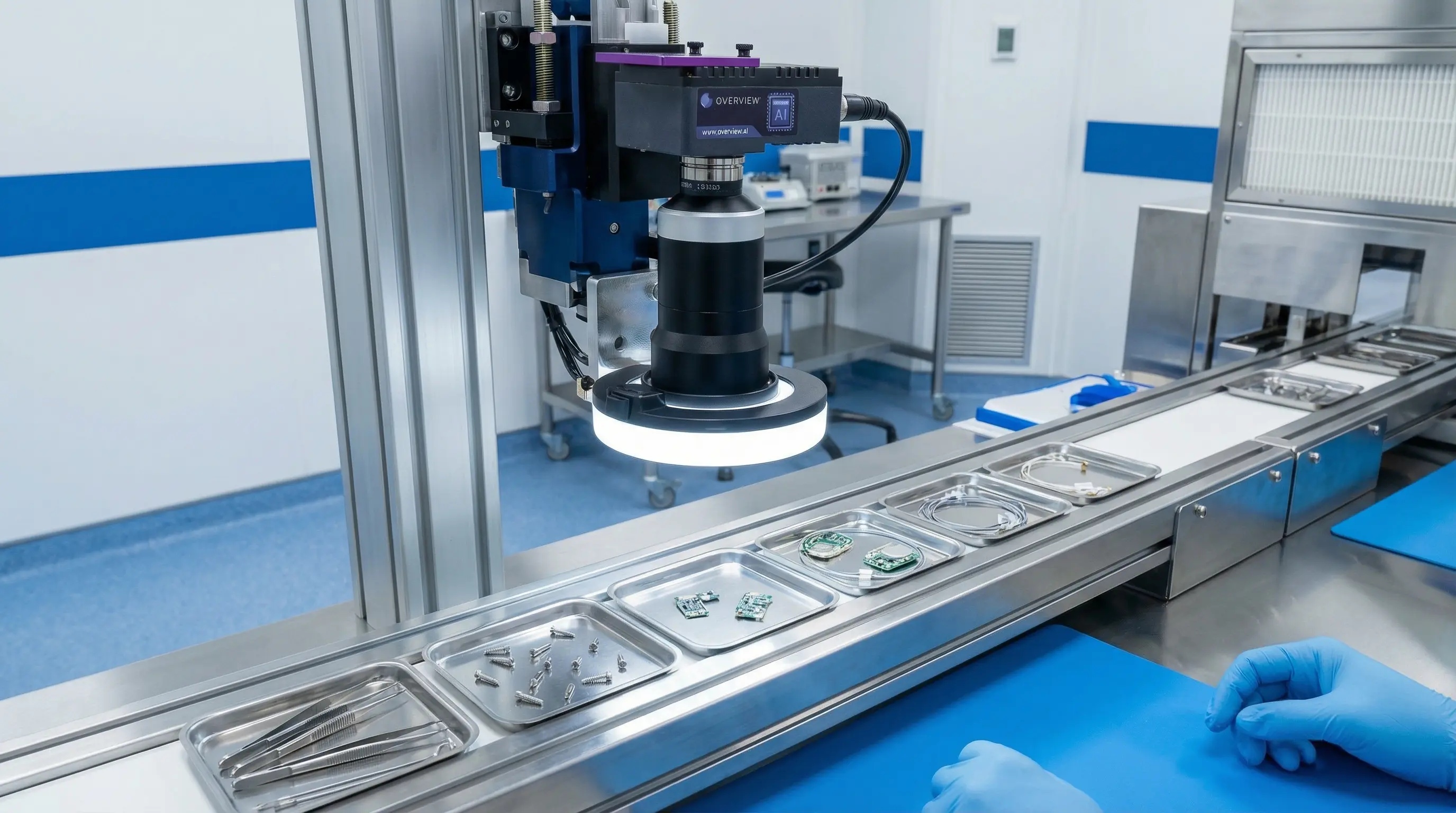
In medical device manufacturing, quality isn't a metric. It's a patient safety imperative. A hairline crack in a syringe, a microscopic burr on a catheter, or a misassembled insulin pump can harm or kill. For medical device manufacturers, 100% inspection isn't a goal; it's a regulatory requirement and an ethical mandate. AI vision makes it achievable at production scale.
When Quality Means Life or Death
Medical device manufacturing operates under the most demanding quality requirements of any industry:
Regulatory Reality
- •FDA 21 CFR Part 820: Quality System Regulation requiring documented inspection
- •ISO 13485: Medical device quality management standards
- •21 CFR Part 11: Electronic records and signatures requirements
- •Zero-defect expectation for Class III life-sustaining devices
Manual inspection at these standards is exhausting, error-prone, and increasingly impossible at modern production volumes. A single inspector examining thousands of tiny components per shift cannot maintain the vigilance required. AI never gets tired, never gets distracted, and provides the documented consistency regulators demand.
Critical Inspection Points in Medical Device Manufacturing
AI vision addresses quality requirements across the medical device production process:
Component Inspection
Incoming components like needles, cannulas, tips, o-rings, and housings must meet specifications before assembly. AI verifies dimensions, surface finish, material defects, and cleanliness.
Assembly Verification
Multi-component devices must be correctly assembled: right components in right positions with proper orientation. AI confirms assembly completeness and correctness in real-time.
Surface & Coating Quality
Medical surfaces must be free of scratches, burrs, contamination, and coating defects. For implants, surface finish can determine biocompatibility and osseointegration.
Sterile Packaging Integrity
Sterile barrier packaging must maintain integrity through storage and shipping. AI inspects seals, punctures, wrinkles, and contamination through transparent packaging without opening.
Labeling & UDI Compliance
Every device requires accurate labeling including Unique Device Identification (UDI). AI verifies label content, placement, readability, and UDI barcode quality.
Real-World Medical Device Inspection Scenarios
Syringe Manufacturing
Prefilled syringes for biologics require inspection at multiple points:
- •Barrel inspection for cracks, inclusions, and dimensional accuracy
- •Needle sharpness and bevel angle verification
- •Stopper position and silicone coating consistency
- •Fill level and particulate detection in liquid
Catheter Production
Cardiovascular catheters demand micron-level inspection:
- •Tip profile and smoothness (burrs can damage blood vessels)
- •Lumen patency and interior surface quality
- •Balloon integrity and inflation symmetry
- •Coating uniformity and bond strength indicators
Orthopedic Implant Inspection
Joint replacements and spinal implants require comprehensive surface analysis:
- •Surface roughness measurement for bone integration
- •Coating thickness and porosity verification
- •Dimensional accuracy for proper fit
- •Laser marking legibility for traceability
Achieving FDA Compliance with AI Vision
AI vision systems can be validated to meet FDA requirements when properly implemented:
21 CFR Part 11 Compliance
Electronic records from AI inspection systems must maintain integrity. Proper implementation includes audit trails, electronic signatures, access controls, and backup procedures that satisfy Part 11 requirements.
Computer System Validation (CSV)
AI inspection systems require validation under GAMP 5 principles. AI models must be documented, version-controlled, and validated for their intended use with defined acceptance criteria.
Change Control
Any changes to inspection criteria, AI models, or system configuration must follow documented change control procedures with impact assessment and re-validation when required.
Why AI Vision Excels in Medical Device Inspection
Consistent Vigilance
AI maintains identical inspection criteria for the first unit and the millionth unit. Unlike human inspectors who experience fatigue and attention drift, AI delivers documented consistency that satisfies regulatory scrutiny.
Complete Documentation
Every inspection decision is recorded with the image evidence. When FDA auditors ask "how do you know this device was inspected?" the answer is a complete, timestamped visual record linked to the device's unique identifier.
Subtle Defect Detection
AI can detect defects invisible to the human eye: microscopic cracks, subtle coating variations, and dimensional deviations at micron scale. The OV80i's 8.3MP resolution combined with AI analysis exceeds human capability.
Implementing AI Vision in Medical Device Manufacturing
Implementation Requirements
- •Cleanroom compatibility: Equipment rated for ISO Class 7/8 environments
- •Validation documentation: IQ/OQ/PQ protocols and executed test results
- •Audit trail: Tamper-evident electronic records per 21 CFR Part 11
- •User access controls: Role-based permissions with electronic signatures
The OV20i ($9,450) with IP67 protection and edge processing provides the validated inspection platform medical device manufacturers require. All data stays on-premise with no cloud dependency, meeting data residency requirements. For enterprise deployments, OV Fleet enables standardization across global manufacturing sites with centralized model management and real-time yield monitoring.
ROI in Medical Device AI Inspection
Value Analysis (typical device line)
- Recall avoidance (per incident)$10-100M
- Inspection labor savings$300K-600K/year
- False reject reduction$200K-400K/year
- Documentation compliance valueRisk mitigation
- Typical payback period4-8 months
Frequently Asked Questions
Q: How is AI different from traditional AOI in medical device inspection?
A: Traditional Automated Optical Inspection uses fixed rules that must be programmed for each defect type. AI learns from examples, enabling detection of subtle or previously unknown defect patterns without explicit programming.
Q: Can AI inspection replace human inspectors entirely?
A: AI serves as a force multiplier, handling 100% automated inspection while human quality engineers focus on exception handling, continuous improvement, and audit preparation. The combination delivers better outcomes than either alone.
Q: What happens when the AI model needs to be updated?
A: Model updates follow change control procedures. New models are validated against known good/bad samples, and deployment is documented. The previous model is retained for comparison and rollback if needed.
Protect Patients with AI-Powered Quality
Join leading medical device manufacturers using AI vision to achieve 100% inspection coverage with regulatory compliance. See how Overview can strengthen your quality system.
Schedule a Demo