AI Vision for High-Volume Fulfillment Center Quality Inspection
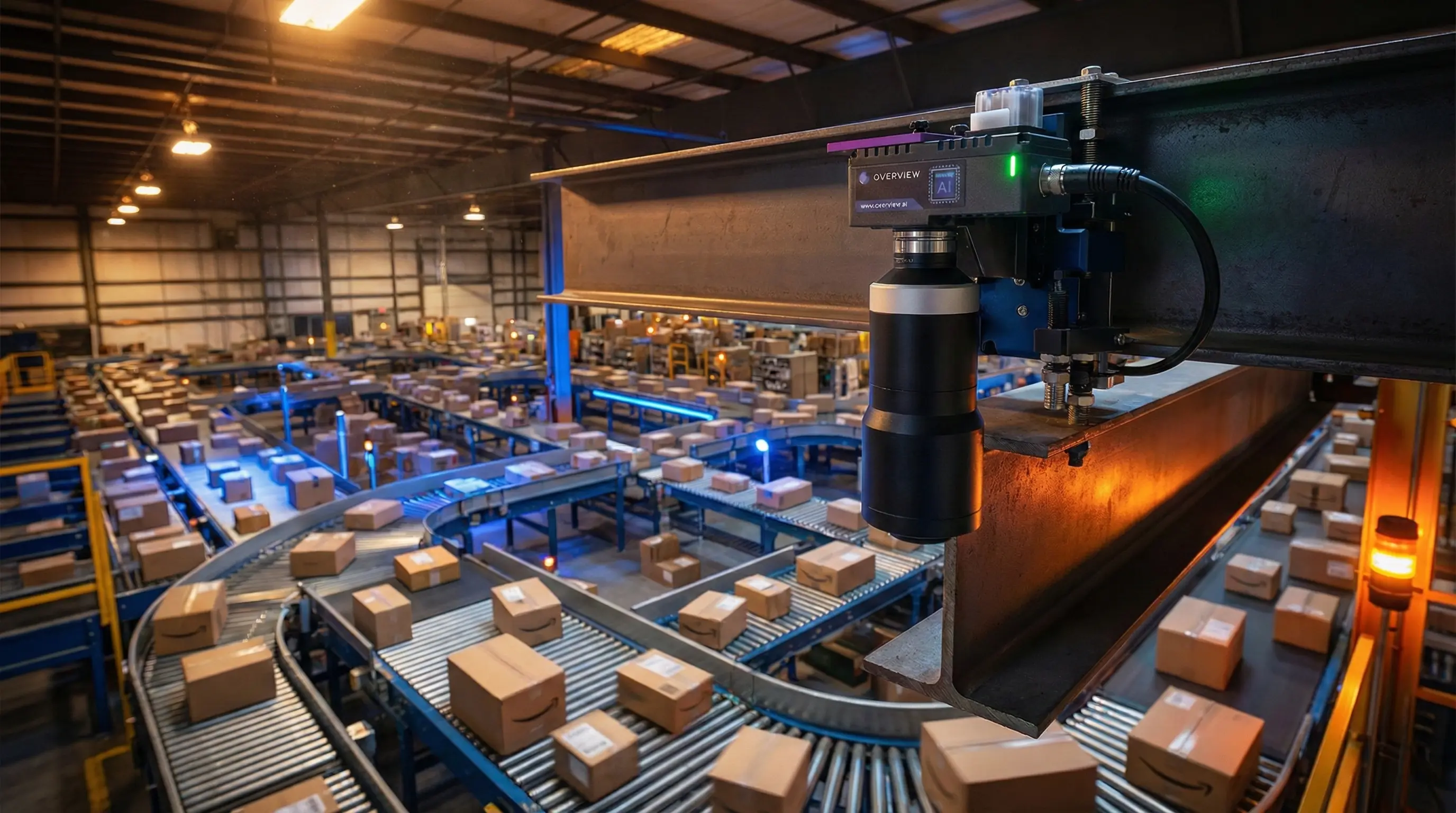
When you're shipping 25 million packages per day, even a 0.1% damage rate means 25,000 customer complaints daily. AI-powered vision inspection gives high-volume fulfillment operations the ability to catch damaged packages, verify shipping labels, and ensure order accuracy before products leave the building. What was once a bottleneck becomes a competitive advantage.
The Scale Problem: Why Manual Inspection Doesn't Work
Modern e-commerce fulfillment centers operate at a scale that would have been unimaginable a decade ago. A single large fulfillment center can process over 1 million packages per day. At that volume, traditional quality control methods like random sampling, manual spot-checks, and end-of-line audits catch only a fraction of issues.
The consequences of missed defects are significant:
Returns & Refunds
Damaged packages result in automatic refunds and free return shipping, a double cost that erodes margins on already thin e-commerce profits.
Customer Trust
One damaged delivery can lose a Prime member. With customer acquisition costs exceeding $50 per subscriber, every damaged package is a potential $1,000+ lifetime value loss.
Carrier Disputes
Without photographic evidence of package condition at ship-out, fulfillment centers absorb damage claims that may have occurred in transit. This amounts to billions in disputed costs annually industry-wide.
What AI Vision Inspects in Fulfillment Operations
AI-powered vision systems deployed at strategic points throughout the fulfillment workflow can inspect 100% of packages in real-time. Unlike rule-based systems that fail on package variety, deep learning models handle the infinite variation of box sizes, tape patterns, and label placements found in real operations.
Package Damage Detection
Crushed corners, dents, tears, wet spots, and tape failures are identified before the package enters the shipping stream. AI models learn the difference between acceptable wear and damage that will result in customer complaints.
Label Verification
Shipping labels are verified for presence, readability, correct orientation, and barcode scan success. Mis-labeled packages are caught before they route to the wrong destination.
Seal & Tape Integrity
Open flaps, insufficient tape coverage, and tamper evidence are flagged. This prevents theft claims and ensures packages survive the rigors of sorting and delivery.
Dimensional Compliance
Packages exceeding carrier size limits or using incorrect box sizes for the contents are identified, preventing surcharges and optimizing shipping costs.
Why AI Beats Traditional Barcode-Only Systems
Traditional fulfillment quality systems rely on barcode scanning, which tells you nothing about the physical condition of the package. AI vision adds a layer of understanding that transforms quality control:
Infinite Package Variety
Unlike rule-based vision that needs programming for each box type, AI models generalize across variations, handling everything from poly mailers to oversized boxes without reconfiguration.
Subtle Damage Detection
A slightly crushed corner might pass a dimensional scan but result in product damage inside. AI learns to flag the compression patterns that correlate with internal damage.
Photographic Evidence
Every inspection creates a timestamped image record. When a customer claims damage, you can prove the package left your facility intact, recovering millions in disputed carrier claims.
Deploying AI Vision in Fulfillment Operations
The key to successful fulfillment center deployment is strategic camera placement at high-value inspection points:
Optimal Inspection Points
- •Pack Station Exit: Catch damage from packing process before label application
- •Post-Label: Verify label presence, readability, and correct placement
- •Sortation Induct: Final check before packages enter the carrier network
- •Dock Door: Photographic evidence of condition at ship-out for claims defense
With the OV20i smart camera ($9,450), deployment takes hours, not weeks. The IP67-rated camera connects directly to your WMS via Ethernet/IP or PROFINET, with pass/fail signals triggering divert mechanisms for damaged or mis-labeled packages. For operations needing higher resolution to catch subtle damage, the OV80i delivers 8.3MP imaging at 30 FPS with 70 TOPS of edge AI processing.
The ROI of Fulfillment Center AI Inspection
For high-volume fulfillment operations, the math is compelling:
Sample ROI Calculation (1M packages/day operation)
- Current damage rate0.3% (3,000 packages/day)
- Average cost per damaged package$15 (refund + return shipping)
- Daily damage cost$45,000
- AI inspection damage reduction70%
- Daily savings$31,500
Common Questions About Fulfillment Center AI Inspection
Q: Can AI keep up with high-speed conveyors?
A: Yes. The OV20i processes images with sub-10ms latency using its onboard NVIDIA Xavier NX processor (21 TOPS). This handles conveyor speeds exceeding 600 feet per minute, faster than most sortation systems. All processing happens at the edge with no cloud dependency.
Q: How does the system handle package variety?
A: Deep learning models are trained on diverse package types and generalize to new variations automatically. Unlike rule-based systems, AI requires no programming for each new box size.
Q: What about integration with existing WMS?
A: Overview cameras support standard industrial protocols including Ethernet/IP, PROFINET, OPC UA, and Modbus TCP. REST APIs and MQTT enable direct integration with warehouse management and sortation control systems. For multi-site deployments, OV Fleet provides centralized monitoring across all facilities.
Stop Shipping Damaged Packages
Join the fulfillment leaders using AI vision to achieve 99.9%+ outbound quality. See how Overview can integrate with your existing operations.
Schedule a Demo