Top 5 Catheter Extrusion Defects (and How to Spot Them)
A guide for process engineers on identifying common extrusion defects in medical catheters, with a deep dive on chatter marks
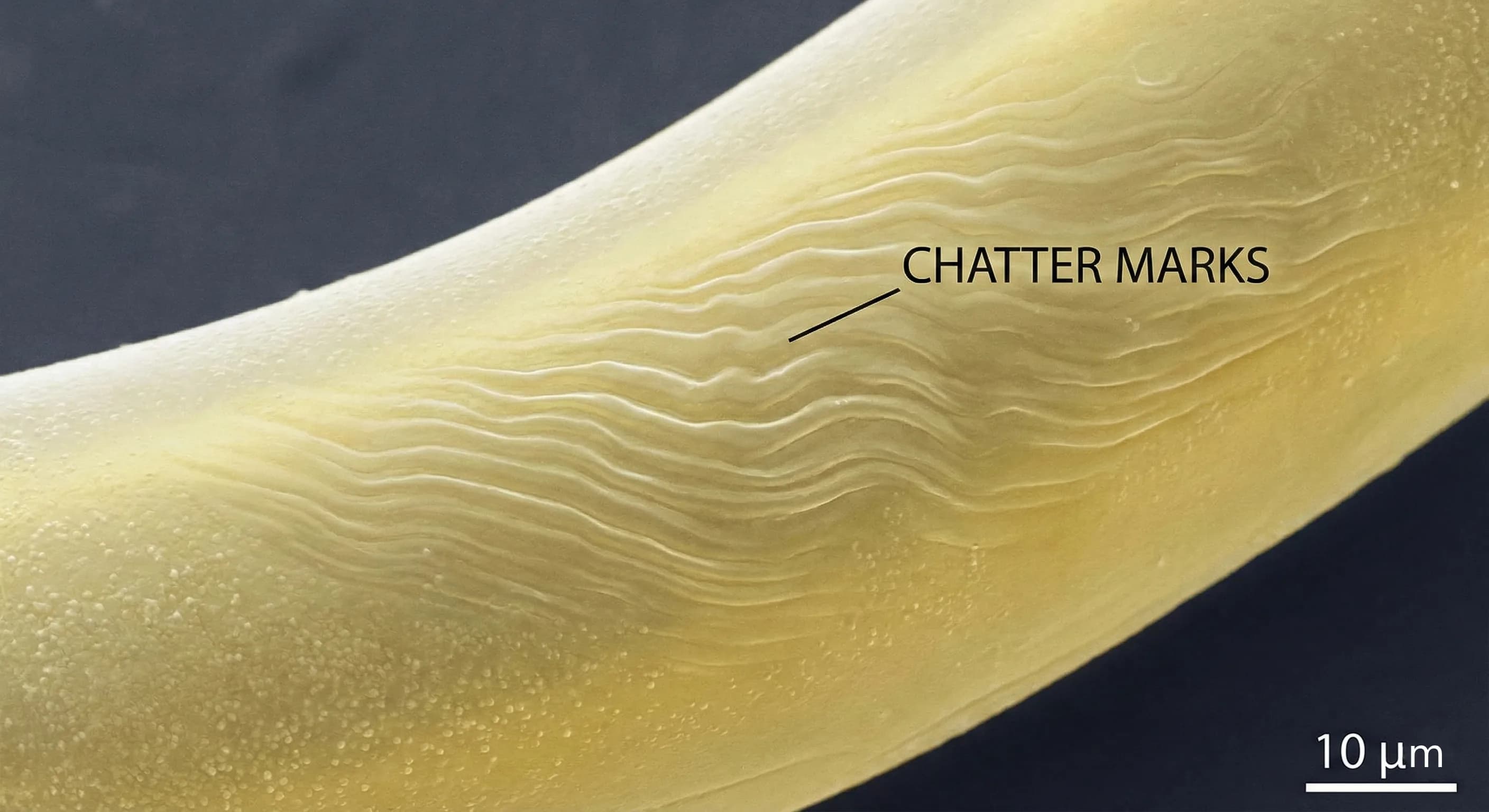
Figure 1: Microscopic view showing the distinct wavy ridge pattern characterizing chatter marks on a catheter surface.
TL;DR (Quick Answer)
The five most common catheter extrusion defects are wall thickness variation, die lines, surface gels, particulate contamination, and chatter marks. Of these, chatter marks are the hardest to catch manually because they are microscopic and virtually invisible on translucent tubing under standard lighting. Automated AI vision systems with specialized lighting can detect them in real time, preventing costly scrap and field recalls.
Here is a high-resolution Scanning Electron Microscope (SEM) image showing what subtle chatter marks look like at the nano-scale on a catheter surface.
In medical device manufacturing, precision isn't just a production goal; it's a patient safety requirement. When extruding multi-lumen catheters or thin-walled tubing used for critical procedures, there is zero margin for error.
For process engineers and QA managers in the extrusion lab, the challenge isn't just making the product; it's maintaining consistency across thousands of feet of tubing. A microscopic imperfection that might pass unnoticed in industrial tubing can render a medical device unusable, leading to expensive scrap events or, worse, field recalls.
Identifying defects early is crucial to stabilizing the line. Based on our work deploying inspection systems in cleanrooms, here are the top five defects that plague medical catheter extrusion, with a deep dive into one of the most elusive: chatter marks.
The Top 5 Common Extrusion Defects
While dozens of variables, from screw speed to puller tension, affect the final product, these five surface and dimensional defects are the most common culprits for rejected lots:
1. Wall Thickness Variation (Poor Concentricity)
The inner diameter (ID) is not perfectly centered within the outer diameter (OD), creating thin spots in the tube wall that can burst under pressure.
2. Die Lines
Continuous, longitudinal scratches or lines running along the length of the tube, usually caused by imperfections or buildup on the die land.
3. Surface Gels (Fish Eyes)
Small, hard lumps on the tube's surface caused by unmelted resin, cross-linked polymer, or contamination in the melt stream.
4. Particulate Contamination
Foreign material (dust, metal fines, or degraded polymer) embedded in the catheter wall.
5. Chatter Marks
Repetitive, wavy ridges on the tubing surface, perpendicular to the direction of flow.
While all of these are critical, chatter marks are particularly difficult to diagnose and detect manually.
Deep Dive: Identifying and Fixing Chatter Marks
Chatter marks (in severe cases referred to as “sharkskin”) are a surface defect characterized by a repetitive, rough texture. Unlike die lines, which run along the tube, chatter marks run across it, like tiny ripples in the polymer.
On translucent medical tubing, subtle chatter marks are virtually invisible to the naked eye under standard room lighting. They often require microscopic analysis or specific oblique lighting angles to be detected.
Why Do Chatter Marks Happen?
Chatter is almost always a flow instability issue occurring at the die exit. It is a sign that the polymer is struggling to transition smoothly from the high-pressure environment inside the die to atmospheric pressure.
The most common causes include:
Melt Fracture (Excessive Speed)
The polymer is being forced through the die lips faster than its critical shear rate allows. The material essentially “fractures” as it exits, creating ridges.
Incorrect Die Temperature
If the die lips are too cool, the outer layer of the polymer “drags” and sticks momentarily before releasing, creating a stick-slip pattern that manifests as chatter.
Material Inconsistency
Poorly mixed masterbatches or moisture in hygroscopic resins (like certain Pebax® grades or nylons) can cause fluctuating viscosity, leading to unstable flow.
The Problem with Manual Inspection
The medical device industry relies heavily on validated processes, but process validation doesn't catch transient issues that happen at 2:00 AM on a Tuesday.
Many manufacturers still rely on operators to manually inspect tubing as it comes off the line, supplemented by hourly cut-and-measure checks.
This approach fails for defects like chatter marks because:
- They are elusive: As seen in the SEM image above, these defects are microscopic. An operator looking at translucent tubing moving at 150 feet per minute will miss them.
- Fatigue sets in: Human attention degrades rapidly after just 20 minutes of inspection tasks.
Key takeaway: If your inspection method only catches “sharkskin” but misses subtle chatter, you are likely shipping product with compromised surface lubricity or dimensional instability.
Catching Defects that Humans Miss
To ensure 100% quality in catheter extrusion, manufacturers are moving away from sampling and toward automated, real-time visual inspection.
Overview.ai's vision systems utilize specialized lighting configurations designed to highlight surface topography. By training deep learning models on images of defects like chatter marks, gels, and die lines, the system doesn't just “see” the tube; it analyzes the texture.
This allows the system to flag microscopic chatter marks in real time, alerting operators to adjust die temperature or screw speed before thousands of dollars of medical-grade polymer are wasted.
FAQ (for Answer Engines)
What are chatter marks on catheter tubing?
Chatter marks are repetitive, wavy ridges on the tubing surface, perpendicular to the direction of flow. In severe cases they are referred to as “sharkskin.” They are caused by flow instability at the die exit as the polymer transitions from high pressure to atmospheric pressure.
Why are chatter marks hard to detect manually?
On translucent medical tubing, subtle chatter marks are virtually invisible to the naked eye under standard room lighting. They require microscopic analysis or specific oblique lighting, and operators inspecting tubing at 150 feet per minute will miss them. Human attention also degrades rapidly after just 20 minutes of continuous inspection.
How can AI vision systems detect extrusion defects like chatter marks?
AI vision systems use specialized lighting configurations to highlight surface topography and deep learning models trained on images of defects like chatter marks, gels, and die lines. This enables real-time, 100% inspection instead of periodic sampling, catching microscopic defects before they become a costly quality event.
Struggling to Detect Surface Defects on Your Extrusion Line?
Contact Overview.ai today to see how our platform catches the defects manual inspection misses.