Automating Solder Ball Splash Detection on Automotive Ethernet Headers
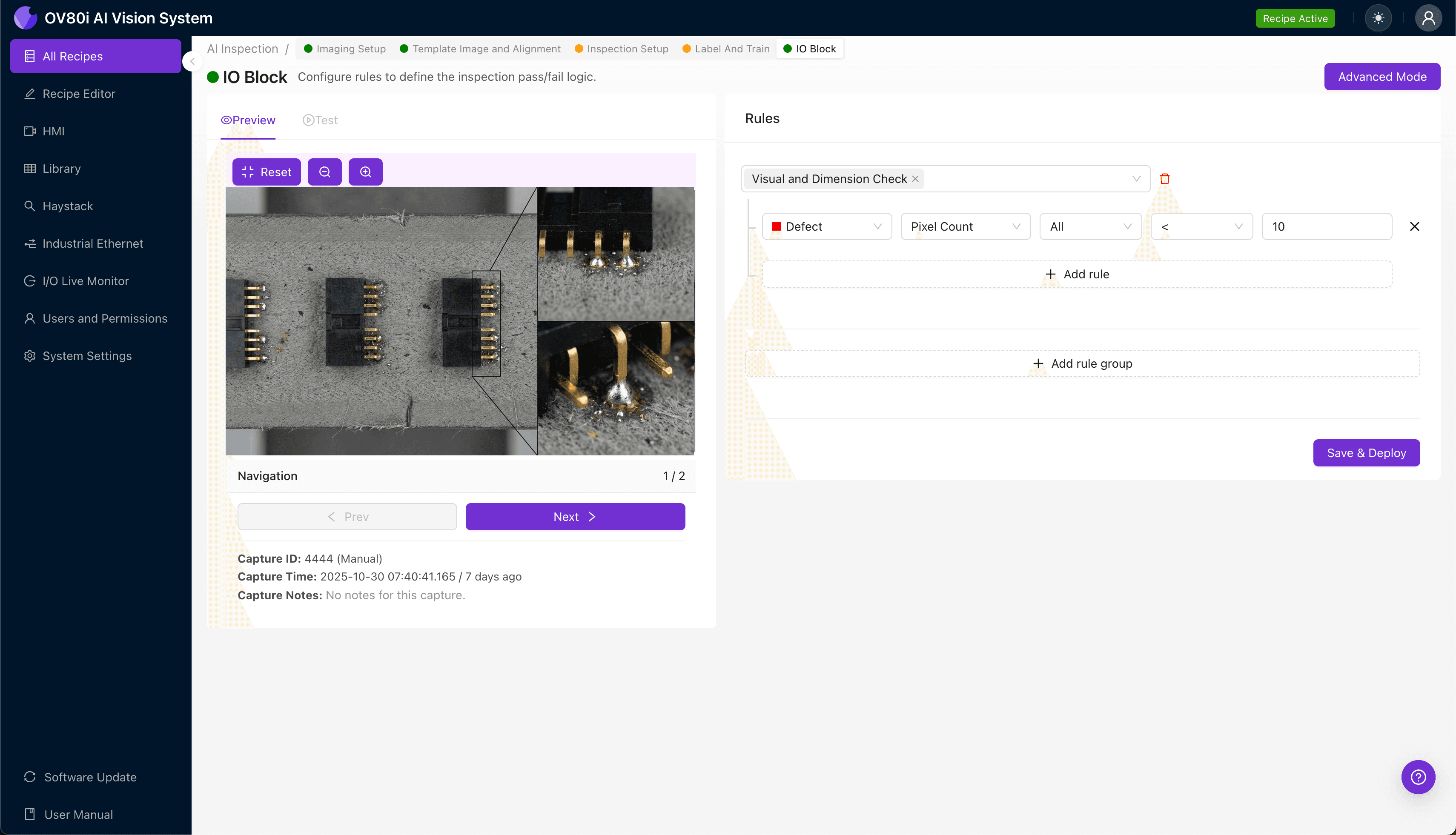
"Solder ball splash on automotive Ethernet headers causes intermittent signal failures and safety concerns. Deep learning-powered visual inspection catches micro-scale contamination that human inspectors miss, delivering consistent detection at full line speed with complete traceability."
The Problem: Why Manual Inspection Falls Short
Automotive Ethernet headers are critical components in modern vehicle communication systems, enabling high-speed data transfer between ECUs, sensors, and infotainment modules. When solder ball splash contaminates these precision connectors during assembly, the consequences range from intermittent signal loss to complete communication failure—a serious safety concern in automotive applications.
Common Defects Found in Automotive Ethernet Headers with Solder Ball Splash:
- Solder ball bridging — conductive spheres creating unintended connections between adjacent pins
- Splash contamination on contact surfaces — solder debris compromising signal integrity at mating interfaces
- Ball migration into housing cavities — loose solder balls trapped in connector recesses causing intermittent shorts
- Pin base contamination — solder splash accumulation at the solder joint-to-plastic interface
- Partial ball adhesion — weakly attached solder spheres at risk of dislodging during vehicle operation
- Thermal damage halos — discoloration patterns around splash zones indicating compromised plastic integrity
Human inspectors examining these micro-scale defects face an impossible task. With inspection windows measured in seconds and defects often smaller than 200 microns, inspector fatigue, subjective judgment, and inconsistent lighting conditions lead to escape rates that automotive OEMs simply cannot tolerate.
The Solution: Machine Vision Powered by Deep Learning
Traditional rule-based machine vision struggles with solder ball splash because defect presentations vary enormously. A splash pattern on one header looks nothing like the next, making hard-coded detection thresholds unreliable.
Deep learning changes the equation entirely. By training neural networks on thousands of labeled images, AI-powered systems learn to recognize the subtle visual signatures of contamination—regardless of size, shape, or location.
Overview.ai's approach delivers what manual inspection cannot: consistent, objective evaluation at full line speed. Every header receives the same rigorous scrutiny, 24/7, with results traceable to the individual unit level.
Step 1: Imaging Setup
Begin by placing a representative Automotive Ethernet header sample under the OV80i camera. Position the component to capture the critical contact surfaces and potential splash zones in a single field of view.
Click "Configure Imaging" in the Overview interface. Adjust Camera Settings including exposure time and gain to achieve clear visualization of both the metallic pin surfaces and any reflective solder ball contamination.
Click "Save" to lock in your imaging parameters.
Step 2: Image Alignment
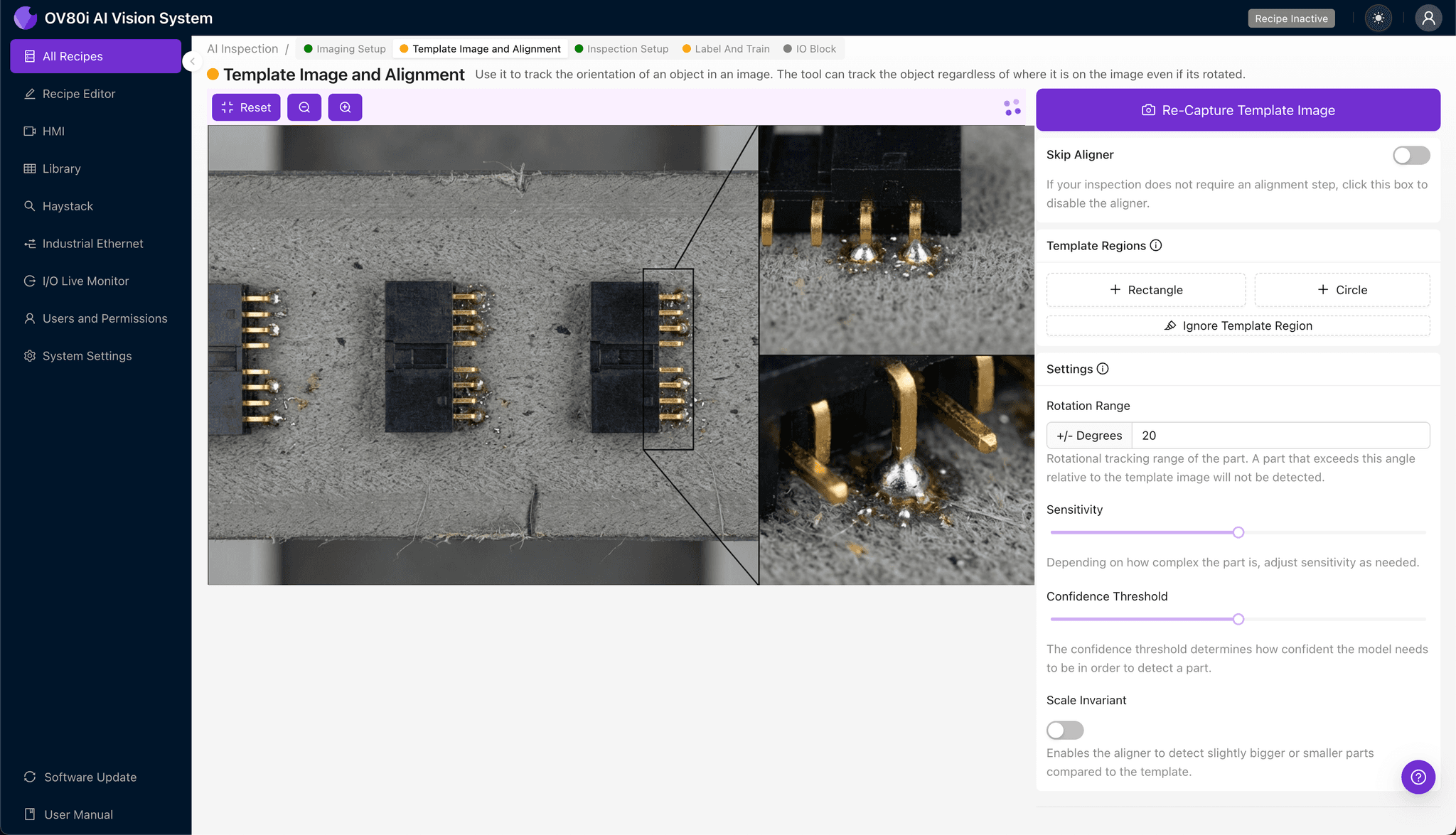
Navigate to the "Template Image" tab and capture a Template of your golden reference part. This establishes the baseline orientation for all subsequent inspections.
Click "+ Rectangle" and draw a region around the main connector body, encompassing the full header outline. Set "Rotation Range" to 20 degrees to accommodate minor variations in part presentation on the line.
Step 3: Inspection Region Selection
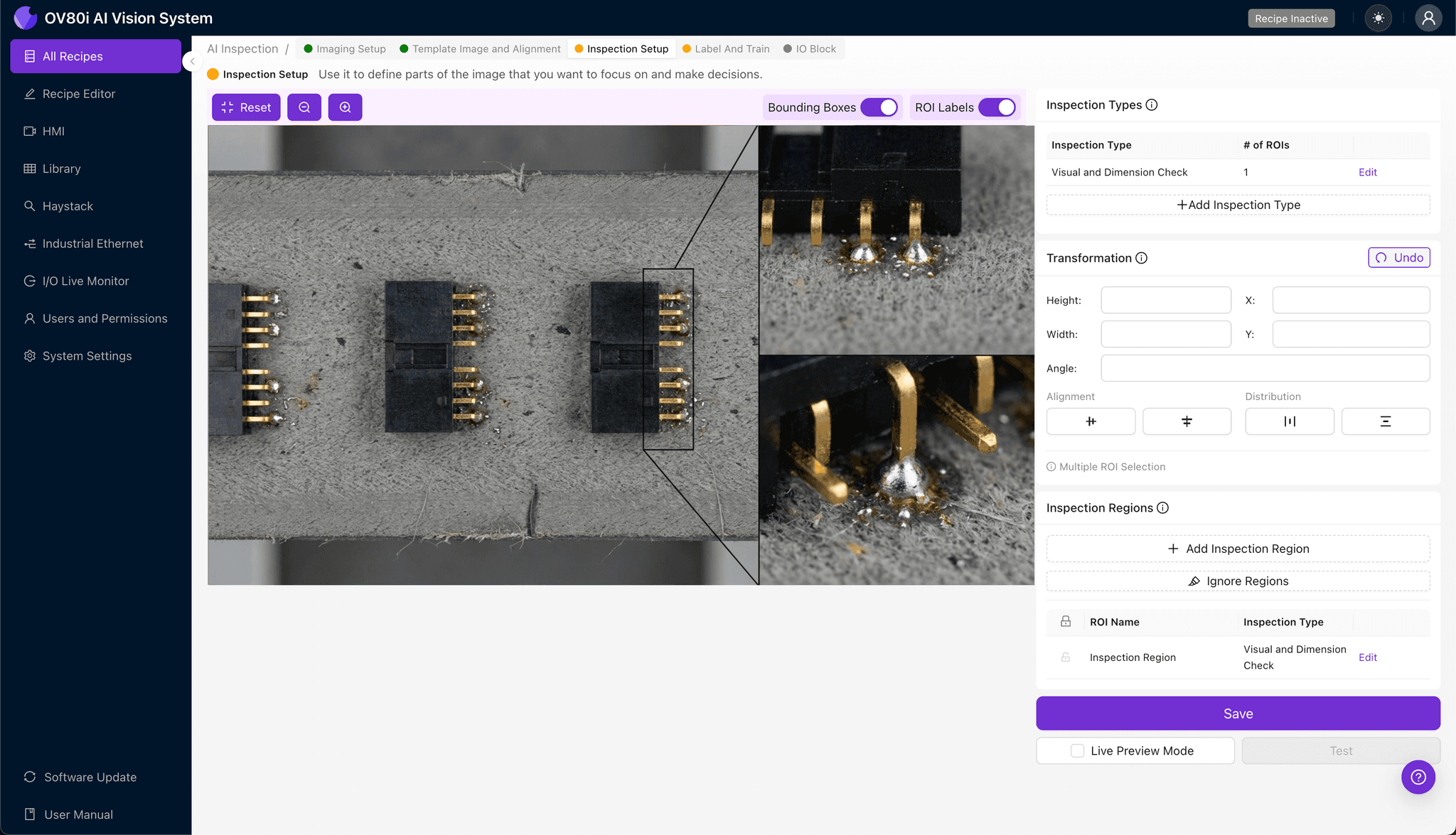
Navigate to "Inspection Setup" to define where the system should look for defects. Rename your "Inspection Types" to reflect your specific failure modes—for example, "Pin_Surface_Splash" and "Housing_Contamination."
Click "+ Add Inspection Region" for each critical area. Resize the yellow bounding box to cover contact mating surfaces, pin bases, and housing cavities where solder balls typically migrate.
Click "Save" after defining all inspection zones.
Step 4: Labeling Data
This step leverages human expertise to teach the AI what matters. Quality engineers review captured images and label them as Good (acceptable) versus Bad (defective).
Include representative samples across your full range of production variation. Critically, ensure your training set contains known failure modes including subtle splash patterns, borderline cases, and confirmed field returns.
Step 5: Creating Rules
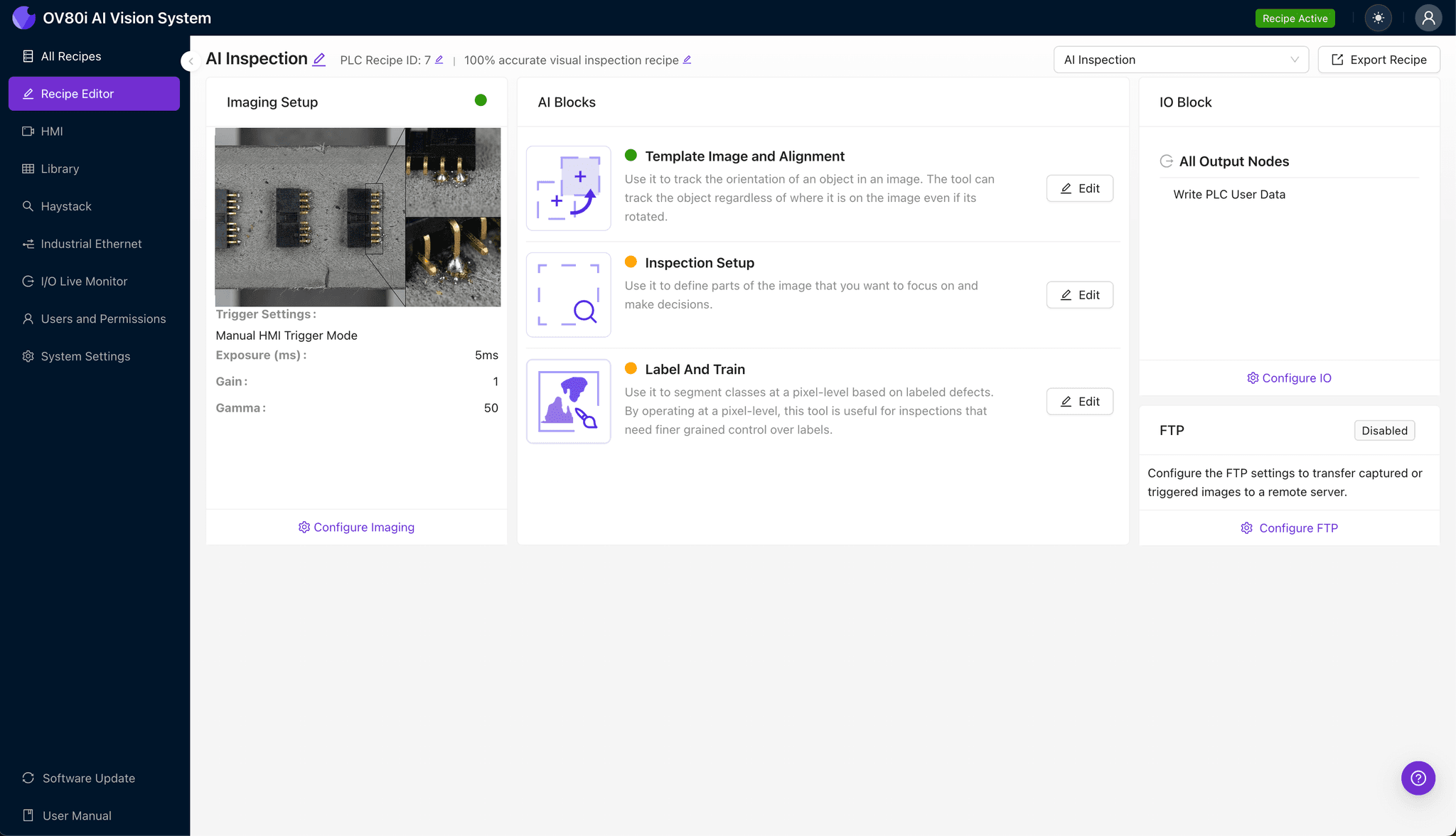
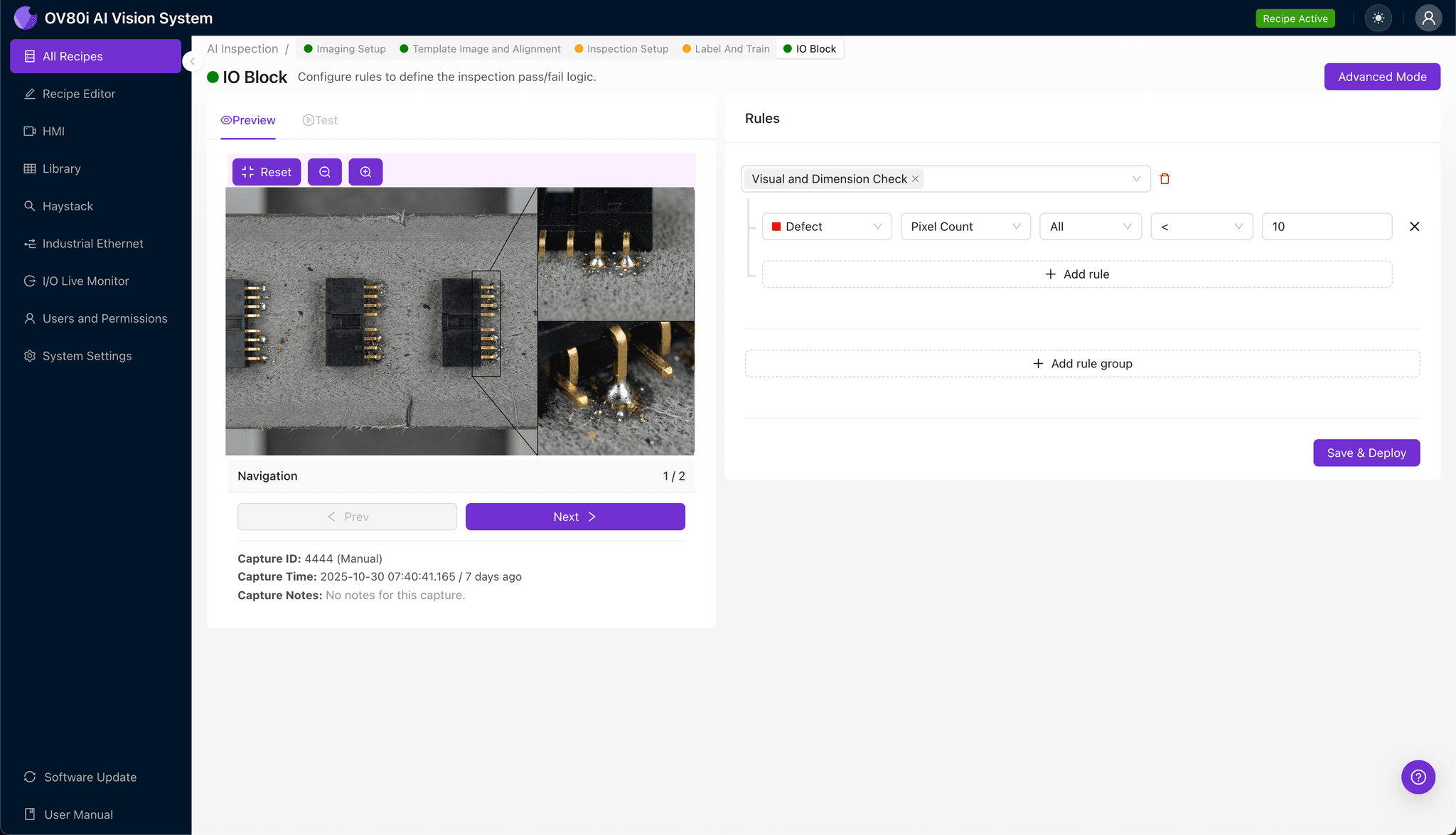
With your trained model deployed, navigate to the Rules configuration. Set pass/fail logic based on your defined Inspection Types—for instance, any detection in "Pin_Surface_Splash" triggers automatic rejection.
These rules gate automated acceptance directly on the production line, removing defective units before they reach downstream assembly or customer shipment.

Key Outcomes & ROI
Implementing AI-powered visual inspection for solder ball splash detection delivers measurable business impact:
- Reduced scrap and rework costs — catch contamination immediately after soldering rather than at end-of-line or worse, in the field
- Higher throughput — eliminate inspection bottlenecks with consistent sub-second cycle times
- Automotive compliance and full traceability — maintain inspection images and results for IATF 16949 audits and customer quality portals
- Process improvement insights — trend analysis identifies upstream soldering issues before they become systemic quality events
For automotive suppliers where a single field failure can trigger costly recalls and damage OEM relationships, automated solder ball splash detection isn't just an efficiency play—it's essential risk mitigation.
Eliminate Solder Ball Splash Escapes Today
Stop relying on manual inspection for your Ethernet header production. Deploy Overview.ai to catch contamination defects instantly.