Detecting Stress-Relaxation Deformation in Beryllium Copper Contacts: A Machine Vision Walkthrough
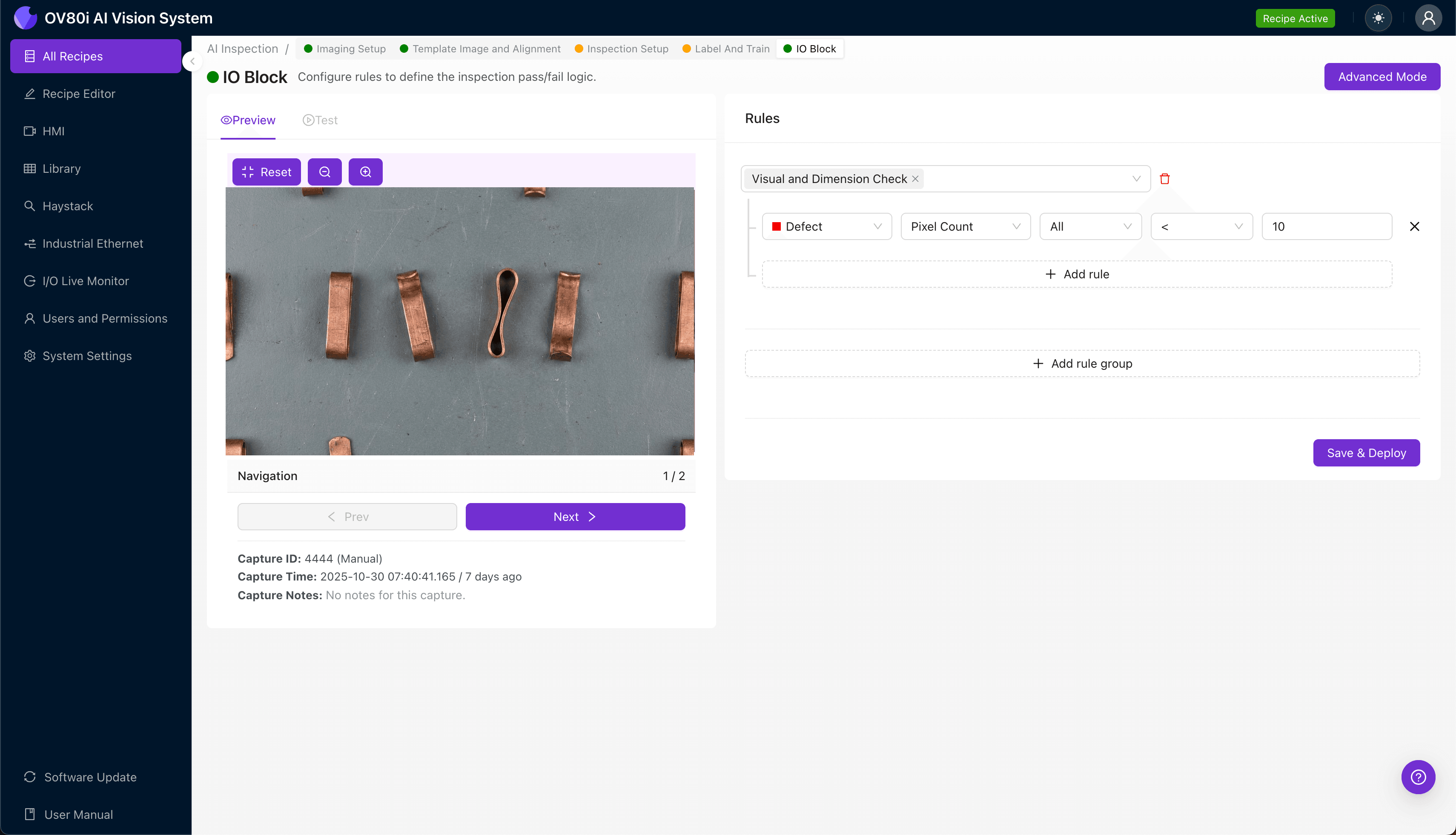
"Stress-relaxation deformation in beryllium copper contacts creates subtle defects that human inspectors struggle to catch consistently. AI-powered machine vision delivers objective, high-speed inspection that identifies permanent set, micro-cracking, and dimensional drift before defective contacts reach downstream assembly."
The Problem: Why Stress-Relaxation Defects Slip Through
Beryllium copper contacts are critical components in high-reliability electrical connectors, prized for their exceptional conductivity and spring properties. However, stress-relaxation deformation—the gradual loss of contact force over time—creates subtle defects that compromise electrical performance and long-term reliability.
Common Defects in Beryllium Copper Contacts with Stress-Relaxation Deformation:
- Permanent set deformation – Contact fingers that fail to return to their original position after repeated mating cycles
- Micro-cracking at bend radii – Hairline fractures forming where stress concentration is highest
- Surface oxidation patterns – Discoloration indicating localized overheating from increased contact resistance
- Dimensional drift – Gradual changes in contact gap spacing beyond tolerance limits
- Spring arm misalignment – Asymmetric deflection caused by uneven stress distribution
- Work hardening artifacts – Visible grain structure changes from excessive mechanical cycling
Human inspectors struggle to catch these defects consistently. Fatigue sets in quickly when examining hundreds of nearly identical contacts per hour, and the subtle nature of early-stage stress relaxation makes it nearly impossible to maintain reliable detection across shifts.
The Solution: Machine Vision + Deep Learning
Machine vision systems equipped with deep learning algorithms excel at detecting the subtle geometric and surface anomalies associated with stress-relaxation deformation. Unlike rule-based systems that require explicit programming for each defect type, AI-powered inspection learns to recognize the complex patterns that indicate material degradation.
Overview.ai's approach delivers consistent, objective inspection at full line speed—examining every single contact without the variability introduced by human fatigue or subjective judgment. The system captures high-resolution images and applies trained neural networks to classify parts in milliseconds, ensuring defective contacts never reach downstream assembly.
Step 1: Imaging Setup
Position the beryllium copper contact on the inspection stage, ensuring the critical spring arm geometry is fully visible to the camera. Proper fixturing is essential—the contact should be oriented consistently to capture stress-relaxation deformation from the optimal angle.
Click "Configure Imaging" in the Overview.ai interface to access the Camera Settings panel. Adjust exposure to highlight surface details without washing out reflective areas, and fine-tune gain to maximize contrast on the copper substrate.
Click "Save" to lock in your imaging configuration.
Step 2: Image Alignment
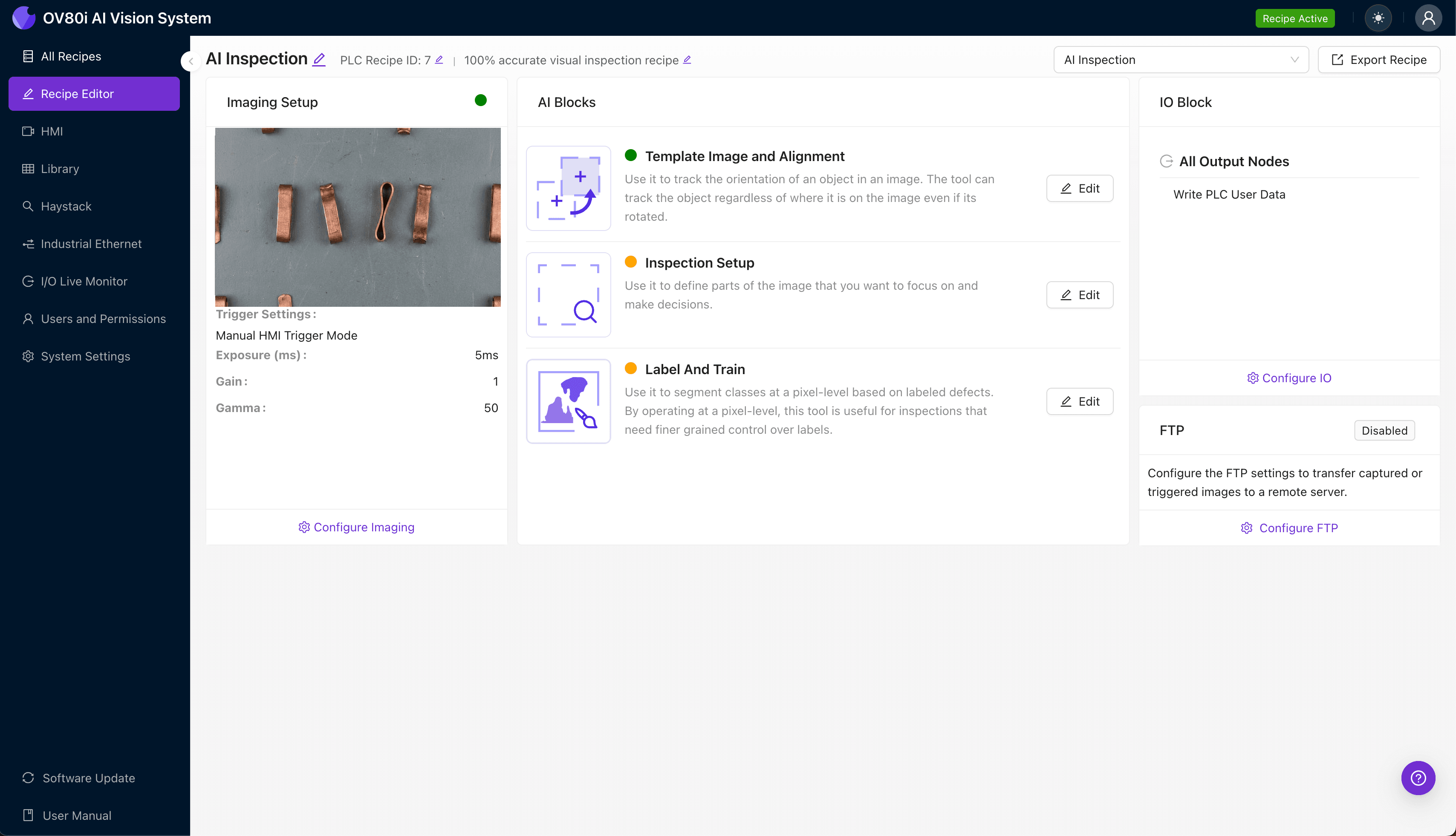
Navigate to the "Template Image" section and capture a reference image of a known-good contact. This template establishes the baseline geometry against which all inspected parts will be compared.
Click "+ Rectangle" to add an alignment region around the main body of the contact. Position this rectangle over stable geometric features that won't vary between parts.
Set the "Rotation Range" to 20 degrees to accommodate minor orientation variations as contacts enter the inspection zone.
Step 3: Inspection Region Selection
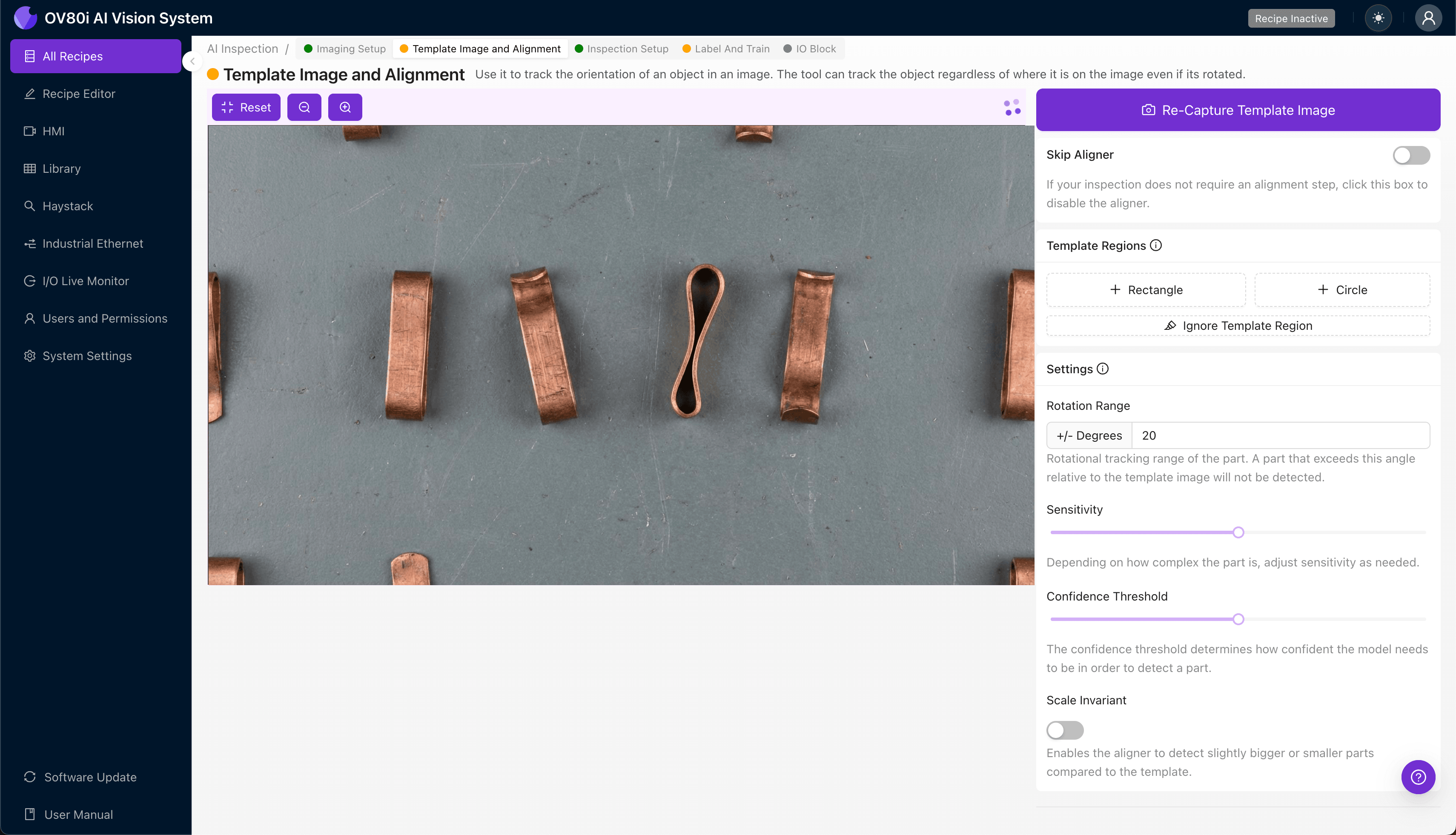
Navigate to "Inspection Setup" to define where the system should focus its analysis. Rename your "Inspection Types" to reflect the specific failure modes you're targeting—for example, "Spring Arm Deformation" or "Contact Gap Spacing."
Click "+ Add Inspection Region" to create a new zone. Resize the yellow bounding box to cover the critical areas most susceptible to stress-relaxation defects, such as bend radii and contact tips.
Click "Save" to confirm your inspection regions.
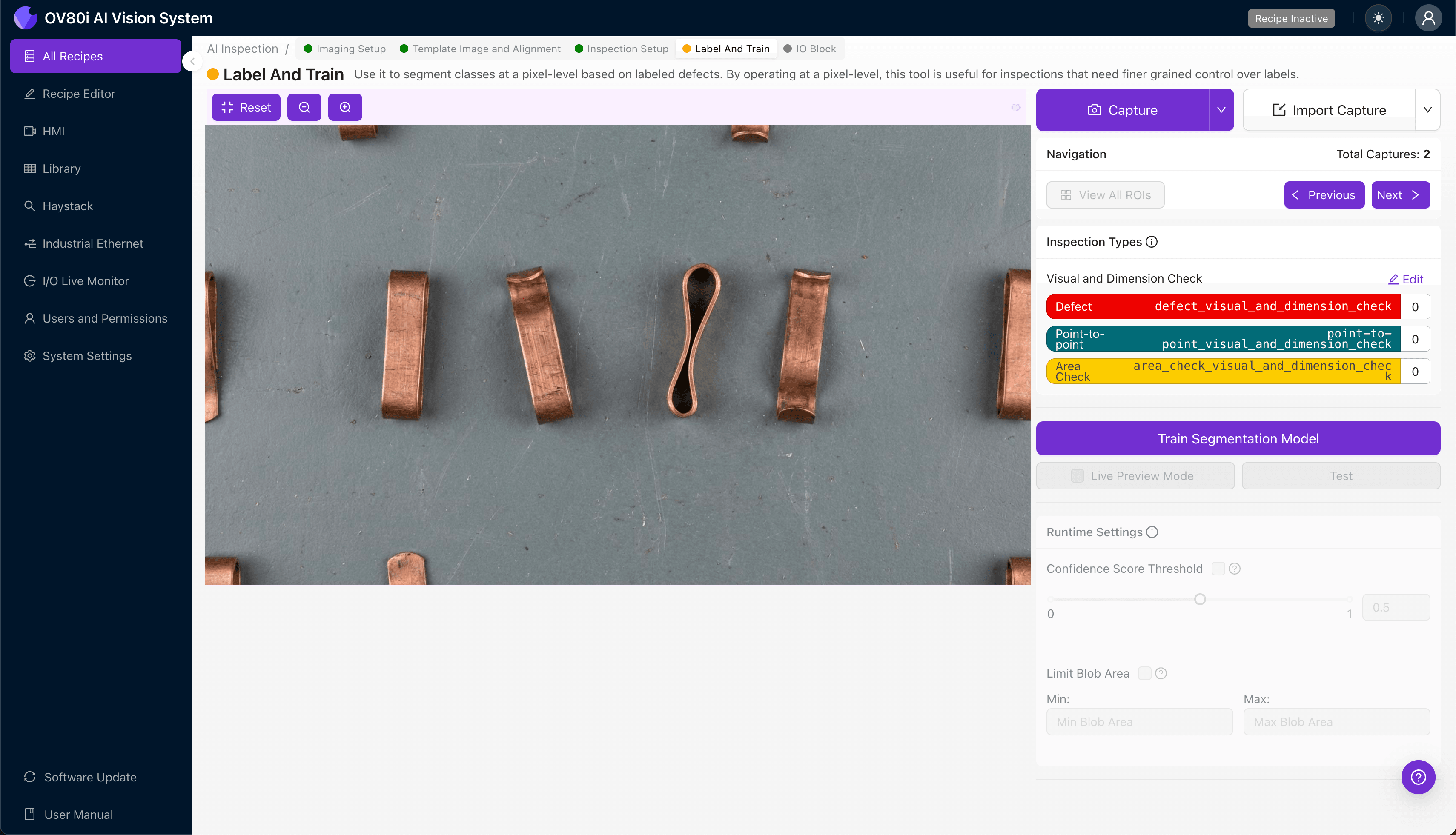
Step 4: Labeling Data
The human-in-the-loop labeling process is where your team's expertise trains the AI model. Review captured images and classify each contact as Good or Bad based on your quality standards.
Include representative samples across the full range of acceptable variation, as well as known failure modes from historical rejects. The more diverse your labeled dataset, the more robust your trained model will become.
Aim for balanced representation—the system learns best when it sees comparable numbers of passing and failing examples.
Step 5: Creating Rules
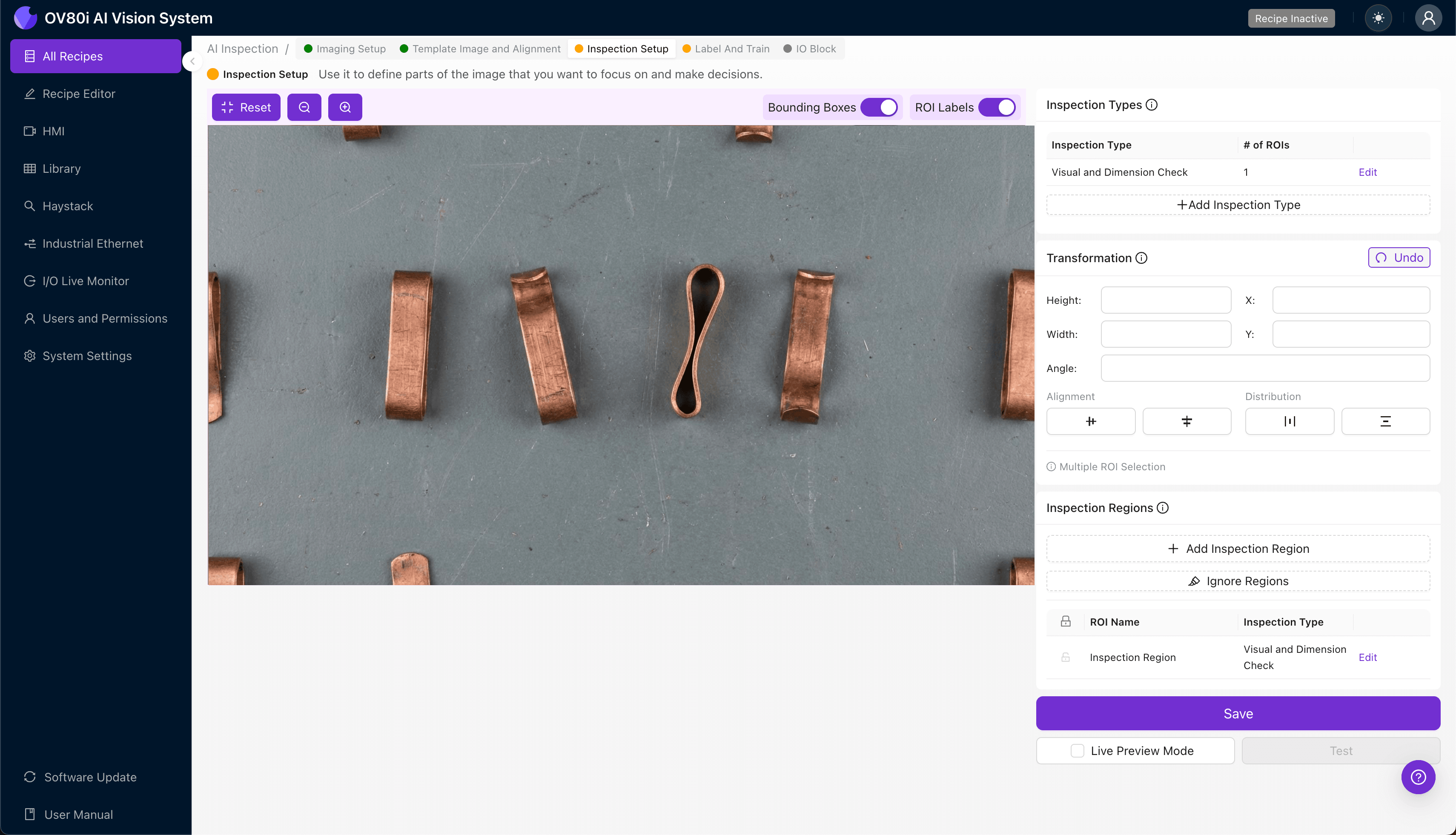
With your model trained, navigate to the rules engine to set pass/fail logic based on your defined Inspection Types. Configure confidence thresholds that align with your quality requirements and risk tolerance.
Gate automated acceptance on the line by connecting inspection results to your reject mechanism. Parts flagged as defective can be automatically diverted, ensuring only conforming contacts proceed to final assembly.
Key Outcomes & ROI
Implementing AI-powered visual inspection for beryllium copper contacts delivers measurable business impact:
- Reduced scrap rates – Catch stress-relaxation defects early, before they cause costly downstream failures or field returns
- Higher throughput – Inspect 100% of contacts at line speed without creating bottlenecks
- Enhanced compliance and traceability – Maintain complete inspection records with timestamped images for quality audits and customer requirements
- Process improvement insights – Analyze defect trends over time to identify upstream issues in forming, heat treatment, or material lots
By replacing subjective manual inspection with consistent AI-driven analysis, manufacturers gain confidence that every beryllium copper contact meets specifications—protecting both product quality and brand reputation.
Eliminate Defects Today
Stop relying on manual inspection for your precision electrical contacts. Deploy Overview.ai to catch stress-relaxation defects instantly.