Detecting Seized Alignment Spring Defects in Blind-Mate Headers with AI-Powered Visual Inspection
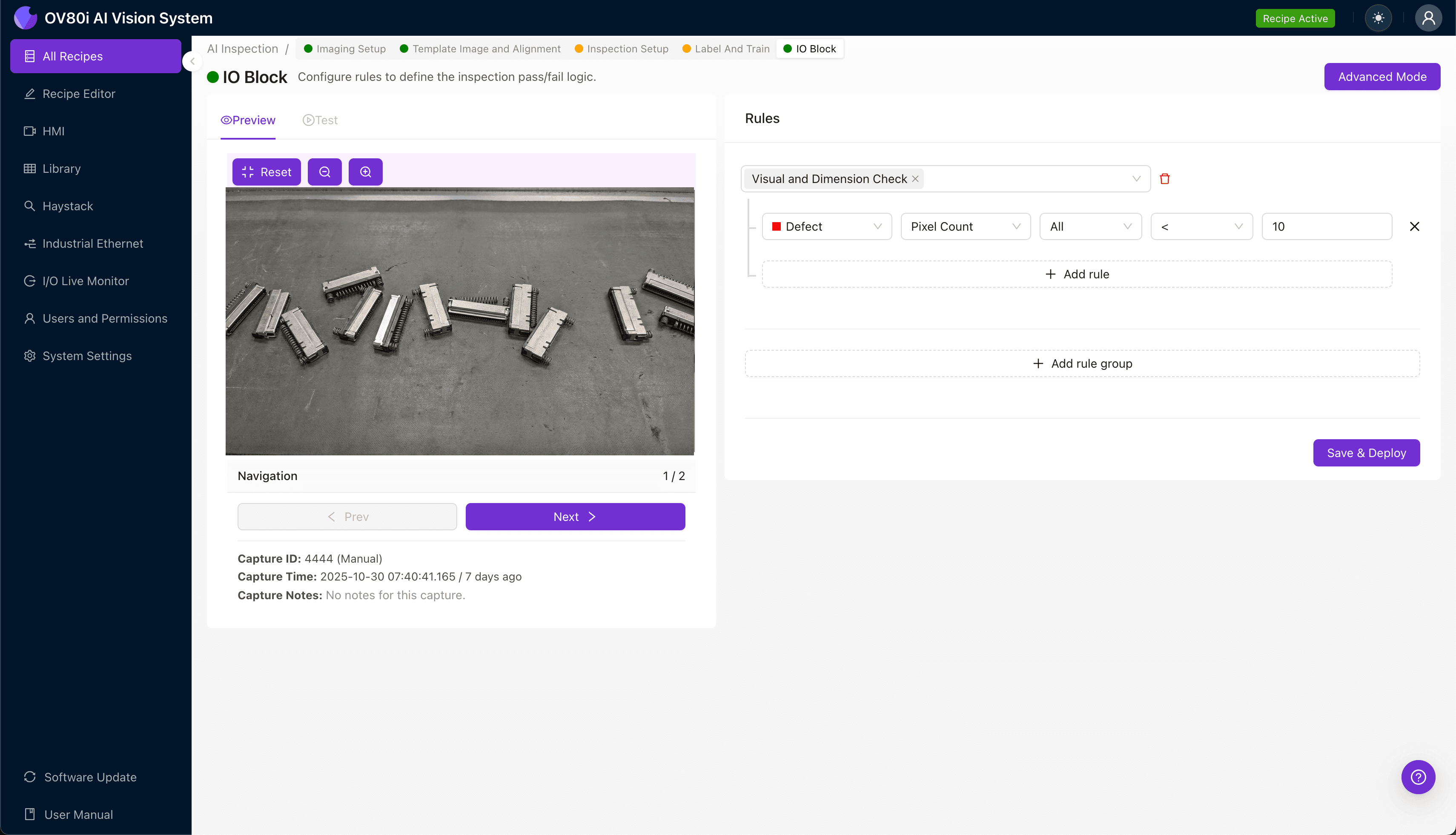
"Seized alignment springs in blind-mate headers cause catastrophic mating failures that manual inspection routinely misses. Overview.ai's deep learning-powered visual inspection delivers 100% inline coverage, detecting subtle defects measured in fractions of a millimeter with consistent accuracy at full production speed."
The Problem: Why Blind-Mate Header Defects Slip Through Traditional QC
Blind-mate headers are critical interconnect components designed for applications where precise alignment happens without direct visual access during mating. When the alignment spring—the component responsible for guiding and compensating for positional tolerances—seizes, the entire connector assembly becomes prone to catastrophic mating failures.
Common Defects in Blind-Mate Headers with Seized Alignment Springs:
- Corrosion buildup on spring coils — oxidation or contamination preventing free movement
- Plastic deformation of spring arms — permanent bending beyond elastic limits from overstress
- Foreign debris lodged in spring cavity — particulates blocking spring travel
- Misaligned or shifted spring retention features — improper seating causing binding
- Fractured or cracked spring elements — stress fractures from fatigue or impact
- Lubricant degradation or absence — dried or missing lubrication causing metal-on-metal friction
Manual inspection of these defects is notoriously unreliable. Inspectors face fatigue-induced errors when examining hundreds of units per shift, and the subtle visual indicators of a seized spring—often measured in fractions of a millimeter—exceed human perceptual consistency at production speeds.
The Solution: Machine Vision + Deep Learning for Consistent Detection
AI-powered visual inspection eliminates the variability inherent in human quality control. By training deep learning models on known good and defective samples, the system learns to identify the subtle visual signatures of seized alignment springs that human inspectors routinely miss.
Overview.ai's approach delivers objective, repeatable inspection at full line speed. The system doesn't get tired, doesn't lose focus, and applies identical inspection criteria to every single unit—enabling true 100% inline quality control.
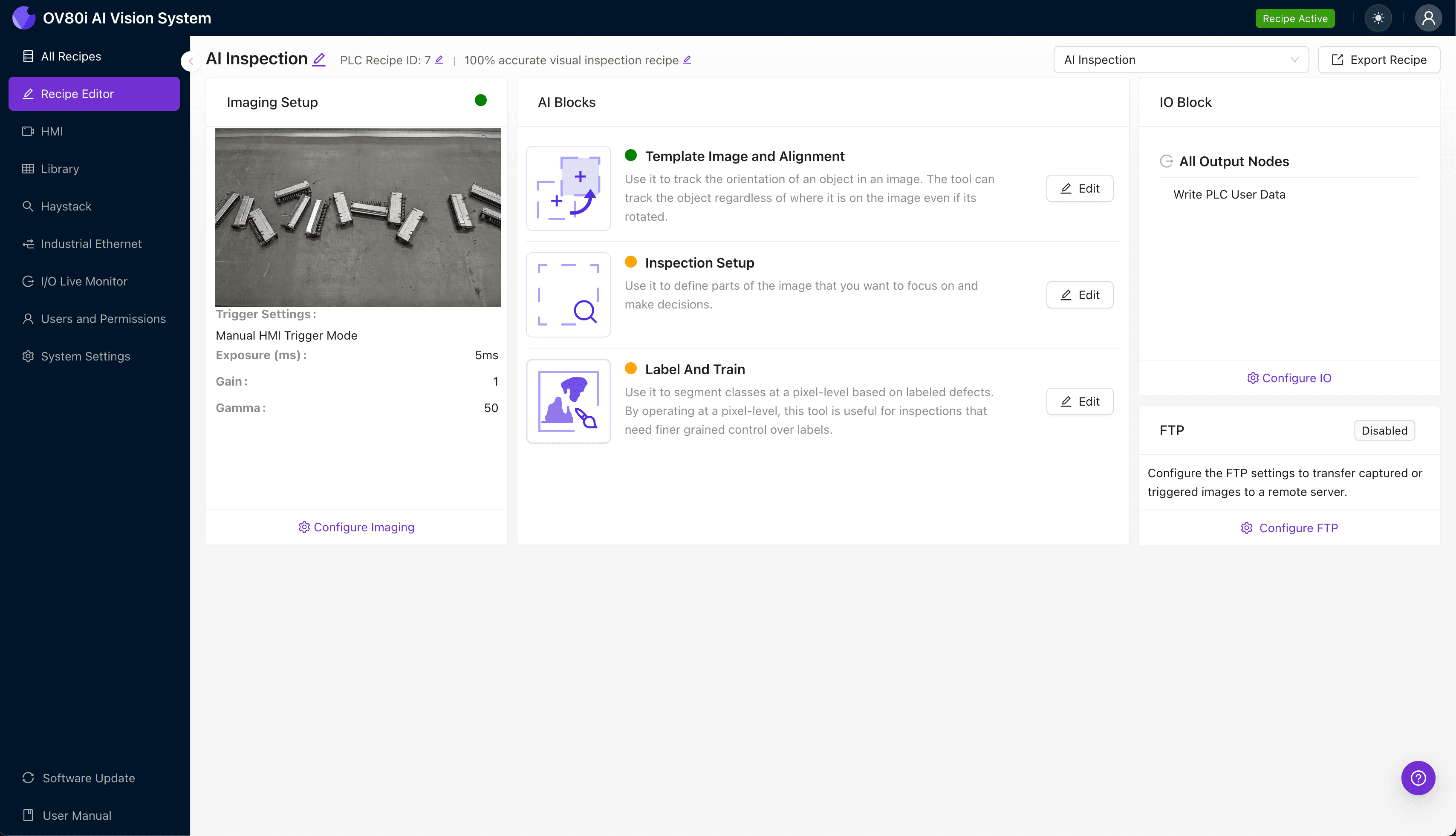
Step 1: Imaging Setup
Position the blind-mate header under the OV80i camera system, ensuring the alignment spring cavity is fully visible. Consistent part presentation is essential for reliable defect detection.
Navigate to "Configure Imaging" in the Overview interface. Adjust Camera Settings including exposure time and gain to clearly illuminate the spring mechanism and surrounding retention features.
Click "Save" to lock in your optimized imaging parameters.
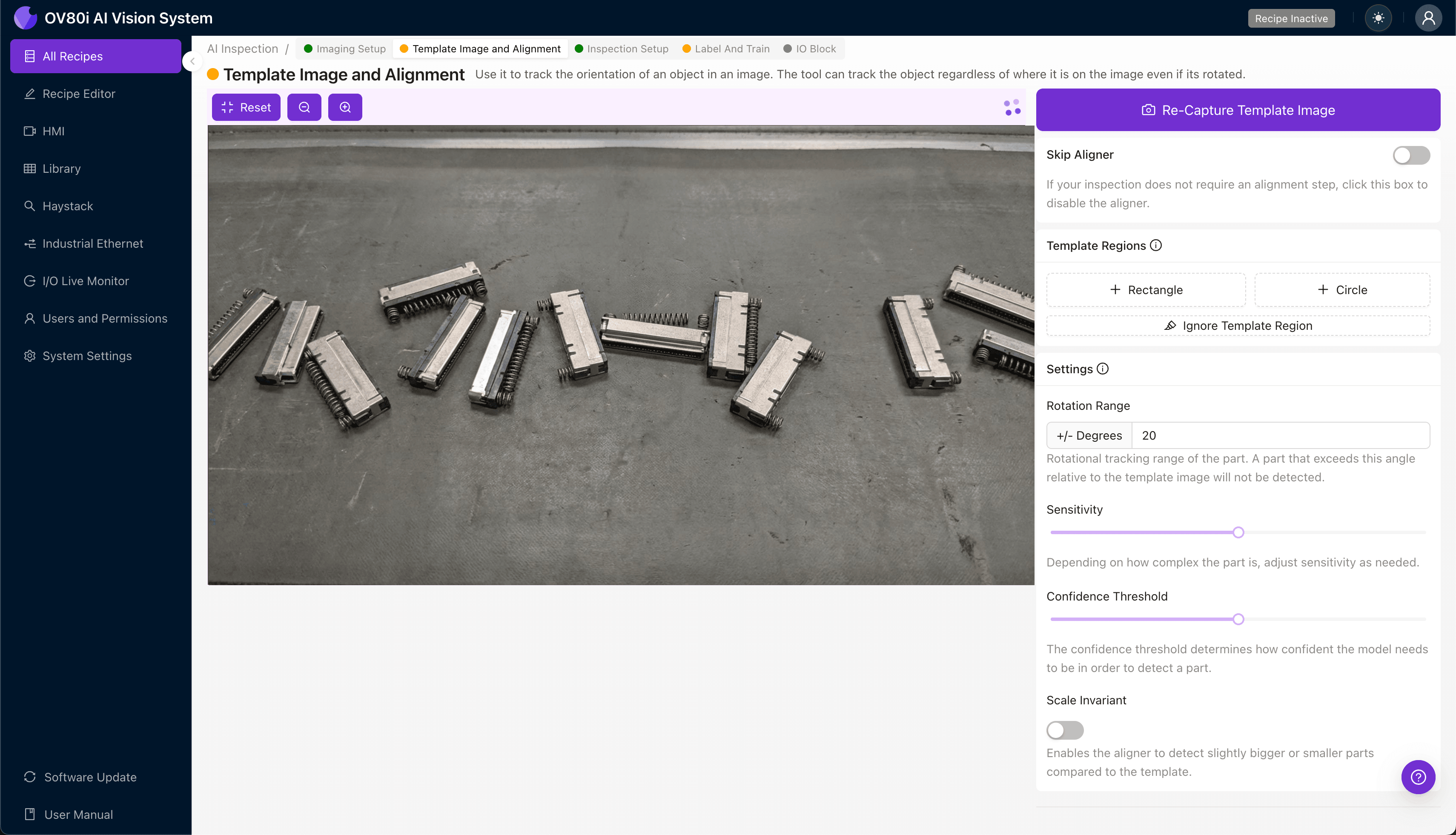
Step 2: Image Alignment
Navigate to the "Template Image" section and capture a reference image of a known-good header. This template serves as the baseline for aligning all subsequent inspections.
Click "+ Rectangle" to draw an alignment region around the header's main body geometry. Set the "Rotation Range" to 20 degrees to accommodate minor orientation variations as parts arrive on the line.
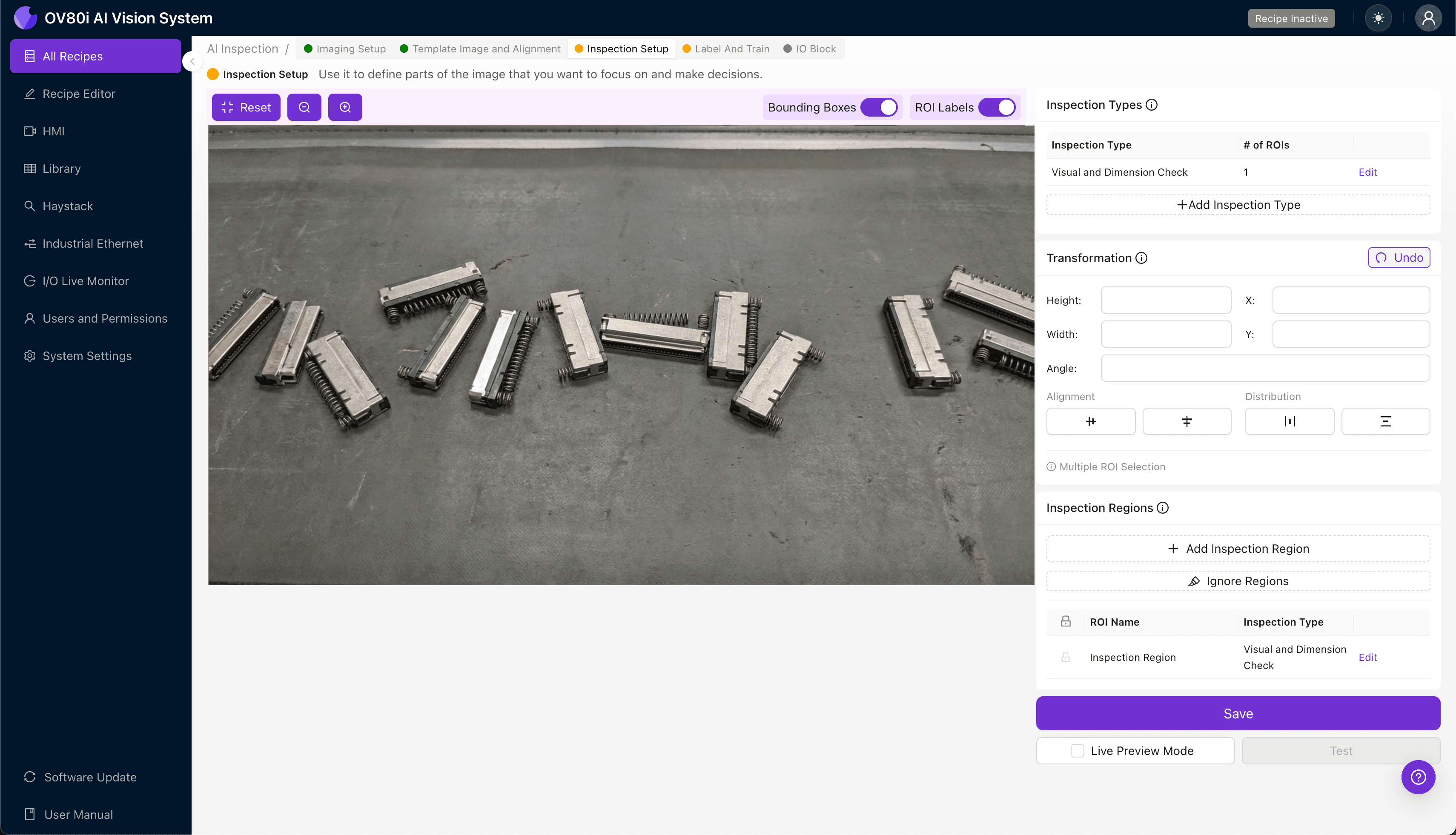
Step 3: Inspection Region Selection
Navigate to "Inspection Setup" to define your detection zones. Rename your "Inspection Types" to reflect the specific failure modes—such as "Spring_Seizure," "Debris_Present," or "Spring_Deformation."
Click "+ Add Inspection Region" for each critical area. Resize the yellow bounding box to cover the alignment spring cavity, retention clips, and any lubricant application zones.
Click "Save" to confirm your inspection configuration.
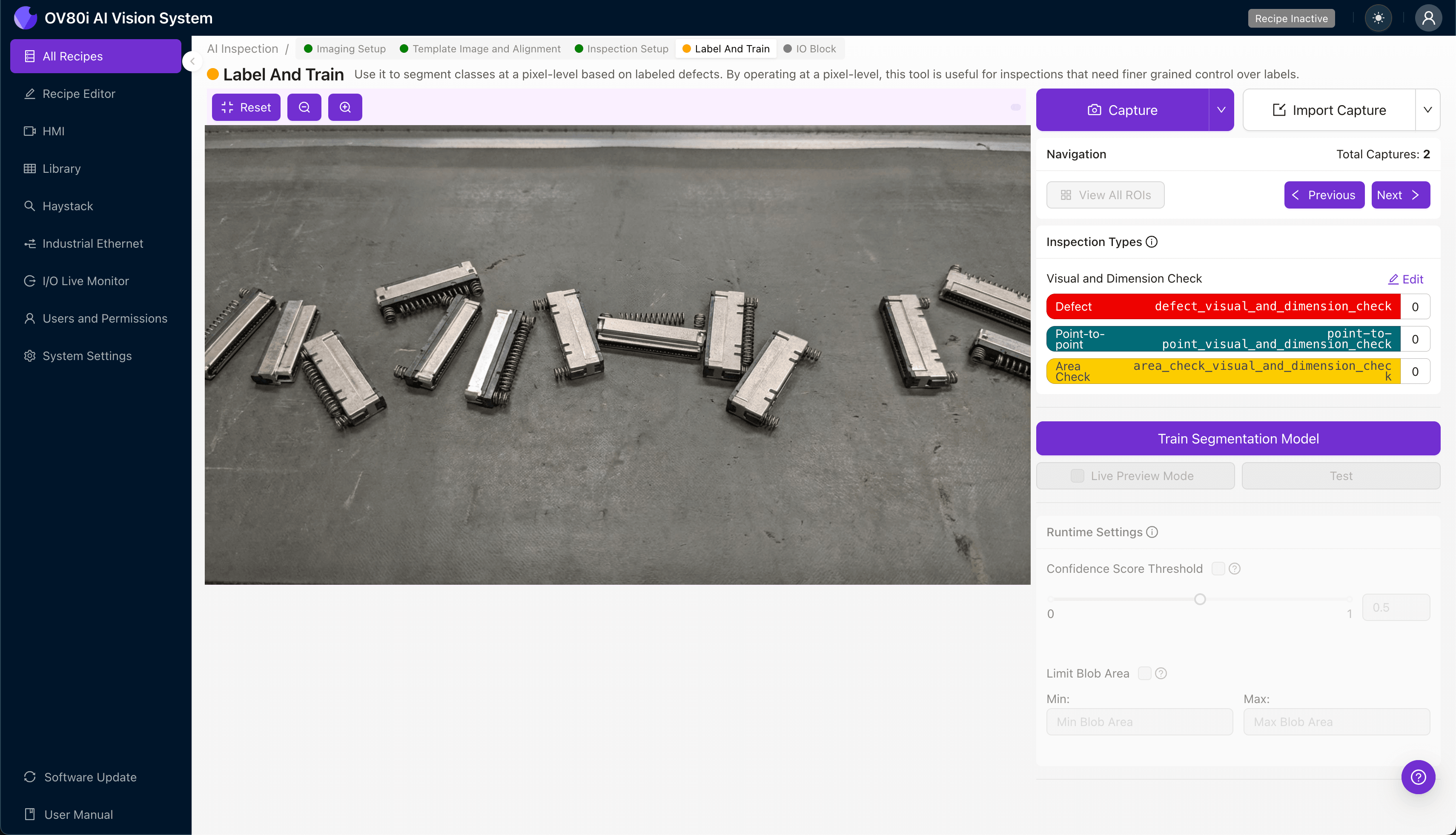
Step 4: Labeling Data
Overview.ai uses a human-in-the-loop approach to build robust detection models. Production images are presented to quality engineers who label each sample as Good or Bad based on established acceptance criteria.
Include representative samples across the full range of acceptable variation. Ensure known failure modes—seized springs, debris contamination, deformed elements—are well-represented in your labeled dataset to maximize model accuracy.
Step 5: Creating Rules
Define your pass/fail logic based on the Inspection Types you've configured. Set confidence thresholds that balance escape rate reduction against false rejection costs.
Gate automated acceptance decisions directly on the production line. Parts flagged as defective can trigger reject mechanisms, alerts, or quarantine protocols without manual intervention.
Key Outcomes & ROI
Implementing AI-powered inspection for blind-mate header quality control delivers measurable business impact:
- Reduced scrap and rework costs — catch seized spring defects before headers reach assembly or ship to customers
- Higher throughput — eliminate inspection bottlenecks with real-time, inline quality decisions
- Enhanced compliance and traceability — automatically log images and inspection results for every unit, supporting automotive, aerospace, and medical device audit requirements
- Process improvement insights — analyze defect trends to identify upstream manufacturing issues before they escalate
Conclusion
Seized alignment springs in blind-mate headers represent a high-risk defect category that traditional inspection methods struggle to detect consistently. With Overview.ai's deep learning-powered visual inspection, manufacturers can achieve 100% inline coverage, eliminate human error, and protect both product quality and customer relationships.
Eliminate Connector Defects Today
Stop relying on manual inspection for critical blind-mate header quality control. Deploy Overview.ai to catch seized alignment springs and other defects instantly.