Detecting Burnt VCSEL Lasers in Active Optical Cables: A Machine Vision Inspection Guide

"Burnt VCSEL lasers in Active Optical Cables cause catastrophic performance failures yet remain nearly invisible to human inspectors. AI-powered machine vision detects subtle thermal damage patterns—discoloration, melted bonds, and micro-fractures—with consistent accuracy at full production speed."
The Problem: Why Burnt VCSEL Defects Slip Through Manual Inspection
Active Optical Cables (AOCs) rely on Vertical-Cavity Surface-Emitting Lasers (VCSELs) to convert electrical signals into high-speed optical data. When these microscopic laser components fail due to thermal damage or electrical overstress, the resulting defects can be nearly invisible to the naked eye—yet catastrophic to performance.
Common Defects in AOCs with Burnt VCSEL Lasers:
- Discolored or darkened VCSEL aperture – thermal oxidation creating brown or black spots on the emitting surface
- Melted or deformed bonding wires – excessive current causing wire bond degradation near the laser die
- Cracked or crazed lens coating – heat-induced stress fractures in the micro-optic assembly
- Carbonized epoxy residue – burnt encapsulation material surrounding the VCSEL array
- Pitting or ablation marks – microscopic surface damage from localized overheating events
- Misaligned optical coupling – thermal expansion causing fiber-to-VCSEL positioning drift
Human inspectors struggle with these defects for good reason. The inspection area is often less than 500 microns across, and subtle discoloration variations are difficult to distinguish under inconsistent lighting after hours on the line.
Fatigue compounds the problem—studies show visual acuity drops significantly after just 30 minutes of microscope work, making consistent defect detection virtually impossible at production speeds.
The Solution: AI-Powered Visual Inspection for AOC Quality Control
Machine vision systems equipped with deep learning algorithms excel precisely where human inspection fails. By capturing high-resolution images under controlled, repeatable lighting conditions, these systems detect subtle thermal damage patterns that would escape even the most experienced technician.
Deep learning models learn to recognize the complex visual signatures of VCSEL burn damage—not through rigid rule-based programming, but by training on thousands of labeled examples of both healthy and damaged components.
Overview.ai's approach delivers consistent, objective inspection at full line speed. The OV80i platform evaluates every single AOC module against learned defect patterns, eliminating the sampling compromises and subjective judgment calls that plague manual QC processes.
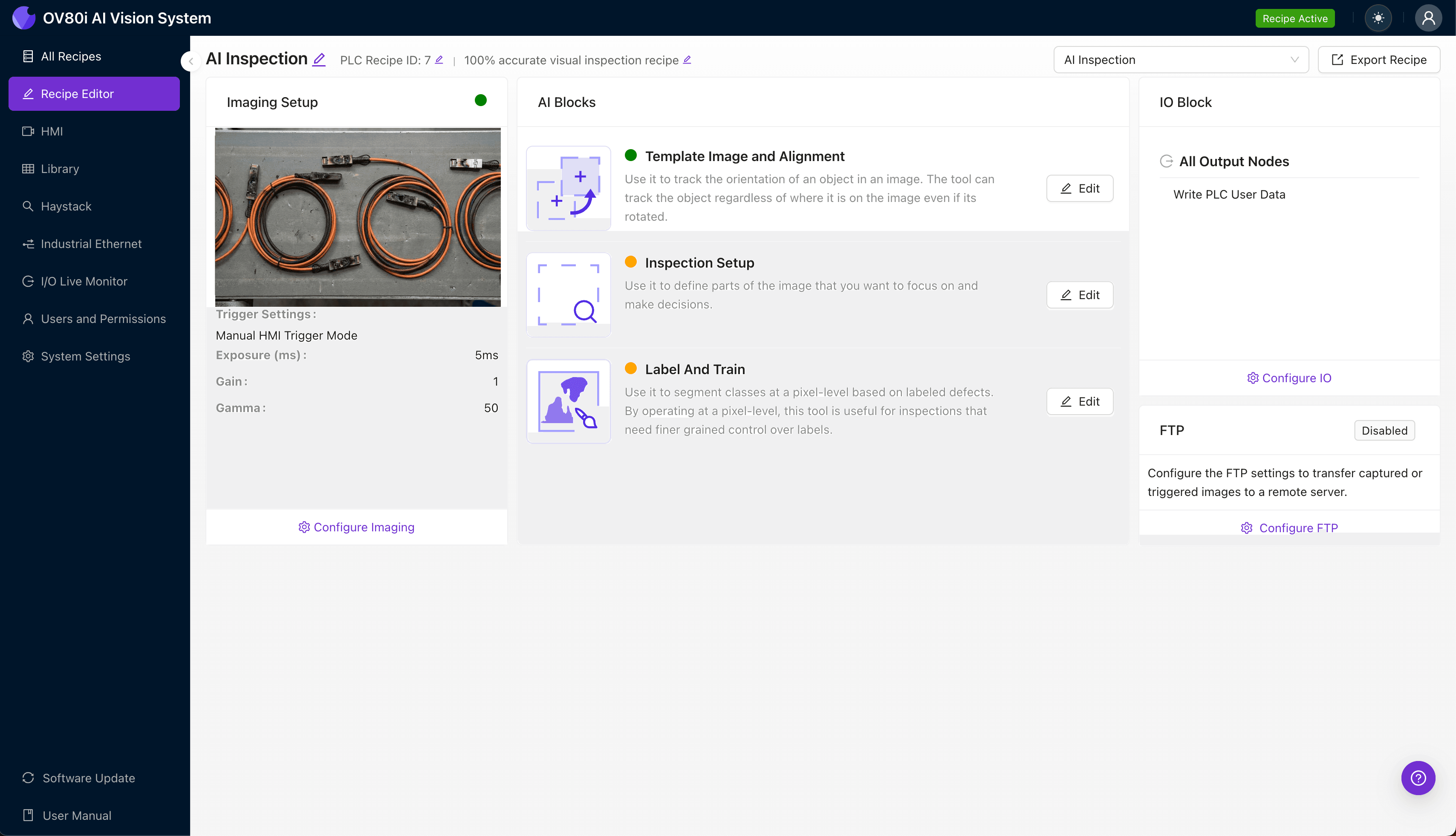
Step 1: Imaging Setup
Position the Active Optical Cable with the suspected burnt VCSEL under the inspection camera, ensuring the optical transceiver module faces the lens. Proper fixturing is critical—the VCSEL array must be consistently oriented for repeatable imaging.
Click "Configure Imaging" in the Overview.ai interface to access Camera Settings. Adjust exposure to capture detail in both the reflective lens surface and the darker burnt regions, and fine-tune gain to minimize noise while maintaining sensitivity to subtle discoloration.
Click "Save" to lock in your imaging parameters.
Step 2: Image Alignment
Navigate to the "Template Image" section and capture a Template of your reference AOC connector. This establishes the baseline geometry the system will use to align every subsequent unit.
Click "+ Rectangle" to add an alignment region around the main body of the optical transceiver housing. Set the "Rotation Range" to 20 degrees to accommodate normal variation in how cables present on the conveyor or inspection fixture.

Step 3: Inspection Region Selection
Navigate to "Inspection Setup" to define where the system should look for defects. Rename your "Inspection Types" with descriptive labels like "VCSEL_Burn_Damage" or "Bond_Wire_Integrity" to keep your configuration organized.
Click "+ Add Inspection Region" to create a new detection zone. Resize the yellow bounding box to cover the critical VCSEL aperture area and surrounding bond wire locations where thermal damage typically manifests.
Click "Save" to confirm your inspection regions.
Step 4: Labeling Data
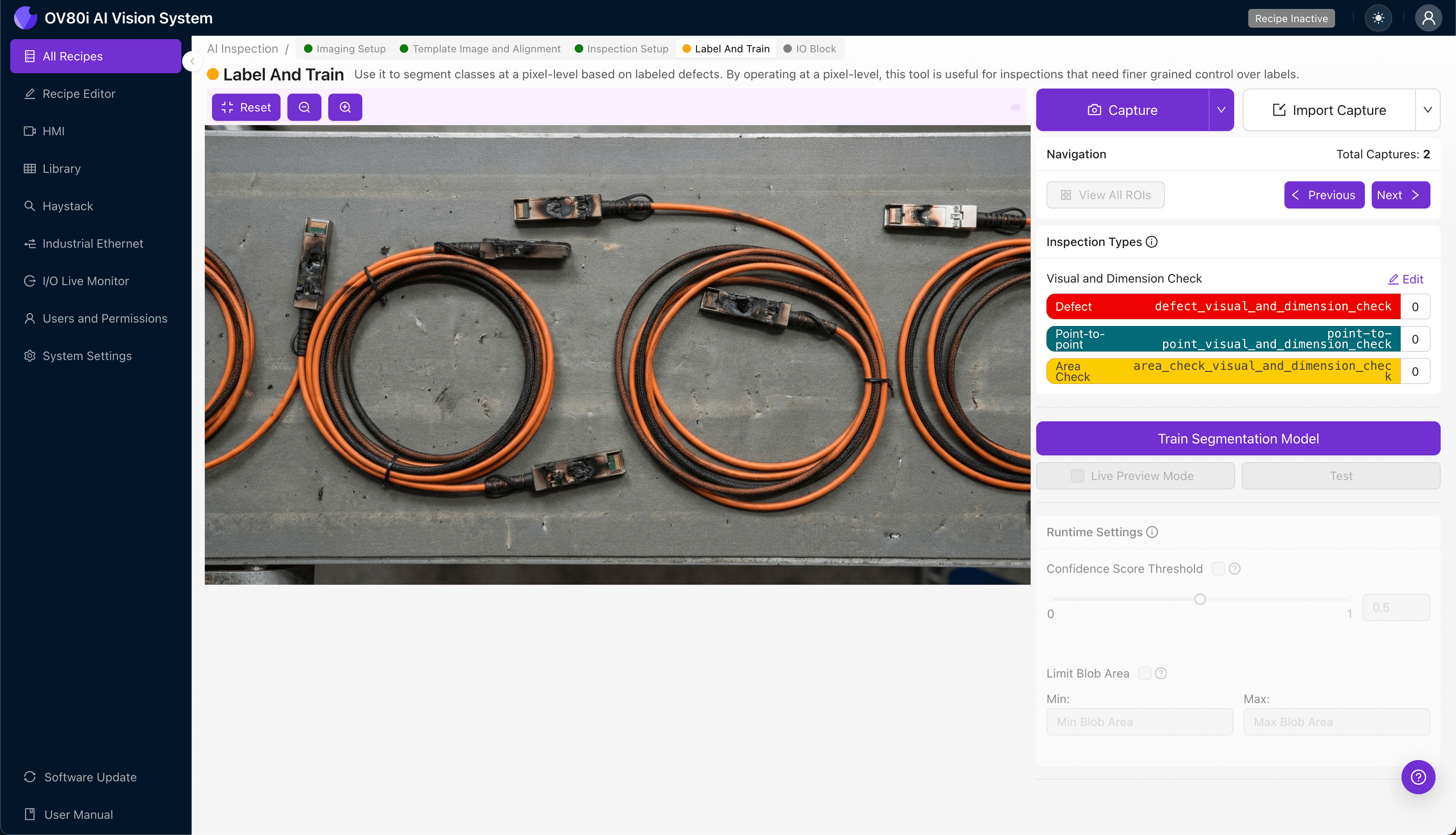
This human-in-the-loop phase is where your domain expertise trains the AI. Review captured images and label each as Good (healthy VCSEL, no thermal damage) or Bad (visible burn indicators, discoloration, or structural damage).
Include representative samples across the full spectrum of production variation—different AOC suppliers, normal lens reflections, and acceptable cosmetic marks. Most importantly, incorporate all known failure modes from your defect library to ensure the model learns every variant of VCSEL burn damage you've historically encountered.

Step 5: Creating Rules
With your model trained, establish pass/fail logic based on your defined Inspection Types. Configure thresholds that match your quality standards—for example, rejecting any unit where "VCSEL_Burn_Damage" confidence exceeds 85%.
These rules gate automated acceptance directly on the production line. Units passing inspection proceed to packaging; flagged units route automatically to secondary review or scrap, eliminating burnt VCSEL AOCs before they reach customers.
Key Outcomes & ROI
Implementing automated VCSEL burn detection delivers measurable business impact:
- Reduced scrap and rework costs – catch thermal damage early before additional assembly steps add value to defective units
- Higher throughput with 100% inspection – eliminate the bottleneck of statistical sampling while inspecting every unit at line speed
- Enhanced compliance and traceability – automatically log inspection images and results for customer audits, warranty claims, and regulatory documentation
- Process improvement insights – aggregate defect data to identify upstream issues like driver IC failures or assembly process drift causing VCSEL burnout
Conclusion
Burnt VCSEL lasers represent a critical—and notoriously difficult—defect category in AOC manufacturing. By combining precision imaging with deep learning-based defect recognition, Overview.ai enables manufacturers to catch these failures consistently, objectively, and at production speed.
The result: higher quality AOCs reaching your customers, lower warranty exposure, and actionable data to continuously improve your manufacturing process.
Eliminate Burnt VCSEL Defects Today
Stop relying on manual microscope inspection. Deploy Overview.ai to catch thermal damage in AOCs instantly and at full production speed.