Carrier Strip with Pilot Hole Pitch Variance: A Complete Visual Inspection Guide

"Pilot hole pitch variance in carrier strips compromises downstream automation and causes costly defects. Overview.ai's machine vision platform delivers 100% inline inspection at full production speed, catching pitch drift before defective strips contaminate your process."
The Problem: Why Pilot Hole Pitch Variance Threatens Production Quality
Carrier strips serve as the backbone of automated manufacturing processes, guiding components through stamping, plating, and assembly operations with precision. When pilot hole pitch variance occurs, the entire downstream process becomes compromised, leading to costly defects and production delays.
Common Defects Associated with Pilot Hole Pitch Variance:
- Cumulative pitch drift — Progressive spacing errors that compound across the strip length
- Inconsistent hole-to-hole spacing — Individual pitch deviations exceeding tolerance specifications
- Elongated or oval pilot holes — Tooling wear causing dimensional distortion that affects pitch measurement
- Burr interference — Material buildup altering effective hole position and engagement accuracy
- Edge-to-hole misalignment — Lateral positioning errors affecting strip tracking and registration
- Thermal expansion variation — Temperature-induced dimensional changes creating intermittent pitch inconsistencies
Manual inspection of pilot hole pitch fails for several critical reasons. Human inspectors cannot maintain the micron-level measurement consistency required across thousands of holes per shift, and visual fatigue dramatically increases escape rates after just 20-30 minutes of repetitive measurement tasks.
The Solution: Machine Vision and Deep Learning for Pitch Inspection
Machine vision systems eliminate the subjectivity and fatigue inherent in manual pitch verification. By capturing high-resolution images and applying precise measurement algorithms, these systems detect pitch variance in real-time with repeatability that human inspectors simply cannot match.
Overview.ai's approach combines consistent, objective inspection at full line speed with deep learning capabilities that adapt to complex variance patterns. The OV80i system performs 100% inline inspection, catching pitch drift before defective strips contaminate downstream processes and ensuring every carrier strip meets specification requirements.
Step 1: Imaging Setup
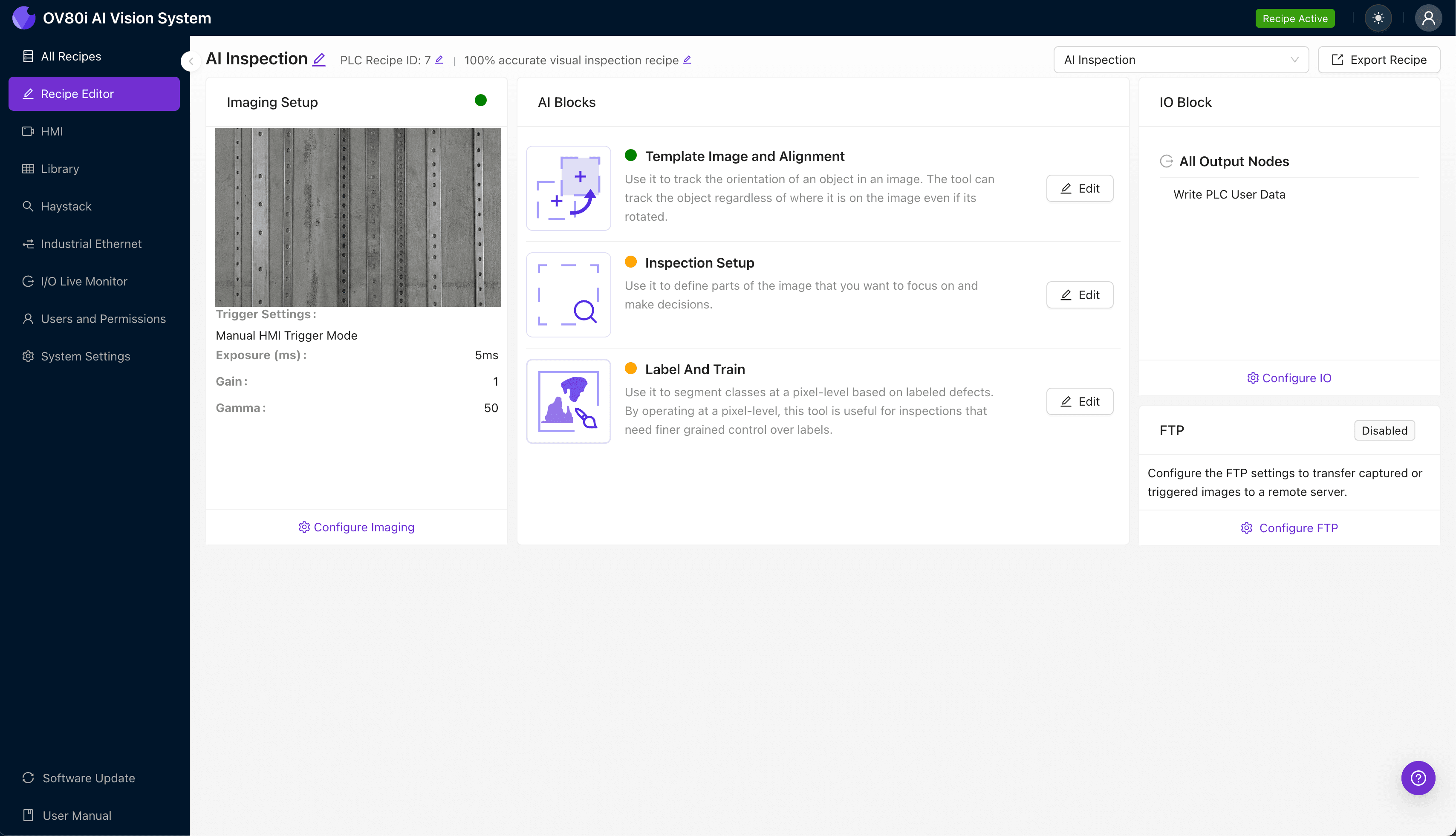
Position the carrier strip under the camera system, ensuring the pilot holes are clearly visible within the field of view. The strip should lie flat against the inspection surface with adequate backlighting or direct illumination to maximize hole edge contrast.
Click "Configure Imaging" to access the camera settings panel. Adjust the exposure to eliminate overexposure around hole edges, and fine-tune the gain to achieve crisp, high-contrast images of the pilot hole boundaries.
Click "Save" to lock in your optimized imaging parameters.
Step 2: Image Alignment
Navigate to "Template Image" in the configuration menu. Capture a template image of a known-good carrier strip section with proper pilot hole pitch.
Click "+ Rectangle" to add a region around the main body of the carrier strip, encompassing multiple pilot holes for reference. Set the "Rotation Range" to 20 degrees to accommodate slight strip orientation variations during production runs.

Step 3: Inspection Region Selection
Navigate to "Inspection Setup" from the main menu. Rename your "Inspection Types" with descriptive labels such as "Pitch_Variance_Check" or "Pilot_Hole_Spacing" for clear identification.
Click "+ Add Inspection Region" to create a new detection zone. Resize the yellow bounding box to cover the critical pitch measurement areas between consecutive pilot holes.
Click "Save" to confirm your inspection region configuration.
Step 4: Labeling Data
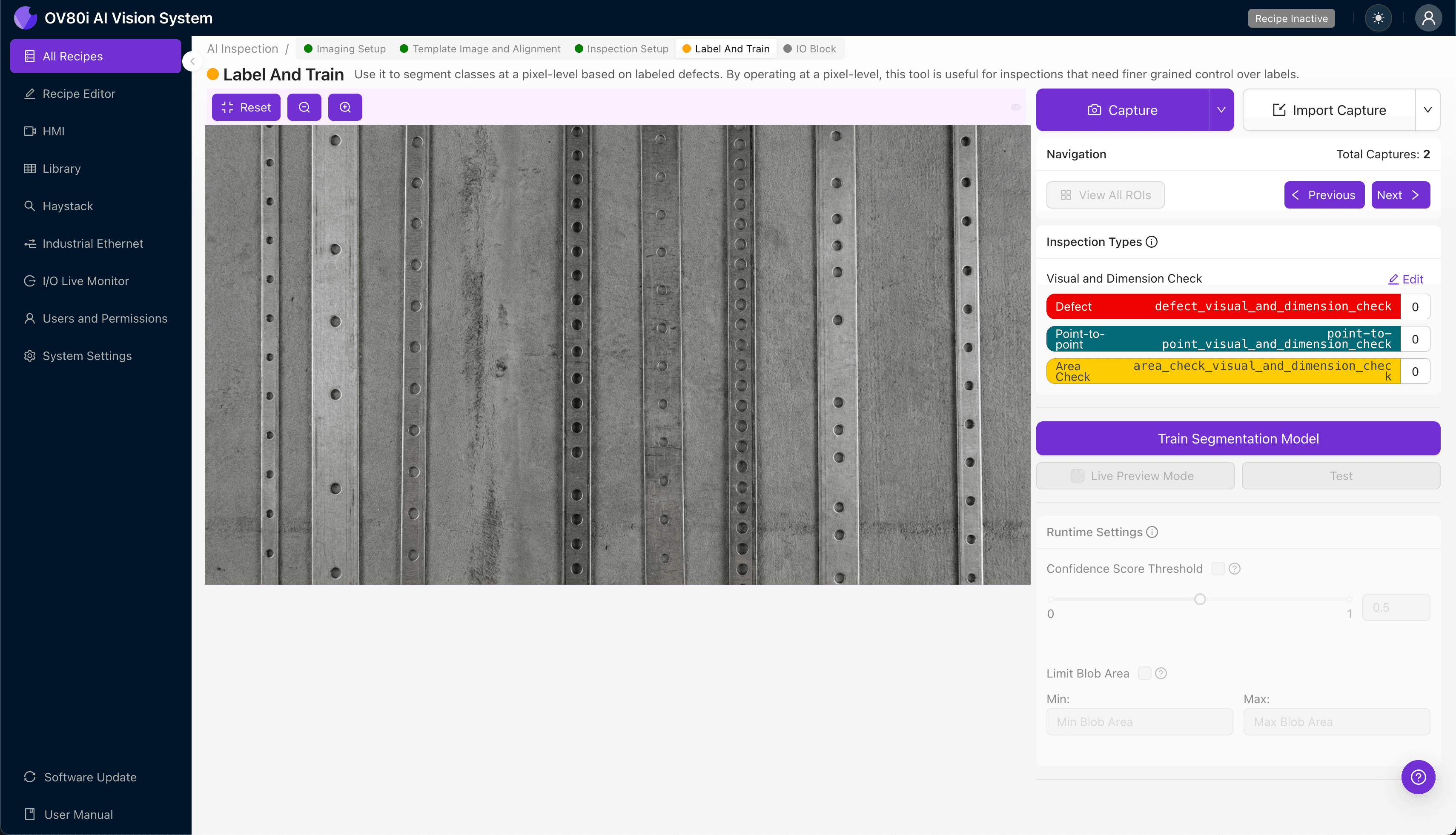
The human-in-the-loop labeling process trains the deep learning model to recognize acceptable versus unacceptable pitch variance. Review captured production images and label each as Good (within tolerance) or Bad (out of specification).
Include representative samples spanning the full range of acceptable variation, along with known failure modes such as progressive drift, sudden jumps, and edge cases near tolerance limits. This comprehensive training dataset ensures the model generalizes accurately across real-world production conditions.

Step 5: Creating Rules
Configure pass/fail logic based on your defined Inspection Types and tolerance thresholds. Set specific pitch variance limits that trigger automatic rejection when measurements exceed acceptable ranges.
Gate automated acceptance on the line to ensure only conforming carrier strips proceed to subsequent operations. This real-time decision-making prevents defective material from contaminating downstream processes.
Key Outcomes & ROI
Implementing automated visual inspection for carrier strip pilot hole pitch variance delivers measurable business impact:
- Reduced scrap rates — Catch pitch drift early before entire strip batches require rejection
- Higher throughput — Eliminate manual measurement bottlenecks with 100% inline inspection at full production speed
- Enhanced compliance and traceability — Maintain complete inspection records for quality audits and customer requirements
- Process improvement insights — Identify tooling wear patterns and environmental factors contributing to pitch variance through trend analysis
Conclusion
Carrier strip pilot hole pitch variance represents a critical quality parameter that demands inspection precision beyond human capability. Overview.ai's machine vision platform delivers the consistent, objective, high-speed inspection manufacturers need to maintain quality standards while maximizing production efficiency.
Eliminate Pitch Variance Defects Today
Stop relying on manual measurement. Deploy Overview.ai to catch pilot hole pitch variance instantly at full line speed.