Detecting Connector Latch Low-Temperature Brittleness Failure with AI-Powered Visual Inspection
"Low-temperature brittleness in connector latches causes invisible defects during warm production that become catastrophic failures in cold-climate deployment. Overview.ai's deep learning platform catches micro-fractures, surface crazing, and stress marks at full production speed—eliminating escapes before they reach customers."
The Problem: When Cold Weather Turns Quality into a Crisis
Connector latches are critical fastening components in automotive, aerospace, and industrial applications—and they must perform reliably across extreme temperature ranges. When polymer or metal alloy latches experience low-temperature brittleness failure, the consequences range from field returns to catastrophic system failures.
Common Defects Associated with Low-Temperature Brittleness Failure:
- Micro-fractures at stress concentration points – hairline cracks forming at corners, notches, or attachment holes
- Brittle surface crazing – network of fine surface cracks indicating material degradation
- Latch arm snap-off – complete fracture of the flexible engagement mechanism
- Whitening or stress marks – visible discoloration indicating polymer chain damage
- Edge chipping – small material fragments breaking away from high-stress edges
- Dimensional warping – subtle geometric changes from internal stress relief
Manual inspection consistently fails to catch these defects at production speeds. Human inspectors experience fatigue-induced accuracy drops of 20-30% over a single shift, and micro-fractures measuring under 0.5mm are virtually impossible to detect with the naked eye under time pressure.
The Solution: Machine Vision Meets Deep Learning
Traditional rule-based machine vision struggles with low-temperature brittleness defects because they present inconsistently—a micro-fracture on one latch looks different from the next. Deep learning models excel here because they learn the full spectrum of "good" versus "bad" from real production data, adapting to natural variation while flagging true anomalies.
Overview.ai's approach delivers consistent, objective inspection at full line speed—every single part, every single time. The OV80i system integrates directly into existing production lines, providing 100% inline inspection without creating bottlenecks or requiring dedicated quality stations.
Step 1: Imaging Setup
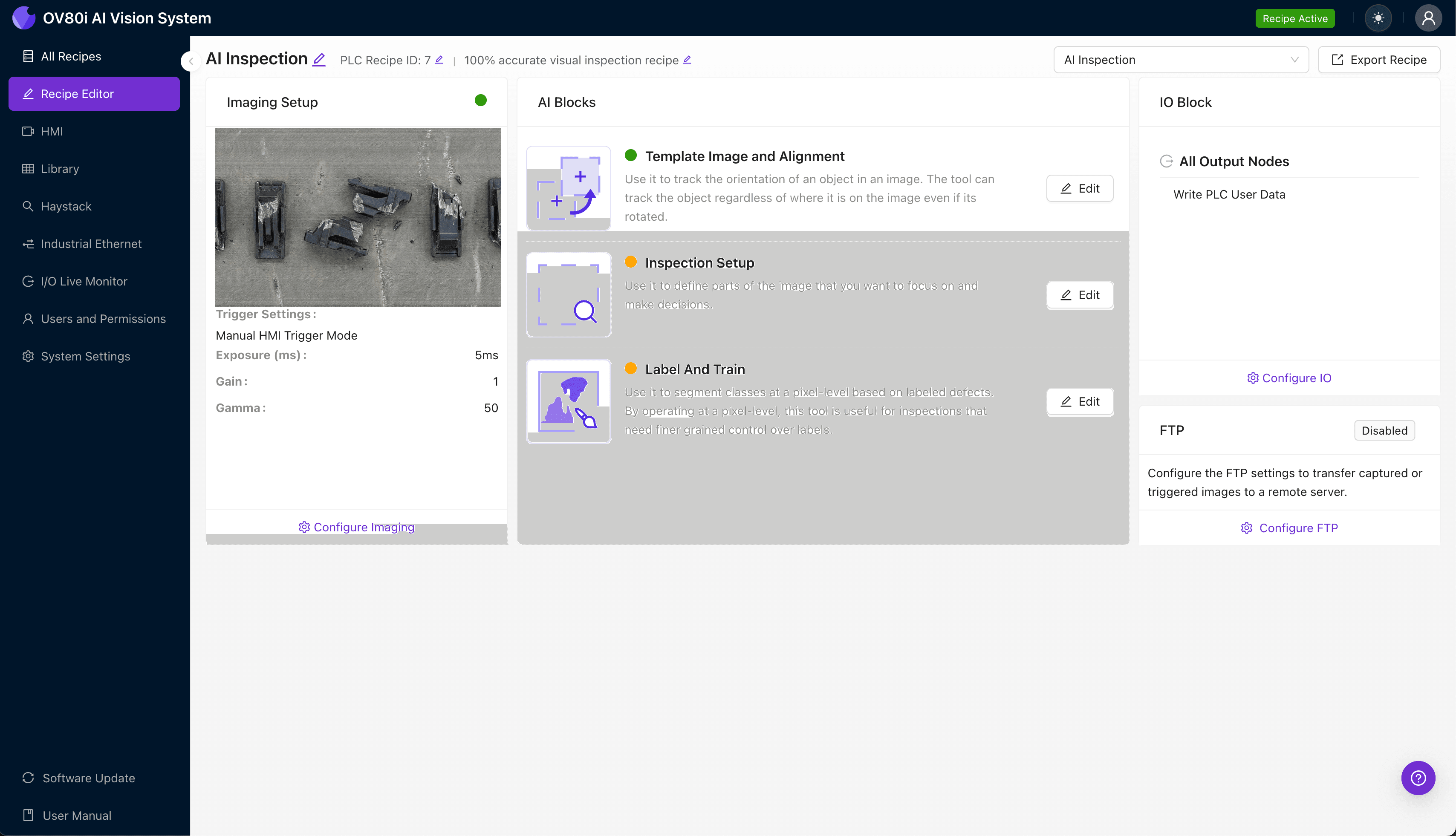
Position the connector latch under the OV80i camera system, ensuring consistent orientation and lighting conditions. For brittleness defects, proper illumination angle is critical—low-angle lighting often reveals surface crazing and micro-fractures that overhead lighting misses.
Click "Configure Imaging" in the Overview interface to access Camera Settings. Adjust exposure time and gain to maximize contrast on potential fracture sites while avoiding overexposure on reflective latch surfaces.
Click "Save" to lock in your optimized imaging parameters.
Step 2: Image Alignment
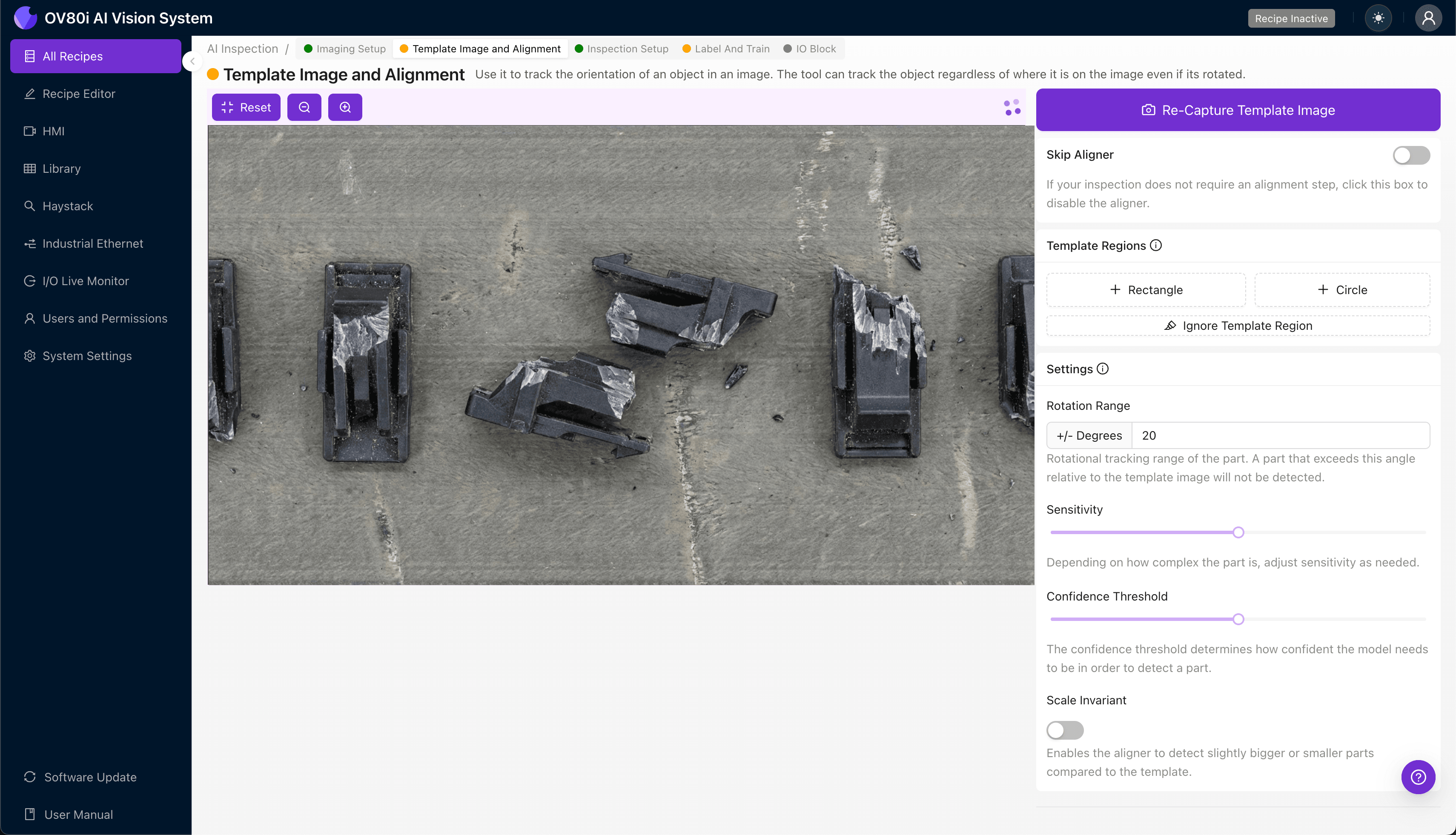
Navigate to the "Template Image" section and capture a reference image of a known-good connector latch. This template serves as the baseline for aligning all subsequent parts during inspection.
Click "+ Rectangle" to draw an alignment region around the main latch body, focusing on stable geometric features like mounting holes or outer edges. Set the "Rotation Range" to 20 degrees to accommodate natural variation in part placement on the conveyor.
Step 3: Inspection Region Selection
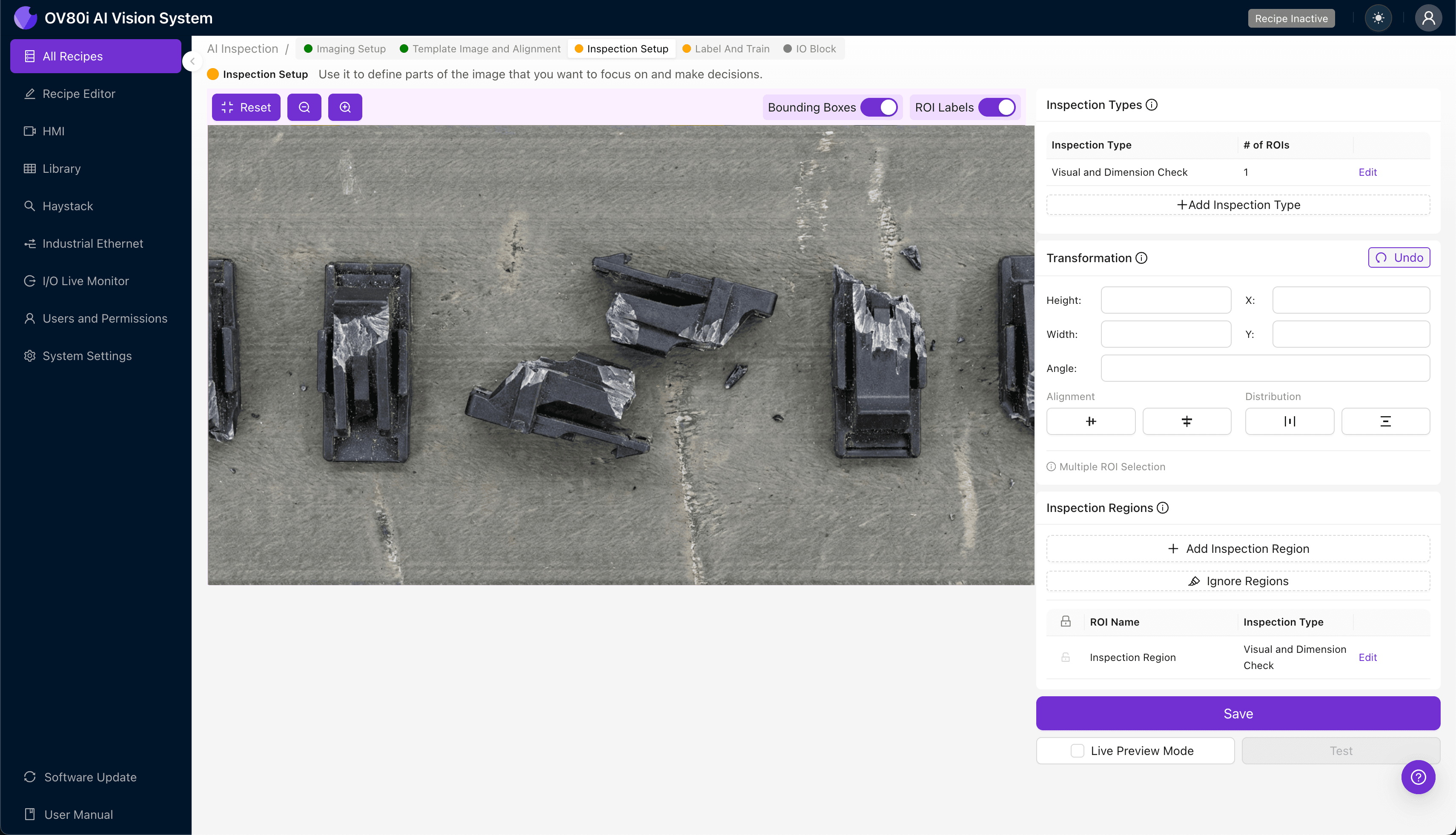
Navigate to "Inspection Setup" to define where the system should focus its analysis. Rename your "Inspection Types" with descriptive labels like "Latch_Arm_Fracture" or "Surface_Crazing" for clear traceability.
Click "+ Add Inspection Region" to create targeted zones. Resize the yellow bounding box to cover critical defect areas—particularly the latch arm hinge point, engagement hooks, and any thin-wall sections prone to brittleness failure.
Click "Save" to confirm your inspection regions.
Step 4: Labeling Data
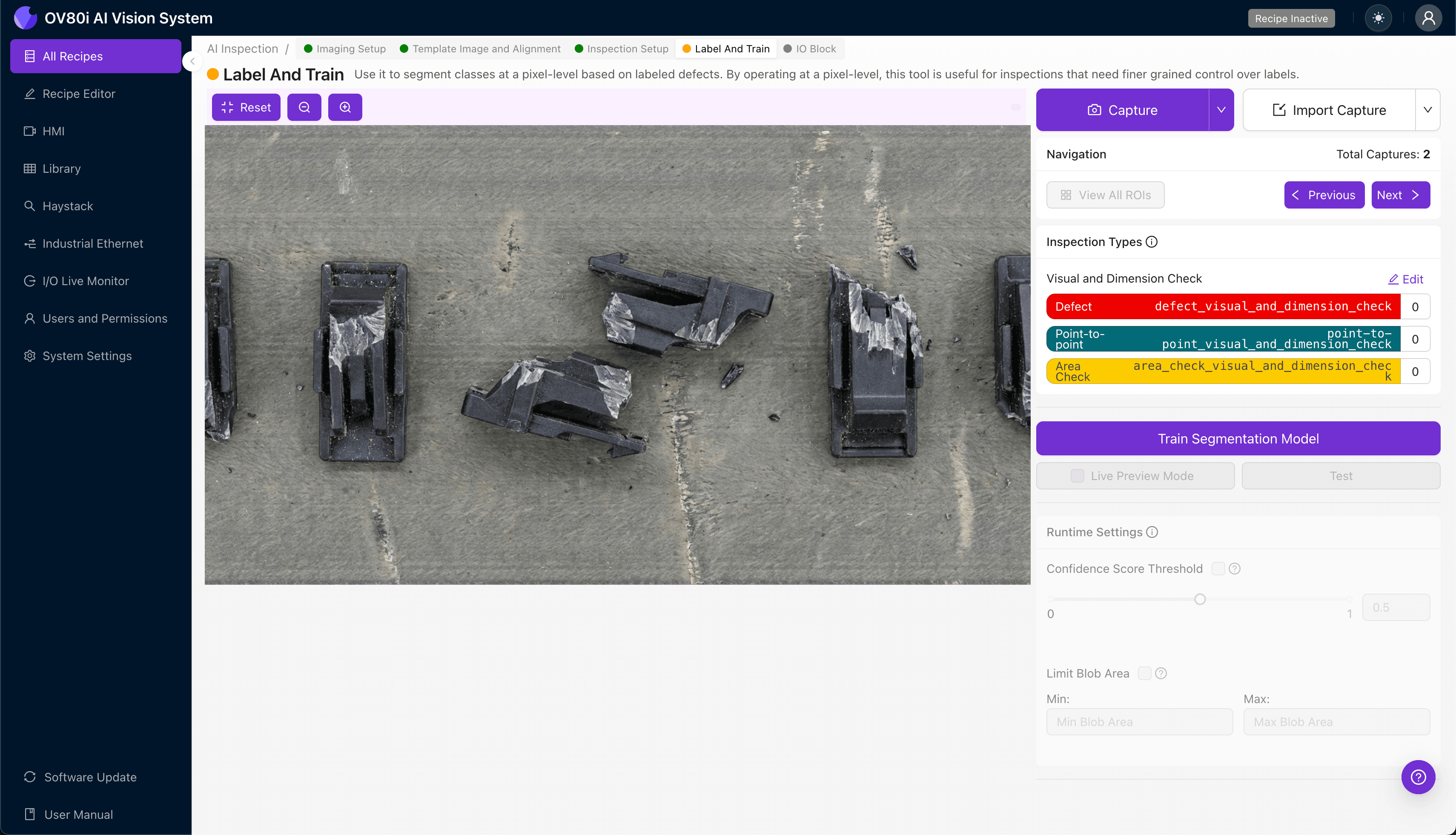
Overview.ai uses a human-in-the-loop process to build accurate detection models. Quality engineers review captured images and label them as "Good" or "Bad," teaching the AI what acceptable and defective parts look like.
Include representative samples across your full production variation—different colors, slight dimensional differences, and acceptable cosmetic marks. Most importantly, incorporate known failure modes: parts that failed cold-chamber testing, field returns with brittleness fractures, and intentionally stressed samples.
Step 5: Creating Rules
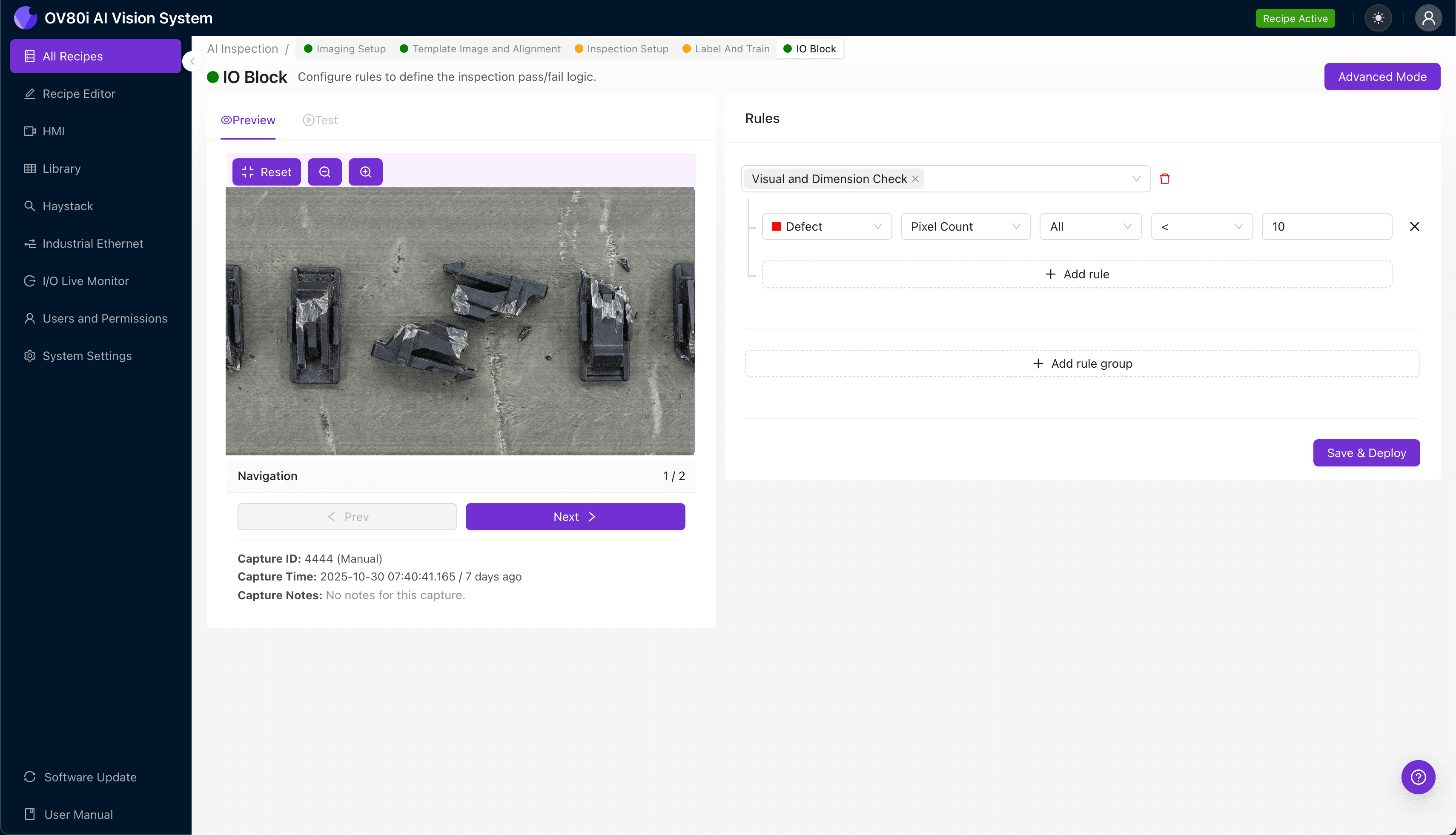
With labeled data in place, configure your pass/fail logic based on defined Inspection Types. Set confidence thresholds that balance escape risk against false rejection rates—typically starting at 85% confidence for initial deployment.
Gate automated acceptance on the production line so that flagged parts divert to a reject bin or secondary inspection station. This creates a closed-loop system where every suspect latch receives appropriate disposition before reaching customers.
Key Outcomes & ROI
Implementing AI-powered visual inspection for connector latch brittleness failure delivers measurable business impact:
- Reduced scrap and rework costs – catch defects before assembly, preventing downstream waste and disassembly labor
- Higher throughput with 100% inspection – eliminate sampling-based quality gates that slow production
- Enhanced compliance and traceability – automatically log inspection images and results for audit trails and customer documentation
- Process improvement insights – identify patterns linking brittleness failures to specific material lots, molding parameters, or environmental conditions
Low-temperature brittleness represents one of the most challenging failure modes in connector latch manufacturing—invisible during warm-environment production, catastrophic in cold-climate deployment. Overview.ai's visual inspection platform gives manufacturers the tools to catch these defects consistently, objectively, and at full production speed.
Stop Brittleness Failures Before They Escape
Deploy Overview.ai to catch micro-fractures, surface crazing, and stress marks at full production speed.