How to Detect Broken Micro-Bumps in CPO Sockets Using AI-Powered Visual Inspection

"Broken micro-bumps in CPO sockets cause catastrophic field failures and millions in warranty claims. AI-powered visual inspection catches these microscopic defects—measuring just 25-75 micrometers—with superhuman precision at production speed, eliminating the inconsistency and fatigue of manual inspection."
The Problem: Why Broken Micro-Bumps in CPO Sockets Are a Critical Quality Challenge
Co-Packaged Optics (CPO) represent the cutting edge of data center interconnect technology, integrating optical engines directly onto switch ASICs to dramatically reduce power consumption and latency. At the heart of this architecture lies the CPO socket—a precision component where micro-bump interconnects must maintain perfect integrity to ensure reliable high-speed signal transmission.
When micro-bumps fail, the consequences cascade throughout the entire optical module, leading to signal degradation, thermal issues, and catastrophic field failures that can cost manufacturers millions in warranty claims and damaged customer relationships.
Common Defects Found in CPO Sockets with Broken Micro-Bumps:
- Cracked or fractured micro-bumps — Structural failures in the solder bump itself, often caused by thermal cycling or mechanical stress during assembly
- Missing micro-bumps — Complete absence of bump material at designated pad locations, resulting in open circuits
- Collapsed or bridged micro-bumps — Excessive compression causing adjacent bumps to short-circuit, compromising signal integrity
- Non-wetting or partial wetting — Incomplete solder reflow leaving weak metallurgical bonds prone to early failure
- Micro-bump height variation — Inconsistent bump coplanarity preventing proper socket engagement
- Oxidation or contamination — Surface degradation on bump surfaces inhibiting electrical conductivity
Manual inspection of these defects is fundamentally inadequate for production-scale CPO manufacturing. Micro-bumps typically measure just 25-75 micrometers in diameter—far below the threshold of reliable human visual detection. Inspector fatigue sets in rapidly when examining hundreds of microscopic interconnects per socket, and the subjective nature of "pass" versus "fail" decisions leads to inconsistent quality gates across shifts and operators.
The Solution: Machine Vision and Deep Learning for CPO Socket Inspection
Machine vision systems equipped with deep learning algorithms fundamentally transform CPO socket inspection by capturing high-resolution imagery and analyzing micro-bump integrity with superhuman precision. Unlike rule-based systems that struggle with the natural variation in solder joint appearance, neural networks learn to distinguish subtle defect signatures from acceptable process variation.
Deep learning models excel at detecting the nuanced visual patterns that indicate micro-bump failure—hairline cracks invisible to the human eye, slight discoloration suggesting contamination, or geometric irregularities predicting future reliability issues.
Overview.ai's approach delivers consistent, objective inspection at line speed, eliminating the bottleneck that manual inspection creates in high-volume CPO production. By deploying systems like the OV80i directly inline, manufacturers achieve 100% inspection coverage without sacrificing throughput, catching defective sockets before they're assembled into expensive optical modules.
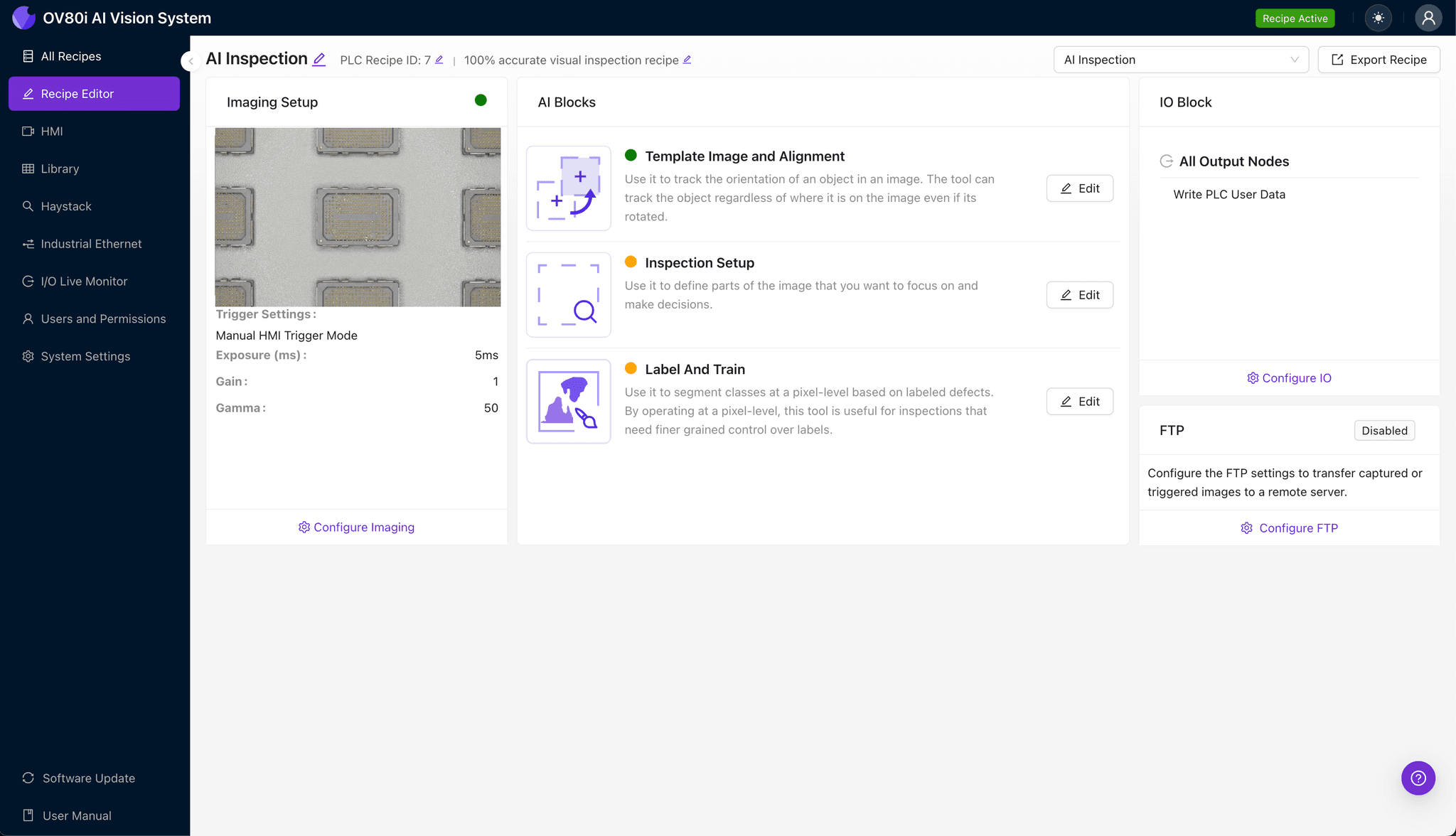
Step 1: Imaging Setup
Position the CPO socket with broken micro-bumps under the inspection camera, ensuring the micro-bump array is centered within the field of view. Proper fixturing is critical—the socket should be held at a consistent angle that maximizes bump visibility while minimizing shadowing.
Click "Configure Imaging" to access the camera settings panel. Adjust exposure to capture clear detail without overexposing the reflective solder surfaces, and fine-tune gain to optimize signal-to-noise ratio for the micro-bump features.
Click "Save" to lock in your imaging parameters.
Step 2: Image Alignment
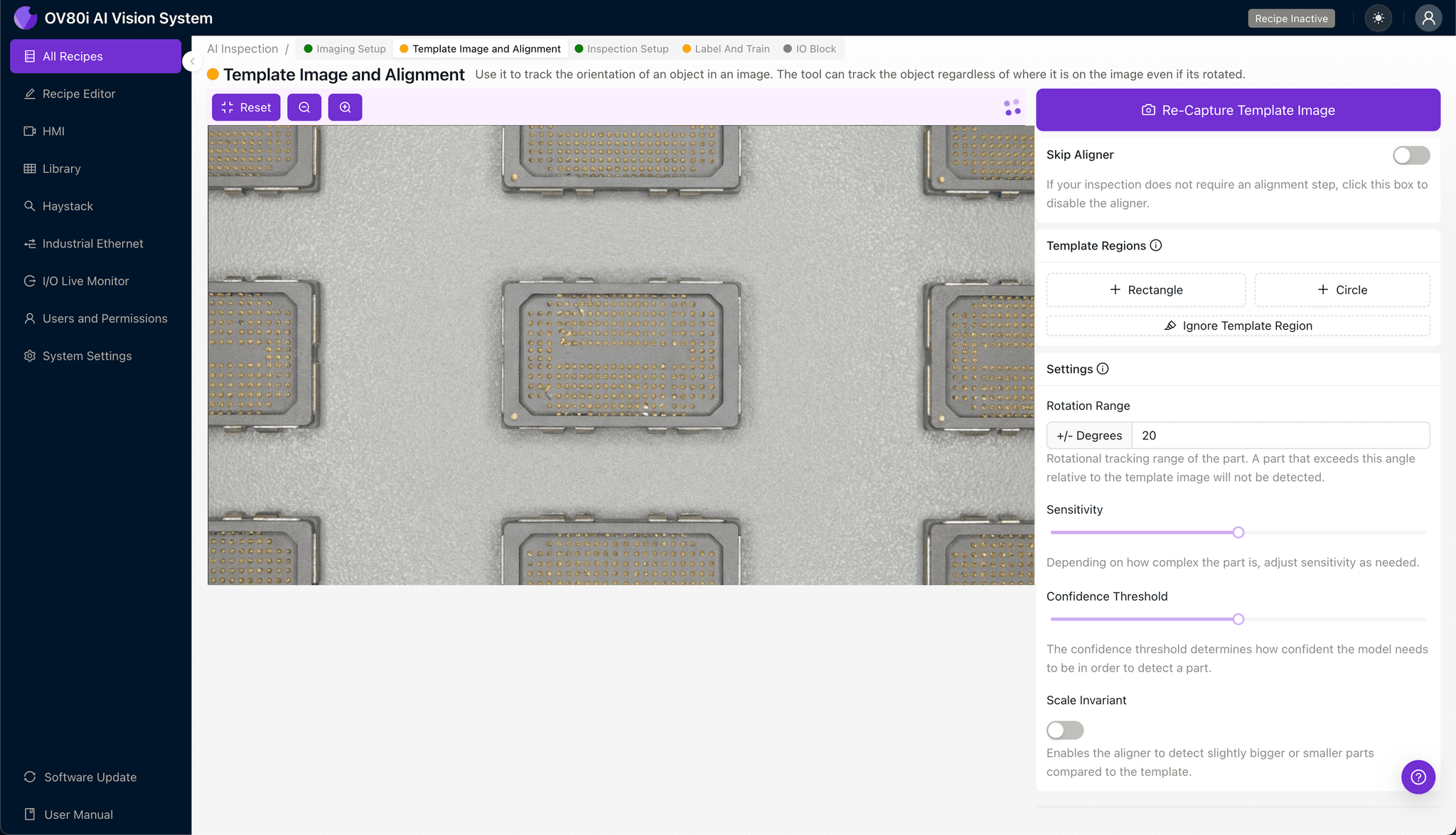
Navigate to the "Template Image" tab and capture a reference image of a properly positioned CPO socket. This template establishes the baseline geometry that the system uses to align all subsequent inspection images.
Click "+ Rectangle" to add an alignment region around the main socket body, encompassing distinctive features like corner fiducials or package edges. Set the "Rotation Range" to 20 degrees to accommodate natural variation in part presentation on the production line.
Step 3: Inspection Region Selection
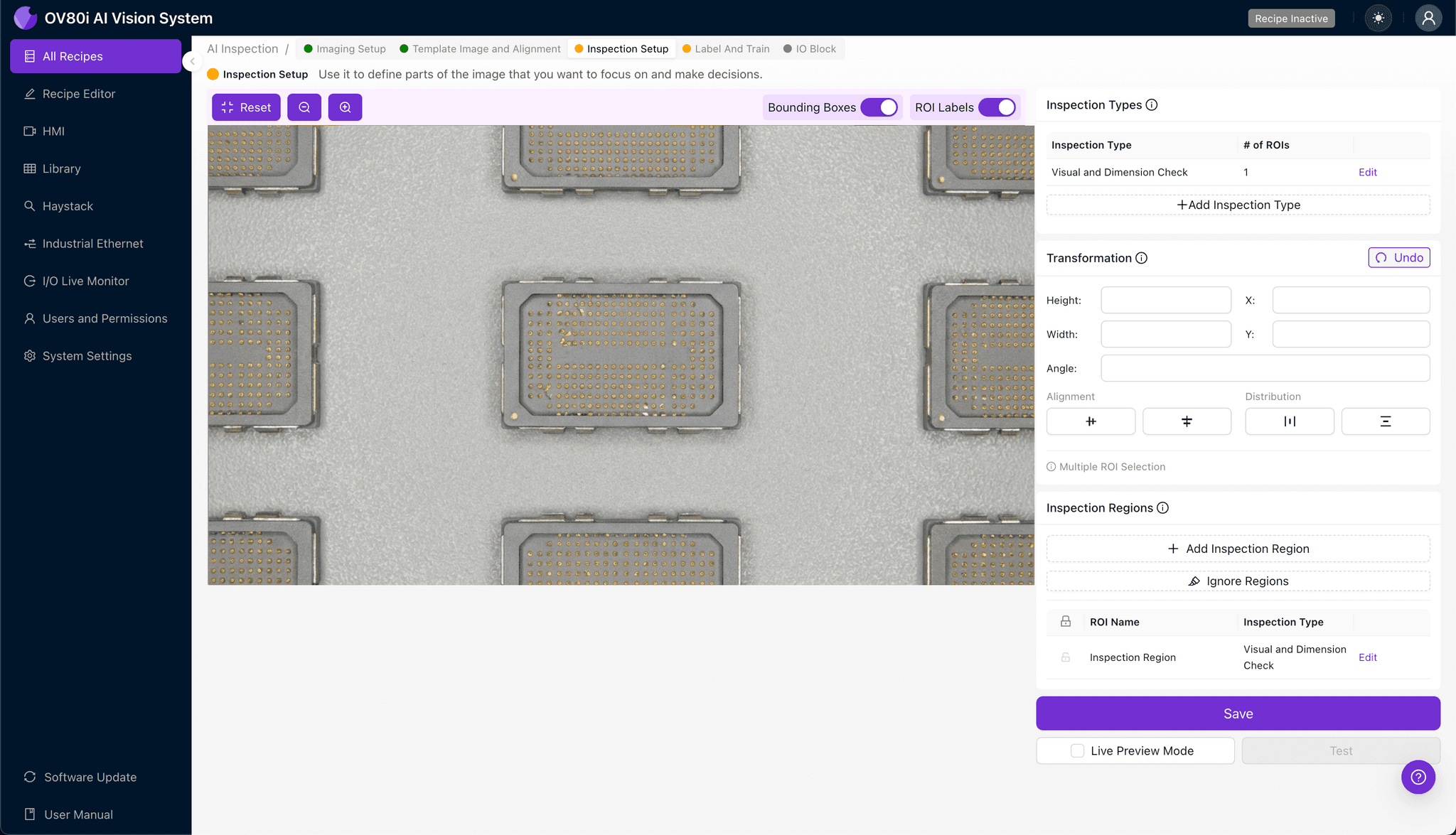
Navigate to "Inspection Setup" to define where the system should focus its analysis. Rename your "Inspection Types" to reflect the specific defect categories relevant to micro-bump failure—for example, "Micro-Bump Crack," "Missing Bump," or "Bump Bridge."
Click "+ Add Inspection Region" to create a new zone. Resize the yellow bounding box to encompass the critical micro-bump array areas, ensuring complete coverage of all interconnect locations.
Click "Save" to confirm your inspection regions.

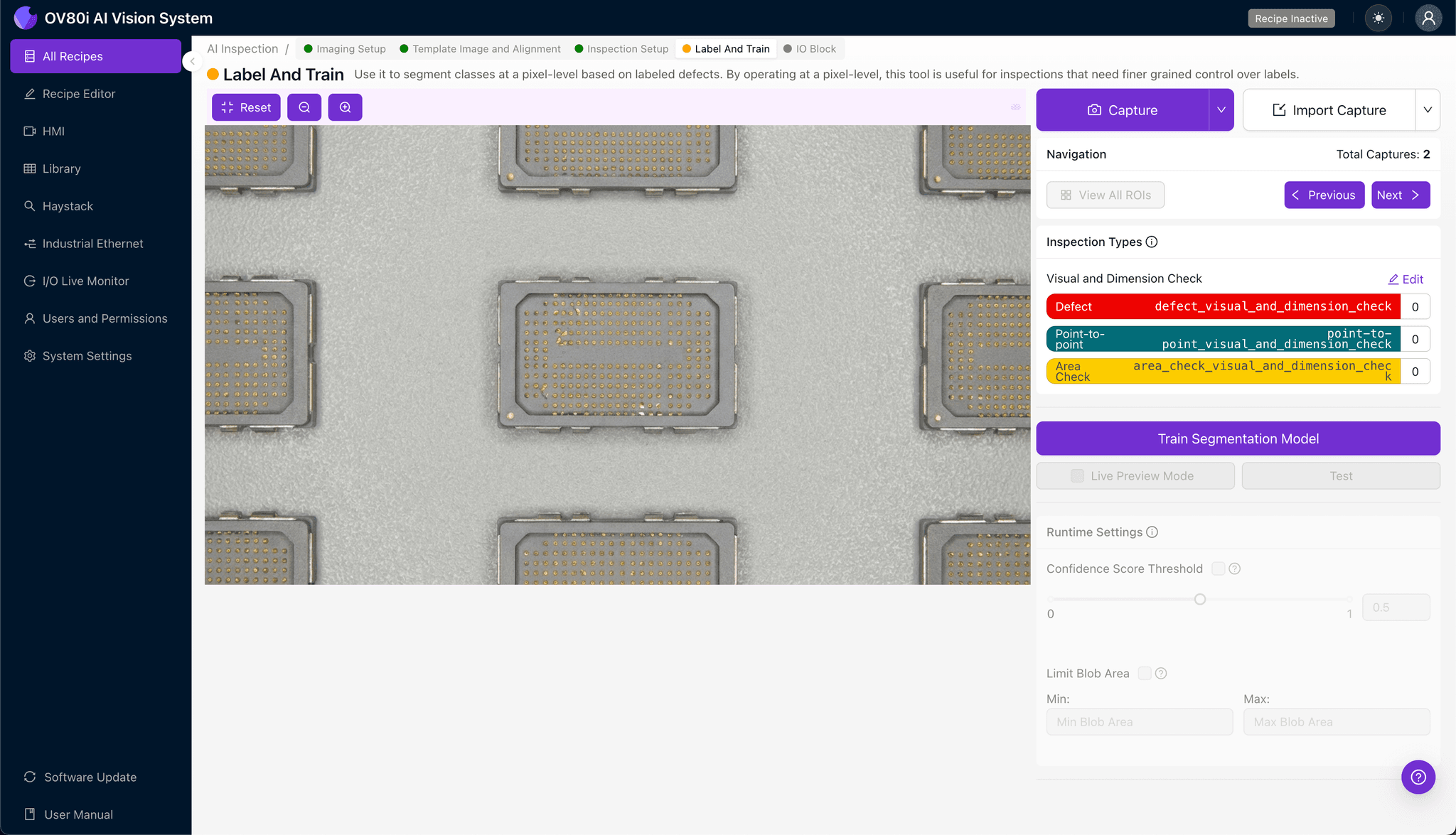
Step 4: Labeling Data
The human-in-the-loop labeling process is where your manufacturing expertise trains the AI model. Review captured images and categorize each CPO socket as Good (acceptable micro-bump integrity) or Bad (defective micro-bumps present).
Include representative samples across the full spectrum of acceptable variation, as well as known failure modes from your defect library. The more diverse your labeled dataset, the more robust your trained model will perform against real-world production variation.
Step 5: Creating Rules
Define your pass/fail logic based on the Inspection Types you've configured. Set thresholds that align with your quality specifications—for example, any detected micro-bump crack results in automatic rejection.
These rules gate automated acceptance on the line, enabling real-time sorting of conforming versus non-conforming CPO sockets without manual intervention.
Key Outcomes & ROI
Deploying AI-powered visual inspection for CPO socket micro-bump defects delivers measurable business impact across multiple dimensions:
- Reduced scrap and rework costs — Catch defective sockets before they're assembled into complete CPO modules, avoiding the 10-50x cost multiplier of downstream failure discovery
- Higher throughput and line efficiency — Eliminate manual inspection bottlenecks while achieving 100% coverage at production speed
- Enhanced compliance and traceability — Automatically log inspection images and results for every socket, supporting customer audits and regulatory requirements
- Process improvement insights — Analyze defect trends over time to identify upstream process issues before they impact yield at scale
Conclusion
Broken micro-bumps in CPO sockets represent exactly the type of high-stakes, microscopic defect that AI-powered visual inspection was designed to catch. By implementing a systematic approach using Overview.ai's platform, manufacturers can transform this critical quality checkpoint from a liability into a competitive advantage.
Ready to see how automated inspection can protect your CPO production line? Contact Overview.ai to schedule a demo with your actual components.
Eliminate Micro-Bump Defects Today
Stop relying on manual inspection for microscopic CPO socket defects. Deploy Overview.ai to catch broken micro-bumps instantly at production speed.