Crimp Ferrule with an Uneven Bellmouth: A Complete Visual Inspection Guide
"Uneven bellmouths in crimp ferrules compromise hydraulic assembly integrity and slip past fatigued inspectors. Overview.ai's deep learning platform catches asymmetrical flares, edge burrs, and geometric defects at full line speed—delivering consistent quality control with complete traceability."
The Problem: Why Uneven Bellmouths Slip Through Traditional QC
Crimp ferrules are critical components in hydraulic assemblies, electrical connections, and fluid transfer systems where reliable termination is non-negotiable. When the bellmouth—the flared entry point of the ferrule—forms unevenly during the crimping process, it compromises both assembly integrity and long-term performance.
Common Defects Found in Crimp Ferrules with Uneven Bellmouths:
- Asymmetrical flare geometry — one side of the bellmouth opening sits higher or wider than the opposite side
- Insufficient flare depth — the bellmouth fails to open adequately for proper hose or cable insertion
- Excessive flare angle — over-crimping creates stress concentrations prone to cracking
- Edge burrs and deformation — rough or torn material at the bellmouth lip
- Circumferential inconsistency — varying wall thickness around the bellmouth perimeter
- Surface scoring or tool marks — damage from misaligned crimping dies
Human inspectors struggle to catch these defects consistently, especially at production speeds exceeding hundreds of parts per hour. Inspector fatigue sets in quickly when evaluating subtle geometric variations, and the subjective nature of "acceptable" versus "unacceptable" flare profiles leads to inconsistent pass/fail decisions across shifts.
The Solution: Machine Vision + Deep Learning
Traditional rule-based vision systems require explicit programming for every defect type—a near-impossible task when bellmouth irregularities present in countless subtle variations. Deep learning changes this paradigm by training neural networks on labeled examples of good and bad parts, enabling the system to generalize and catch defects it was never explicitly programmed to find.
Overview.ai's approach combines high-resolution imaging with AI models purpose-built for manufacturing environments. The result is consistent, objective inspection at full line speed—every part, every time, with zero fatigue and complete traceability.
Step 1: Imaging Setup
Position the crimp ferrule under the OV80i camera with the bellmouth facing upward for optimal defect visibility. Proper lighting is essential—consider using diffuse ring illumination to minimize glare on the metallic surface while highlighting geometric inconsistencies.
Click "Configure Imaging" in the Overview interface to access Camera Settings. Adjust exposure time to capture crisp detail without overexposing reflective areas, and fine-tune gain to balance image brightness with noise levels.
Click "Save" once your ferrule appears sharp and evenly lit across the entire bellmouth region.

Step 2: Image Alignment
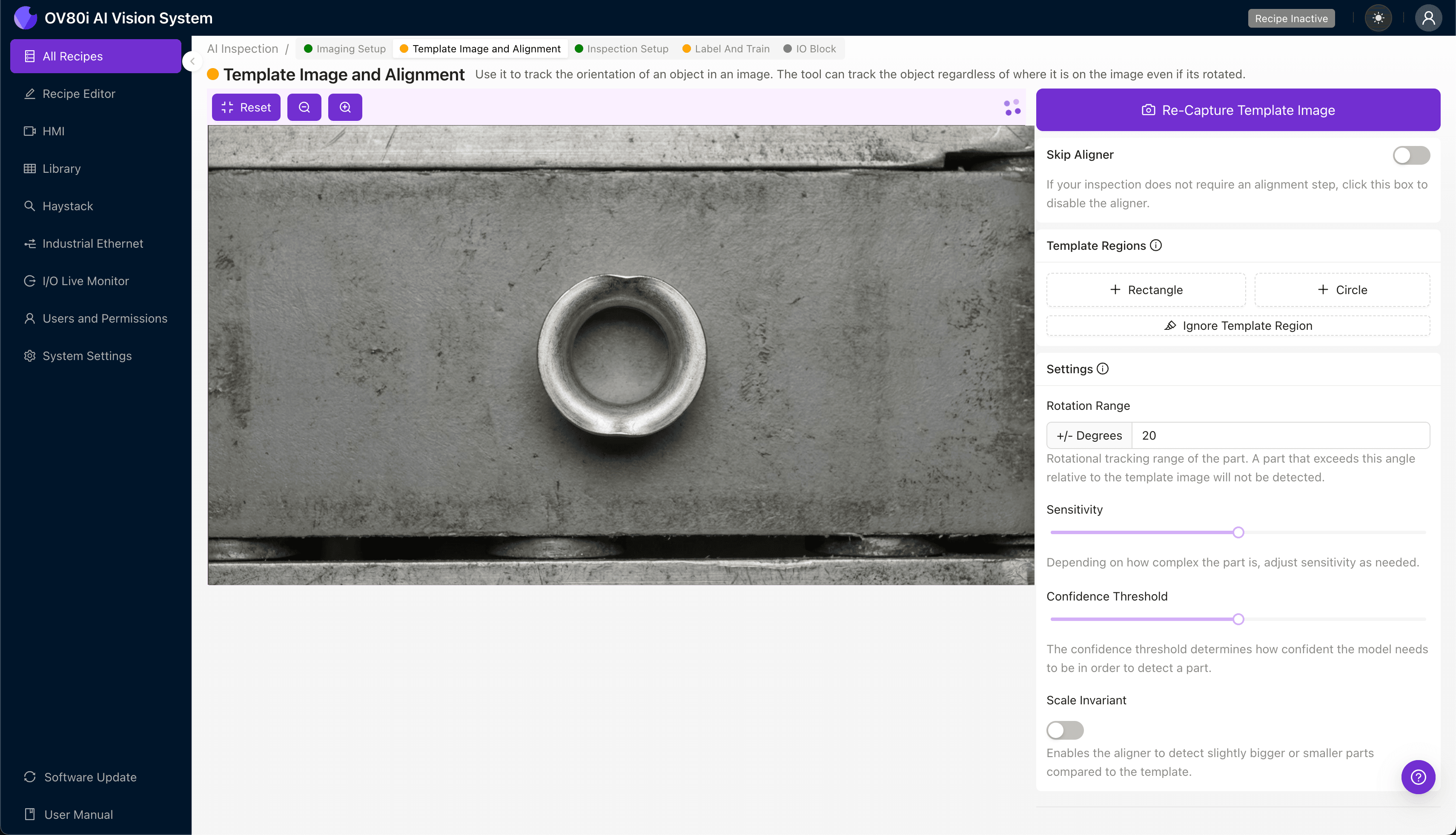
Navigate to the "Template Image" tab and capture a reference image of a correctly positioned ferrule. This template ensures the system can locate and orient each part consistently, even if ferrules arrive at slightly different positions on the conveyor.
Click "+ Rectangle" to add an alignment region around the main cylindrical body of the ferrule. Set the "Rotation Range" to 20 degrees to accommodate minor orientation variations without losing tracking accuracy.
Step 3: Inspection Region Selection
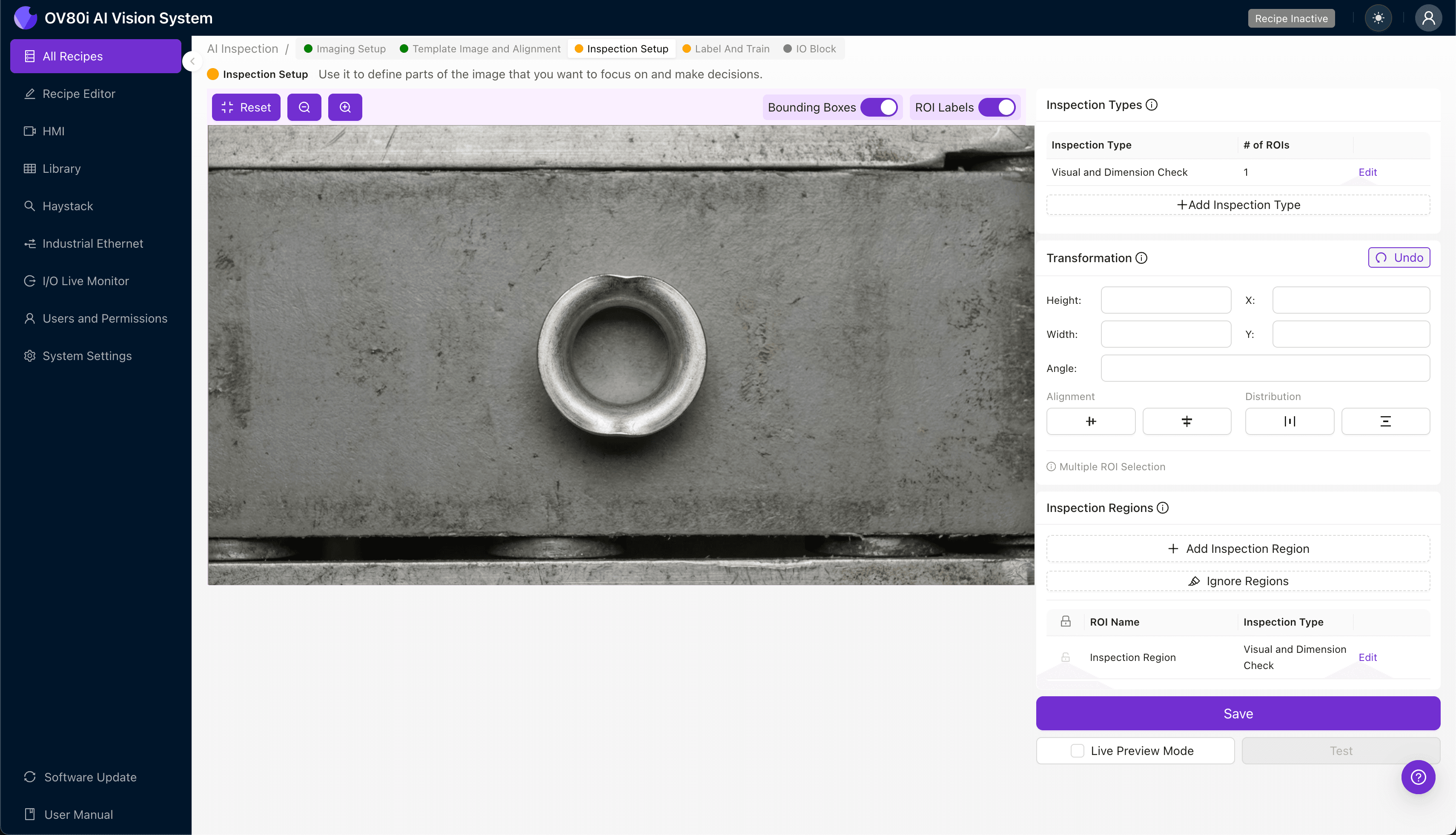
Navigate to "Inspection Setup" to define where the AI should focus its analysis. Rename your "Inspection Types" with clear, descriptive labels such as "Bellmouth_Symmetry" and "Flare_Edge_Quality" for easier reporting downstream.
Click "+ Add Inspection Region" and resize the yellow bounding box to cover the critical bellmouth area—including the flared opening, transition zone, and surrounding lip. For comprehensive coverage, consider adding a second region targeting the crimp body for secondary defect detection.
Click "Save" to lock in your inspection zones.
Step 4: Labeling Data
This is where human expertise trains the AI. The human-in-the-loop labeling process transforms your quality team's knowledge into machine intelligence.
Review incoming images and label each as Good (acceptable bellmouth geometry) or Bad (uneven, damaged, or out-of-spec). Include representative samples across your full range of acceptable variation, plus known failure modes like asymmetrical flares, edge burrs, and tool marks.
The more diverse your labeled dataset, the more robust your model becomes at distinguishing subtle defect boundaries.
Step 5: Creating Rules
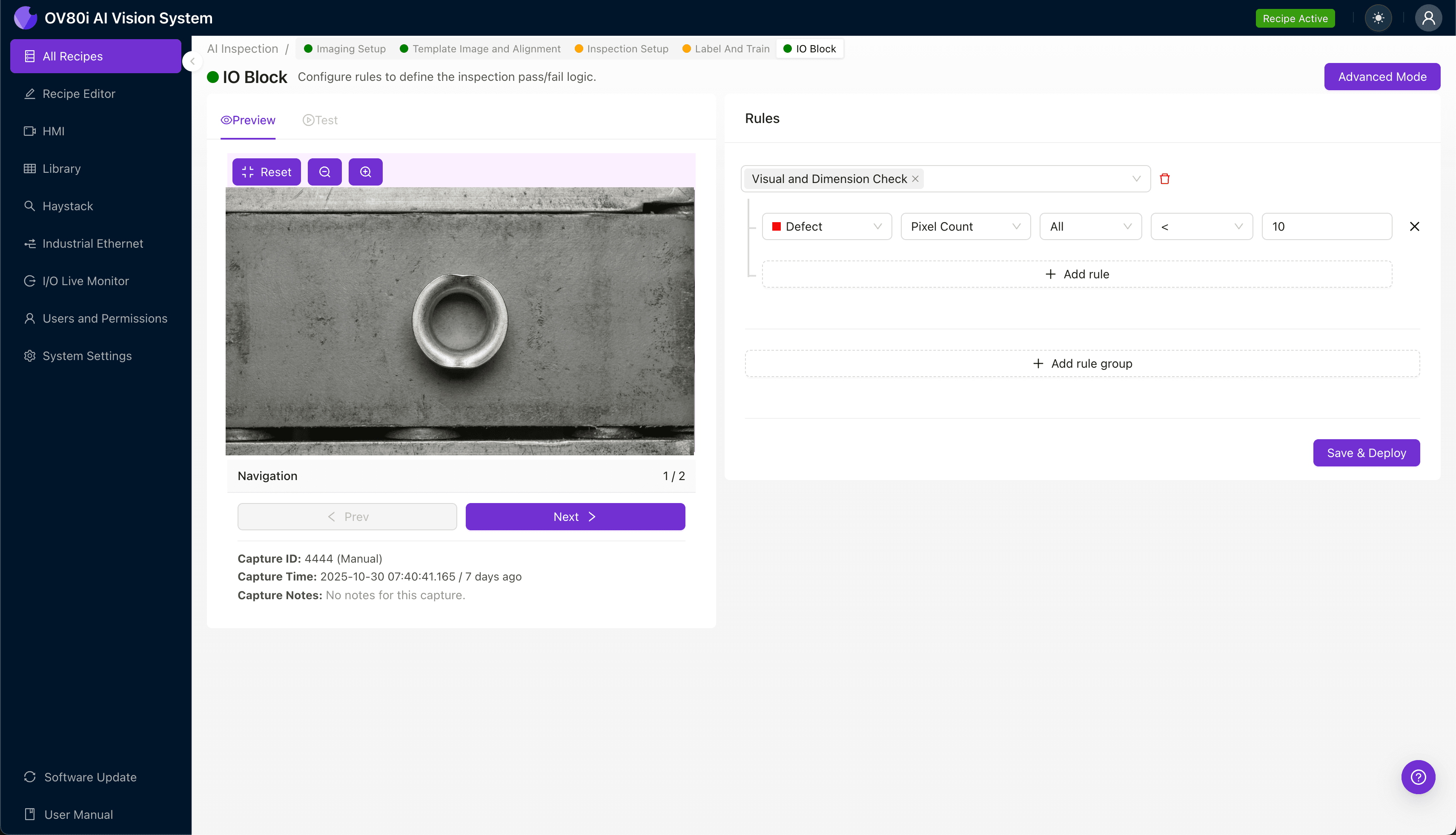
With your trained model in place, navigate to the Rules configuration to set pass/fail logic based on your defined Inspection Types. Establish confidence thresholds that align with your quality standards—tighter tolerances for safety-critical applications, appropriate margins for cosmetic-only concerns.
Gate automated acceptance on the line by connecting inspection results to your reject mechanism. Parts flagged as "Bad" route automatically to quarantine bins, while "Good" parts continue downstream without operator intervention.

Key Outcomes & ROI
Implementing AI-powered visual inspection for crimp ferrule bellmouth defects delivers measurable business impact:
- Reduced scrap and rework costs — catch defects before they propagate into finished assemblies or reach customers
- Higher throughput — inspect 100% of parts at line speed without creating bottlenecks or adding labor
- Compliance and traceability — maintain timestamped inspection records with images for every part, supporting audit requirements and customer quality documentation
- Process improvement insights — analyze defect trends over time to identify upstream issues like worn crimping dies or material inconsistencies before they cause major quality events
Ready to Eliminate Bellmouth Defects?
Stop relying on fatigued inspectors and inconsistent sampling. Deploy Overview.ai to catch every uneven bellmouth with AI-powered precision.