How to Inspect Fiber Ribbon with Shattered Glass Core Using AI-Powered Vision Systems
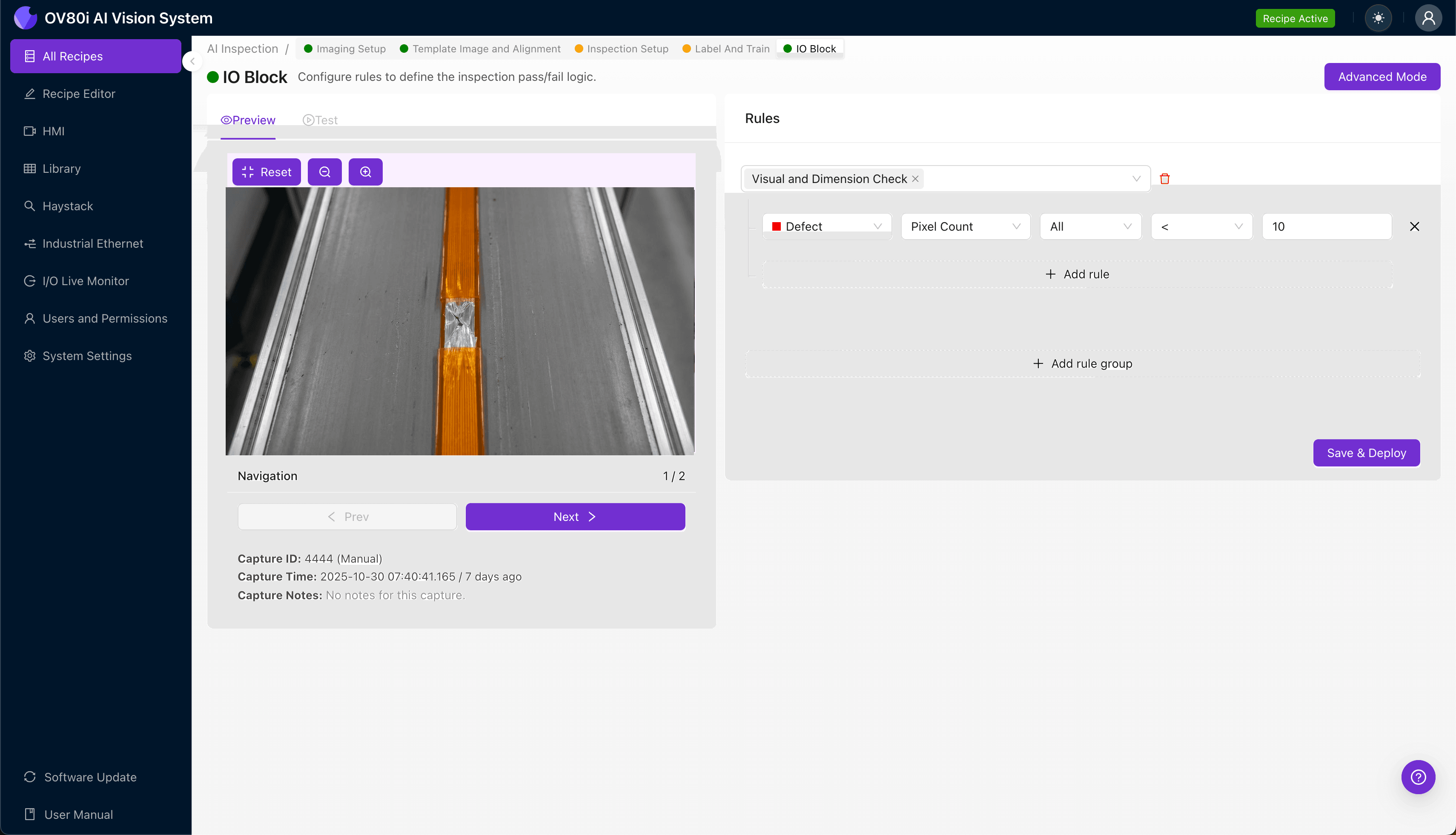
"Shattered glass cores in fiber ribbon cables create microscopic fracture patterns that cause catastrophic signal loss. AI-powered visual inspection detects radial fractures, delamination zones, and micro-void clusters with consistent accuracy—catching defects invisible to human inspectors at full production line speed."
The Problem: Why Traditional Inspection Falls Short
Fiber ribbon cables with glass core construction are critical components in high-speed data transmission and telecommunications infrastructure. When the delicate glass core shatters or fractures, it creates defects that can cause catastrophic signal loss and system failures downstream.
Common Defects in Fiber Ribbon with Shattered Glass Core:
- Radial fracture patterns – star-shaped cracks emanating from impact points within the glass core
- Axial stress fractures – longitudinal cracks running parallel to the fiber length
- Delamination zones – separation between the glass core and surrounding cladding layers
- Micro-void clusters – tiny air pockets formed during shattering that scatter light signals
- Surface crazing – fine network of surface-level cracks that compromise structural integrity
- Core misalignment – shifted or displaced glass fragments disrupting the optical pathway
Human inspectors struggle to maintain accuracy when examining these microscopic defects across thousands of units per shift. Inspector fatigue, inconsistent lighting interpretation, and the sheer speed of modern production lines make manual inspection unreliable for detecting sub-millimeter fracture patterns.
The Solution: Machine Vision + Deep Learning
AI-powered visual inspection eliminates the variability inherent in human quality control. Deep learning models can be trained to recognize the subtle visual signatures of shattered glass cores—including fracture patterns invisible to the naked eye—with consistent accuracy across every single unit.
Overview.ai's approach delivers objective, repeatable inspection at full line speed. By deploying systems like the OV80i directly on the production line, manufacturers achieve 100% inline inspection without sacrificing throughput or relying on statistical sampling.
Step 1: Imaging Setup
Position the fiber ribbon sample with the suspected shattered glass core under the OV80i camera system. Ensure the lighting angle highlights internal fracture patterns and surface irregularities.
Click "Configure Imaging" to access the Camera Settings panel. Adjust exposure to capture internal glass structure detail and gain to optimize contrast between intact and fractured regions.
Click "Save" to lock in your imaging configuration.

Step 2: Image Alignment
Navigate to the "Template Image" section within the software interface. Capture a Template image of a properly positioned fiber ribbon sample to serve as your alignment reference.
Click "+ Rectangle" to add a region around the main body of the fiber ribbon. Set the "Rotation Range" to 20 degrees to accommodate minor positioning variations as samples move through the inspection station.
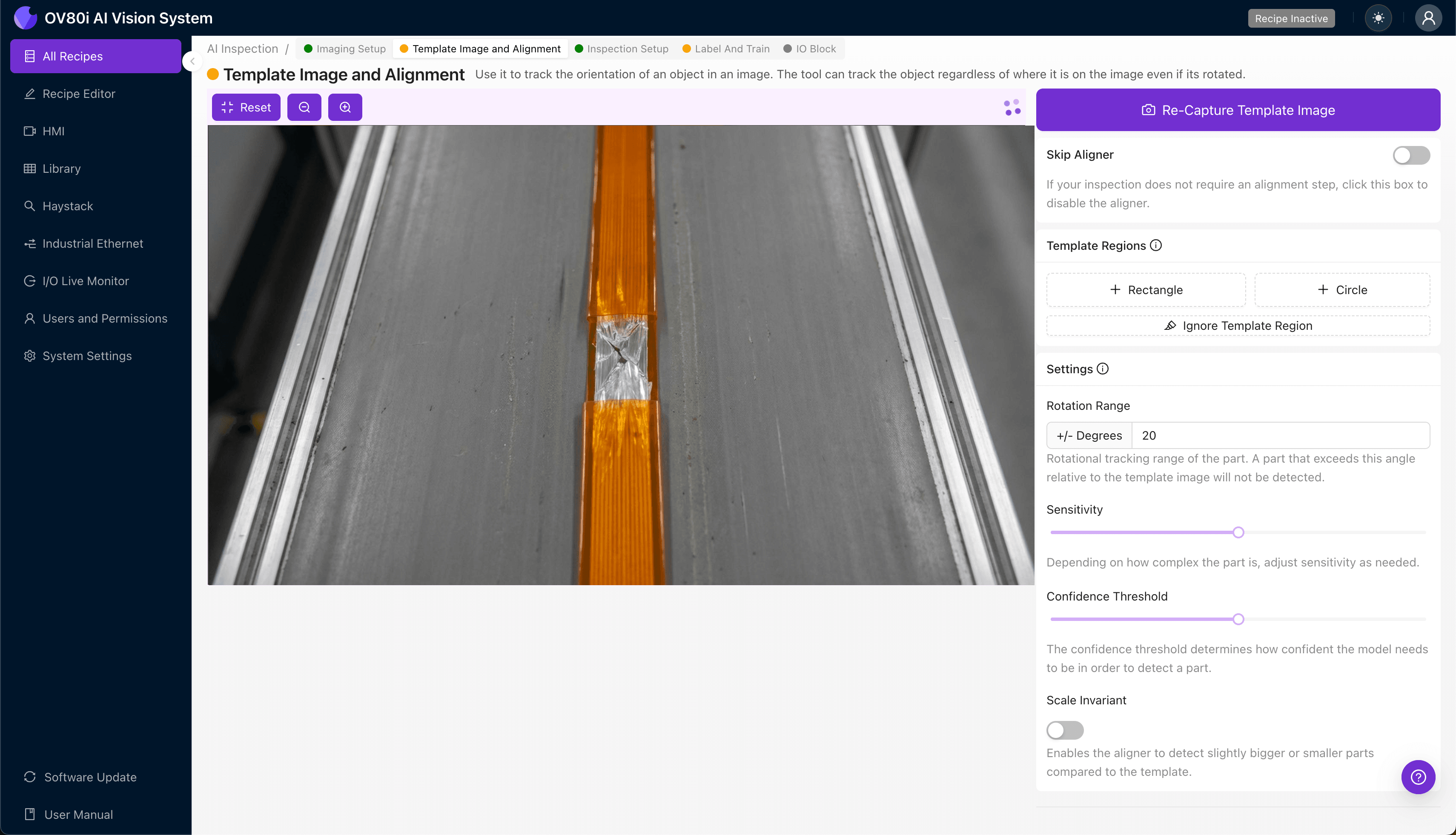
Step 3: Inspection Region Selection
Navigate to "Inspection Setup" in the main menu. Rename your "Inspection Types" to reflect the specific defects you're targeting—for example, "Core Fracture," "Delamination," and "Surface Crazing."
Click "+ Add Inspection Region" to define your areas of interest. Resize the yellow bounding box to cover the critical defect areas—typically the glass core centerline and cladding interface zones.
Click "Save" to confirm your inspection region configuration.
Step 4: Labeling Data
This human-in-the-loop process trains the AI to distinguish acceptable products from defective ones. Review captured images and label each as Good (intact core) or Bad (shattered/fractured core).
Include representative samples across the full spectrum of defect severity. Incorporate known failure modes from historical quality data to ensure the model learns from real-world production variability.
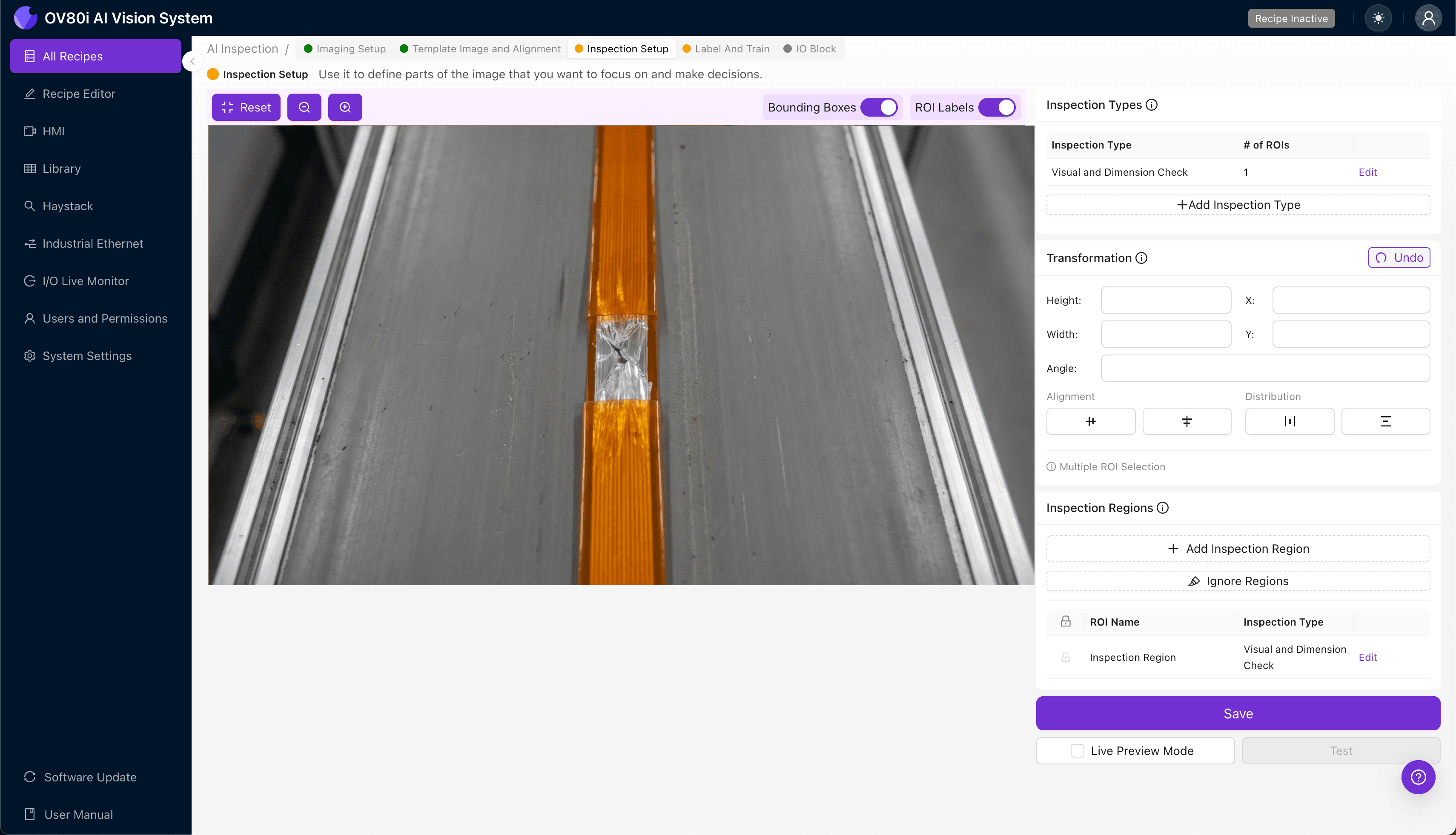
Step 5: Creating Rules
Set your pass/fail logic based on the Inspection Types you defined earlier. Configure threshold rules—for example, flagging any sample where "Core Fracture" confidence exceeds 85%.
Gate automated acceptance on the line to ensure only verified good parts proceed to packaging. Rejected units can be automatically diverted for secondary review or disposal.

Key Outcomes & ROI
Implementing AI-powered inspection for fiber ribbon with shattered glass core delivers measurable business impact:
- Reduced scrap rates – Catch fractured cores before they're assembled into finished products, eliminating costly downstream waste
- Higher throughput – Inspect 100% of production at line speed without bottlenecking operations
- Compliance and traceability – Maintain detailed inspection records with timestamped images for audit trails and customer documentation
- Process improvement insights – Analyze defect trend data to identify upstream manufacturing issues causing glass core failures
Ready to Automate Your Fiber Ribbon Inspection?
Stop relying on inconsistent manual inspection and start catching every shattered glass core defect—automatically.