Detecting Selective Gold-Plated Terminal with Nickel Underplate Migration: A Machine Vision Walkthrough
"Nickel underplate migration through gold plating creates subtle visual defects that compromise contact reliability. Overview.ai's deep learning-powered inspection detects these microscopic anomalies at production speed, eliminating quality escapes before they reach downstream assembly."
The Problem: Why Nickel Migration Defects Slip Through Manual Inspection
Selective gold-plated terminals with nickel underplates are critical components in high-reliability connectors used across automotive, aerospace, and medical device manufacturing. When the nickel barrier layer migrates through the gold plating, it compromises contact resistance, solderability, and long-term corrosion protection.
Common Defects in Selective Gold-Plated Terminals with Nickel Migration
- Surface discoloration — brownish or grayish tinting where nickel has diffused to the gold surface
- Porosity and micro-pitting — tiny voids in the gold layer exposing the nickel underplate
- Plating boundary irregularities — uneven demarcation between plated and unplated zones
- Thickness variation — insufficient gold coverage allowing accelerated nickel diffusion
- Oxidation staining — localized corrosion spots indicating barrier layer failure
- Contact area contamination — nickel oxide formation on critical mating surfaces
Manual inspection of these defects is notoriously unreliable. Inspectors experience eye fatigue within hours, and subtle color shifts from nickel migration are nearly impossible to detect consistently at production speeds. The microscopic scale of porosity and early-stage diffusion defects falls below human visual acuity thresholds, especially under varying ambient lighting conditions.
The Solution: Machine Vision and Deep Learning for Consistent Detection
Machine vision systems equipped with deep learning algorithms excel at detecting the subtle visual signatures of nickel migration. Unlike rule-based systems that require explicit programming for each defect type, neural networks learn to identify anomalies from labeled training data—including defects that engineers haven't explicitly defined.
This approach captures the full spectrum of migration-related failures, from obvious discoloration to barely perceptible early-stage diffusion. Overview.ai's platform delivers consistent, objective inspection at line speed—eliminating the variability inherent in human inspection. The OV80i system performs 100% inline inspection, catching defects that would otherwise escape to customers or downstream assembly processes.
Step 1: Imaging Setup
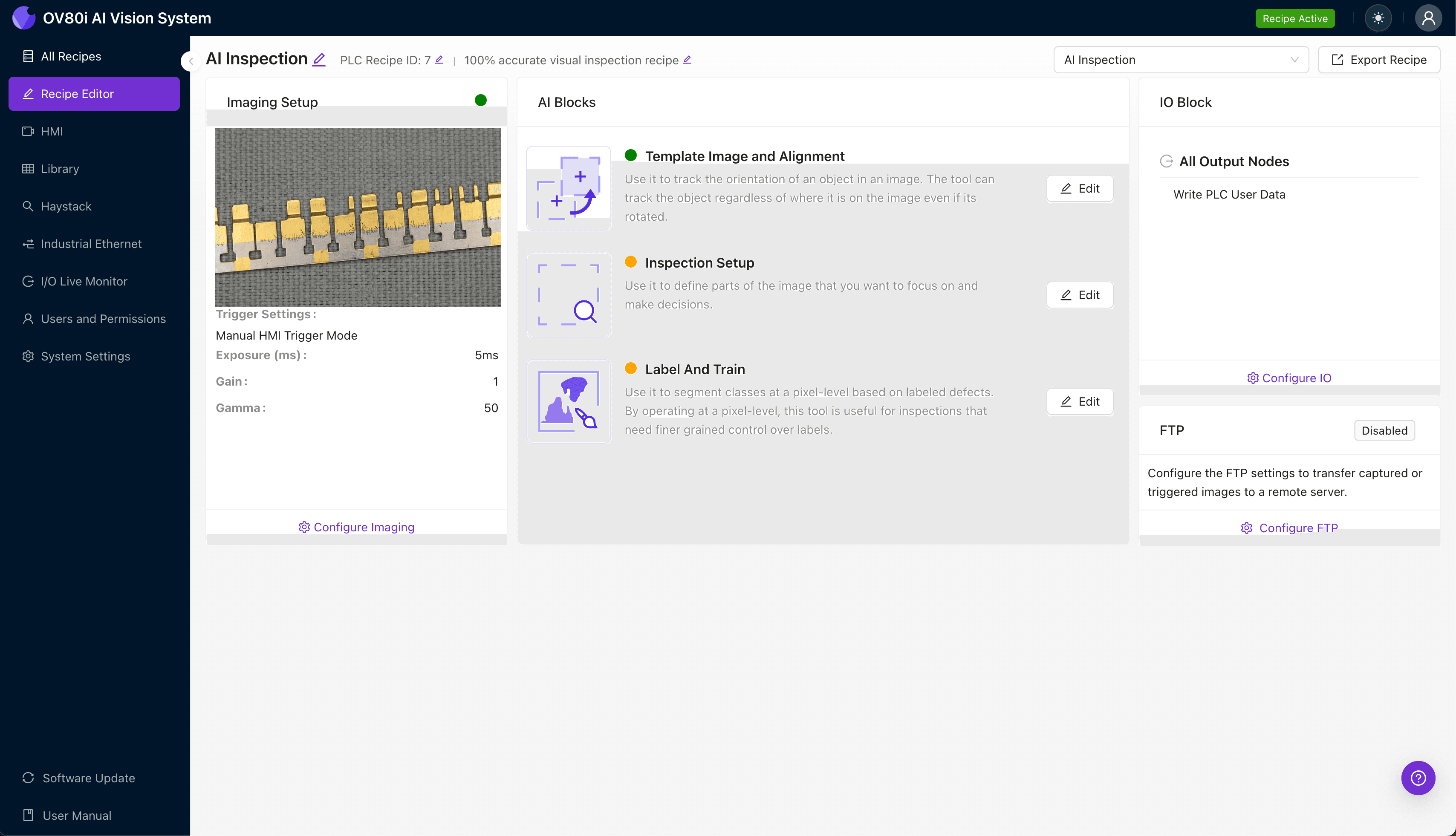
Position the selective gold-plated terminal under the OV80i camera system, ensuring the gold-plated contact surfaces face the lens. Proper orientation is critical for consistent detection of migration-related surface anomalies.
Click "Configure Imaging" in the Overview.ai interface. Adjust Camera Settings including exposure time and gain to optimize contrast between the gold plating, nickel migration zones, and base metal substrate. For gold-plated terminals, slightly elevated exposure often enhances visibility of subtle color shifts. Click "Save" to lock in your imaging parameters.
Step 2: Image Alignment
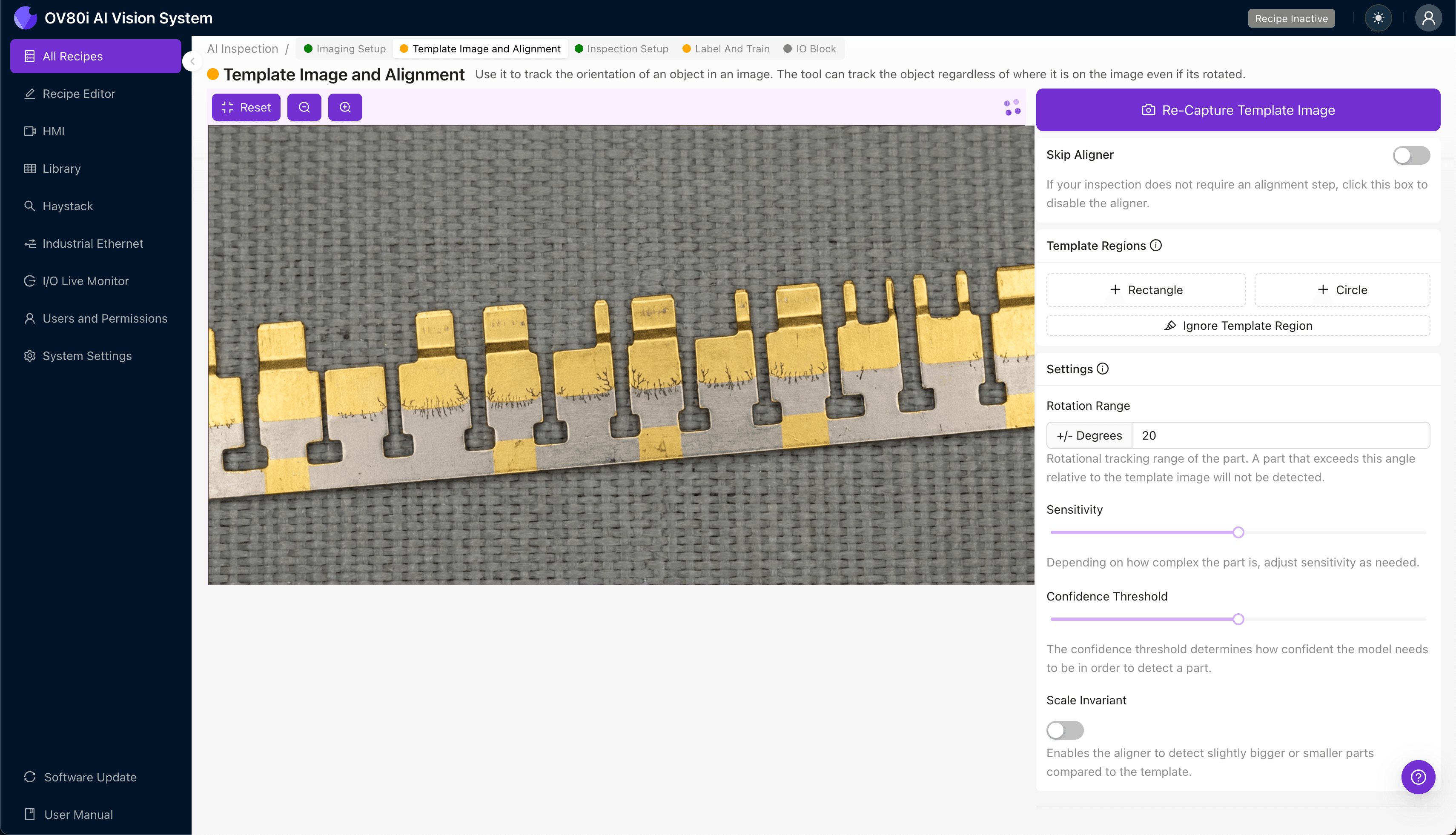
Navigate to the "Template Image" tab in the configuration menu. Capture a Template image of a known-good terminal in the standard inspection orientation.
Click "+ Rectangle" to add an alignment region around the main terminal body. Focus this region on stable geometric features like the connector housing outline or pin shoulders. Set the "Rotation Range" to 20 degrees to accommodate minor positional variation as parts enter the inspection zone. This ensures consistent alignment regardless of how terminals arrive on the line.
Step 3: Inspection Region Selection
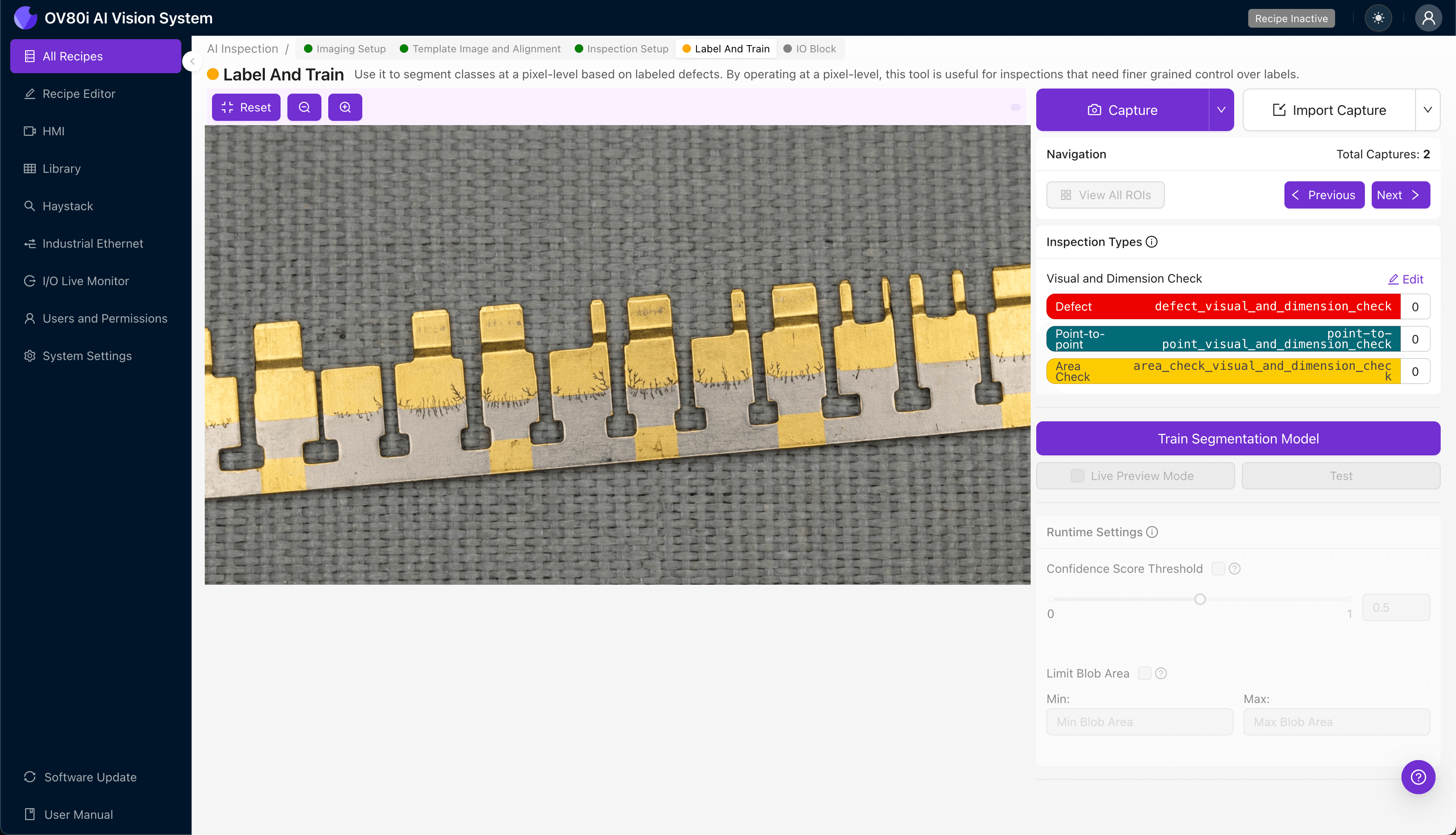
Navigate to "Inspection Setup" from the main configuration panel. Rename your "Inspection Types" to reflect the specific defects you're targeting—for example, "Nickel_Migration," "Gold_Porosity," and "Plating_Boundary."
Click "+ Add Inspection Region" to create a new detection zone. Resize the yellow bounding box to cover critical defect areas, particularly the gold-plated contact surfaces and plating transition zones where migration typically manifests. Click "Save" after defining each inspection region. Multiple regions can target different areas of the terminal geometry.
Step 4: Labeling Data
The human-in-the-loop labeling process is where your engineering expertise trains the AI model. Review captured images and classify each terminal as Good or Bad based on your quality criteria.
Include representative samples across the full range of acceptable parts—accounting for normal variation in gold color and plating appearance. Equally important: incorporate known failure modes including confirmed nickel migration samples, porous plating, and boundary defects. Aim for balanced datasets with hundreds of examples in each category. The model learns from this diversity, building robust detection capabilities that generalize to production conditions.

Step 5: Creating Rules
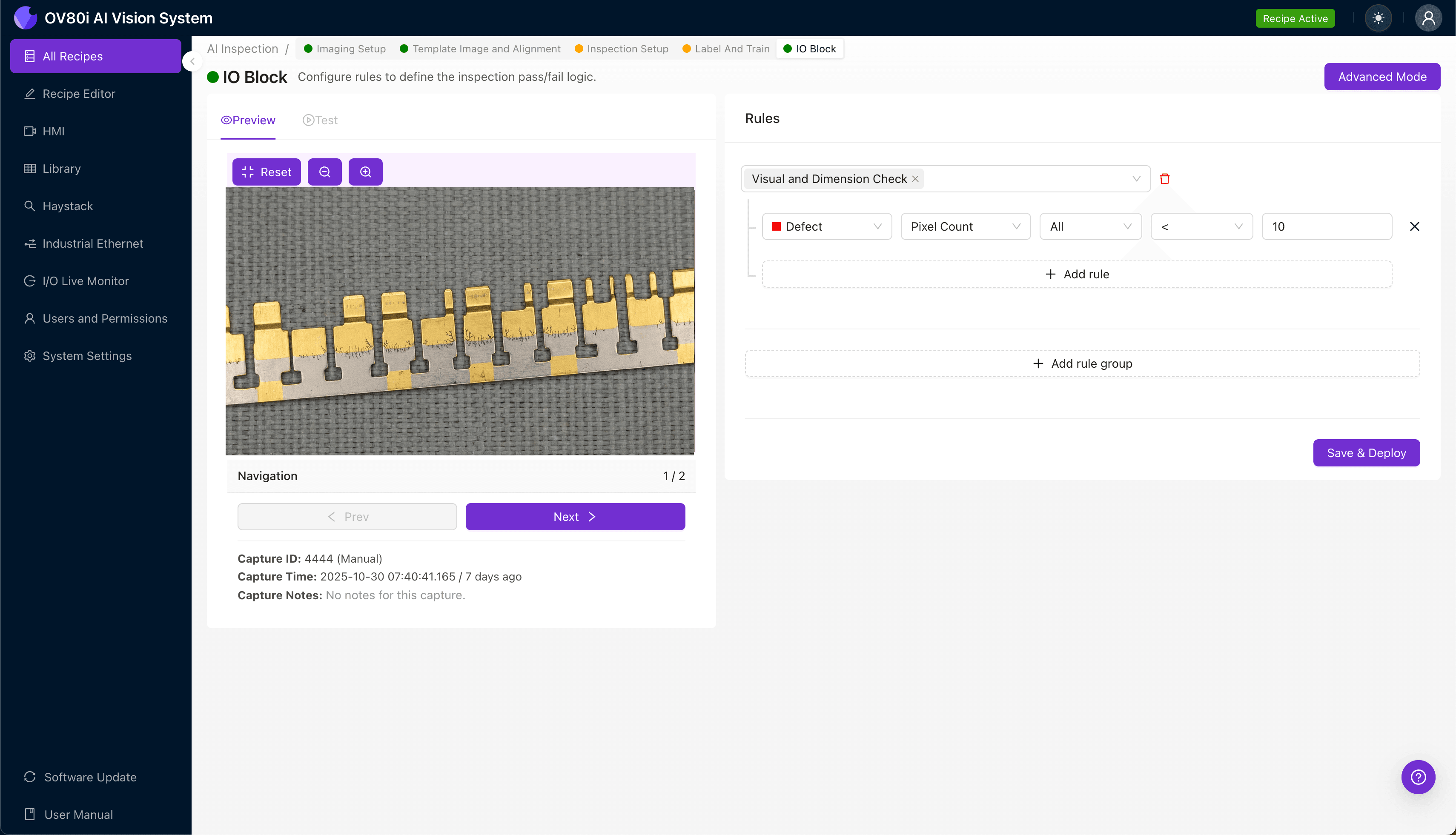
With your trained model deployed, navigate to the rules engine to set pass/fail logic based on your defined Inspection Types. Configure confidence thresholds that balance escape rate against false rejection rate.
Gate automated acceptance on the line by connecting inspection results to your reject mechanism or sorting system. Terminals flagged for nickel migration defects are automatically diverted before reaching downstream assembly or final packaging.
Key Outcomes & ROI
Implementing automated visual inspection for selective gold-plated terminals delivers measurable business impact:
- Reduced scrap rates — catch migration defects before terminals are assembled into expensive connector housings
- Higher throughput — eliminate manual inspection bottlenecks while achieving 100% coverage
- Compliance and traceability — maintain complete inspection records for automotive (IATF 16949) and aerospace (AS9100) quality requirements
- Process improvement insights — trend data reveals upstream plating process drift before it causes widespread quality escapes
Conclusion
Nickel underplate migration represents one of the most challenging defect types in terminal manufacturing—subtle, variable, and critically important for end-product reliability. Overview.ai's deep learning-powered inspection transforms this from an uncontrollable risk into a measurable, manageable quality parameter.
Ready to eliminate migration-related escapes from your plating line? Contact Overview.ai to schedule a proof-of-concept with your actual terminal samples.
Eliminate Nickel Migration Defects Today
Stop relying on manual inspection for subtle plating defects. Deploy Overview.ai to catch nickel migration instantly at line speed.