Ground Fence with Broken Continuity at the Weld Point: A Complete Visual Inspection Guide
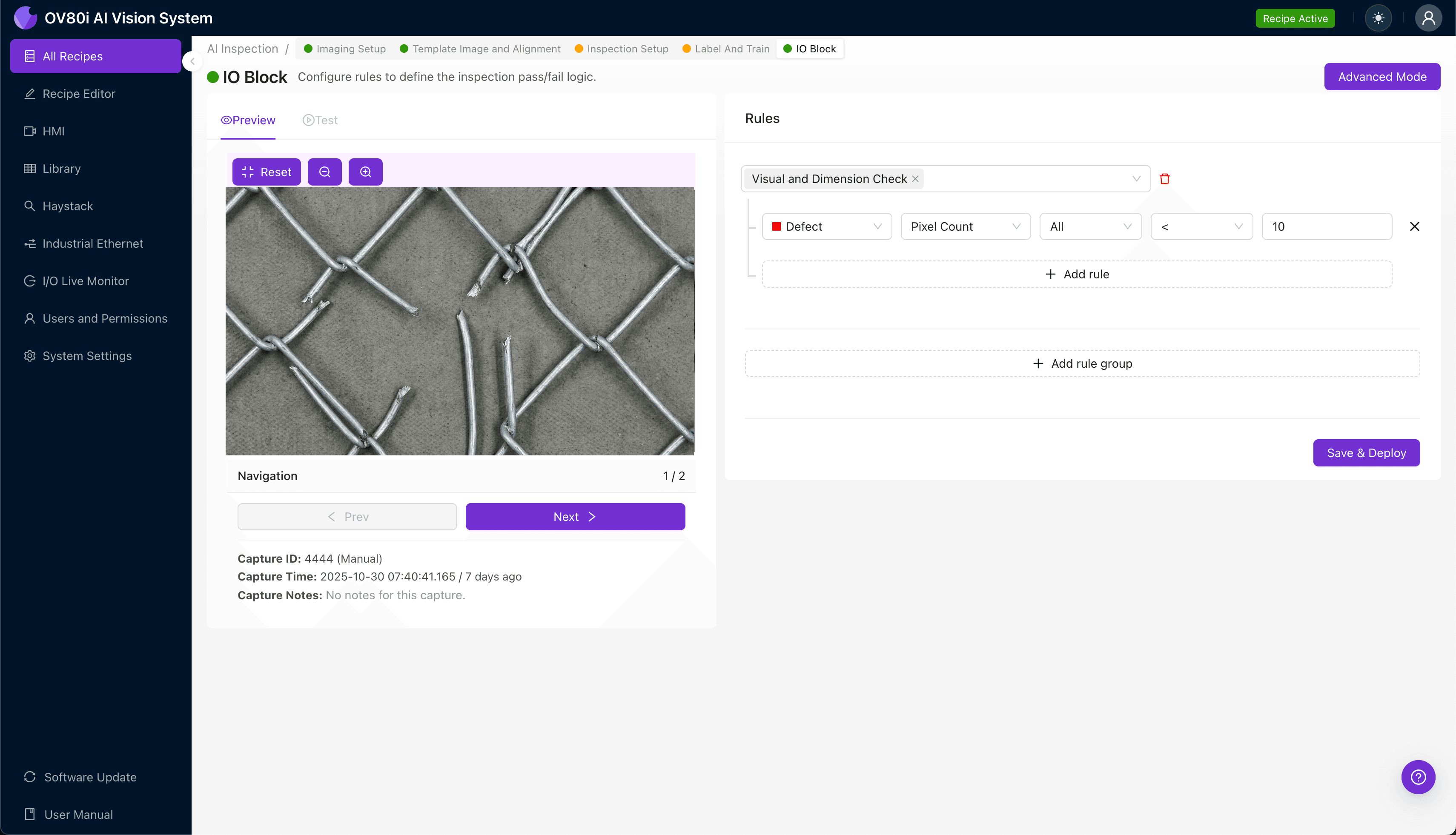
"Broken continuity at ground fence weld points creates critical safety hazards that manual inspection often misses. Overview.ai's deep learning vision system detects cold welds, porosity, cracks, and incomplete penetration at full production speed—ensuring every weld meets electrical continuity standards."
The Problem: Why Weld Continuity Failures Slip Through
Ground fences serve as critical safety components in electrical systems, providing essential fault current pathways that protect equipment and personnel. When continuity breaks occur at weld points, the consequences range from equipment damage to serious safety hazards.
Common Defects Found at Ground Fence Weld Points
- Cold welds – Insufficient fusion between the fence wire and grounding terminal due to inadequate heat input
- Porosity clusters – Gas pockets trapped within the weld bead that create high-resistance pathways
- Incomplete penetration – Weld metal failing to fully fuse through the joint thickness
- Burn-through damage – Excessive heat causing holes or material loss at thin fence wire sections
- Spatter contamination – Metal droplets creating surface irregularities that mask underlying discontinuities
- Crack propagation – Micro-fractures originating from the heat-affected zone that compromise electrical contact
Manual inspection of these defects is notoriously unreliable. Human inspectors experience fatigue-induced errors during repetitive evaluation, and subtle continuity-affecting flaws like micro-porosity or hairline cracks are nearly invisible to the naked eye at production speeds.
The Solution: Machine Vision and Deep Learning
Machine vision systems equipped with deep learning algorithms excel at detecting the subtle visual signatures that indicate weld continuity failures. Unlike rule-based systems that rely on simple threshold measurements, AI models learn the complex visual patterns associated with both acceptable welds and failure modes.
Overview.ai's approach delivers consistent, objective inspection at full line speed—examining every single ground fence weld point without the variability inherent in human judgment. The system never tires, never loses focus, and applies identical scrutiny to part number one and part number ten thousand.
Step 1: Imaging Setup
Position the ground fence assembly under the OV80i camera, ensuring the weld point is centered in the field of view. Proper lighting angle is critical for revealing surface irregularities and weld bead geometry.
Click "Configure Imaging" to access the Camera Settings panel. Adjust exposure time to capture weld detail without overexposing reflective metal surfaces, and fine-tune gain settings to optimize contrast in the heat-affected zone.
Click "Save" to lock in your imaging configuration.
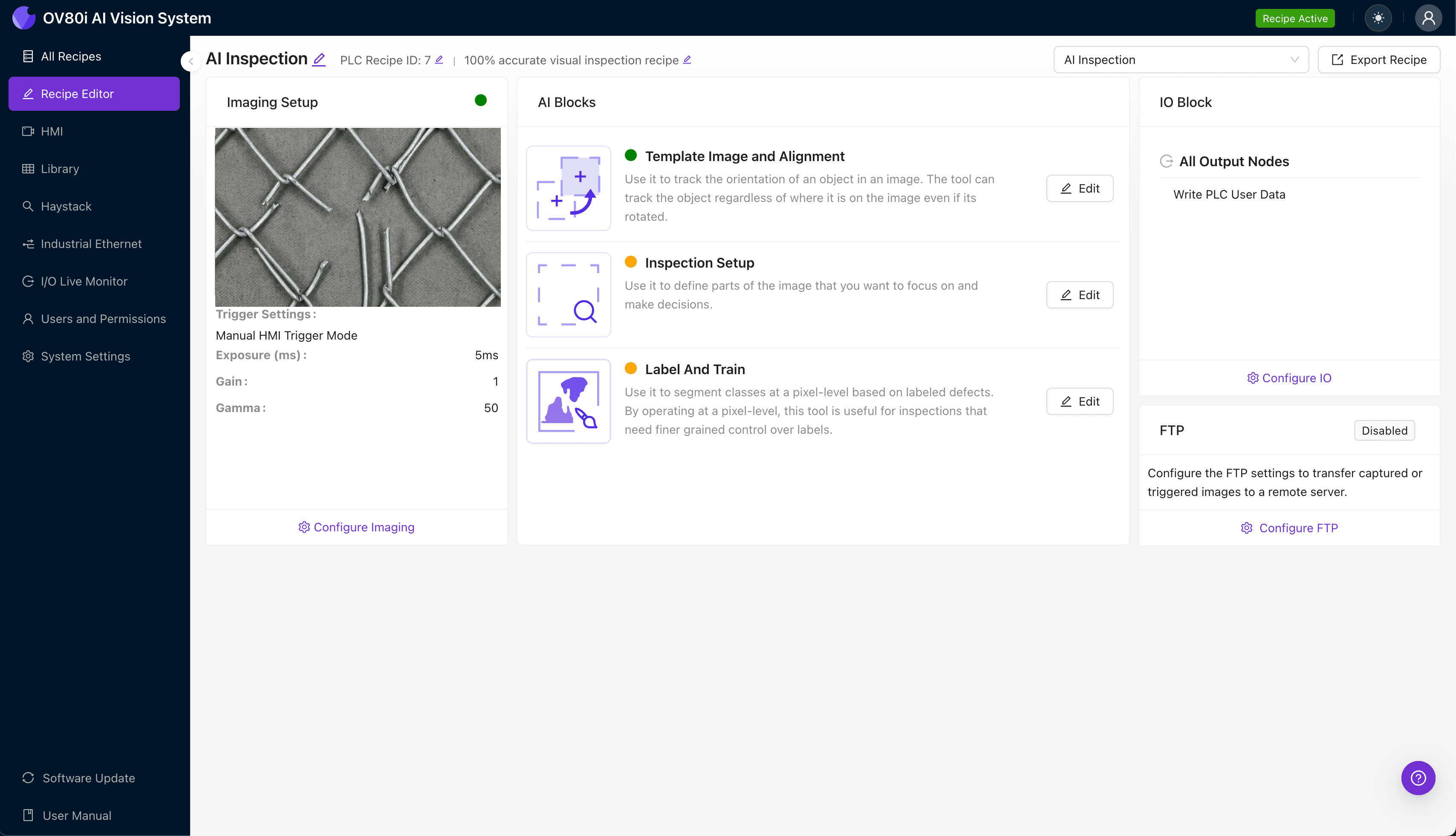
Step 2: Image Alignment
Navigate to the "Template Image" section and capture a reference image of a properly positioned ground fence assembly. This template establishes the baseline orientation for all subsequent inspections.
Click "+ Rectangle" to add an alignment region around the main fence body and terminal connection area. Set the "Rotation Range" to 20 degrees to accommodate normal variation in part placement on the line.

Step 3: Inspection Region Selection
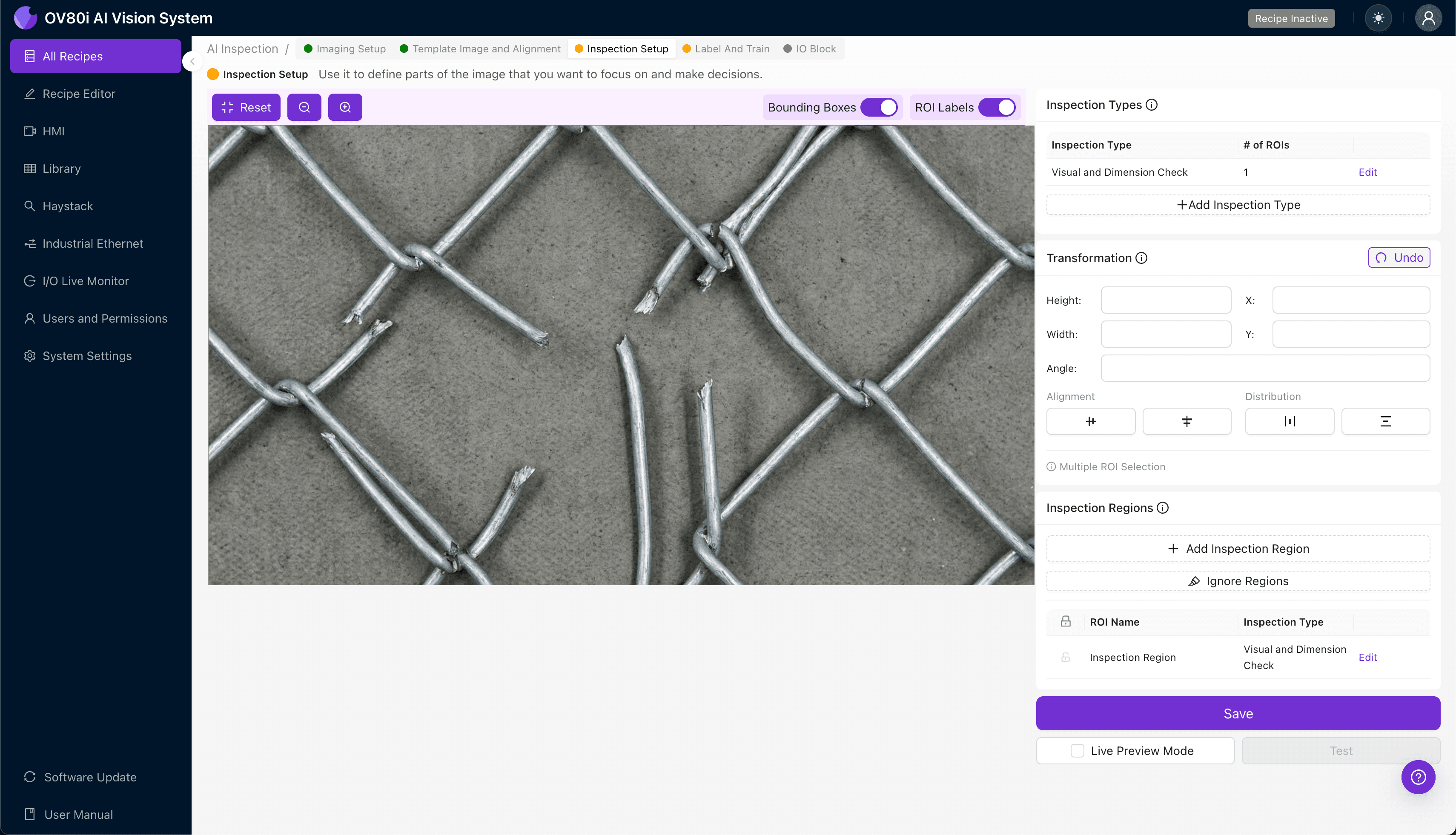
Navigate to "Inspection Setup" from the main configuration menu. Rename your "Inspection Types" to reflect the specific defect categories—for example, "Weld_Continuity" and "Surface_Integrity."
Click "+ Add Inspection Region" to define your area of interest. Resize the yellow bounding box to cover the weld junction, heat-affected zone, and immediate surrounding material where defects typically manifest.
Click "Save" to confirm your inspection regions.
Step 4: Labeling Data
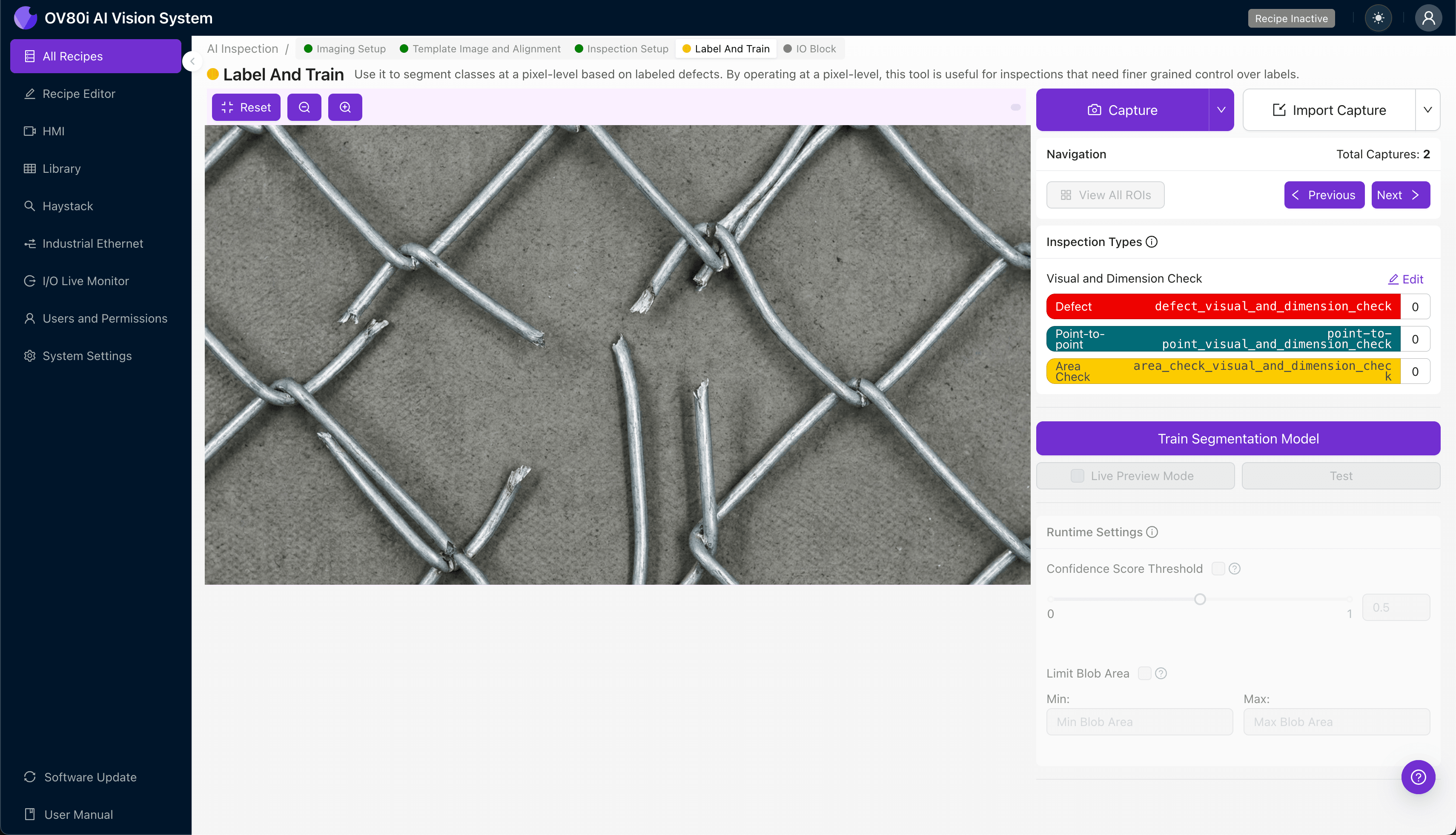
The human-in-the-loop labeling process is where your manufacturing expertise trains the AI model. Review captured images and classify each weld point as Good or Bad based on your quality standards.
Include representative samples across the full spectrum of acceptable variation in your Good dataset. Equally important: ensure your Bad dataset contains examples of every known failure mode, including edge cases and subtle defects that have historically escaped detection.
Step 5: Creating Rules
Configure your pass/fail logic based on the Inspection Types you defined earlier. Set confidence thresholds that balance false rejection rates against the risk of shipping defective ground fences.
Gate automated acceptance on the line by connecting inspection results to your reject mechanism or sorting system. Parts failing the weld continuity check are automatically diverted for rework or scrap disposition.
Key Outcomes & ROI
Implementing automated visual inspection for ground fence weld points delivers measurable business impact:
- Reduced scrap rates – Catch defects earlier in the process before additional value-add operations
- Higher throughput – Eliminate inspection bottlenecks with 100% inline evaluation at production speed
- Compliance and traceability – Maintain complete inspection records with timestamped images for every part
- Process improvement insights – Identify upstream welding parameter drift through defect trend analysis
Conclusion
Broken continuity at ground fence weld points represents a critical quality and safety concern that demands reliable detection. Overview.ai's visual inspection platform transforms this challenge into a solved problem—delivering the consistency, speed, and accuracy that manual inspection simply cannot match.
Eliminate Defects Today
Stop relying on manual inspection. Deploy Overview.ai to catch defects instantly.