High-Speed Wafer with a Shorted Signal-to-Ground Path: A Complete Visual Inspection Walkthrough
"Signal-to-ground shorts in high-speed wafers can render entire lots unusable if not detected early. AI-powered visual inspection delivers 100% coverage with consistent accuracy, catching metallic bridging and contamination that human inspectors miss."
The Problem: Detecting Shorted Signal-to-Ground Paths in High-Speed Wafers
Signal-to-ground shorts represent one of the most critical failure modes in semiconductor fabrication. These defects can render entire wafer lots unusable if not caught early in the production process.
Common Defects Associated with Signal-to-Ground Shorts:
- Metallic bridging — Excess conductive material connecting signal traces to ground planes
- Via overfill contamination — Copper or tungsten overflow creating unintended electrical pathways
- Dielectric breakdown — Insulation layer failures allowing current leakage between layers
- Particle contamination — Conductive debris deposited during lithography or etching processes
- Misaligned interconnects — Patterning errors causing trace overlap with ground structures
- Electromigration damage — Metal ion movement creating whisker formations that bridge connections
Manual inspection of these microscopic defects is fundamentally unreliable. Human inspectors experience fatigue after just 20-30 minutes of microscope work, leading to inconsistent detection rates that can drop below 60% by shift's end. The sheer volume of inspection points—often thousands per wafer—makes 100% human inspection economically impossible at production speeds.
The Solution: AI-Powered Visual Inspection
Machine vision systems equipped with deep learning algorithms transform wafer inspection from a statistical sampling exercise into true 100% coverage. These systems never tire, never lose focus, and apply identical inspection criteria to every single wafer.
Deep learning models excel at detecting the subtle visual signatures of signal-to-ground shorts—including faint bridging patterns and early-stage contamination that escape human detection. The AI continuously improves as it processes more production data.
Overview.ai's approach delivers consistent, objective, at-line-speed inspection that integrates seamlessly into existing fab workflows. The OV80i system captures high-resolution imagery and processes it in real-time, flagging defective wafers before they advance to subsequent process steps.
Step 1: Imaging Setup
Position the high-speed wafer with the suspected shorted signal-to-ground path directly under the inspection camera. Ensure the wafer is seated flat and stable in the fixture to prevent image distortion.
Click "Configure Imaging" in the Overview.ai interface to access the Camera Settings panel. Adjust the exposure to reveal subtle metallic bridging without overexposing reflective surfaces, and fine-tune the gain to optimize signal-to-noise ratio for detecting faint contamination particles.
Click "Save" to lock in your imaging parameters for this inspection recipe.
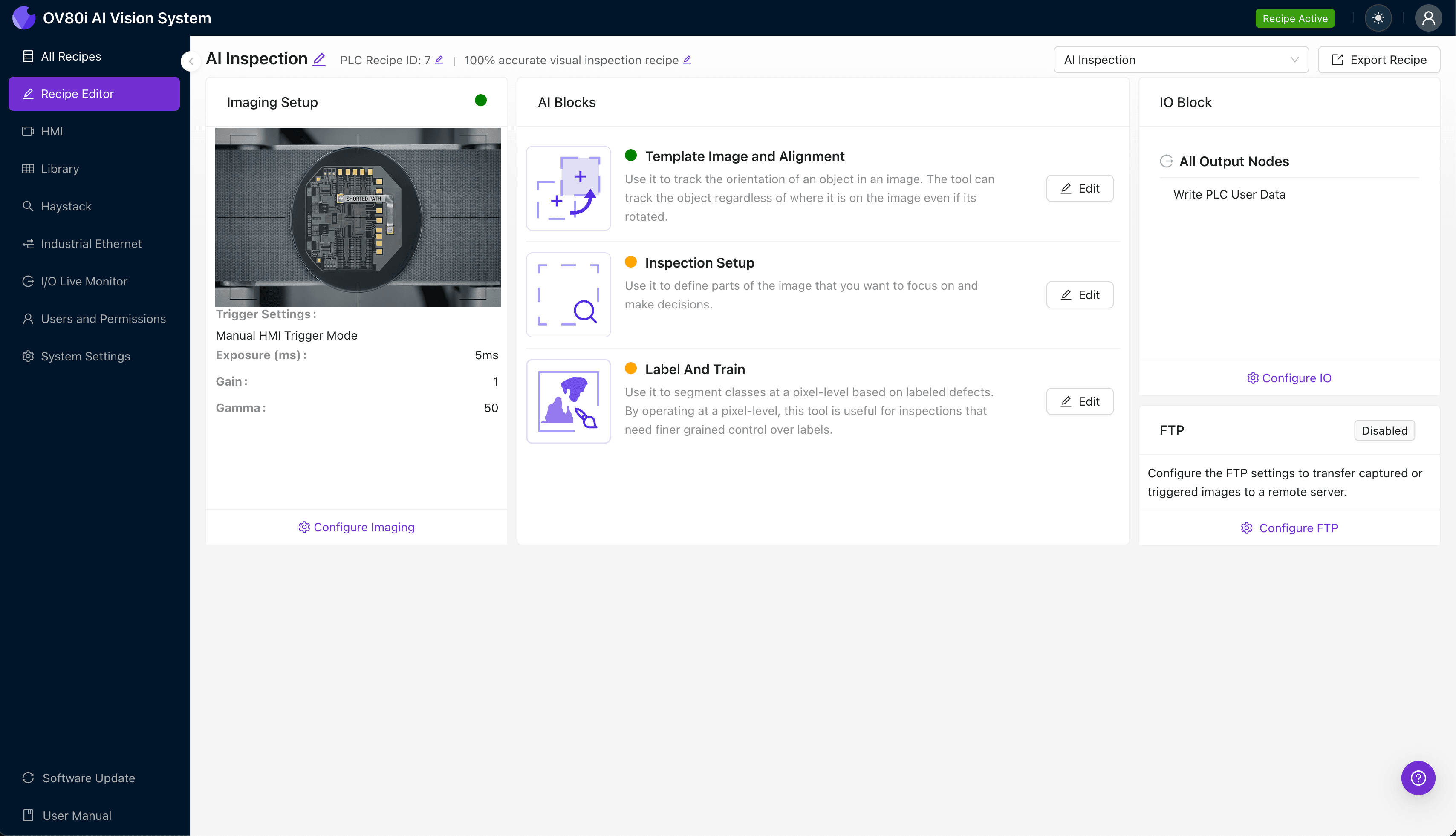
Step 2: Image Alignment
Navigate to the "Template Image" tab within the configuration menu. Capture a Template image of a known-good wafer that will serve as your alignment reference for all subsequent inspections.
Click "+ Rectangle" to add an alignment region around the main body of the wafer's die pattern. This region should encompass distinctive features like fiducial marks or corner structures that remain consistent across all wafers.
Set the "Rotation Range" to 20 degrees to accommodate minor orientation variations during wafer loading. This tolerance ensures reliable alignment without sacrificing inspection accuracy.

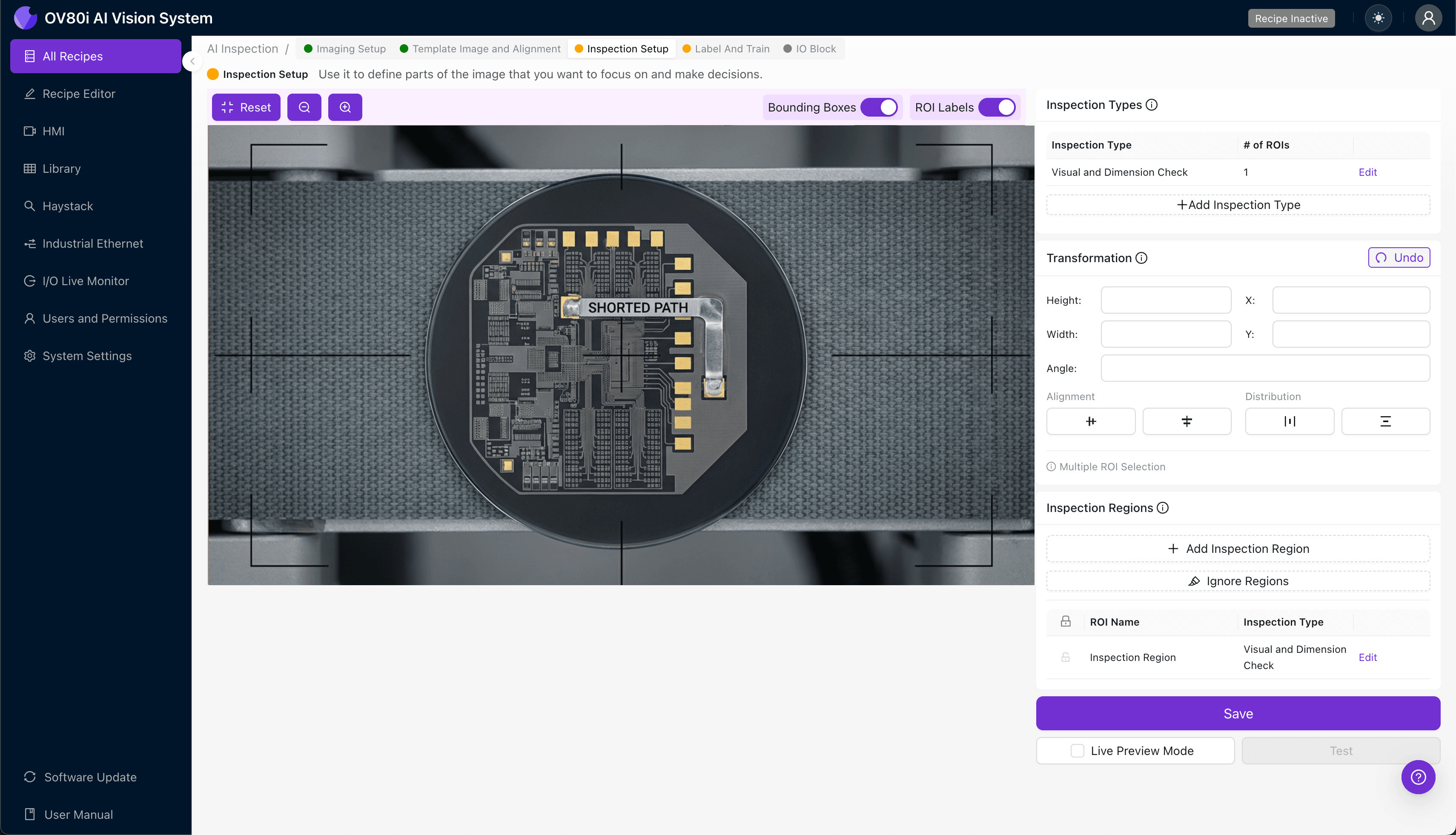
Step 3: Inspection Region Selection
Navigate to "Inspection Setup" to define where the system should look for defects. This step focuses the AI's attention on the areas most susceptible to signal-to-ground shorts.
Rename your "Inspection Types" with descriptive labels such as "Signal_Trace_Bridging," "Via_Contamination," and "Interconnect_Alignment." Clear naming conventions simplify recipe management and defect reporting.
Click "+ Add Inspection Region" to create your first detection zone. Resize the yellow bounding box to cover critical defect areas—particularly the signal traces running adjacent to ground planes and the via structures connecting metal layers.
Click "Save" after positioning all inspection regions.
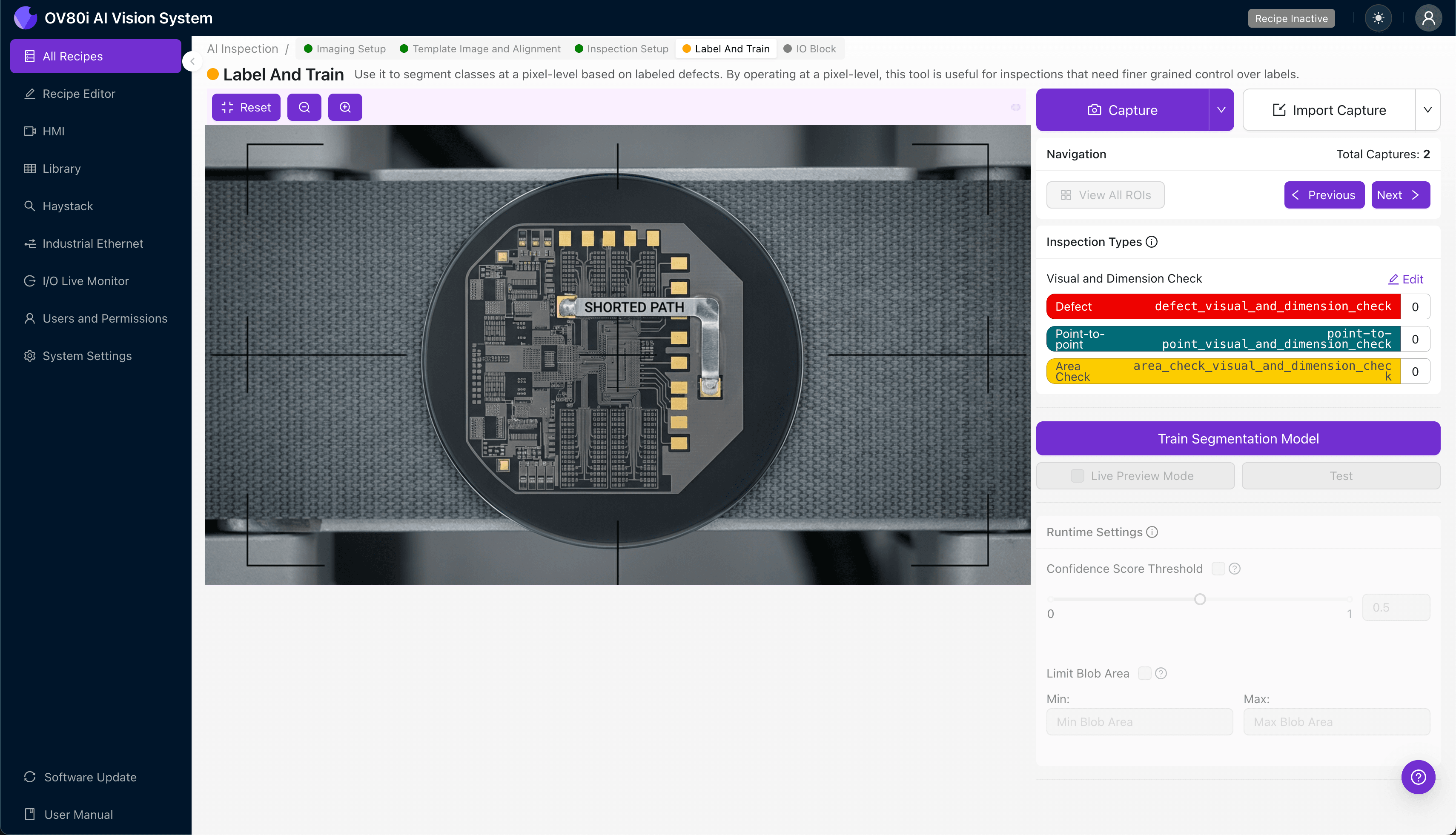
Step 4: Labeling Data
The human-in-the-loop labeling process trains the deep learning model to recognize your specific defect types. This step leverages your engineering team's expertise to teach the AI what constitutes a failure.
Review captured wafer images and label each as Good (acceptable) or Bad (defective). For shorted signal-to-ground paths, pay particular attention to any visible bridging, contamination, or alignment issues.
Include representative samples across the full spectrum of acceptable variation, plus known failure modes from your defect library. The more diverse your labeled dataset, the more robust your inspection model becomes.
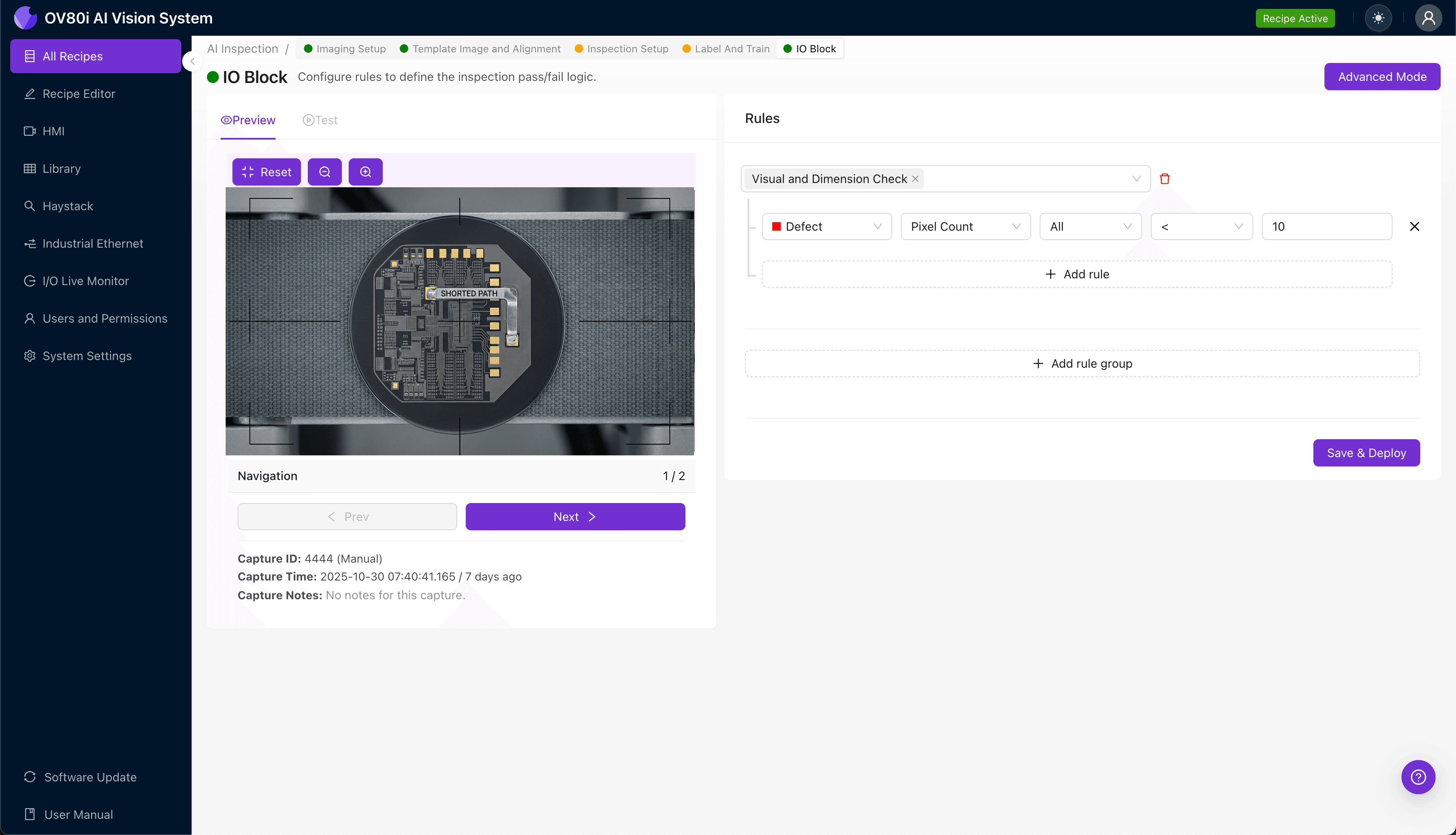
Step 5: Creating Rules
Configure your pass/fail logic based on the Inspection Types you defined earlier. For signal-to-ground shorts, you may set zero-tolerance rules for metallic bridging while allowing minor cosmetic variations that don't affect electrical performance.
Gate automated acceptance on the line by linking inspection results to your material handling system. Wafers flagged with potential shorts route automatically to secondary verification or rework stations, while passing wafers advance to the next process step without delay.
Key Outcomes & ROI
Implementing AI-powered inspection for high-speed wafer signal-to-ground shorts delivers measurable business impact:
- Reduced scrap rates — Catch defects earlier in the process before additional value-add steps multiply losses
- Higher throughput — Eliminate inspection bottlenecks with real-time, at-line-speed detection
- Enhanced compliance and traceability — Generate comprehensive inspection records for every wafer, supporting automotive and aerospace quality standards
- Process improvement insights — Analyze defect trend data to identify upstream process drift before it causes yield excursions
Eliminate Signal-to-Ground Defects Today
Stop relying on manual inspection. Deploy Overview.ai to catch wafer defects instantly with 100% coverage.