How to Detect Moisture-Induced Blistering in LCP Connector Bodies Using AI-Powered Visual Inspection
"Moisture-induced blistering in LCP connectors causes catastrophic failures during reflow soldering, yet these defects are nearly invisible to human inspectors. AI-powered visual inspection detects subtle surface blisters, delamination, and micro-cracking at full production speed—eliminating moisture-damaged components before they reach downstream assembly."
The Problem: Why Moisture-Induced Blistering Threatens LCP Connector Quality
Liquid Crystal Polymer (LCP) connectors are prized for their exceptional dimensional stability and high-temperature performance in automotive, telecommunications, and consumer electronics applications. However, moisture absorption during storage or processing can cause catastrophic blistering defects when these components encounter reflow soldering temperatures.
Common Defects Associated with Moisture-Induced Blistering in LCP Connectors:
- Surface blisters and bubbles – Raised dome-shaped deformations on the connector housing caused by trapped moisture vaporizing during thermal exposure
- Delamination at weld lines – Separation of material layers at injection molding knit lines where moisture weakens polymer bonding
- Micro-cracking around pin cavities – Fine fractures radiating from terminal insertion points due to steam pressure buildup
- Whitening or hazing – Localized discoloration indicating subsurface voiding and material degradation
- Warpage and dimensional distortion – Geometric deformation resulting from uneven moisture distribution and thermal stress
- Crater-like surface pitting – Collapsed blister sites leaving permanent surface defects after cooling
Manual inspection of these defects is notoriously unreliable. Human inspectors experience fatigue-induced accuracy drops after just 20-30 minutes of repetitive visual screening, and subtle early-stage blistering is nearly invisible under standard lighting conditions. The speed requirements of modern connector manufacturing—often exceeding 1,000 parts per hour—make consistent human evaluation physically impossible.
The Solution: Machine Vision + Deep Learning for Consistent Detection
Traditional rule-based machine vision systems struggle with moisture-induced blistering because the defects vary significantly in size, shape, and location. Deep learning changes the game by training neural networks to recognize the subtle visual patterns associated with blistering—even when those patterns don't follow predictable rules.
AI-powered inspection learns from examples rather than explicit programming, enabling detection of defects that would require thousands of hand-coded rules to capture conventionally.
Overview.ai's approach delivers consistent, objective inspection at full line speed. The OV80i system evaluates every single connector with the same vigilance—no breaks, no fatigue, no subjective interpretation—ensuring that moisture-damaged components never reach downstream assembly or end customers.
Step 1: Imaging Setup
Position the LCP connector body under the OV80i camera, ensuring the primary inspection surfaces (top housing, side walls, and pin cavity areas) are visible. Proper lighting is critical for detecting subtle surface blistering—angled illumination often reveals topographical defects that flat lighting misses.
Click "Configure Imaging" in the Overview interface and adjust Camera Settings. Fine-tune exposure to capture surface detail without overexposing reflective areas, and set gain to minimize noise while maintaining sensitivity to subtle texture variations.
Click "Save" to lock in your optimized imaging parameters.

Step 2: Image Alignment
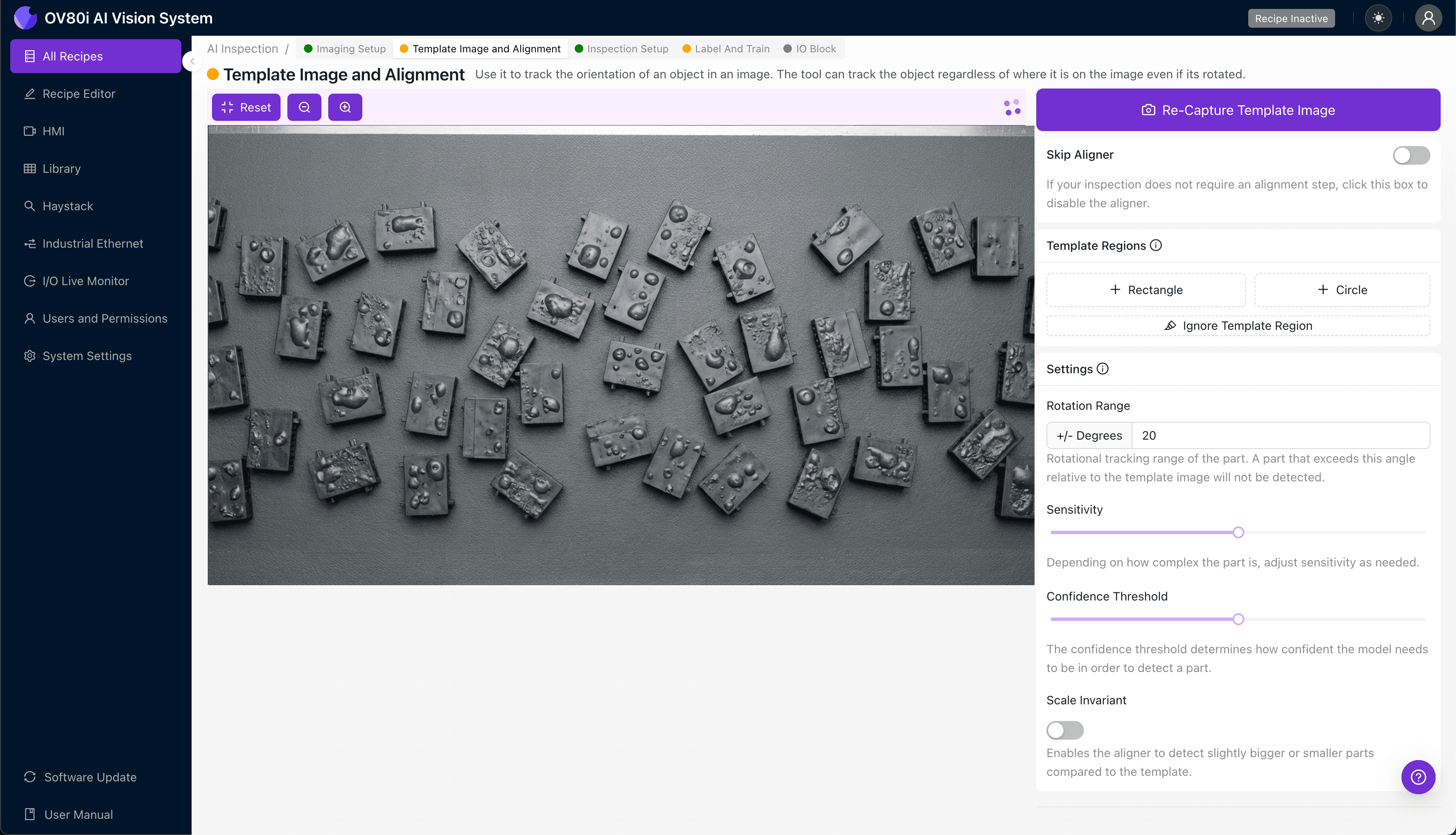
Navigate to "Template Image" and capture a reference image of a known-good connector in the standard inspection orientation. This template enables the system to locate and align each part consistently, regardless of minor positional variation on the conveyor.
Click "+ Rectangle" to add an alignment region around the main connector body outline. Set "Rotation Range" to 20 degrees to accommodate typical part presentation variability while maintaining robust alignment.
Step 3: Inspection Region Selection
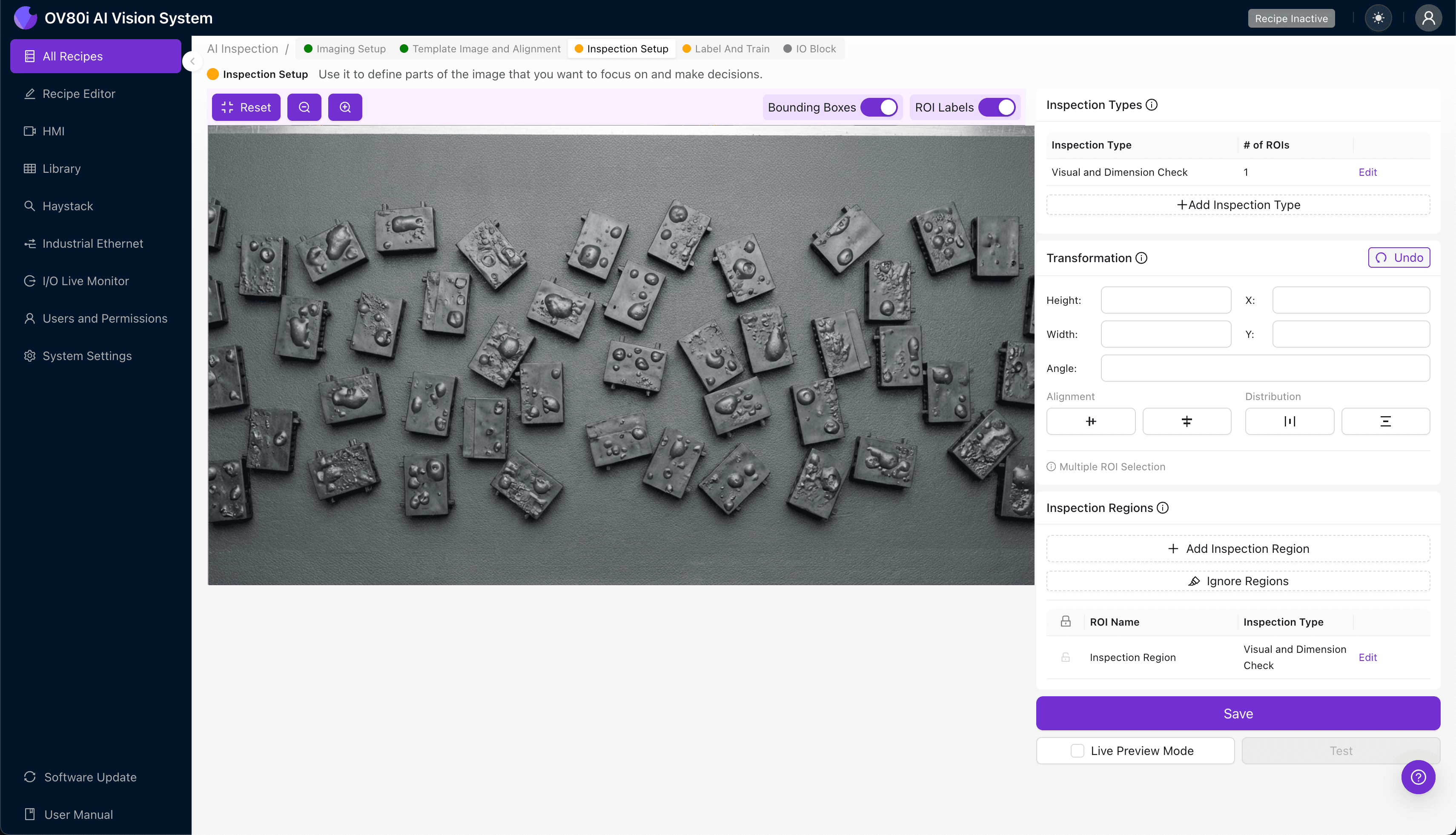
Navigate to "Inspection Setup" to define where the AI should focus its analysis. Rename your "Inspection Types" to reflect the specific defect categories—for example, "Surface Blistering," "Weld Line Delamination," and "Pin Cavity Cracking."
Click "+ Add Inspection Region" for each critical area. Resize the yellow bounding box to cover the top housing surface where blistering typically manifests, the weld line zones along the connector sides, and the pin cavity perimeters where micro-cracking originates.
Click "Save" to confirm your inspection regions.
Step 4: Labeling Data
The human-in-the-loop labeling process is where your manufacturing expertise trains the AI. Review captured images and label each as "Good" or "Bad" based on your quality standards.
Include representative samples across the full spectrum of acceptable parts and known failure modes. The more examples of subtle early-stage blistering, severe delamination, and borderline cases you provide, the more robust your trained model will become.
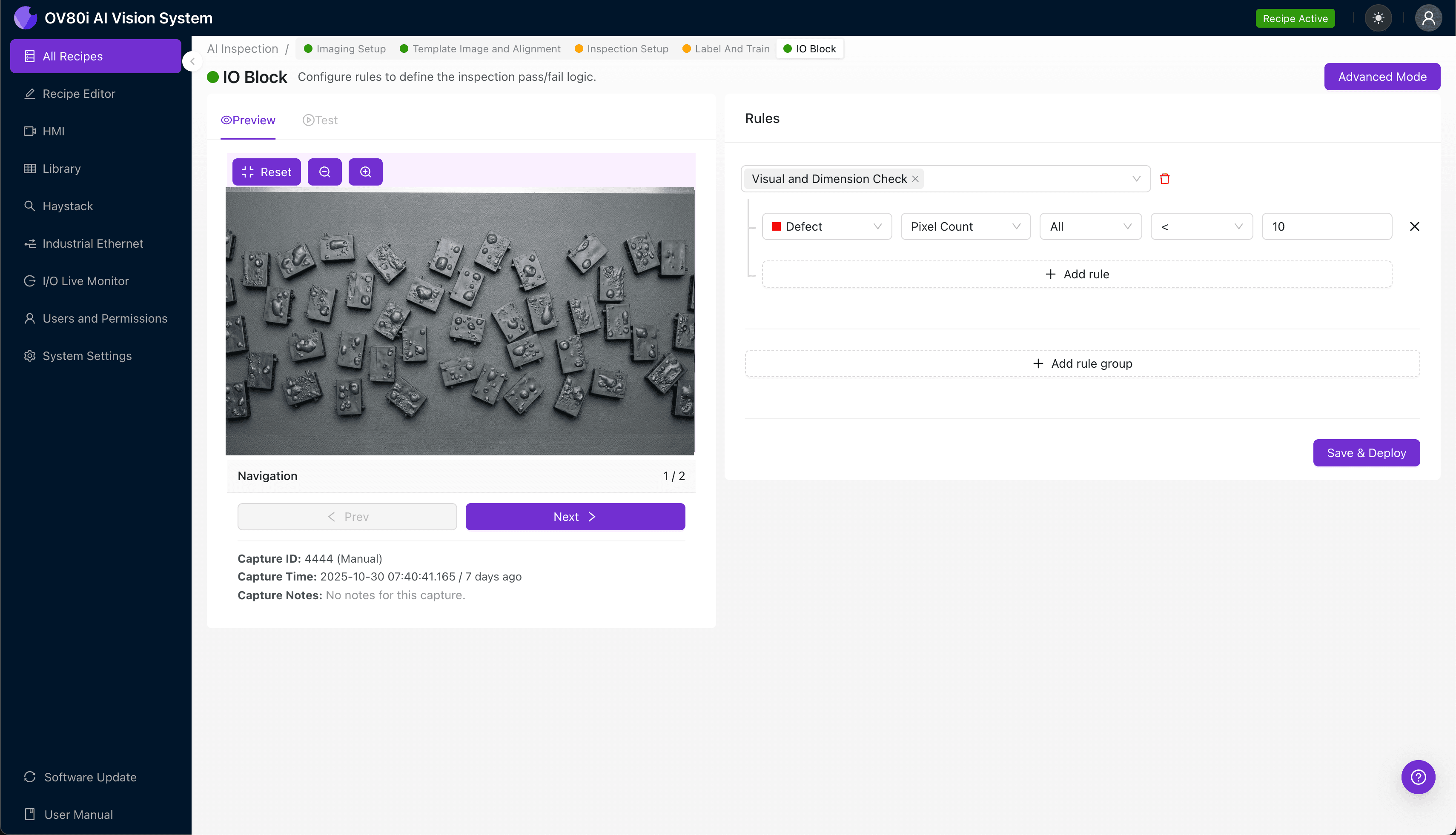
Step 5: Creating Rules
With your trained model ready, set pass/fail logic based on your defined Inspection Types. You might configure the system to reject any part with detected surface blistering while flagging minor weld line anomalies for secondary review.
These rules gate automated acceptance on the line, enabling real-time sorting of conforming versus non-conforming connectors without manual intervention.

Key Outcomes & ROI
Implementing AI-powered inspection for moisture-induced blistering delivers measurable business impact:
- Reduced scrap and rework costs – Catch moisture-damaged components before they consume downstream assembly labor and materials
- Higher throughput with 100% inspection – Eliminate the inspection bottleneck while actually increasing coverage from sampling to every single part
- Enhanced compliance and traceability – Automatically log inspection images and results for customer audits, IATF 16949 requirements, and root cause investigations
- Process improvement insights – Identify moisture exposure patterns by shift, lot, or material batch to address upstream storage and handling issues
Conclusion
Moisture-induced blistering in LCP connectors represents exactly the type of defect that benefits most from AI-powered visual inspection—variable in presentation, subtle in early stages, and critical to catch before field failure.
Overview.ai's deep learning approach transforms this inspection challenge into a solved problem, delivering the consistency and speed that modern connector manufacturing demands.
Eliminate Moisture-Related Escapes Today
Stop relying on manual inspection for LCP connector quality. Deploy Overview.ai to catch blistering defects instantly at full line speed.