Micro-Strip Launch with Excessive Dielectric Overhang: A Complete Visual Inspection Guide
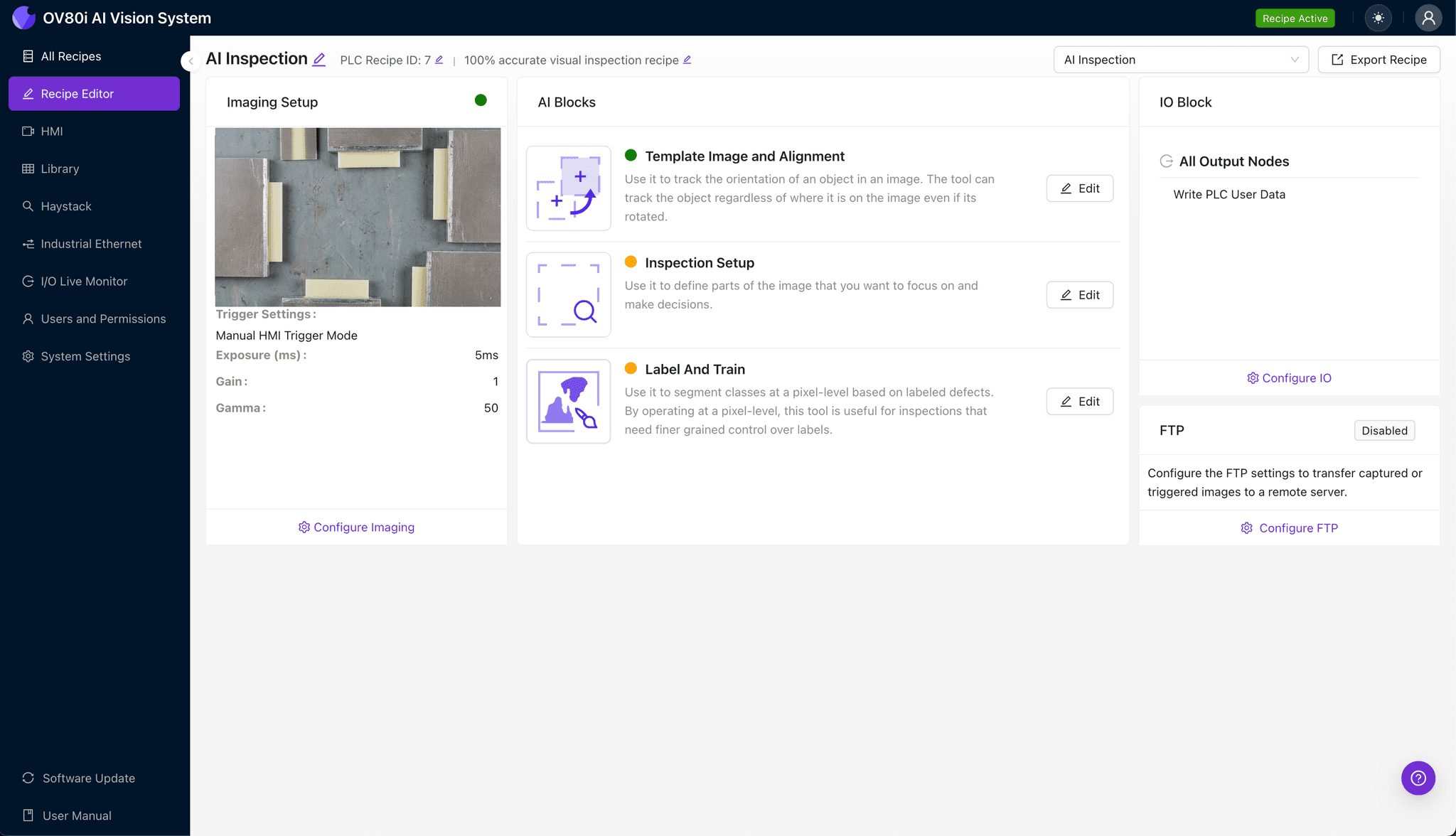
"Excessive dielectric overhang on micro-strip launches creates impedance discontinuities that compromise RF signal integrity. Overview.ai's deep learning platform detects sub-millimeter overhang variations with consistent accuracy, eliminating the fatigue and subjectivity that plague manual inspection."
The Problem: Why Traditional Inspection Falls Short
Micro-strip launches are critical RF interconnect components where precise dimensional tolerances directly impact signal integrity and impedance matching. When dielectric overhang exceeds specifications, it creates impedance discontinuities that compromise high-frequency performance across entire PCB assemblies.
Common Defects Associated with Excessive Dielectric Overhang:
- Impedance mismatch zones — Uncontrolled dielectric extension alters the characteristic impedance at the transition point
- Signal reflection artifacts — Overhang creates parasitic capacitance causing return loss degradation
- Delamination initiation sites — Extended dielectric edges become stress concentration points prone to separation
- Solder joint interference — Excess material impedes proper solder flow to ground plane connections
- Connector mating failures — Dimensional non-conformance prevents secure mechanical interface with mating connectors
- Thermal expansion cracking — Unsupported dielectric overhang experiences differential thermal stress during operation
Manual inspection of micro-strip launches demands sustained focus on sub-millimeter features under magnification—a task where human inspectors experience significant accuracy degradation after just 20-30 minutes. The subtle nature of dielectric overhang variations makes consistent pass/fail decisions nearly impossible across shifts and operators.
The Solution: Machine Vision and Deep Learning
Machine vision systems eliminate the subjectivity and fatigue factors that plague manual micro-strip launch inspection. By capturing high-resolution images and applying deep learning algorithms trained on thousands of examples, these systems detect overhang variations that fall well below human visual acuity thresholds.
Overview.ai's approach delivers consistent, objective inspection at full production line speeds. The OV80i platform learns the precise boundaries between acceptable and defective dielectric geometry, applying that knowledge uniformly to every component—24/7, without performance degradation.
Step 1: Imaging Setup
Position the micro-strip launch assembly under the OV80i camera system, ensuring the dielectric-to-conductor transition zone is centered in the field of view. Proper lighting angle is critical for capturing the subtle shadow variations that reveal overhang conditions.
Click "Configure Imaging" to access the Camera Settings panel. Adjust exposure time to prevent highlight clipping on reflective conductor surfaces, and fine-tune gain settings to maximize contrast between the dielectric material and substrate edges.
Click "Save" to lock in your optimized imaging parameters.
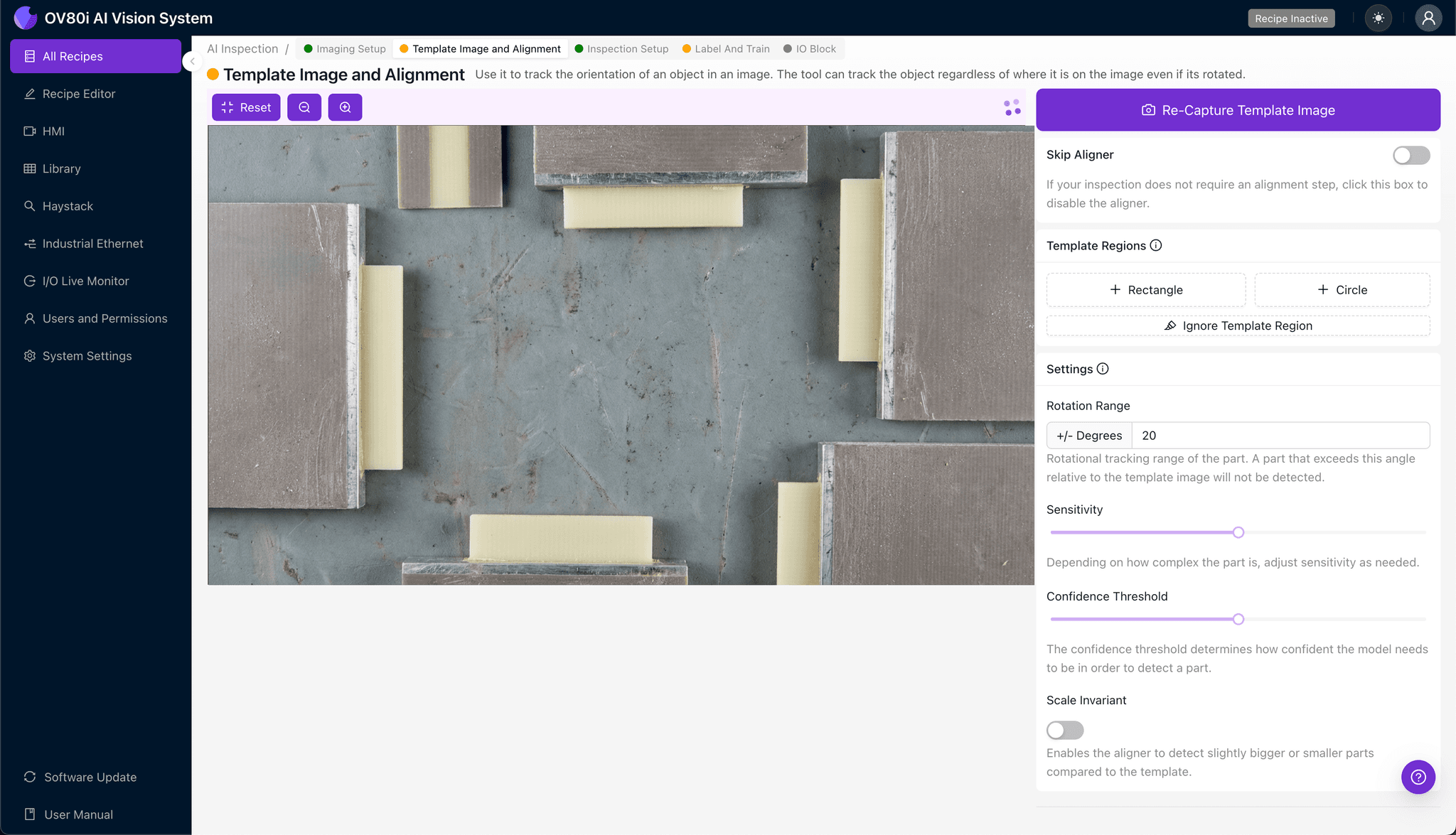
Step 2: Image Alignment
Navigate to the "Template Image" section and capture a reference image of a known-good micro-strip launch. This template establishes the baseline geometry against which all production units will be registered.
Click "+ Rectangle" to add an alignment region around the main connector body and ground plane interface. Set the "Rotation Range" to 20 degrees to accommodate normal positioning variation as components enter the inspection station.
Step 3: Inspection Region Selection
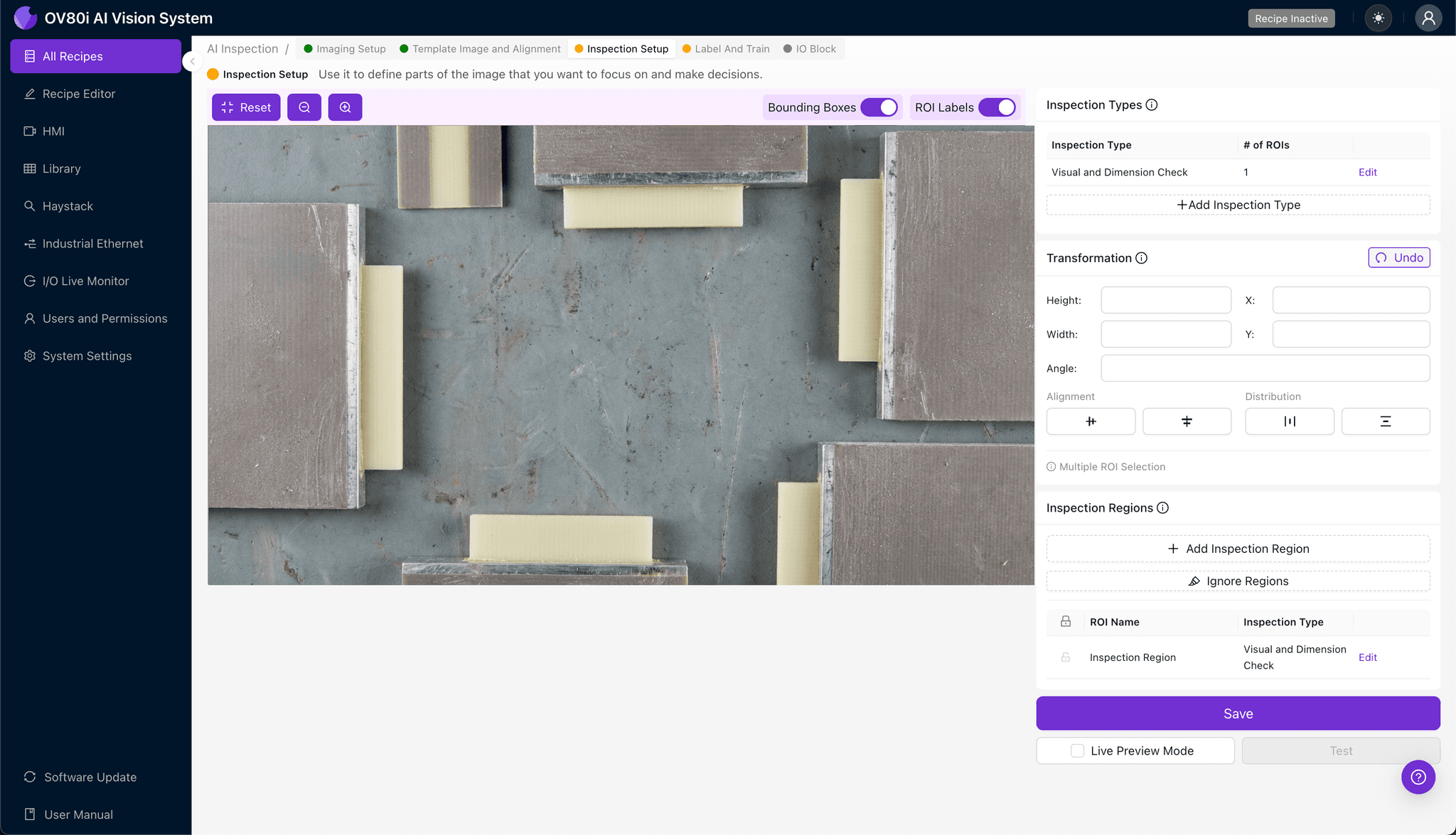
Navigate to "Inspection Setup" to define where the system should focus its analysis. Rename your "Inspection Types" to reflect the specific defect categories—such as "Dielectric_Overhang_Left" and "Dielectric_Overhang_Right."
Click "+ Add Inspection Region" to create targeted analysis zones. Resize the yellow bounding box to encompass the critical dielectric edge areas where overhang typically manifests.
Click "Save" to confirm your inspection region configuration.
Step 4: Labeling Data
The human-in-the-loop labeling process trains the deep learning model to recognize acceptable versus defective overhang conditions. Subject matter experts review captured images and classify each as Good or Bad based on established specifications.
Include representative samples across the full spectrum of production variation—borderline acceptable units, clear rejects, and known failure modes from historical quality records. This diversity ensures the model develops robust decision boundaries that generalize across real-world manufacturing conditions.
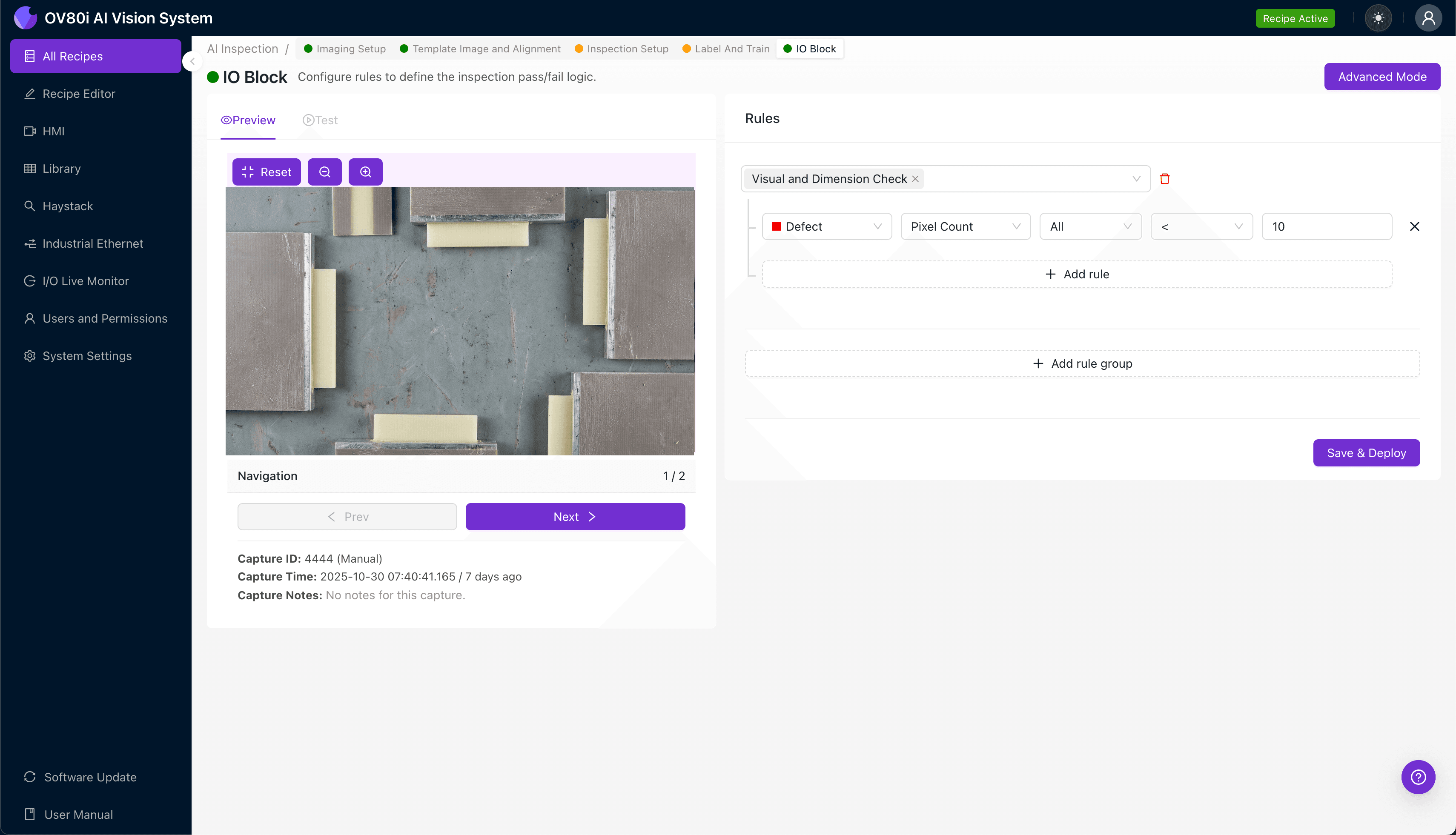
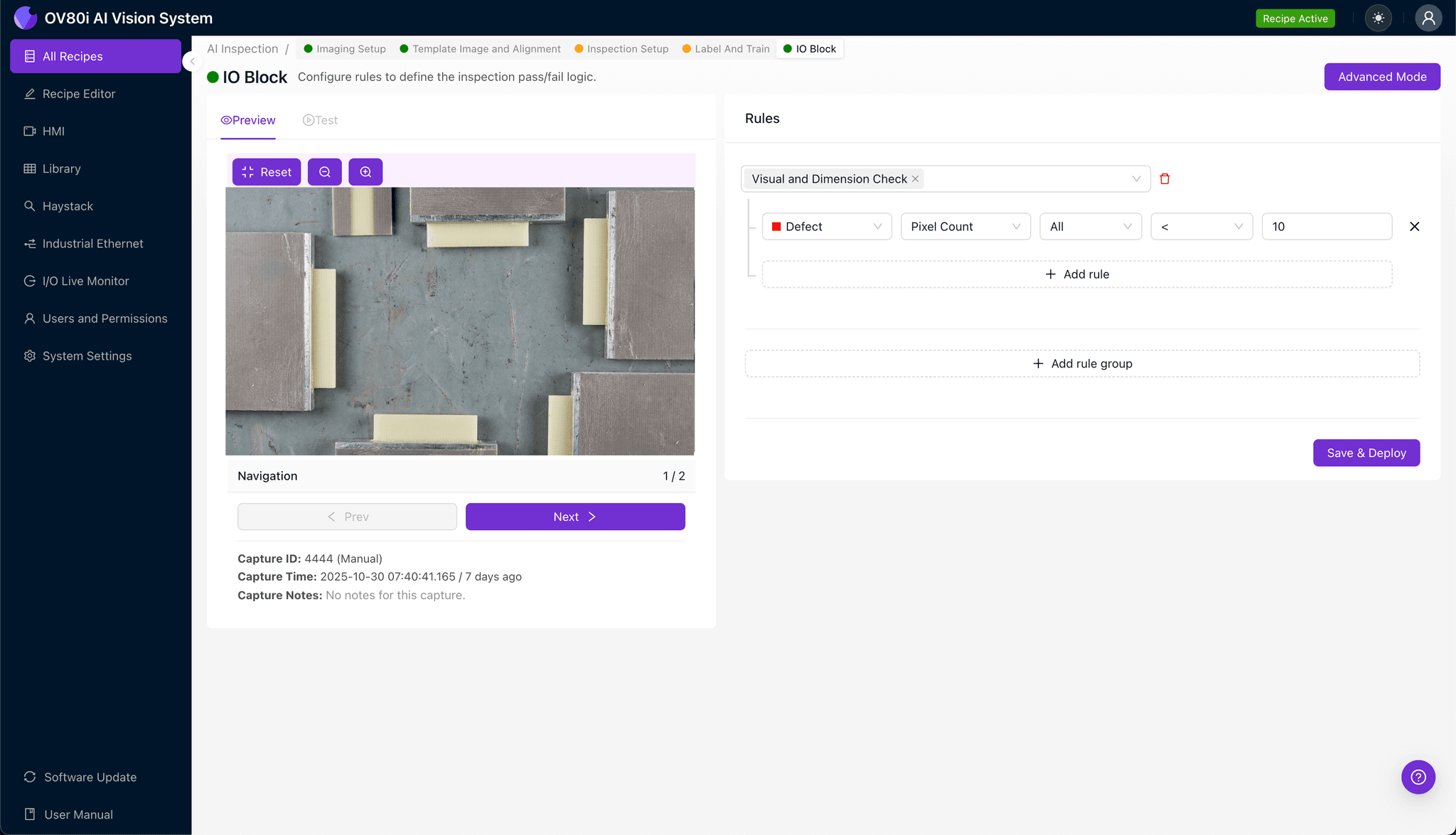
Step 5: Creating Rules
Configure pass/fail logic by setting threshold criteria for each Inspection Type you defined. The system aggregates results across all inspection regions to generate a final disposition for each micro-strip launch.
Gate automated acceptance on the production line by linking inspection outcomes to downstream handling systems. Rejected units can be automatically diverted for rework or further analysis while conforming components proceed without interruption.

Key Outcomes & ROI
Implementing automated visual inspection for micro-strip launch dielectric overhang delivers measurable business impact:
- Reduced scrap rates — Catch overhang defects before components enter higher-value assembly stages
- Higher throughput — Eliminate inspection bottlenecks with consistent at-line-speed analysis
- Enhanced compliance and traceability — Maintain complete inspection records with timestamped images for every unit
- Process improvement insights — Identify upstream manufacturing trends causing overhang variation through aggregated defect analytics
Conclusion
Excessive dielectric overhang on micro-strip launches represents exactly the type of subtle, high-consequence defect where automated visual inspection delivers maximum value. Overview.ai's deep learning platform transforms this challenging inspection task into a reliable, scalable quality gate.
Ready to eliminate micro-strip launch escapes from your production line? Contact Overview.ai to schedule a demonstration with your actual components.
Eliminate Dielectric Overhang Defects Today
Stop relying on manual inspection for critical RF components. Deploy Overview.ai to catch micro-strip launch defects instantly.