How to Detect Short-Shot Defects in Molded Insulators Using AI-Powered Visual Inspection

"Short-shot defects in molded insulators create serious safety hazards in electrical systems. AI-powered visual inspection catches every incomplete fill—consistently and at full production speed—where human inspectors struggle with subtle gradations and fatigue."
The Problem: Why Short-Shot Defects Slip Through Traditional Inspection
Molded insulators are critical components in electrical systems, providing essential protection against current leakage and arc flash events. When injection molding fails to completely fill the mold cavity—a defect known as "short-shot" or incomplete fill—the resulting insulator can catastrophically fail in the field.
Common Defects Found in Short-Shot Molded Insulators:
- Incomplete rib formation — structural ribs that fail to reach full height, compromising mechanical strength
- Missing creepage extensions — unfilled surface features that reduce electrical isolation distance
- Thin wall sections — areas where material didn't fully pack, creating weak points prone to dielectric breakdown
- Surface voids and porosity — trapped air pockets near the flow front that reduce insulation integrity
- Rounded or soft edges — features that should be sharp but show hesitation marks from cooling material
- Unfilled thread or mounting features — connection points that won't mate properly with assemblies
Human inspectors struggle with these defects because many occur in subtle gradations. Inspector fatigue sets in quickly when examining hundreds of near-identical black or translucent parts per hour, and the consistency required to catch marginal short-shots simply exceeds human visual capabilities at production speeds.
The Solution: Machine Vision + Deep Learning
Traditional machine vision systems rely on rigid, rule-based algorithms that struggle with the natural variation in molded parts. Deep learning changes this equation entirely—neural networks learn what "good" looks like from labeled examples, then generalize that understanding to catch defects they've never explicitly seen before.
This approach excels at detecting short-shots because the AI learns the complete, expected geometry of a properly filled insulator. Any deviation from that learned template triggers an alert.
Overview.ai's inspection platform delivers consistent, objective evaluation at full line speed—every single part, every single time. Unlike human inspectors who slow down or lose focus, the system maintains the same detection sensitivity on part 10,000 as it did on part 1.
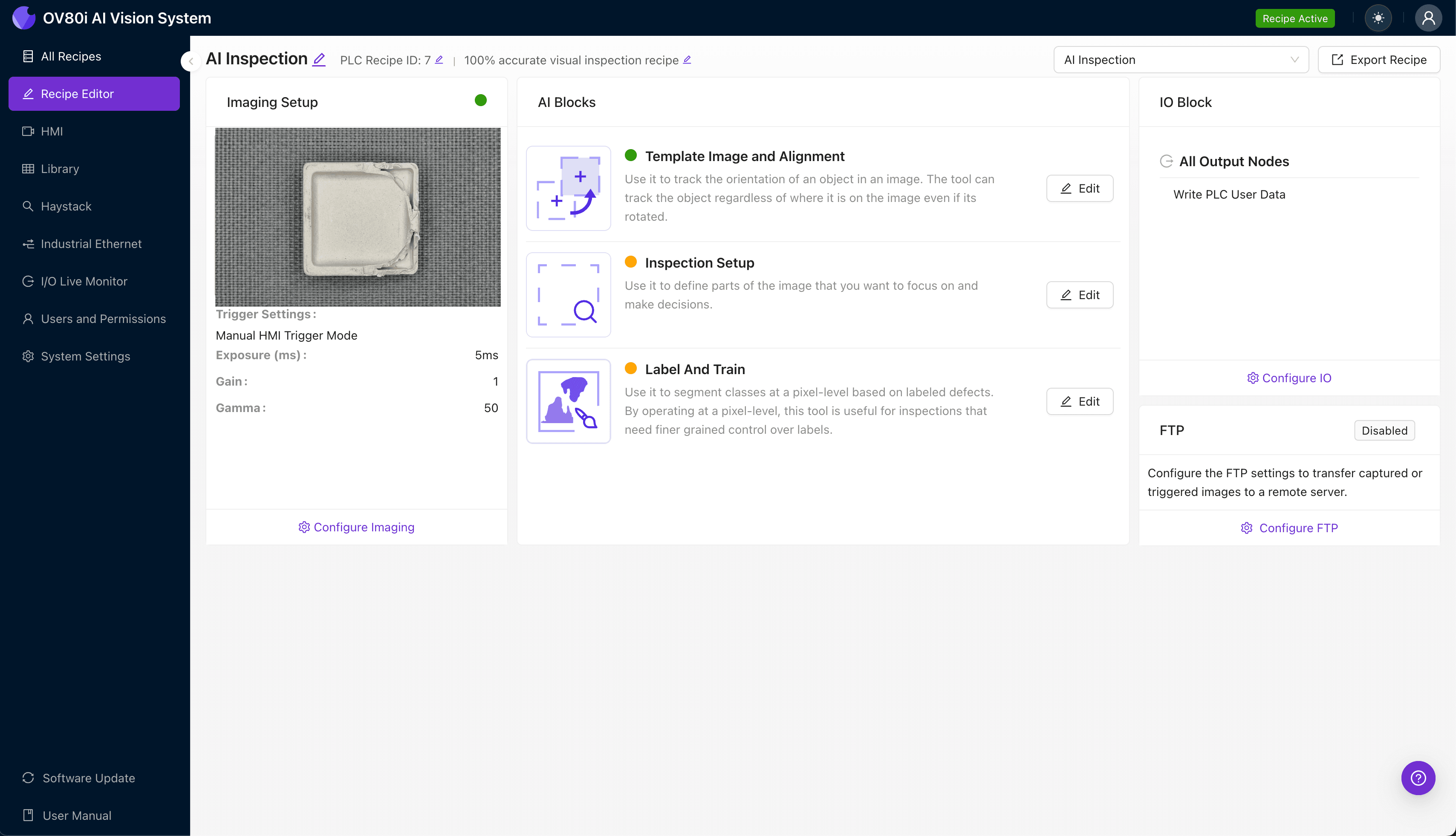
Step 1: Imaging Setup
Position the molded insulator under the OV80i camera system, ensuring the viewing angle captures the critical fill regions where short-shots typically occur. For insulators with complex geometry, you may need multiple camera positions to inspect all surfaces.
Navigate to "Configure Imaging" in the Overview interface. Adjust the Camera Settings—increase exposure to reveal detail in dark-colored insulators, and fine-tune gain to balance signal strength against image noise.
Click "Save" once the insulator's features are clearly visible with good contrast between filled and unfilled regions.
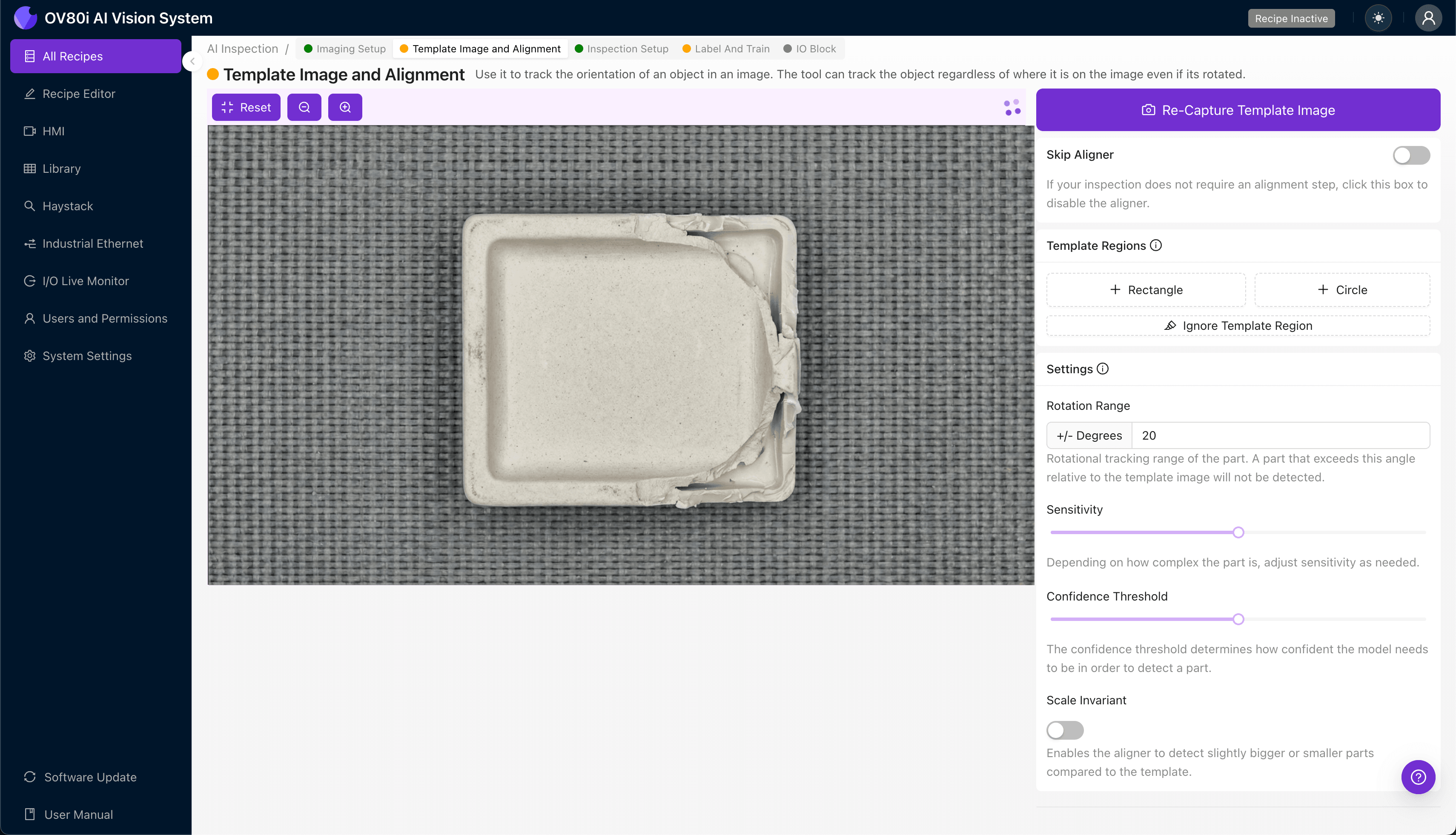
Step 2: Image Alignment
Navigate to the "Template Image" section and capture a reference image of a known-good insulator. This template serves as the baseline for aligning all subsequent parts as they move through inspection.
Click "+ Rectangle" to add an alignment region around the main body of the insulator. Position this rectangle over a stable, high-contrast feature that will be consistent across all parts.
Set the "Rotation Range" to 20 degrees to accommodate normal variation in part orientation on the conveyor or fixture.
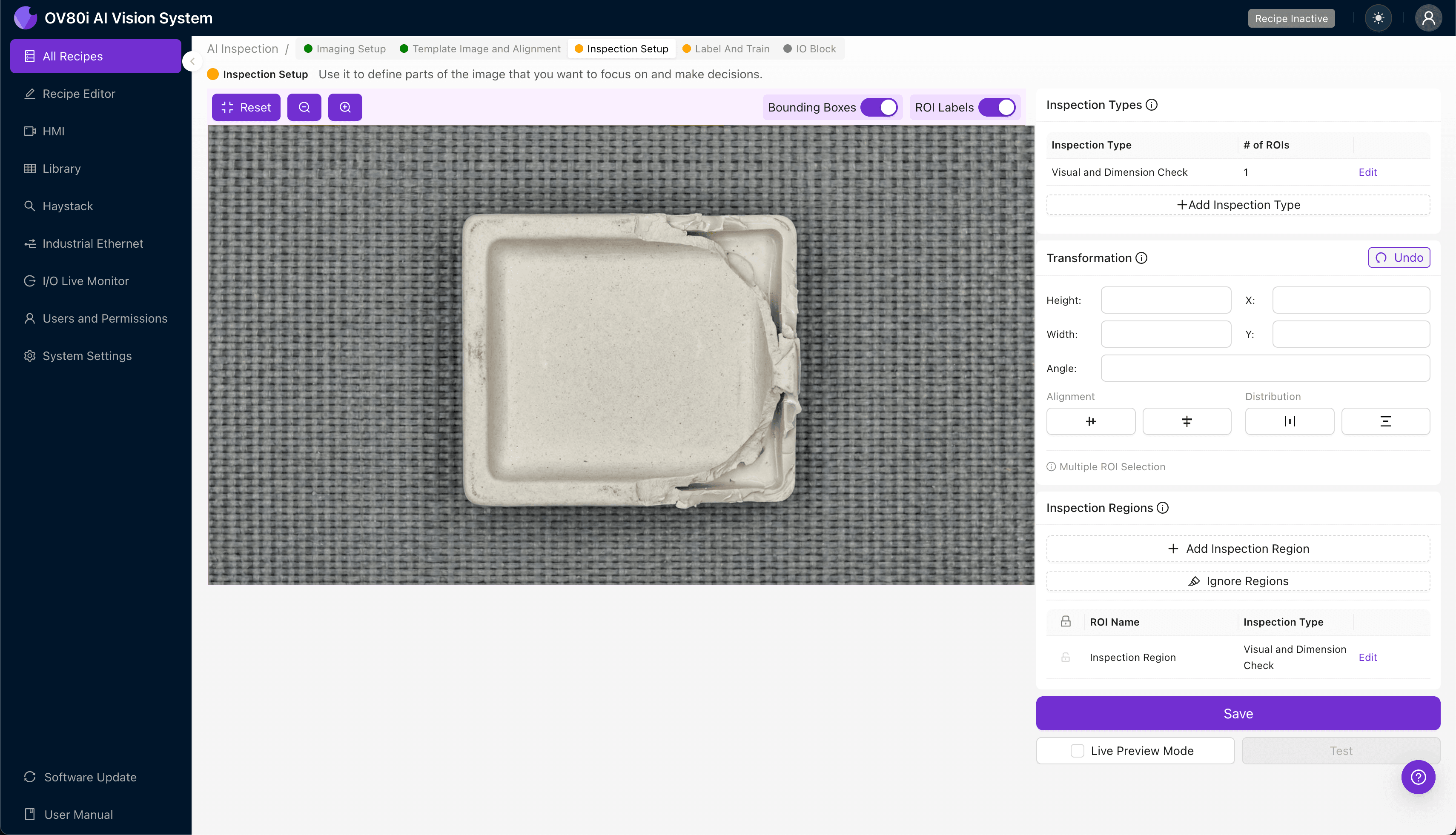
Step 3: Inspection Region Selection
Navigate to "Inspection Setup" to define where the system should look for defects. This focusing step improves both accuracy and processing speed.
Rename your "Inspection Types" to match the defect categories relevant to your process—for example, "Rib Fill," "Creepage Surface," and "Thread Completion."
Click "+ Add Inspection Region" for each critical area. Resize the yellow bounding box to cover zones where short-shots are most likely: thin-wall sections, the ends of flow paths, and detailed features far from the gate.
Click "Save" to lock in your inspection regions.
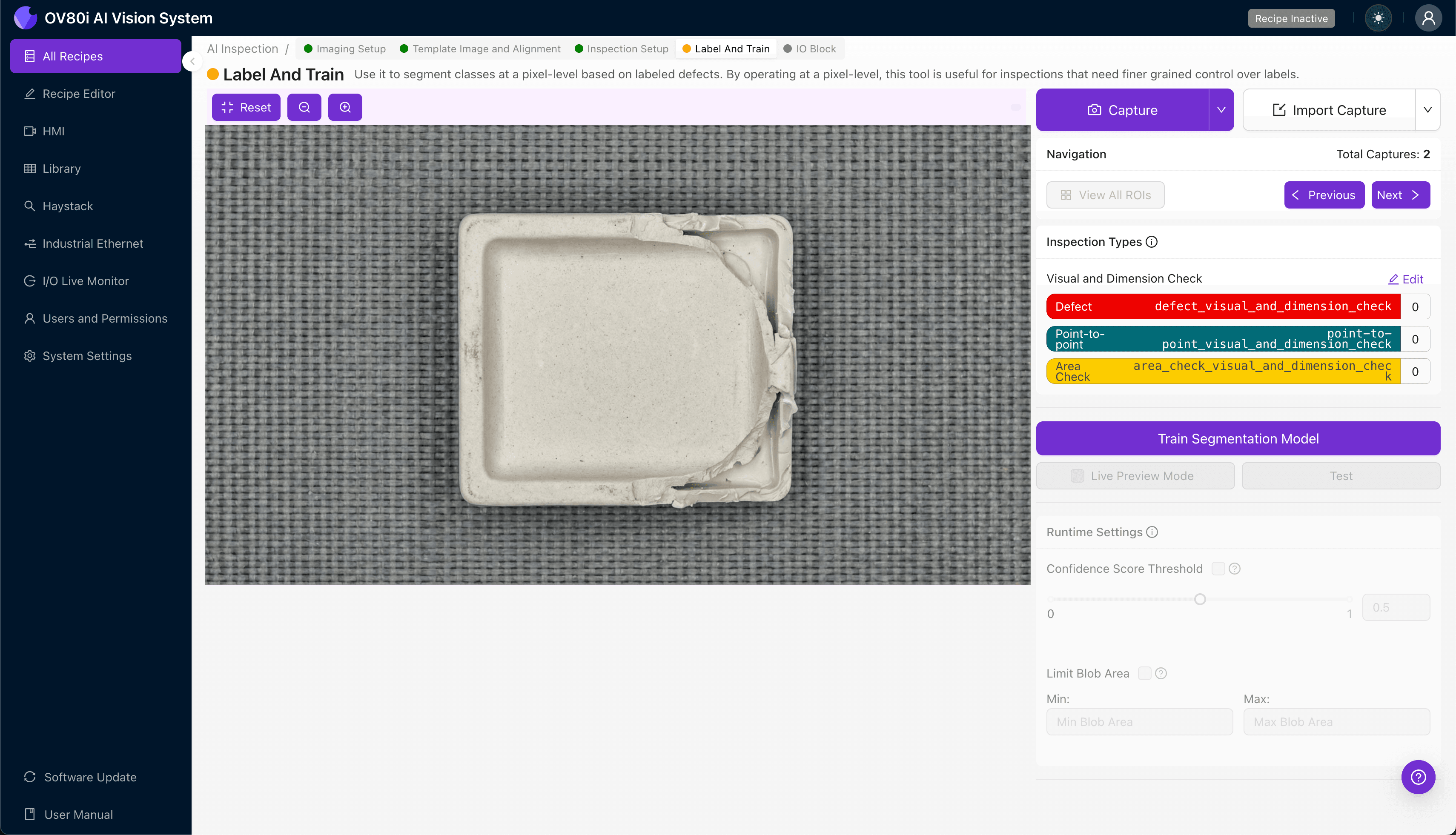
Step 4: Labeling Data
The human-in-the-loop labeling process is where your manufacturing expertise trains the AI. You'll review captured images and teach the system what constitutes acceptable versus rejectable parts.
Label images as Good (fully filled, acceptable parts) or Bad (short-shots and other fill defects). Be consistent in your judgments—the AI learns from your decisions.
Include representative samples across the full range of variation: different material lots, temperature conditions, and known failure modes from your defect library. The more diverse your training set, the more robust your deployed model will be.
Step 5: Creating Rules
With your trained model ready, navigate to the rules engine to set pass/fail logic based on your Inspection Types. You can configure different sensitivity thresholds for different regions—tighter tolerances on safety-critical features, slightly looser on cosmetic areas.
These rules gate automated acceptance on the line. Parts that pass continue downstream; rejects are diverted for secondary review or scrap, ensuring no short-shot insulators reach your customers or assembly operations.
Key Outcomes & ROI
Implementing AI-powered visual inspection for molded insulator short-shots delivers measurable business impact:
- Reduced scrap and rework — catch marginal parts before they consume additional processing resources or fail final test
- Higher throughput — inspect 100% of parts at line speed without creating a bottleneck or requiring inspection slowdowns
- Compliance and traceability — automatically log images and inspection results for every part, supporting automotive, aerospace, and electrical safety certifications
- Process improvement insights — trend data reveals when short-shots increase, enabling proactive mold maintenance or process parameter adjustments before quality escapes
Eliminate Short-Shot Escapes Today
Stop relying on manual inspection for critical electrical insulation components. Deploy Overview.ai to catch every incomplete fill defect instantly.