Detecting Bent Signal Contacts in OSFP Host Connectors: A Machine Vision Walkthrough
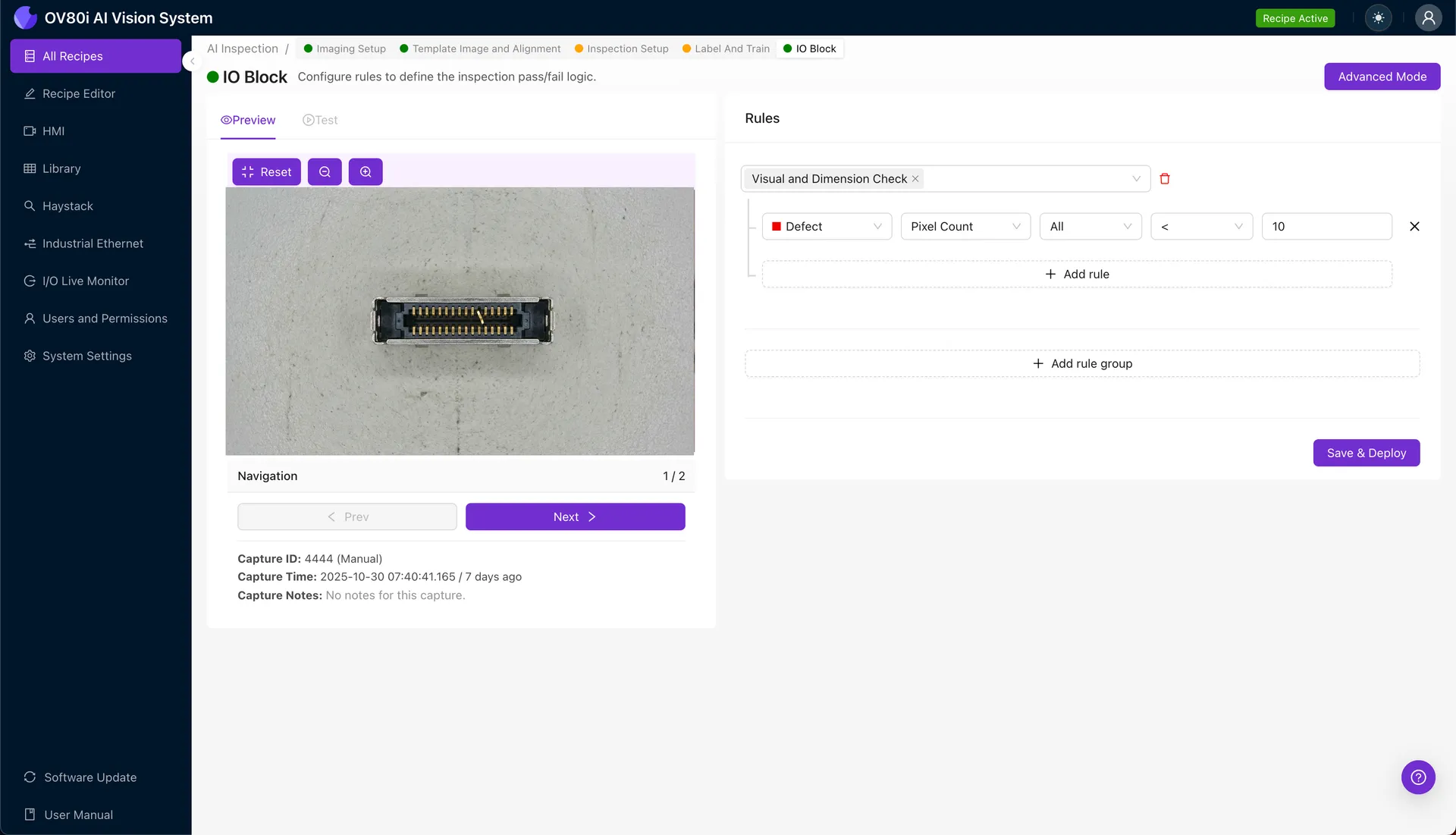
"A single bent signal contact in an OSFP connector can cause catastrophic signal integrity failures in 800G data center infrastructure. AI-powered visual inspection catches these subtle defects at production speed, eliminating the fatigue-induced errors that plague manual inspection of 38-contact arrays."
The Problem: Why Bent Signal Contacts Slip Through Manual Inspection
OSFP (Octal Small Form Factor Pluggable) host connectors are critical components in high-speed data center infrastructure, supporting data rates of 800G and beyond. A single bent signal contact can cause catastrophic signal integrity failures, intermittent connectivity issues, or complete module rejection in the field.
Common Defects Found in OSFP Host Connector Signal Contacts:
- Bent or displaced contact pins – contacts pushed laterally or vertically outside positional tolerance
- Twisted contacts – rotational deformation affecting mating alignment
- Collapsed contact tips – tips bent backward or forward from impact during handling
- Uneven contact height (coplanarity issues) – contacts sitting at different Z-heights across the array
- Contact pitch violations – improper spacing between adjacent signal pins
- Missing contacts – absent pins from incomplete stamping or assembly failures
The challenge with OSFP connectors is their density—38 electrical contacts packed into a compact footprint. Human inspectors struggle with the repetitive micro-inspection required, experiencing fatigue-induced errors after just 20-30 minutes of continuous inspection, and cannot maintain the consistency needed for contacts measuring fractions of a millimeter.
The Solution: Machine Vision + Deep Learning for Consistent Detection
Traditional rule-based machine vision systems often fail with bent contact detection because the defects are subtle, variable in presentation, and occur against complex backgrounds. Deep learning changes this equation by training neural networks to recognize the full spectrum of "good" versus "bad" contact geometry—including edge cases that would require hundreds of explicit rules to define manually.
Overview.ai's approach leverages AI-powered visual inspection that operates at line speed without fatigue or subjectivity. The system delivers consistent, objective defect detection on every single unit, enabling true 100% inline inspection that catches bent contacts before they reach your customer.
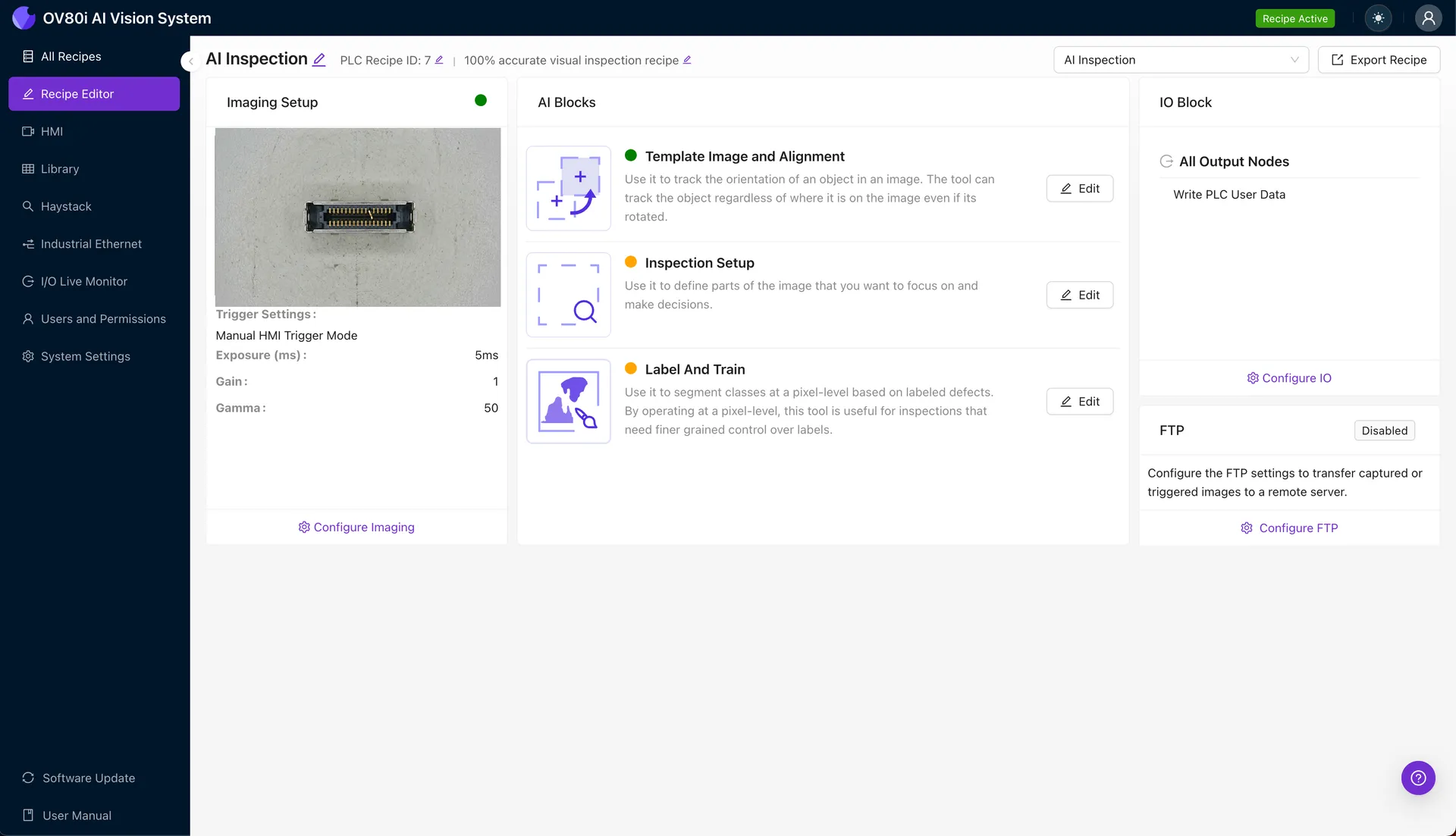
Step 1: Imaging Setup
Begin by placing the OSFP host connector in a fixture under the Overview.ai camera system, ensuring the contact array faces directly toward the lens. Proper lighting is critical—angled illumination often works best to cast micro-shadows that reveal bent contacts.
Click "Configure Imaging" to access the Camera Settings panel. Adjust exposure to capture crisp contact edges without overexposure on reflective gold-plated surfaces, and fine-tune gain to optimize signal-to-noise ratio.
Click "Save" to lock in your imaging parameters.
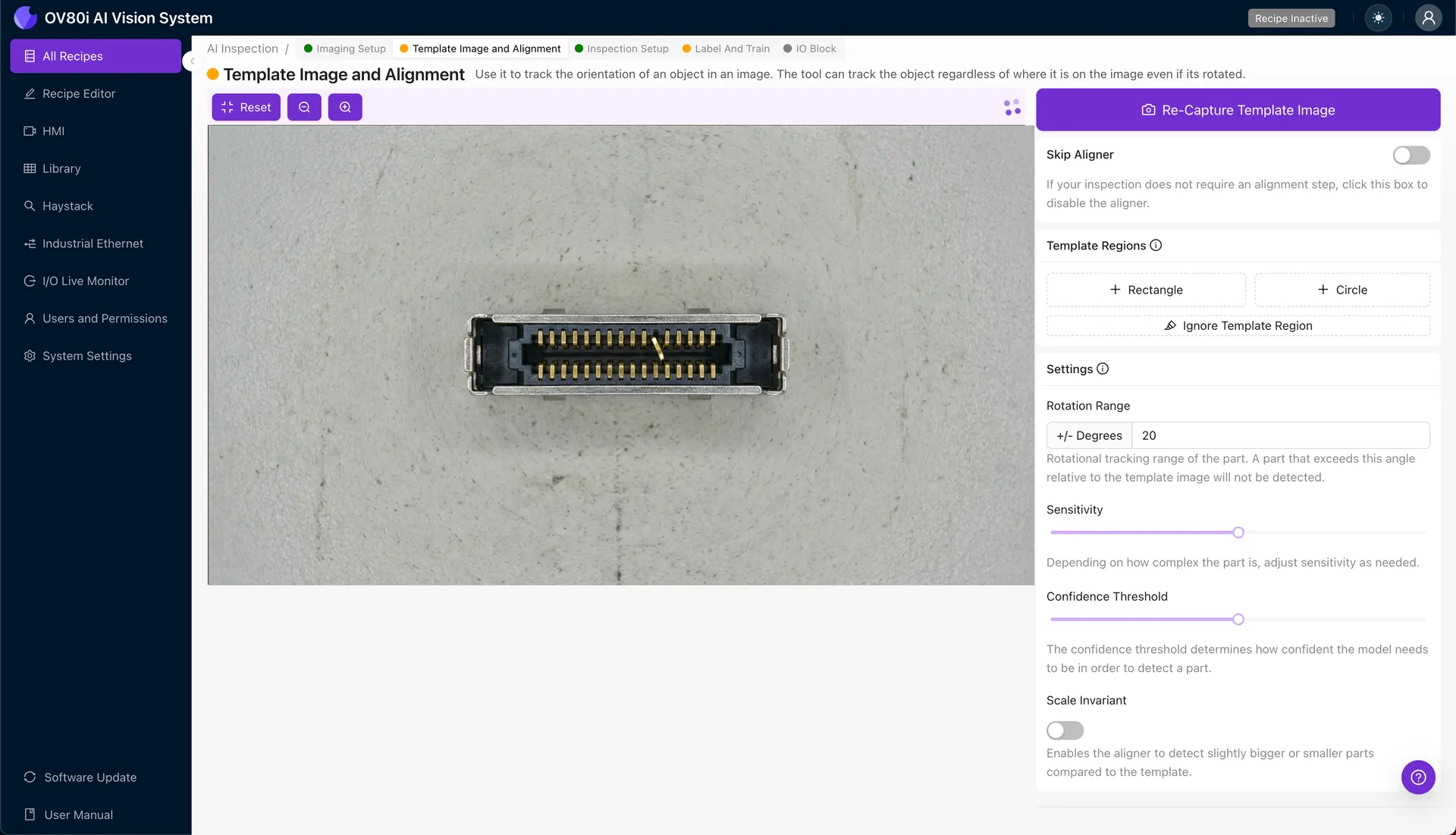
Step 2: Image Alignment
Navigate to the "Template Image" tab and capture a Template using a known-good OSFP connector positioned in its standard orientation. This reference image anchors the system's spatial understanding.
Click "+ Rectangle" and draw a region around the main connector body, encompassing the full contact array and housing edges. Set the "Rotation Range" to 20 degrees to accommodate minor fixture variations and ensure reliable part detection across production runs.
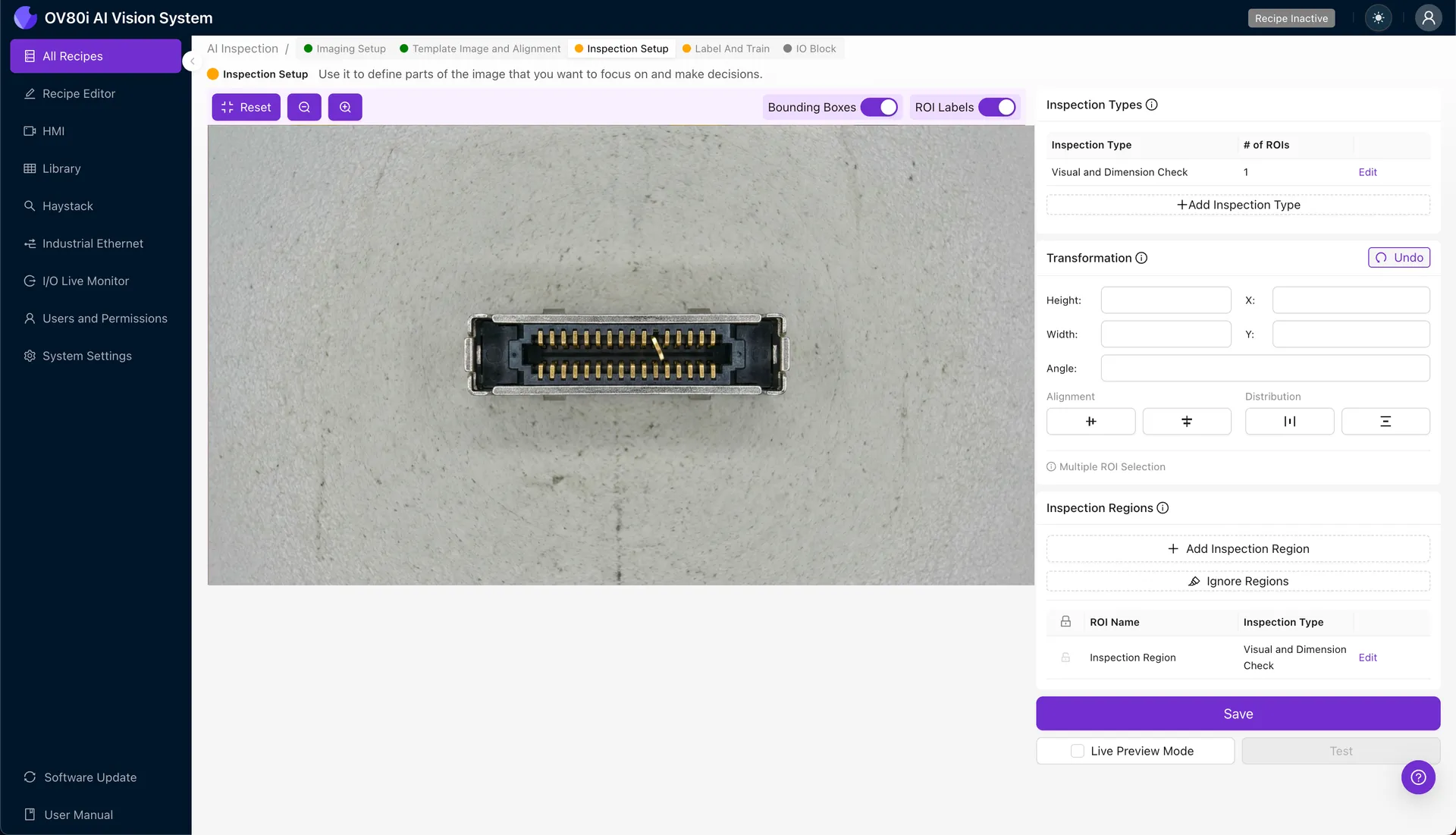
Step 3: Inspection Region Selection
Navigate to "Inspection Setup" in the interface. Rename your "Inspection Types" to reflect the specific defect categories—for example, "Bent_Contact_Row_A" and "Bent_Contact_Row_B" for logical organization.
Click "+ Add Inspection Region" to create a new detection zone. Resize the yellow bounding box to cover the critical signal contact areas where bent pins typically occur—focus especially on outer rows and high-stress zones near the connector edges.
Click "Save" to confirm your inspection regions.
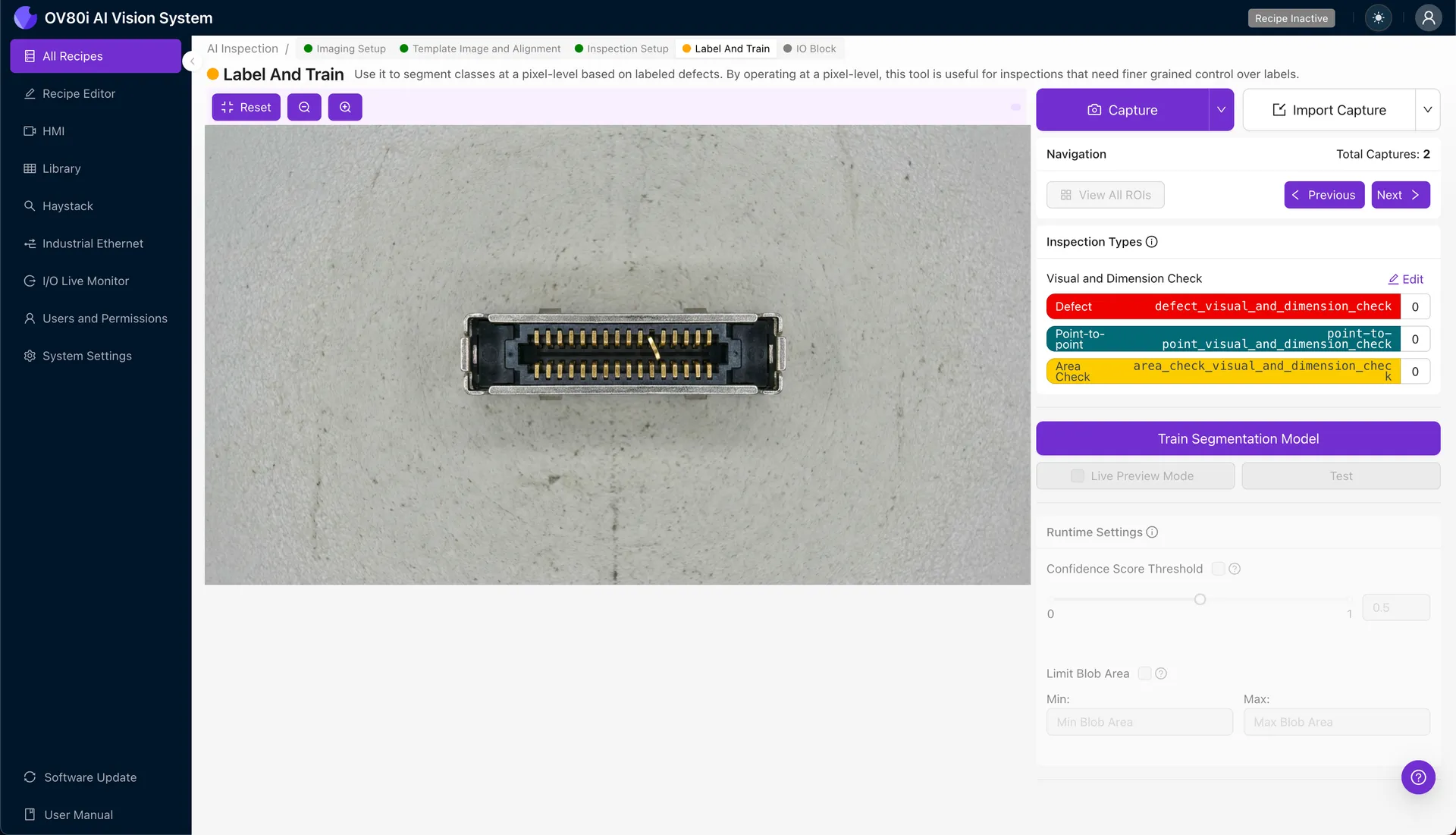
Step 4: Labeling Data
This step leverages the human-in-the-loop process that makes deep learning systems powerful. Subject matter experts review captured images and label each as Good (contacts within specification) or Bad (bent, displaced, or otherwise defective contacts).
Include representative samples across your full production variation—different contact plating lots, lighting conditions, and fixture positions. Critically, incorporate known failure modes: contacts bent at various angles, multiple simultaneous bent pins, and borderline cases that challenge human inspectors.
Step 5: Creating Rules
With your labeled dataset training the model, configure the pass/fail logic based on your defined Inspection Types. Set threshold confidence levels that balance escape rate against false rejection rate for your quality requirements.
Gate automated acceptance on the line so that any connector flagged for bent contacts is automatically diverted for secondary review or rejection. This creates a closed-loop quality system that prevents defective OSFP connectors from advancing downstream.
Key Outcomes & ROI
Implementing AI-powered visual inspection for OSFP connector bent contact detection delivers measurable business value:
- Reduced scrap and rework costs – catch bent contacts immediately after insertion rather than at final test or in the field
- Higher throughput – inspect 100% of units at production speed without creating bottlenecks
- Enhanced compliance and traceability – automatically log images and inspection results for every connector, supporting customer audits and warranty investigations
- Process improvement insights – identify upstream root causes by analyzing when and where bent contacts occur most frequently
Conclusion
Bent signal contacts in OSFP host connectors represent exactly the type of subtle, high-consequence defect that manual inspection cannot reliably catch at scale. By combining precision imaging with deep learning-based defect recognition, Overview.ai enables manufacturers to achieve consistent, objective quality control that protects both yield and customer relationships.
Ready to eliminate bent contact escapes from your OSFP production line? Contact Overview.ai to see the OV80i system in action.
Eliminate Bent Contact Escapes Today
Stop relying on manual inspection for your OSFP connectors. Deploy Overview.ai to catch bent signal contacts instantly at production speed.