Press-Fit Pin with Buckled Eye-of-the-Needle Shoulder: A Machine Vision Inspection Guide
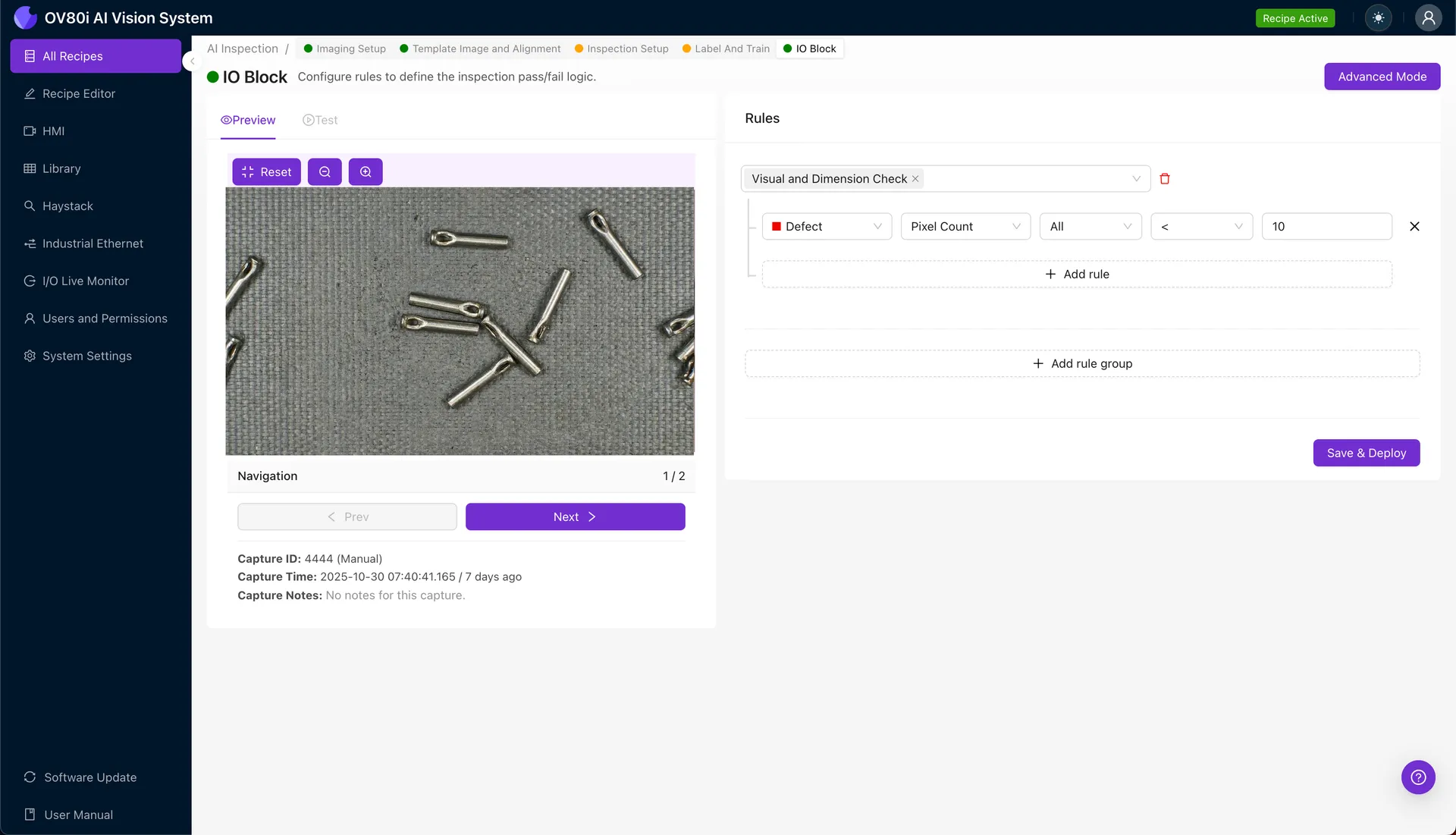
"Buckled eye-of-the-needle shoulders on press-fit pins compromise electrical continuity and mechanical retention, yet manual inspection cannot reliably detect these subtle defects. Overview.ai's deep learning platform delivers consistent, traceable inspection at line speed—catching buckling before pins reach costly downstream assemblies."
The Problem: Why Buckled Shoulders Escape Detection
Press-fit pins with eye-of-the-needle shoulders are critical connector components in automotive ECUs, power modules, and high-reliability electronics assemblies. When the delicate shoulder zone buckles during insertion, it compromises both electrical continuity and mechanical retention—often leading to costly field failures.
Common Defects in Eye-of-the-Needle Shoulder Press-Fit Pins
- Shoulder buckling – Collapse or deformation of the thin-walled needle-eye zone during press insertion
- Asymmetric flaring – Uneven material displacement causing tilted or off-axis shoulder geometry
- Micro-cracking at stress risers – Hairline fractures originating from the eye aperture edges
- Incomplete shoulder formation – Insufficient material flow leaving gaps in the retention feature
- Surface galling – Material transfer marks from tooling friction during the press operation
- Eye aperture distortion – Ovalization or closure of the needle-eye opening due to excessive force
Manual inspection of these defects is notoriously unreliable. Inspectors suffer from visual fatigue within 20-30 minutes when examining hundreds of sub-millimeter shoulder formations per hour.
The subtle difference between acceptable shoulder flare and early-stage buckling is nearly impossible to judge consistently across shifts and operators.
The Solution: AI-Powered Visual Inspection
Machine vision systems equipped with deep learning eliminate the subjectivity that plagues manual shoulder inspection. Unlike rule-based systems that struggle with the organic, variable nature of buckling defects, neural networks learn to recognize the full spectrum of failure modes from labeled examples.
Overview.ai's approach delivers consistent, objective inspection at full line speed—typically 1-2 seconds per part. The system never fatigues, never second-guesses itself, and provides traceable pass/fail decisions for every single pin processed.
Step 1: Imaging Setup
Position the press-fit pin under the OV80i camera with the eye-of-the-needle shoulder facing upward. Consistent orientation is critical for capturing the subtle deformation patterns that indicate buckling.
Click "Configure Imaging" to access the camera controls. Adjust exposure to highlight surface topology without washing out reflective areas, and fine-tune gain to reveal micro-cracks in shadow regions.
Click "Save" to lock in your imaging parameters.
Step 2: Image Alignment
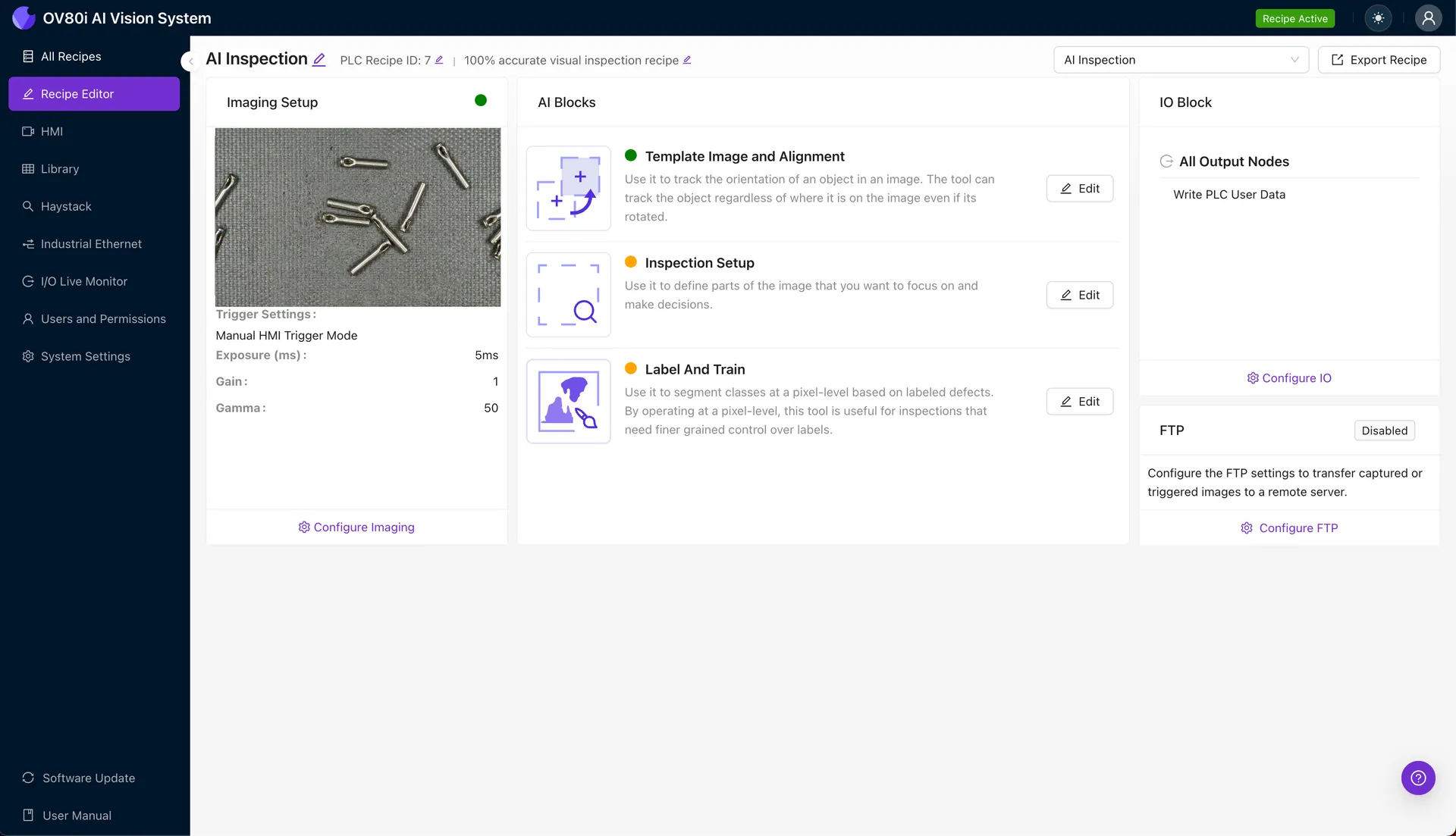
Navigate to the "Template Image" panel and capture a reference image of a known-good pin. This template anchors all subsequent inspections to a consistent baseline.
Click "+ Rectangle" and draw a region around the pin's main body, encompassing the full shoulder zone. Set the "Rotation Range" to 20 degrees to accommodate minor orientation variations as pins enter the inspection station.
Step 3: Inspection Region Selection
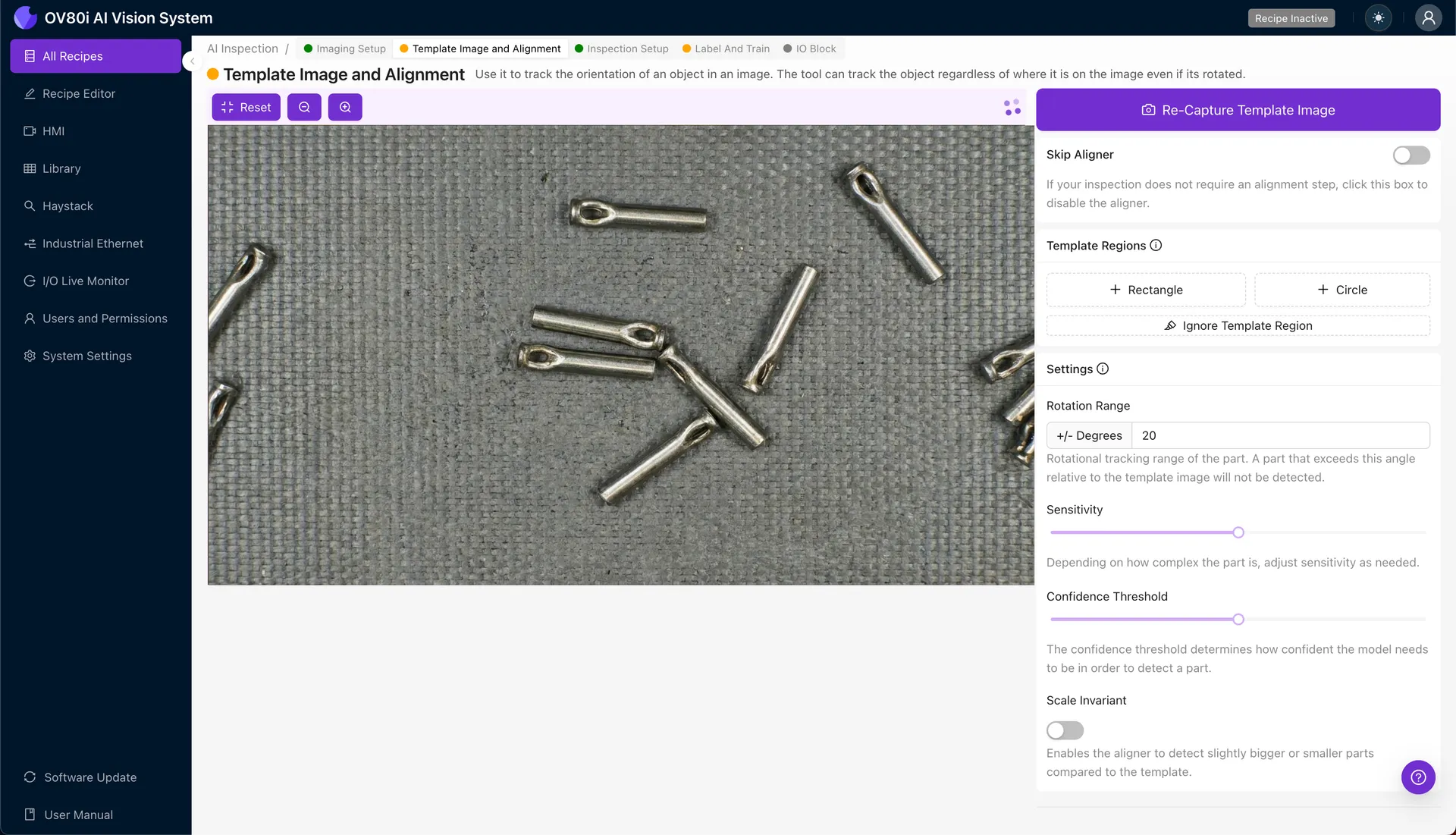
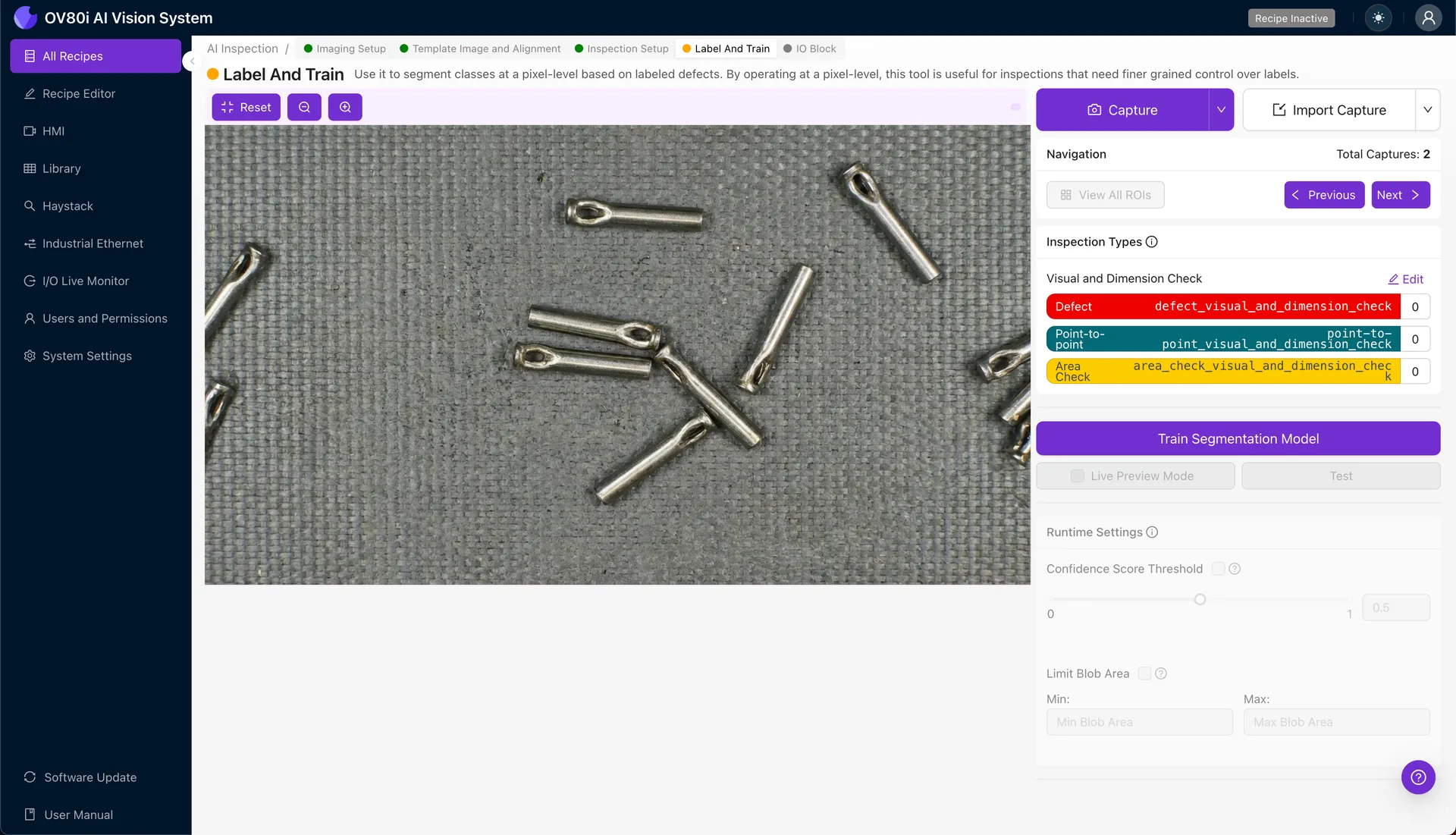
Navigate to "Inspection Setup" in the main menu. Rename your "Inspection Types" to reflect the defect categories—for example, "Shoulder_Buckling" and "Eye_Distortion."
Click "+ Add Inspection Region" to define your zones of interest. Resize the yellow bounding box to cover the critical shoulder area where buckling initiates, ensuring the eye aperture is fully contained.
Click "Save" to confirm your inspection regions.
Step 4: Labeling Data
The human-in-the-loop labeling process is where your expertise trains the AI. Review captured images and classify each as Good (acceptable shoulder formation) or Bad (any defect condition).
Include representative samples across the full range of borderline cases and known failure modes. The more diverse your labeled dataset—including lighting variations and part-to-part differences—the more robust your trained model becomes.
Step 5: Creating Rules
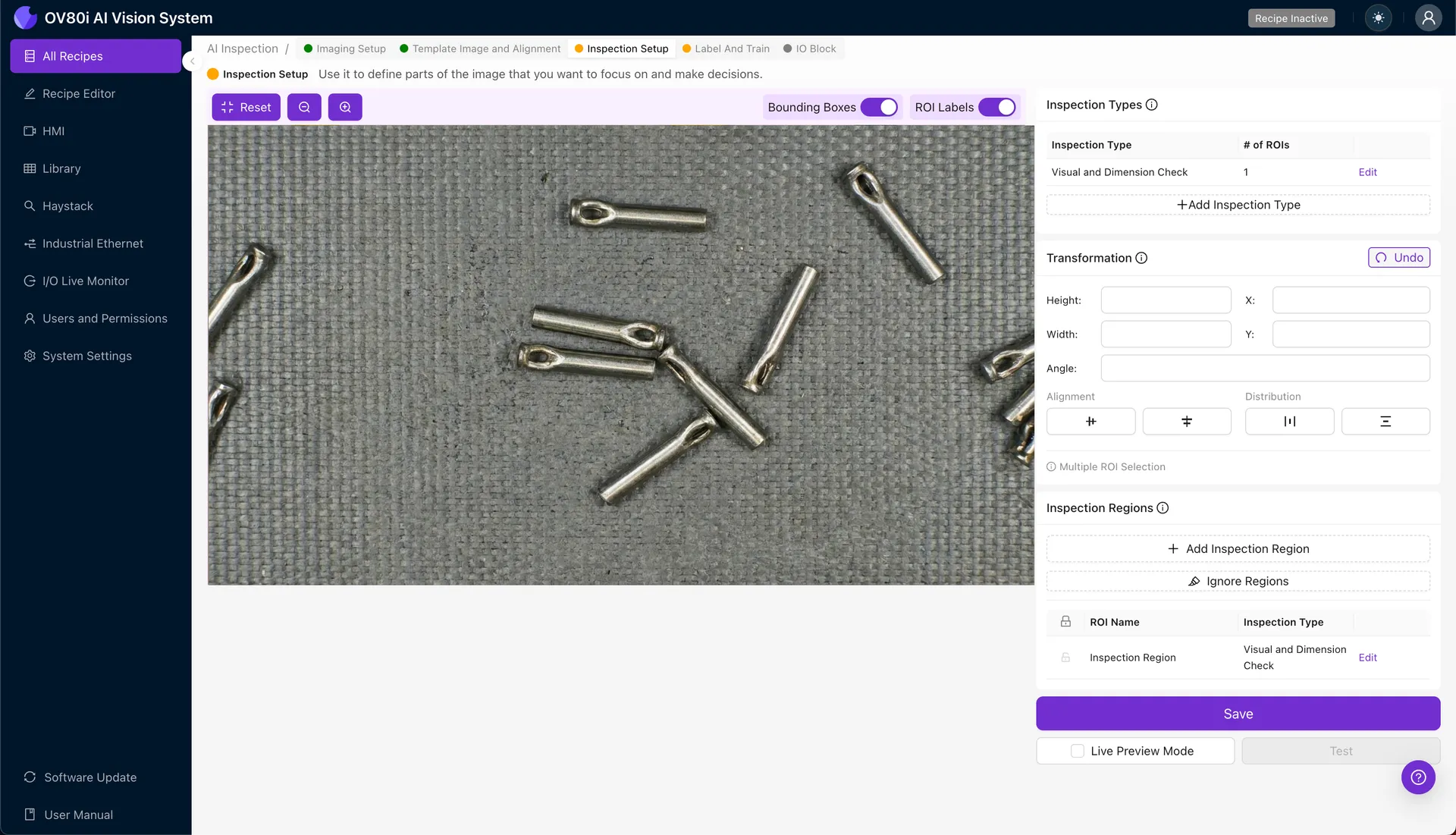
Configure your pass/fail logic based on the Inspection Types you defined. For example, flag any pin where "Shoulder_Buckling" confidence exceeds 85% as a reject.
These rules gate automated acceptance on the line, diverting suspect parts for secondary review or scrap while allowing conforming pins to proceed without interruption.
Key Outcomes & ROI
Implementing automated inspection for press-fit pin shoulders delivers measurable business impact:
- Reduced scrap rates – Catch buckling defects before pins are assembled into expensive modules
- Higher throughput – Inspect 100% of parts at line speed without bottlenecking production
- Compliance and traceability – Maintain auditable inspection records for automotive IATF 16949 and electronics IPC standards
- Process improvement insights – Correlate defect trends with press parameters to optimize upstream tooling and force profiles
Conclusion
Buckled eye-of-the-needle shoulders represent a high-stakes quality challenge that manual inspection simply cannot address at scale. With Overview.ai's deep learning platform, manufacturers gain the consistency, speed, and traceability needed to protect downstream assemblies—and their reputation—from preventable field failures.
Eliminate Press-Fit Pin Defects Today
Stop relying on manual inspection for critical shoulder formations. Deploy Overview.ai to catch buckling defects instantly.