QSFP-DD Cage with Crushed EMI Spring Finger: A Complete Visual Inspection Walkthrough
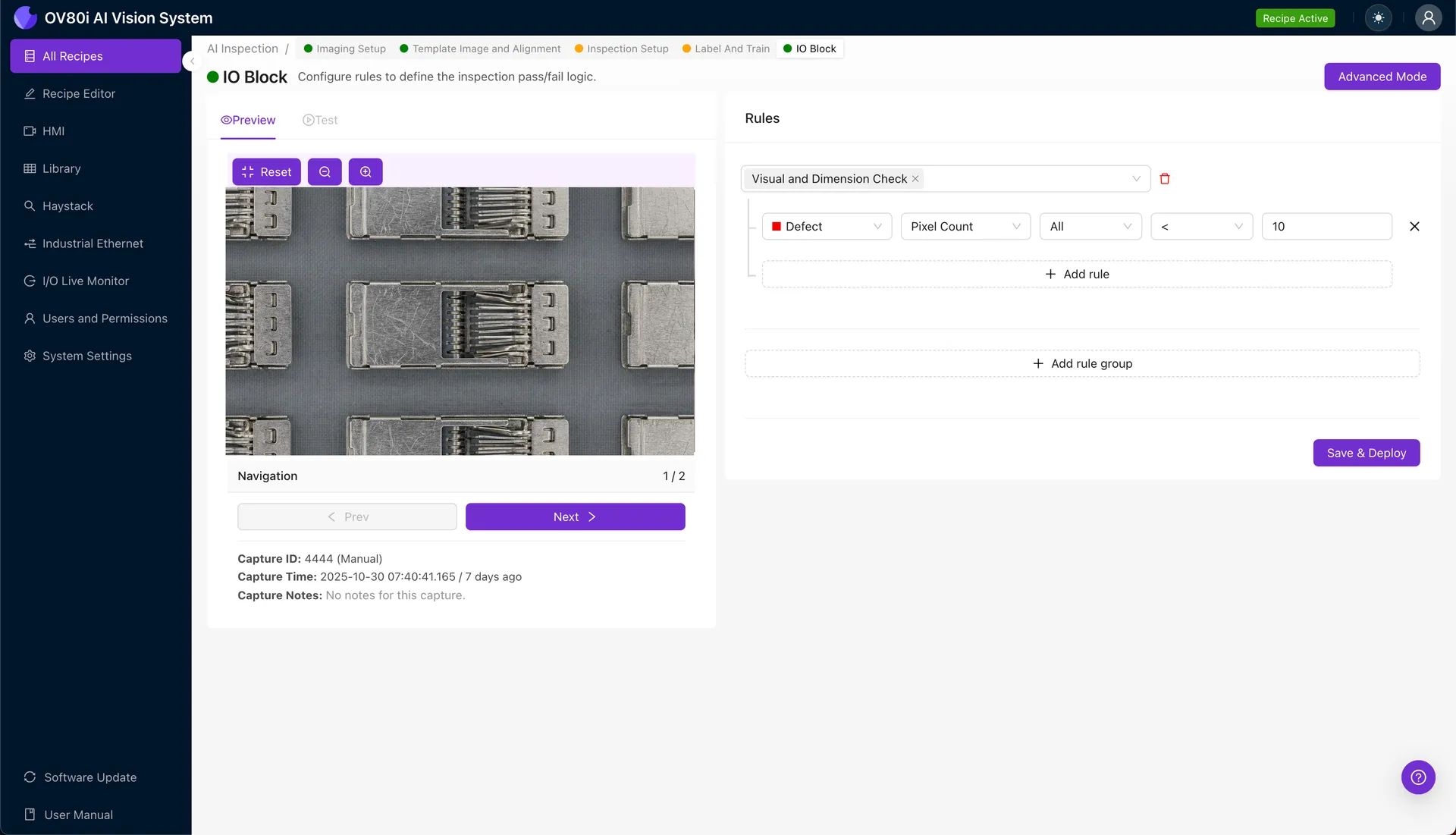
"Crushed EMI spring fingers in QSFP-DD cages compromise signal integrity and electromagnetic shielding in high-speed data center applications. Overview.ai's deep learning inspection platform detects these micro-scale deformations at full production speed, eliminating manual inspection bottlenecks."
The Problem: Why Crushed EMI Spring Fingers Escape Detection
QSFP-DD cages house multiple rows of delicate EMI spring fingers designed to maintain consistent ground contact and electromagnetic shielding. A single crushed or bent spring can compromise the entire module's performance in high-frequency applications.
Common defects found in QSFP-DD EMI spring finger assemblies include:
- Crushed or flattened spring tips — reducing contact pressure below specification
- Bent or misaligned fingers — creating uneven grounding across the cage interface
- Missing spring fingers — often broken during insertion or automated handling
- Irregular spring spacing — causing inconsistent EMI shielding effectiveness
- Surface contamination or debris — trapped between spring elements during assembly
- Over-compressed springs — permanently deformed beyond elastic recovery limits
Manual inspection of these micro-scale features fails at production speeds. Human inspectors experience fatigue-induced inconsistency after just 20-30 minutes, and spring finger deformations measuring fractions of a millimeter simply fall below reliable visual detection thresholds.
The Solution: Machine Vision Meets Deep Learning
Traditional rule-based machine vision struggles with the geometric complexity of EMI spring fingers. Variations in lighting angle, slight positional shifts, and the three-dimensional nature of spring deformation create too many edge cases for simple threshold-based algorithms.
Deep learning changes this equation entirely. Neural networks trained on thousands of labeled examples learn to recognize the subtle visual signatures of crushed springs—regardless of exact position, orientation, or lighting conditions.
Overview.ai's approach delivers consistent, objective inspection at full line speed. The system evaluates every unit against learned quality standards, eliminating the subjectivity and throughput limitations inherent in human inspection processes.
Step 1: Imaging Setup
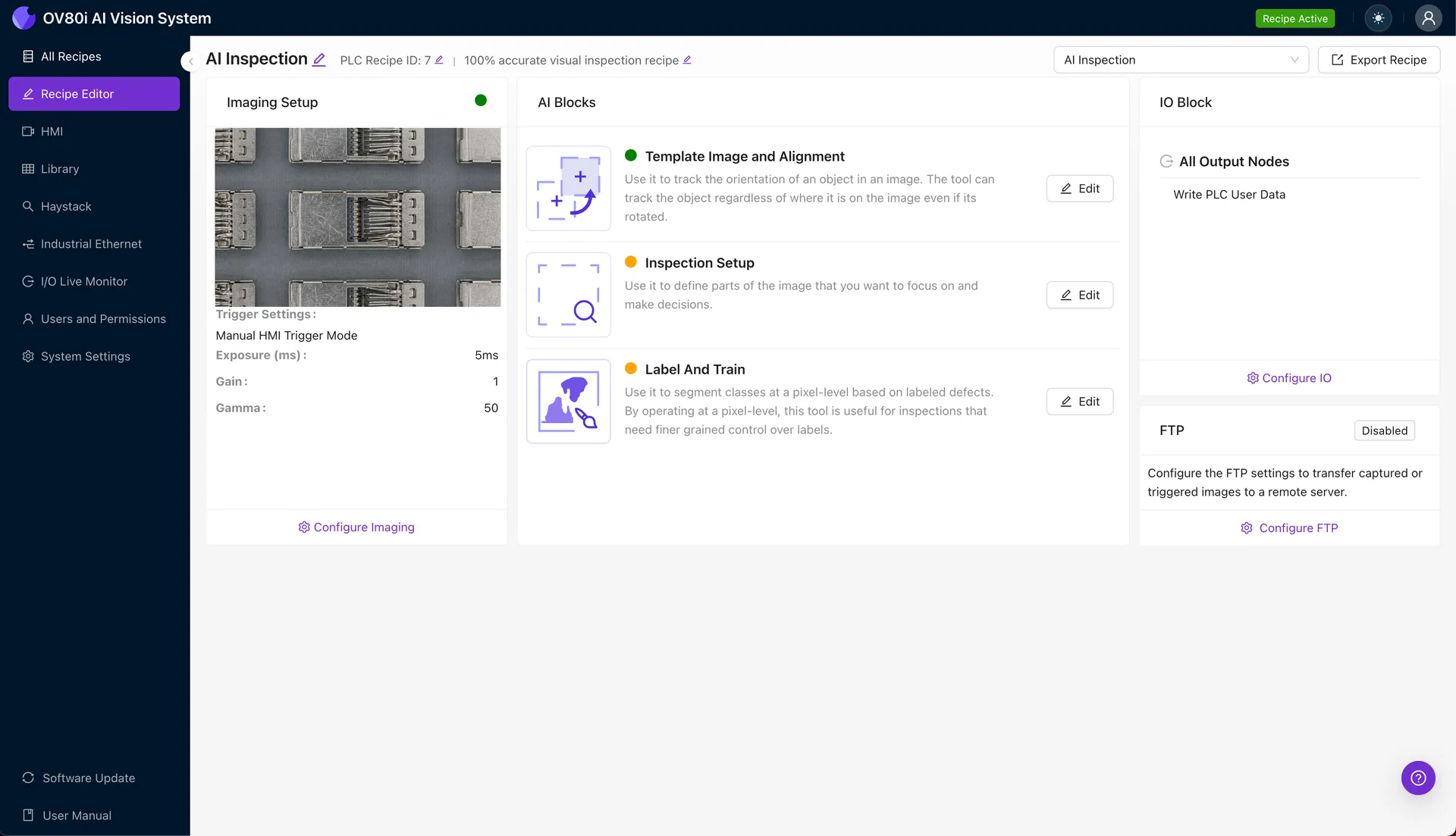
Begin by placing the QSFP-DD cage under the OV80i camera system, positioning the EMI spring finger array within the field of view. Proper orientation ensures all spring fingers are visible without occlusion from cage walls or adjacent components.
Click "Configure Imaging" to access the Camera Settings panel. Adjust exposure time to capture crisp spring finger edges without motion blur, and fine-tune gain to reveal subtle surface deformations in the metallic spring material.
Click "Save" to lock in your optimized imaging parameters.
Step 2: Image Alignment
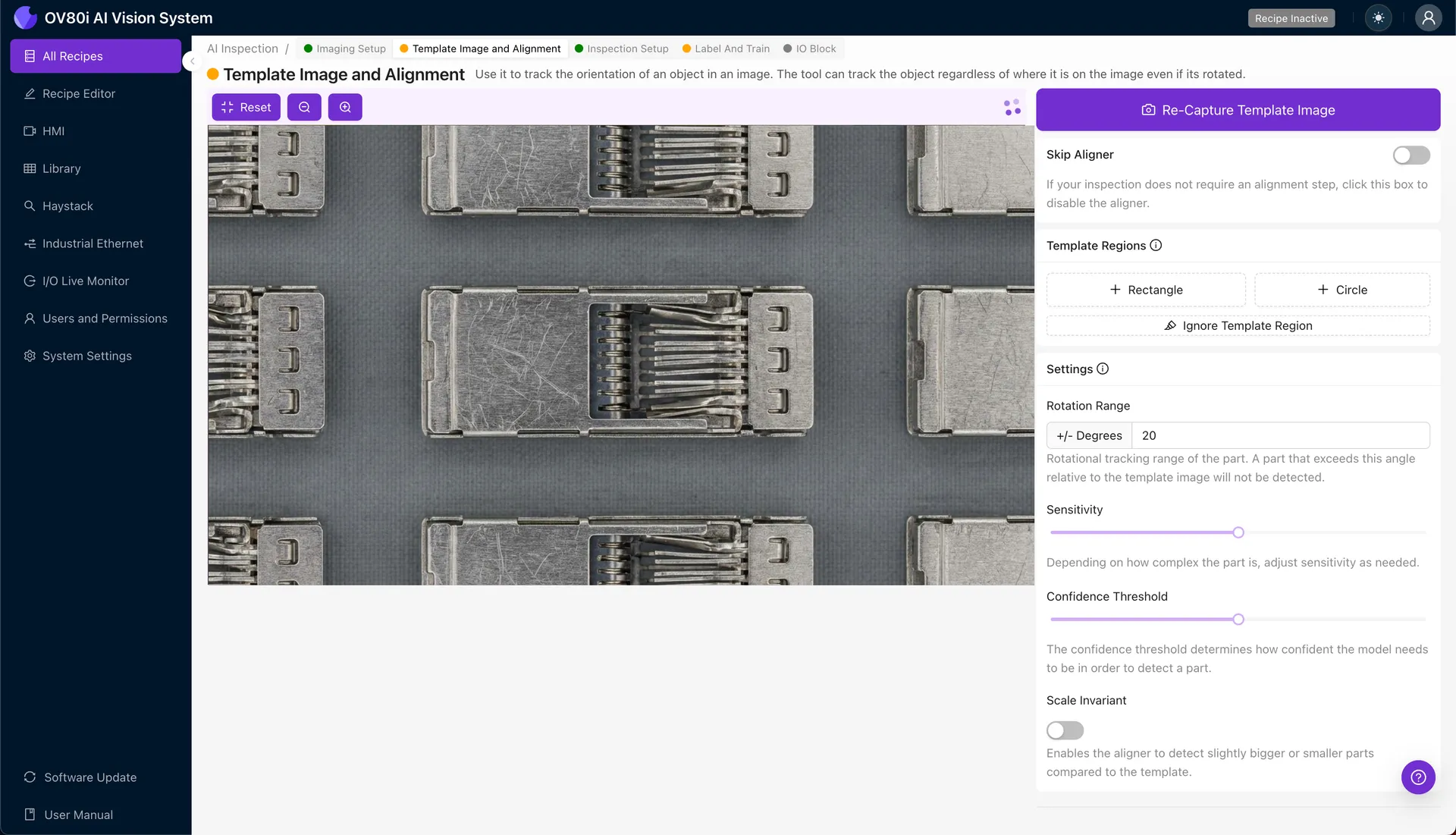
Navigate to "Template Image" in the configuration menu. Capture a Template image of a known-good QSFP-DD cage positioned in standard orientation.
Click "+ Rectangle" to add an alignment region around the main cage body, encompassing the outer housing edges for reliable registration.
Set "Rotation Range" to 20 degrees to accommodate minor orientation variations as parts enter the inspection station.
Step 3: Inspection Region Selection
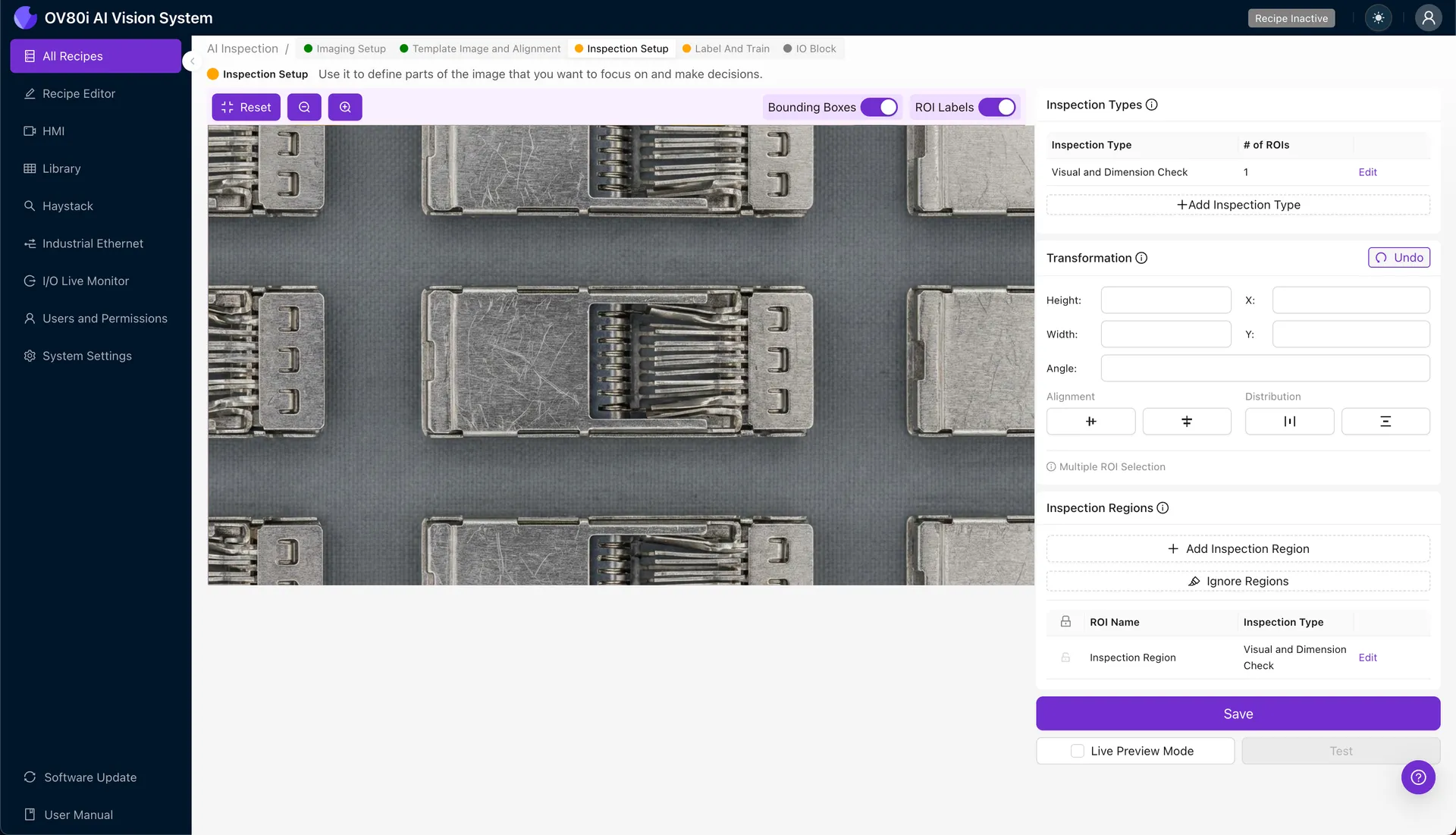
Navigate to "Inspection Setup" to define where the AI should focus its analysis. Rename "Inspection Types" to descriptive labels such as "EMI_Spring_Integrity" or "Spring_Finger_Condition" for clear reporting.
Click "+ Add Inspection Region" to create a new detection zone. Resize the yellow bounding box to cover the critical EMI spring finger array, ensuring all spring tips and contact surfaces fall within the region.
Click "Save" to confirm your inspection geometry.
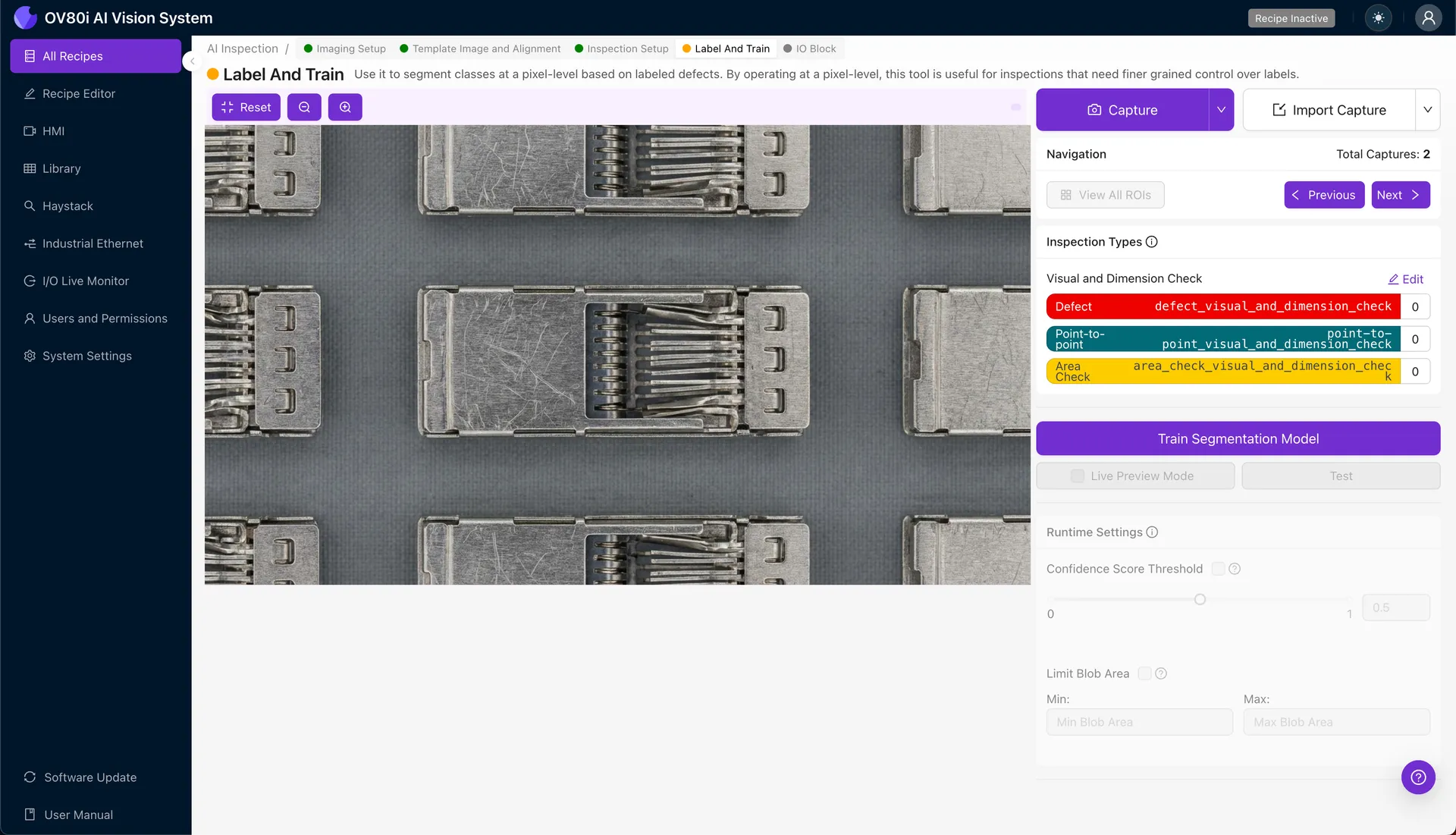
Step 4: Labeling Data
The human-in-the-loop labeling process teaches the AI what constitutes acceptable versus defective spring fingers. Quality engineers review captured images and assign classifications based on production standards.
Label images as Good (properly formed springs with correct geometry) versus Bad (crushed, bent, missing, or otherwise defective). Include representative samples across the full spectrum of acceptable variation and known failure modes.
Incorporate edge cases—springs at the borderline of acceptability—to sharpen the model's decision boundaries.
Step 5: Creating Rules
Set pass/fail logic based on your defined Inspection Types. Configure thresholds that trigger rejection when the AI detects crushed spring conditions with high confidence.
Gate automated acceptance on the production line, routing flagged units to secondary inspection or rework stations. This closed-loop approach ensures no defective QSFP-DD cages reach downstream assembly or final shipment.
Key Outcomes & ROI
Implementing AI-powered visual inspection for QSFP-DD EMI spring fingers delivers measurable business impact:
- Reduced Scrap Rates — catching crushed springs before additional value-add assembly operations
- Higher Throughput — eliminating manual inspection bottlenecks while maintaining 100% coverage
- Compliance & Traceability — generating timestamped inspection records for customer audits and warranty claims
- Process Improvement Insights — identifying upstream causes of spring damage through defect trend analysis
Conclusion
Crushed EMI spring fingers represent a silent threat to QSFP-DD module quality and data center reliability. Overview.ai's deep learning inspection platform transforms this challenging defect category into a solved problem—delivering the consistency, speed, and accuracy that modern electronics manufacturing demands.
Eliminate Defects Today
Stop relying on manual inspection. Deploy Overview.ai to catch crushed EMI spring fingers and other critical defects instantly.