How to Inspect Space-Grade Contacts with Outgassing Film Using AI-Powered Visual Inspection
"Space-grade electrical contacts with outgassing film present extreme inspection challenges due to microscopic defects that can cause catastrophic mission failure. Overview.ai's deep learning platform delivers consistent, objective inspection at full line speed—catching film delamination, pinhole voids, and micro-cracks that human inspectors routinely miss."
The Problem: Why Inspecting Outgassing Film Contacts Is So Challenging
Space-grade electrical contacts with outgassing film represent one of the most demanding inspection challenges in aerospace manufacturing. These components must perform flawlessly in vacuum environments where even microscopic contamination can cause catastrophic mission failure.
Common Defects in Space-Grade Contacts with Outgassing Film
- Film delamination — separation of the outgassing barrier layer from the contact substrate
- Pinhole voids — microscopic gaps in the protective film that allow volatile compounds to escape
- Surface contamination — particulate matter or residue trapped beneath or on the film surface
- Coating thickness inconsistencies — uneven film application affecting outgassing performance
- Micro-cracks in the contact plating — stress fractures that compromise electrical conductivity
- Edge lift or peeling — film separation at contact boundaries exposing base materials
Human inspectors struggle with these defects because many occur at the sub-millimeter scale. Inspector fatigue sets in quickly when examining hundreds of contacts per shift, and the subjective nature of "acceptable" film coverage leads to inconsistent pass/fail decisions across different operators and production runs.
The Solution: Machine Vision and Deep Learning
AI-powered visual inspection eliminates the variability inherent in manual quality control. Deep learning models can be trained to recognize the subtle visual signatures of outgassing film defects—patterns that would be invisible or easily overlooked by even experienced inspectors.
Overview.ai's approach delivers consistent, objective inspection at full line speed. The system captures high-resolution images of every contact, analyzes them against trained models in milliseconds, and flags defective parts automatically—ensuring 100% inspection coverage without creating production bottlenecks.
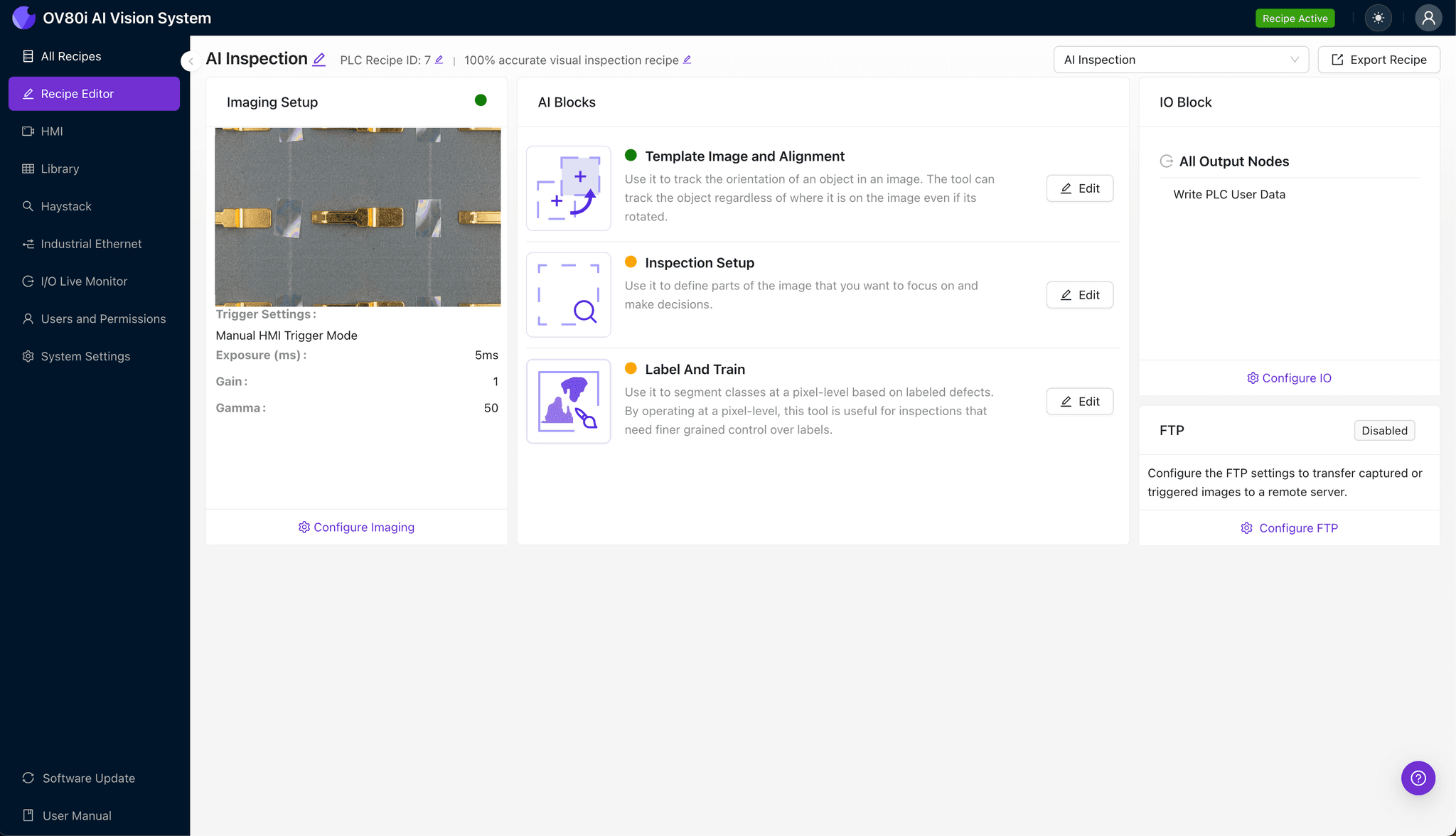
Step 1: Imaging Setup
Position the space-grade contact with outgassing film under the OV80i camera system, ensuring the inspection surface is properly illuminated. Lighting angle is critical—angled illumination often reveals film defects that direct lighting misses.
Click "Configure Imaging" in the Overview interface to access Camera Settings. Adjust exposure to capture film detail without overexposing reflective contact surfaces, and fine-tune gain to optimize signal-to-noise ratio.
Click "Save" to lock in your imaging configuration.
Step 2: Image Alignment
Navigate to "Template Image" and capture a reference image of a known-good contact. This template anchors all subsequent inspections and ensures consistent part positioning.
Click "+ Rectangle" to draw a region around the main body of the contact, including all film-covered surfaces. Set "Rotation Range" to 20 degrees to accommodate minor orientation variations as parts arrive on the line.

Step 3: Inspection Region Selection
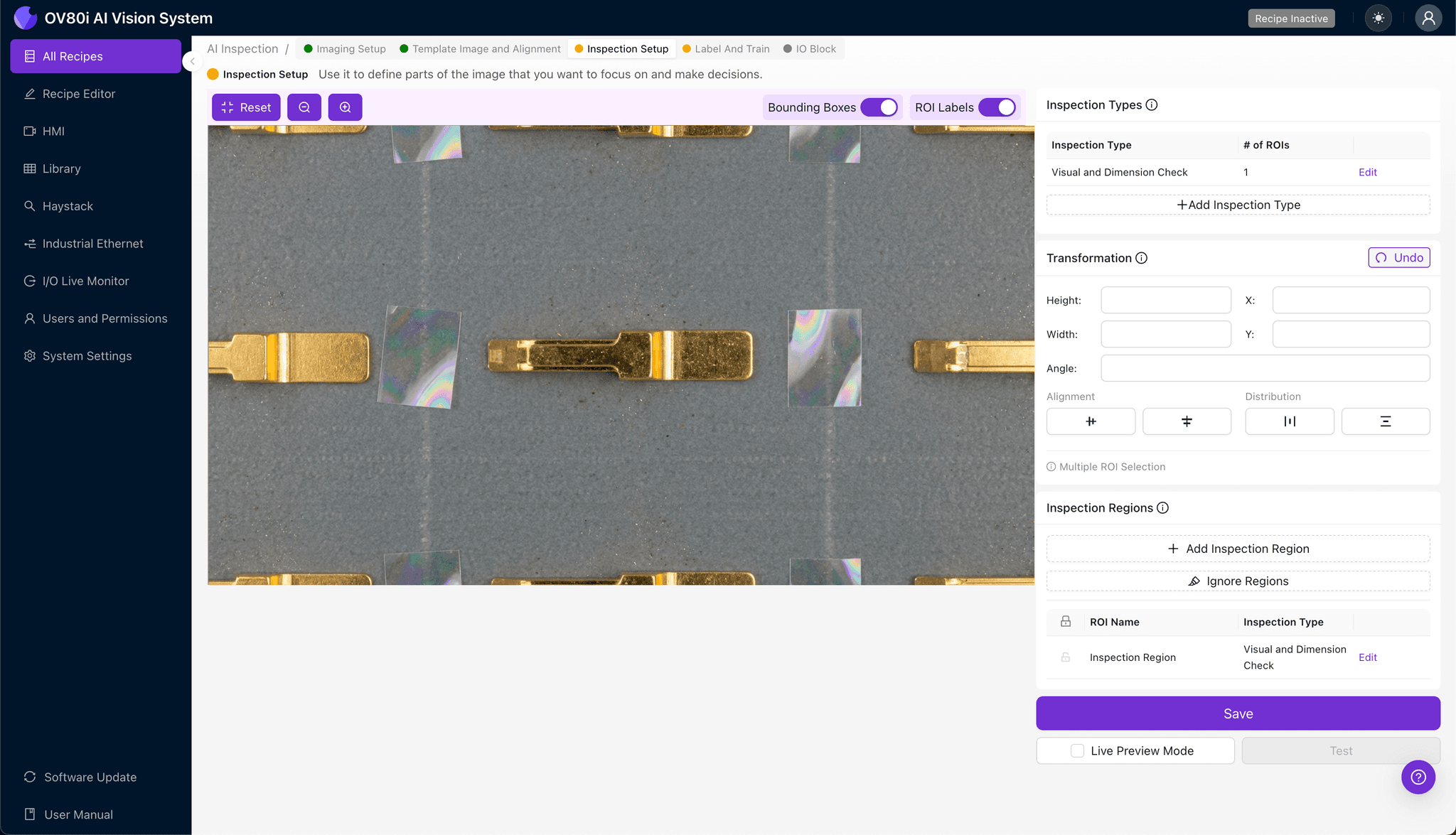
Navigate to "Inspection Setup" to define where the system should look for defects. Rename "Inspection Types" to reflect your specific failure modes—for example, "Film Delamination," "Pinhole Voids," or "Edge Lift."
Click "+ Add Inspection Region" for each critical area. Resize the yellow bounding box to cover the film-contact interface, plated surfaces, and edge boundaries where defects most commonly occur.
Click "Save" to confirm your inspection zones.
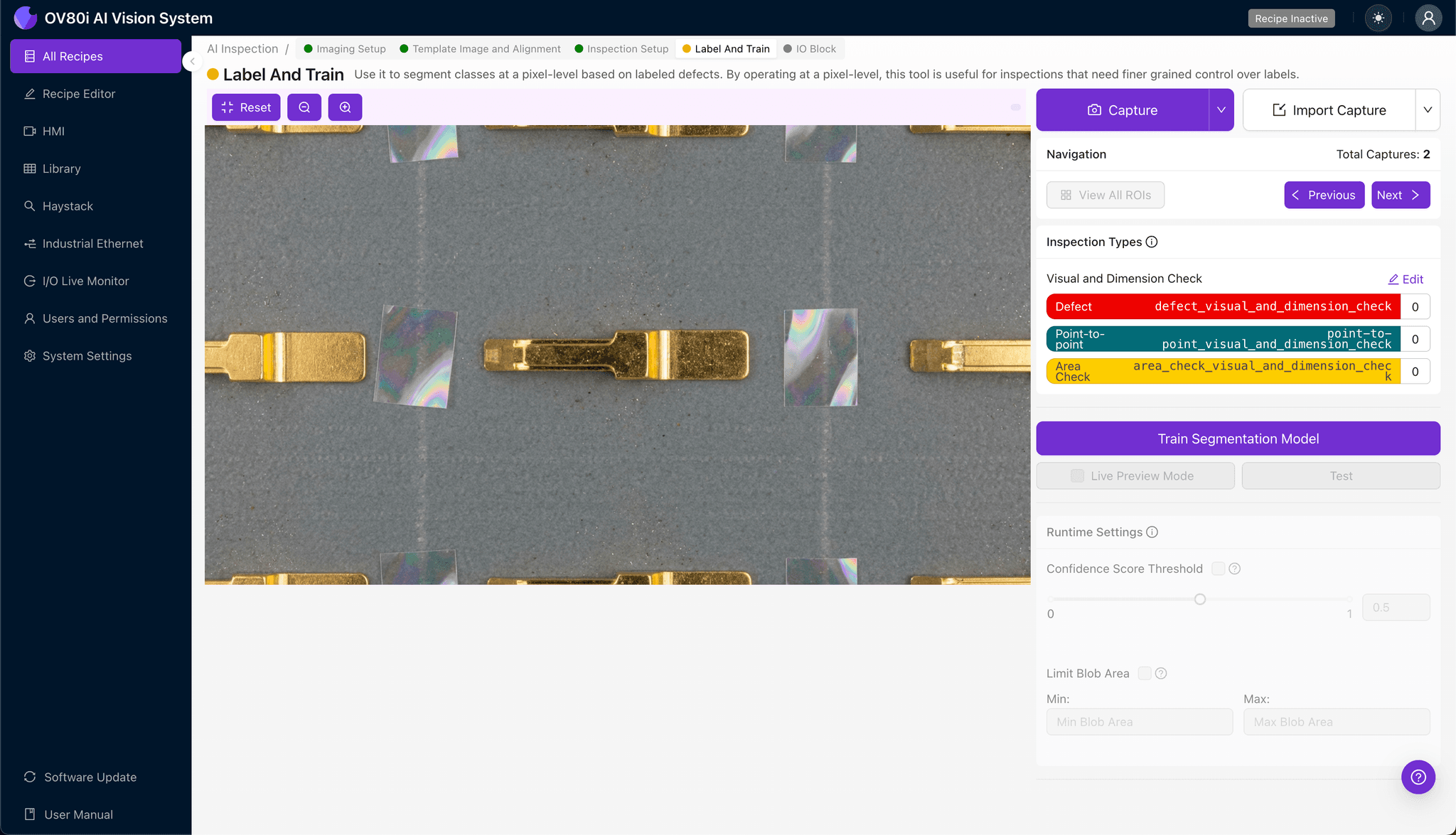
Step 4: Labeling Data
This human-in-the-loop phase trains the AI to distinguish acceptable contacts from rejects. Review captured images and label each as "Good" or "Bad" based on your quality standards.
Include representative samples across the full range of acceptable variation. Critically, incorporate known failure modes—contacts rejected in past audits, customer returns, and intentionally induced defect samples provide the model with clear decision boundaries.
Step 5: Creating Rules
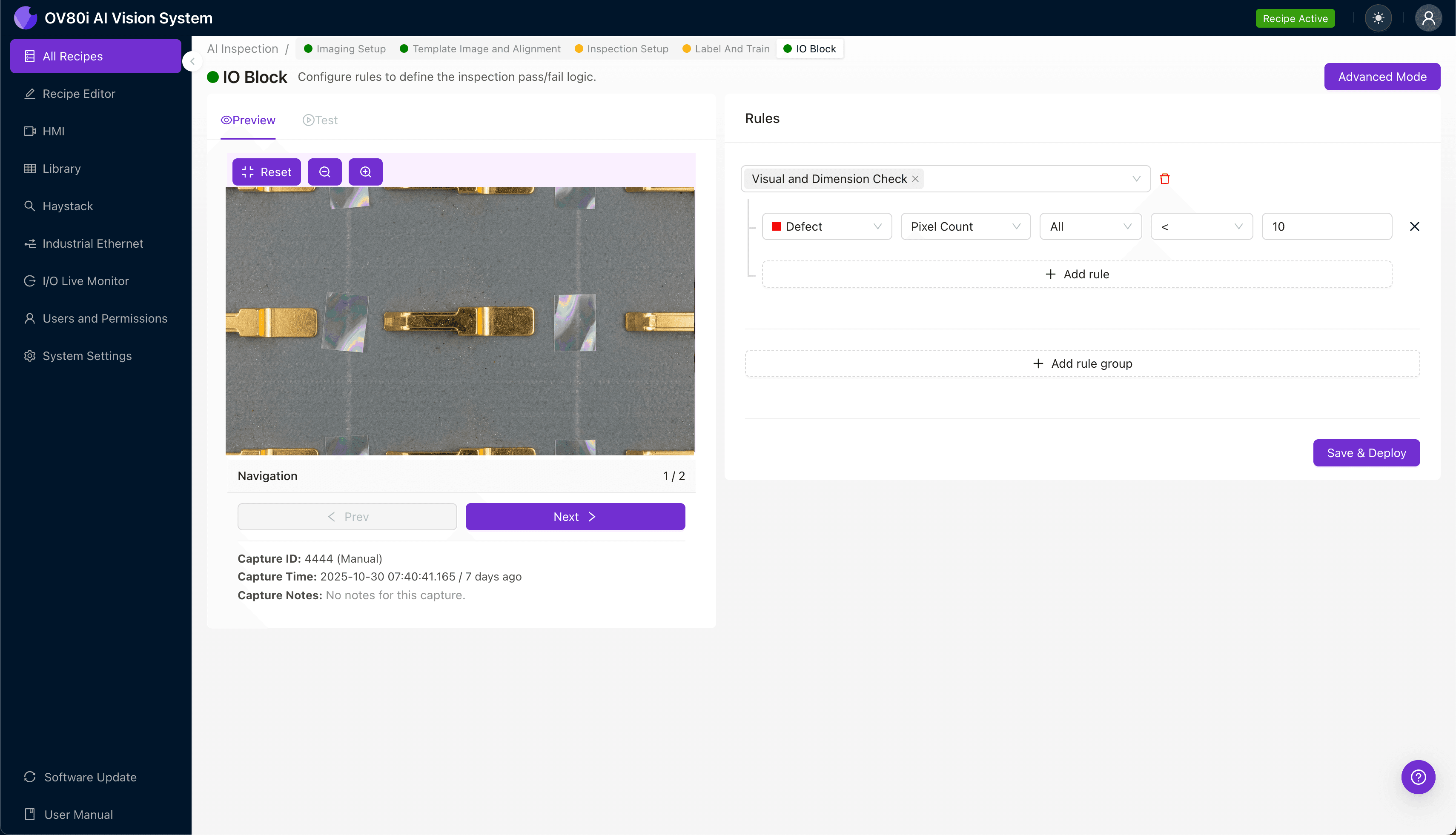
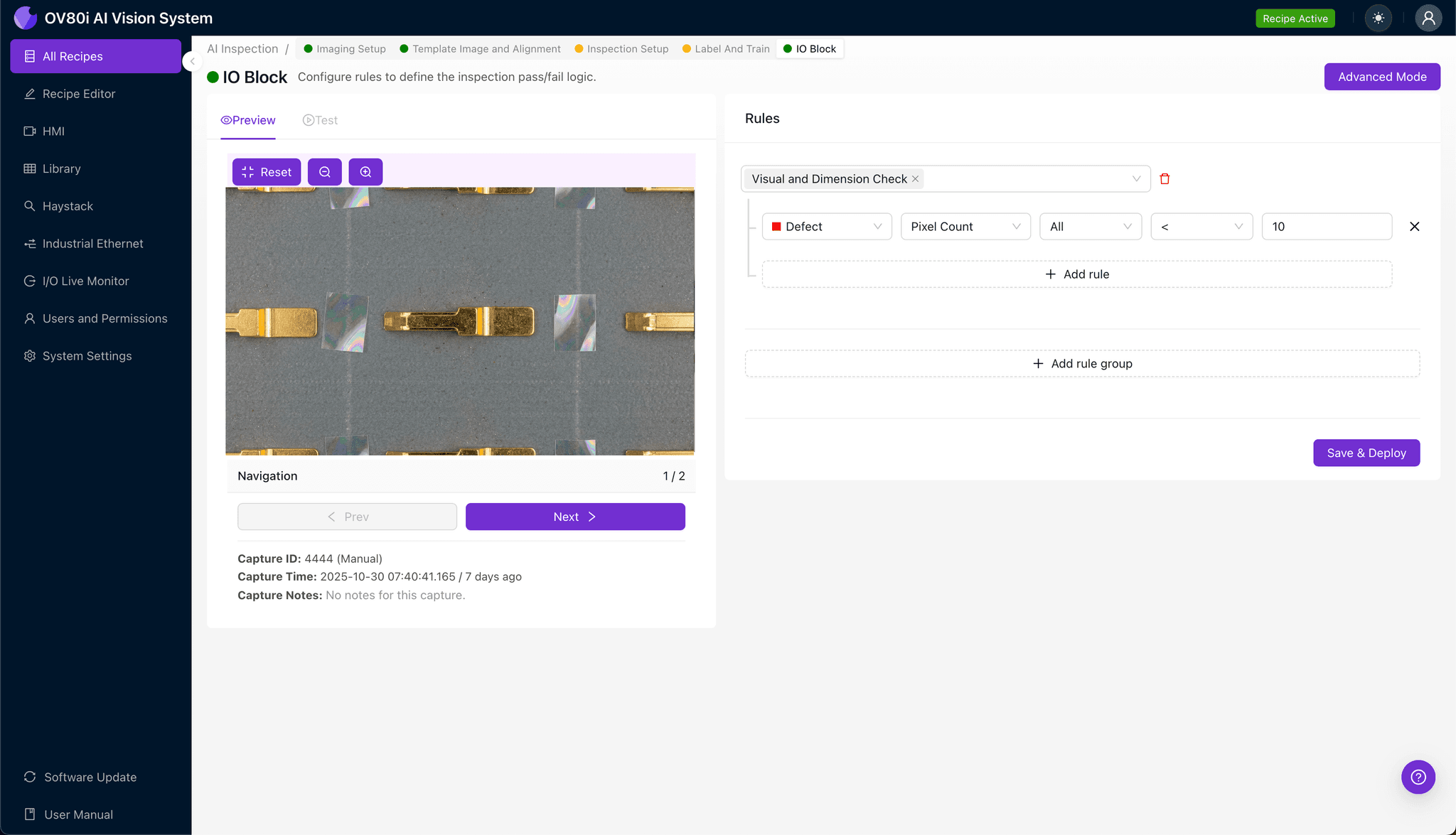
Configure pass/fail logic based on your defined Inspection Types. You might require all zones to pass, or weight certain defects (like film delamination) as automatic failures while allowing minor surface contamination to trigger secondary review.
Gate automated acceptance on the production line, ensuring only verified-good contacts proceed to downstream assembly. Rejected parts route automatically for disposition or rework.
Key Outcomes & ROI
Implementing AI-powered inspection for space-grade contacts with outgassing film delivers measurable business impact:
- Reduced scrap rates — catch defects early before value-added processing wastes material and labor
- Higher throughput — inspect 100% of production at line speed without manual bottlenecks
- Compliance and traceability — automatically log inspection images and results for AS9100 and NASA-STD-6016 audit requirements
- Process improvement insights — trend data reveals upstream process drift before it causes batch failures
Conclusion
Space-grade contacts with outgassing film demand inspection rigor that human operators simply cannot maintain at production scale. Overview.ai's visual inspection platform combines high-resolution imaging with deep learning to deliver the consistency, speed, and documentation that aerospace manufacturing requires—protecting both mission success and your bottom line.
Eliminate Defects Today
Stop relying on manual inspection. Deploy Overview.ai to catch defects instantly.