How to Inspect Stamped Ground Blades with Fractured Lance Features Using AI Vision
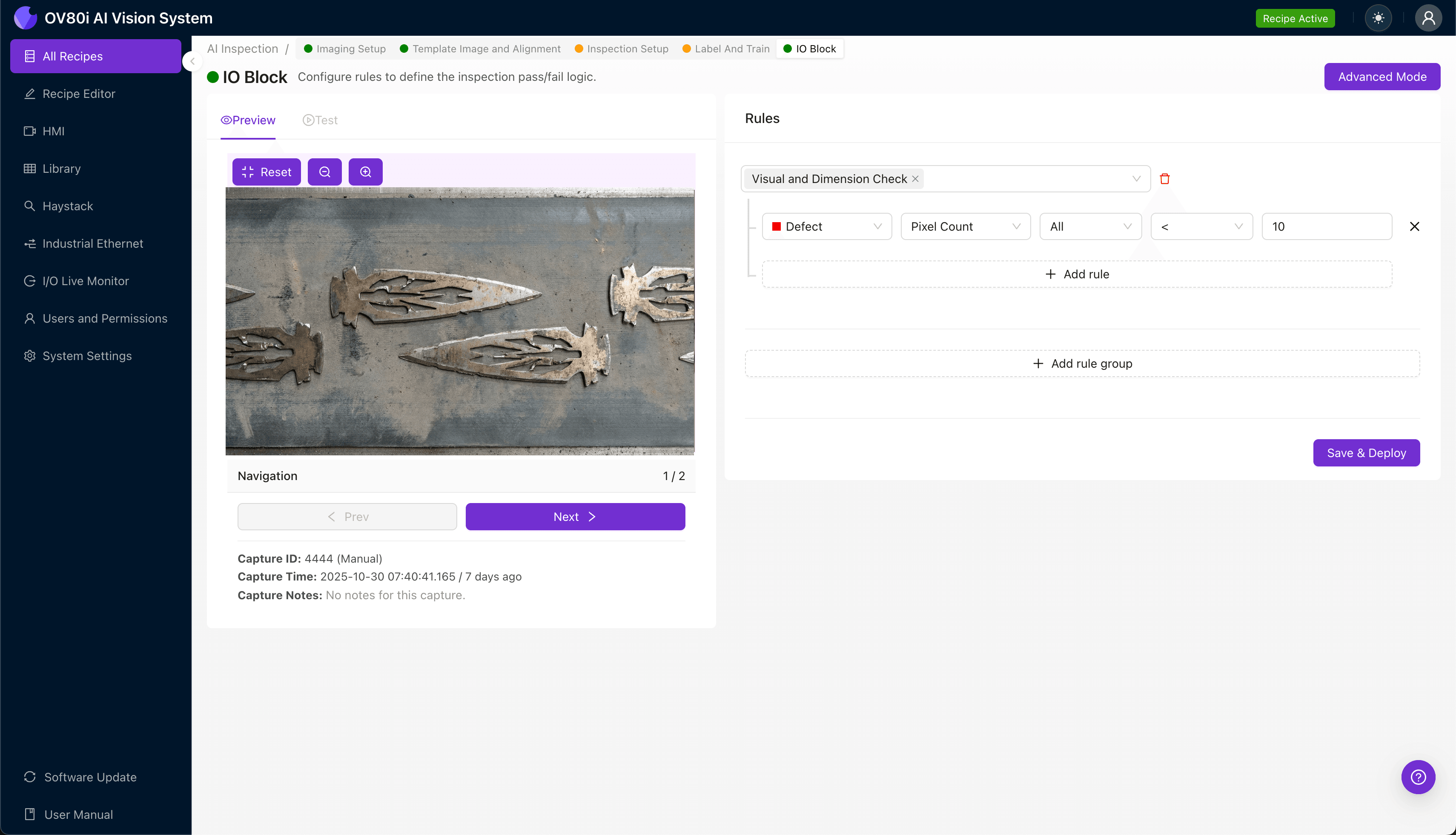
"Fractured lance features on stamped ground blades often measure under 0.5mm, making them nearly impossible for human inspectors to catch consistently. AI-powered visual inspection detects these micro-fractures at full line speed, eliminating escaped defects and protecting downstream assembly quality."
The Problem: Why Fractured Lance Defects Slip Through Manual Inspection
Stamped ground blades with lance features are critical components in HVAC systems, automotive heat exchangers, and industrial cooling applications. When the lance feature fractures during the stamping process, the entire assembly's thermal transfer efficiency and structural integrity become compromised.
Common Defects in Stamped Ground Blades with Lance Features
- Fractured lance tips – Partial or complete breakage at the lance peak during forming
- Lance root cracking – Micro-fractures where the lance meets the blade base
- Incomplete lance formation – Underdeveloped features due to die wear or material inconsistency
- Burr formation at lance edges – Sharp material remnants creating assembly hazards
- Lance misalignment – Angular deviation from specified orientation
- Surface scoring on ground areas – Grinding wheel damage near lance features
Human inspectors struggle with these defects because lance fractures often measure less than 0.5mm. Inspector fatigue sets in quickly when examining hundreds of blades per hour, and the reflective ground surfaces create visual inconsistencies that make defect identification unreliable.
The Solution: Machine Vision + Deep Learning
Traditional rule-based machine vision systems fail on stamped ground blades because the acceptable variation in lance geometry is difficult to define programmatically. Deep learning changes this by training neural networks to recognize the subtle visual patterns that distinguish good lances from fractured ones.
Overview.ai's approach delivers consistent, objective inspection at full line speed—examining every single blade without slowdowns or sampling. The system learns from your actual production data, adapting to your specific tooling, materials, and quality standards.
Step 1: Imaging Setup
Position the stamped ground blade under the OV80i camera with the lance feature facing upward. Ensure consistent part placement using a fixture or conveyor guides to minimize variation between inspections.
Click "Configure Imaging" in the Overview interface. Adjust the Camera Settings—increase exposure to capture detail in the ground surface while setting gain to minimize noise around the lance edges.
Click "Save" to lock in your imaging parameters.
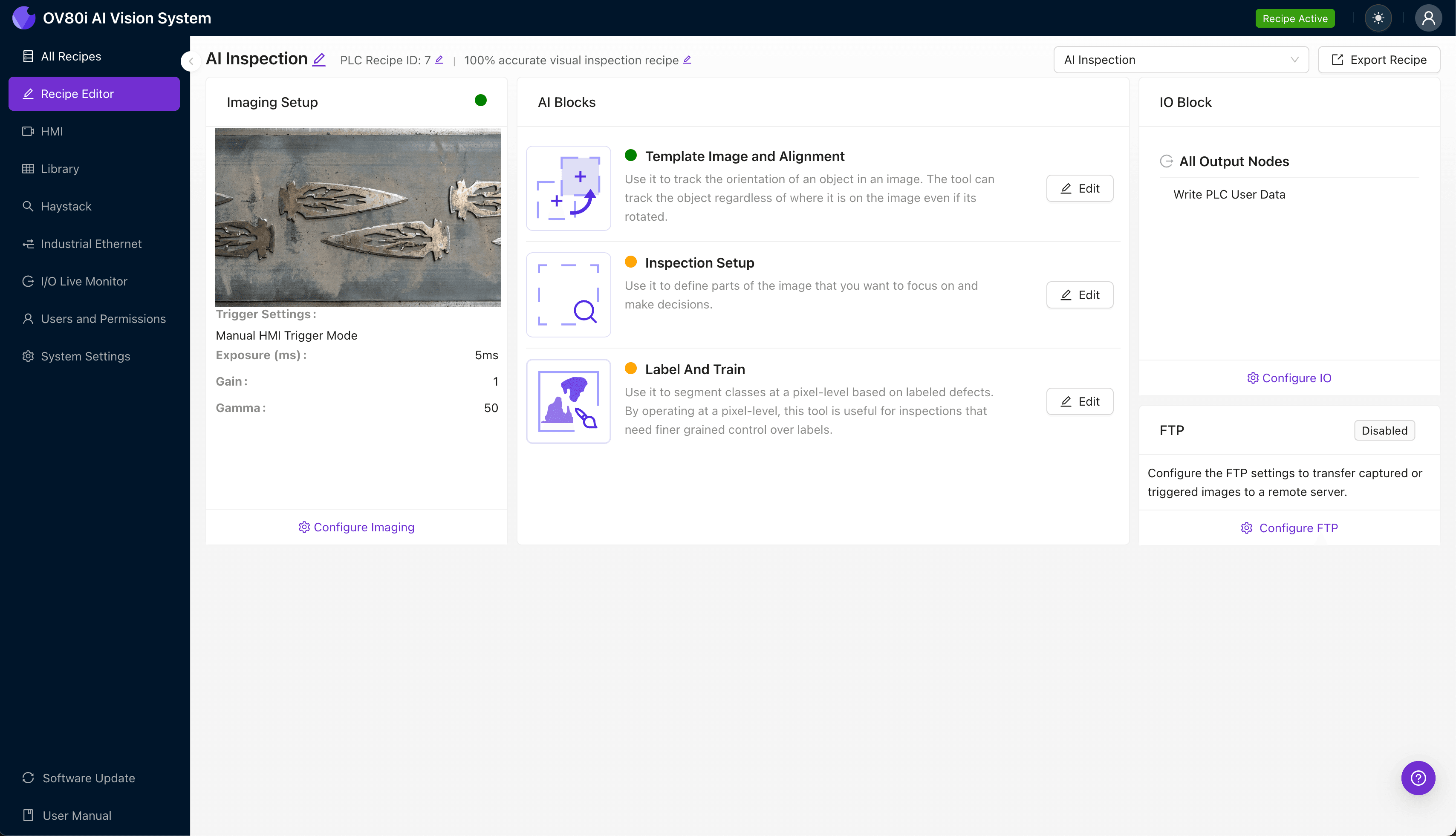
Step 2: Image Alignment
Navigate to "Template Image" in the configuration menu. Capture a Template using a known-good blade positioned in the standard orientation.
Click "+ Rectangle" and draw a region around the main blade body, ensuring the lance feature sits centered within the boundary. Set the "Rotation Range" to 20 degrees to accommodate minor part rotation on the line.

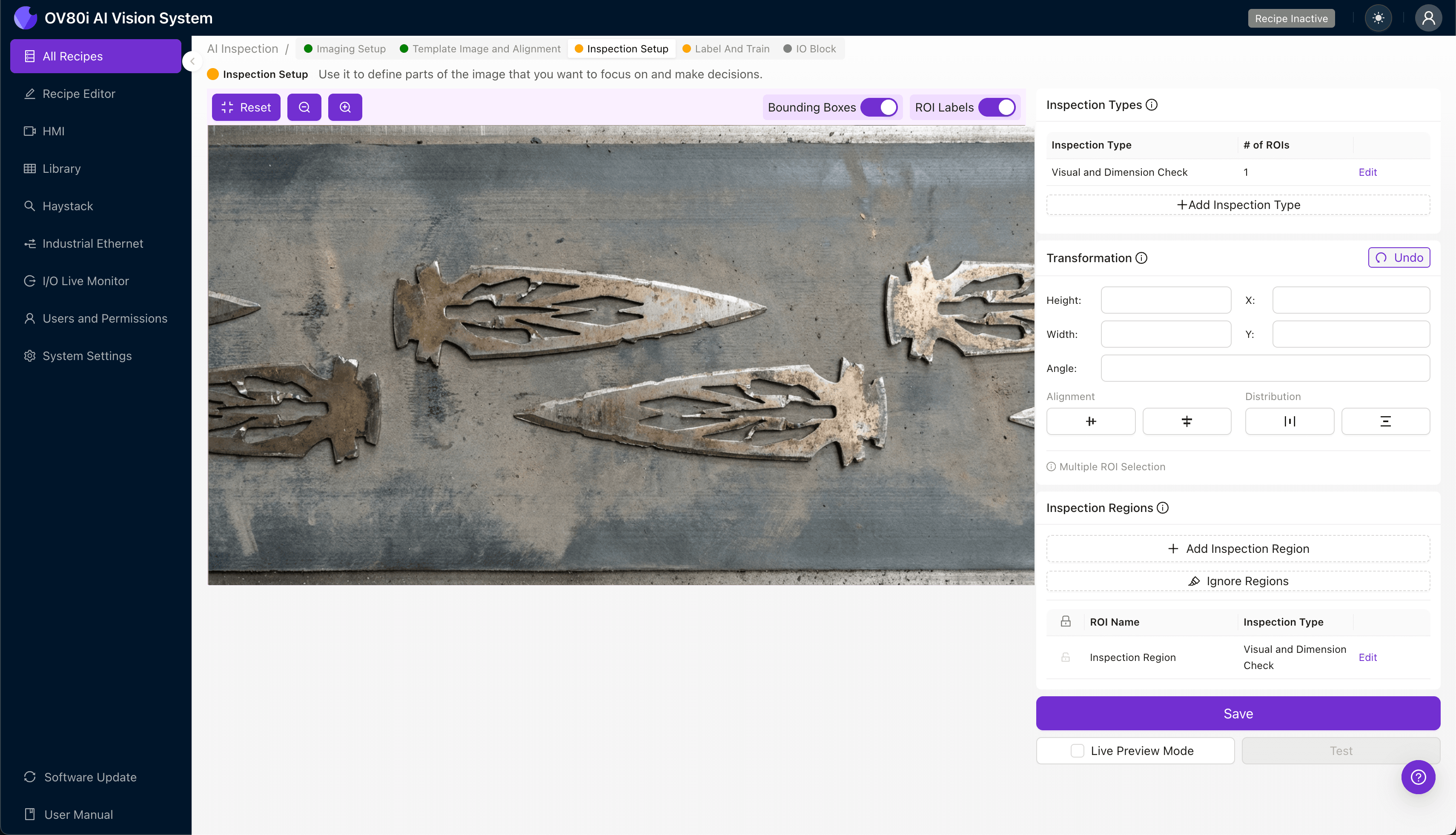
Step 3: Inspection Region Selection
Navigate to "Inspection Setup" from the main dashboard. Rename your "Inspection Types" to reflect the specific defect categories—for example, "Lance Fracture," "Root Crack," and "Burr Detection."
Click "+ Add Inspection Region" for each defect type. Resize the yellow bounding box to cover the critical lance tip area, the lance-to-base junction, and the ground surface zones.
Click "Save" after defining all inspection regions.
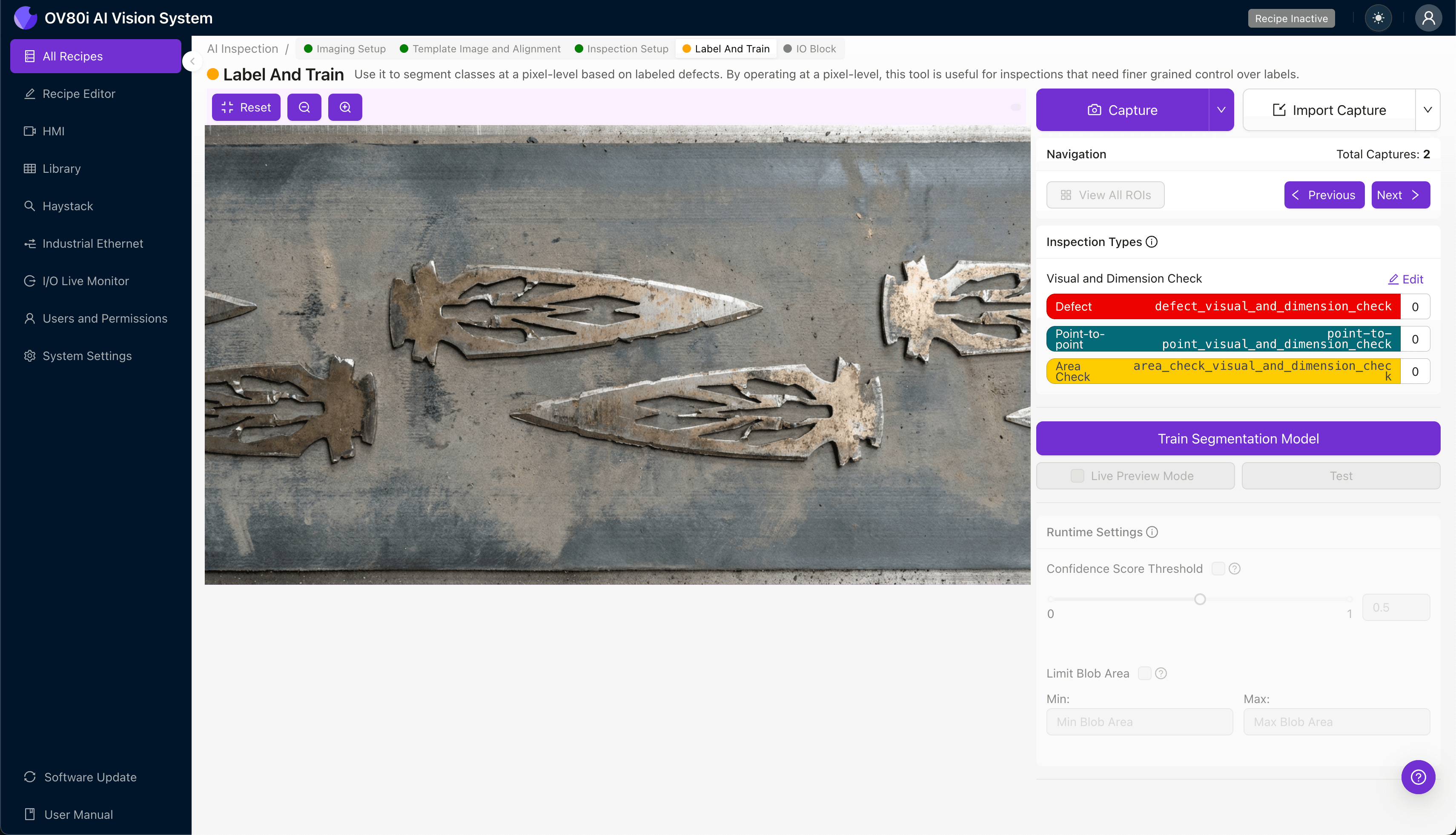
Step 4: Labeling Data
The human-in-the-loop labeling process teaches the AI what your specific defects look like. Review captured images and label each as Good or Bad based on your quality standards.
Include representative samples across your full production variation—different material lots, tooling states, and shift conditions. Ensure known failure modes like hairline lance cracks and partial tip fractures appear in your labeled dataset to build robust detection capability.
Step 5: Creating Rules
Set your pass/fail logic based on the Inspection Types you defined. Configure thresholds for each defect category—for instance, any detected lance fracture triggers an automatic reject.
Gate automated acceptance on the line by linking inspection results to your reject mechanism. Parts passing all inspection criteria proceed downstream while flagged blades divert for secondary review or scrap.
Key Outcomes & ROI
Implementing AI-powered inspection for stamped ground blades delivers measurable business impact:
- Reduced scrap rates – Catch fractured lances before downstream assembly wastes additional labor and materials
- Higher throughput – Inspect 100% of production without bottlenecking the stamping line
- Compliance and traceability – Maintain complete inspection records for automotive and aerospace quality audits
- Process improvement insights – Correlate defect trends with die wear, material batches, or press parameters to address root causes
Stop Fractured Lances from Escaping Your Line
Fractured lance features don't have to slip past your quality gates. Deploy Overview.ai's deep learning inspection for the consistency and speed that manual inspection cannot match.