Detecting Tin-Plated Terminal Whisker Growth with AI-Powered Visual Inspection
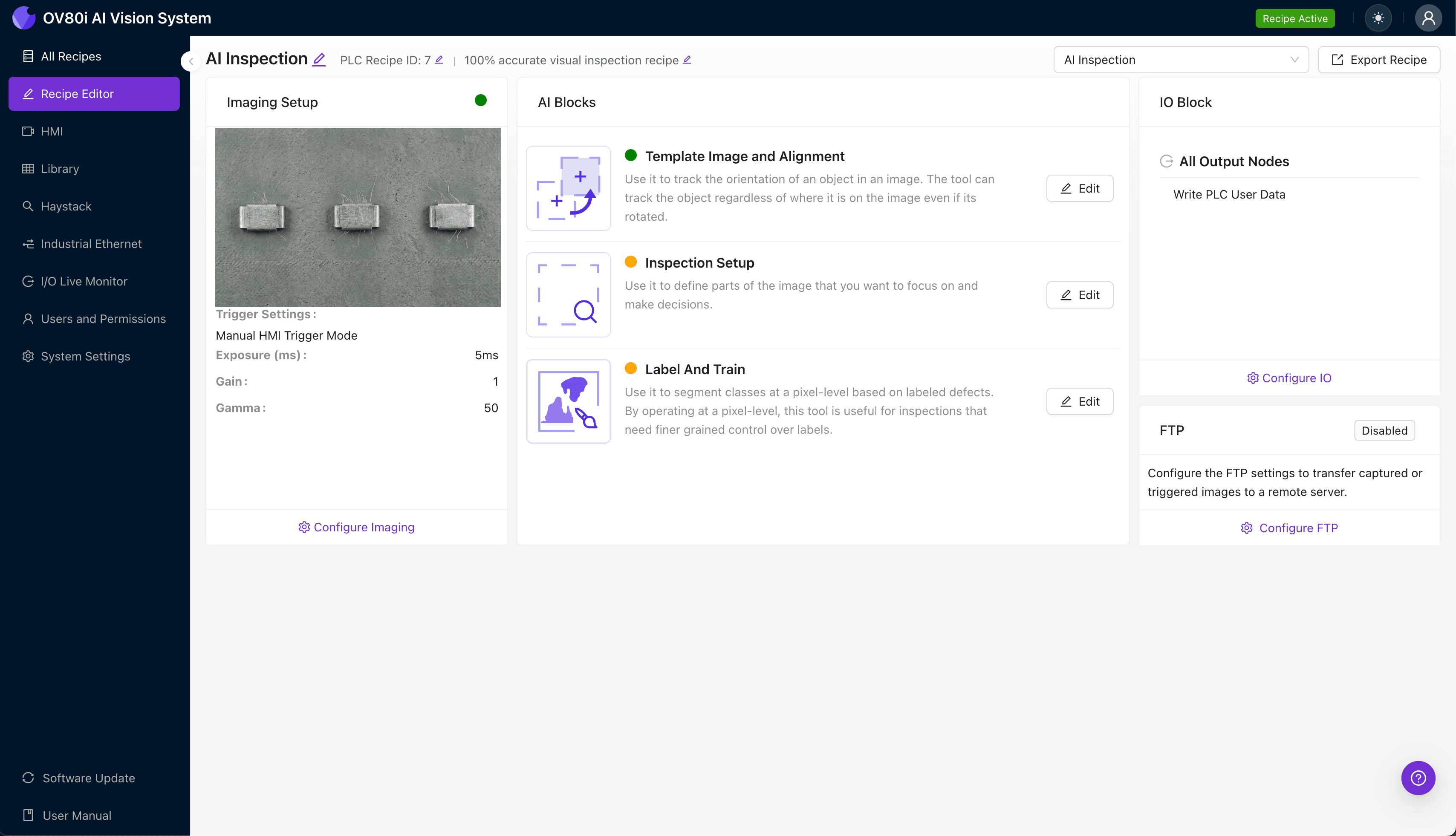
"Tin whiskers are microscopic crystalline filaments that spontaneously grow from tin-plated surfaces, causing catastrophic failures in electronics. AI-powered visual inspection detects these nearly invisible defects at production speed, enabling 100% inline quality control that human inspectors simply cannot achieve."
The Problem: A Microscopic Defect with Catastrophic Consequences
Tin whiskers are crystalline metal filaments that spontaneously grow from tin-plated surfaces, sometimes reaching several millimeters in length. These nearly invisible structures have caused failures in everything from medical devices to satellites, making them one of the most insidious defects in electronics manufacturing.
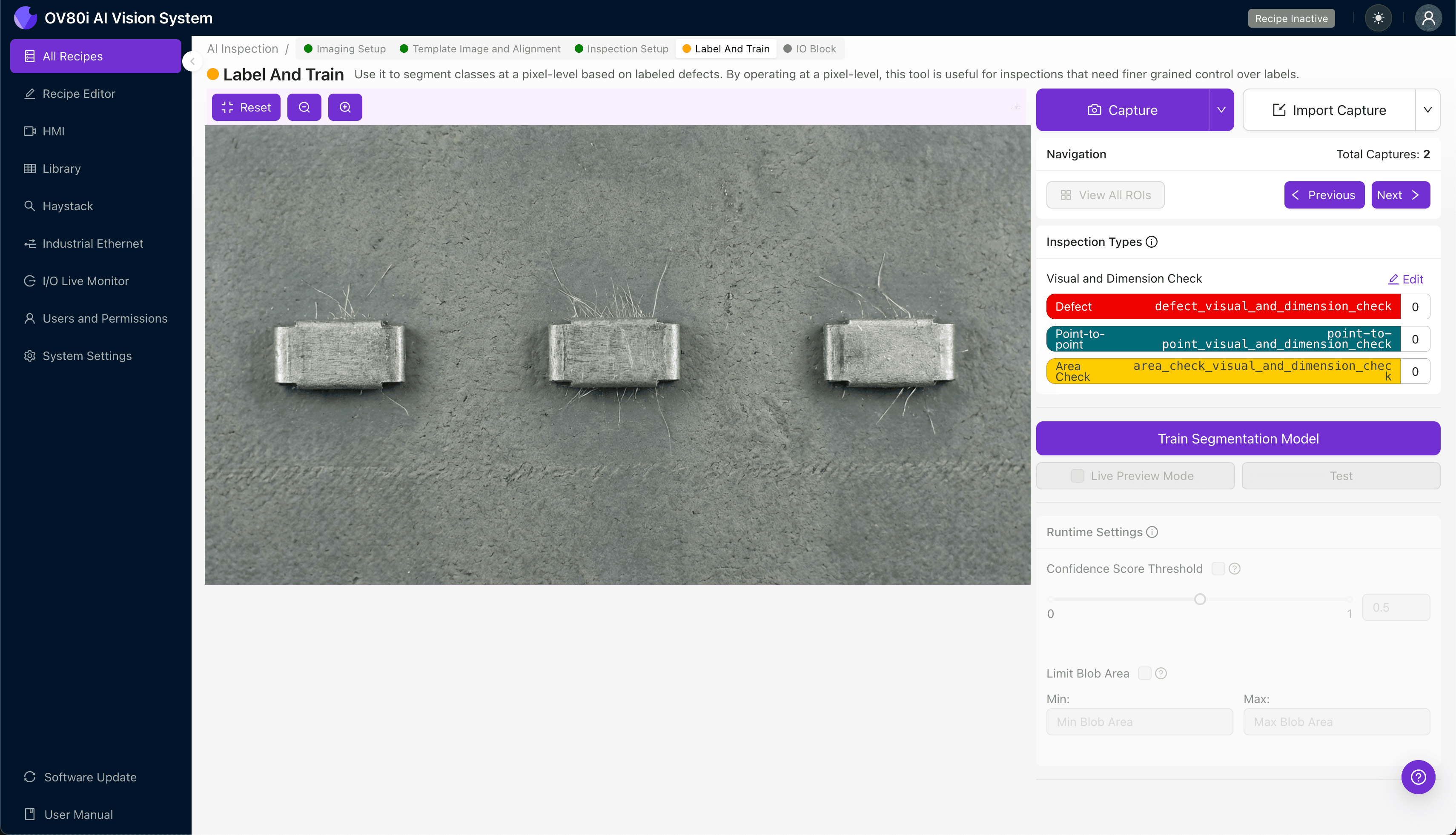
Common Defects Found in Tin-Plated Terminals with Whisker Growth
- Filament whiskers — hair-like protrusions extending from the tin surface that can bridge adjacent conductors
- Nodular eruptions — dome-shaped growths that precede or accompany whisker formation
- Hillocks — raised mounds on the tin surface indicating internal stress and early-stage whisker nucleation
- Bridging whiskers — filaments that have grown long enough to contact neighboring terminals or traces
- Broken whisker debris — detached whisker fragments that become conductive contaminants
- Surface oxidation patterns — discoloration indicating stress zones prone to future whisker development
Traditional manual inspection consistently fails to catch tin whisker defects. The filaments can be as thin as 1 micron in diameter—far below the threshold of reliable human visual detection, especially at production speeds.
Inspector fatigue compounds the problem during extended shifts, and the subjective nature of identifying early-stage growth leads to inconsistent pass/fail decisions across different operators and inspection stations.
The Solution: Machine Vision and Deep Learning
AI-powered visual inspection systems overcome human limitations by analyzing every terminal with consistent, objective criteria. Deep learning models trained on thousands of whisker examples can identify growth patterns that would escape even the most experienced quality technician.
Unlike rule-based machine vision that struggles with the variable morphology of whiskers, neural networks learn to recognize subtle surface anomalies and predict high-risk areas. Overview.ai's approach delivers this capability at full line speed, enabling 100% inline inspection without creating production bottlenecks.
Step 1: Imaging Setup
Position the tin-plated terminal under the OV80i camera system, ensuring the plated surface faces the lens with appropriate working distance. Proper lighting angle is critical—oblique illumination helps reveal the shadow signatures of microscopic whiskers.
Click "Configure Imaging" to access the Camera Settings panel. Adjust exposure to capture surface detail without washout, and fine-tune gain to maximize whisker visibility against the reflective tin background.
Click "Save" to lock in your optimized imaging parameters.
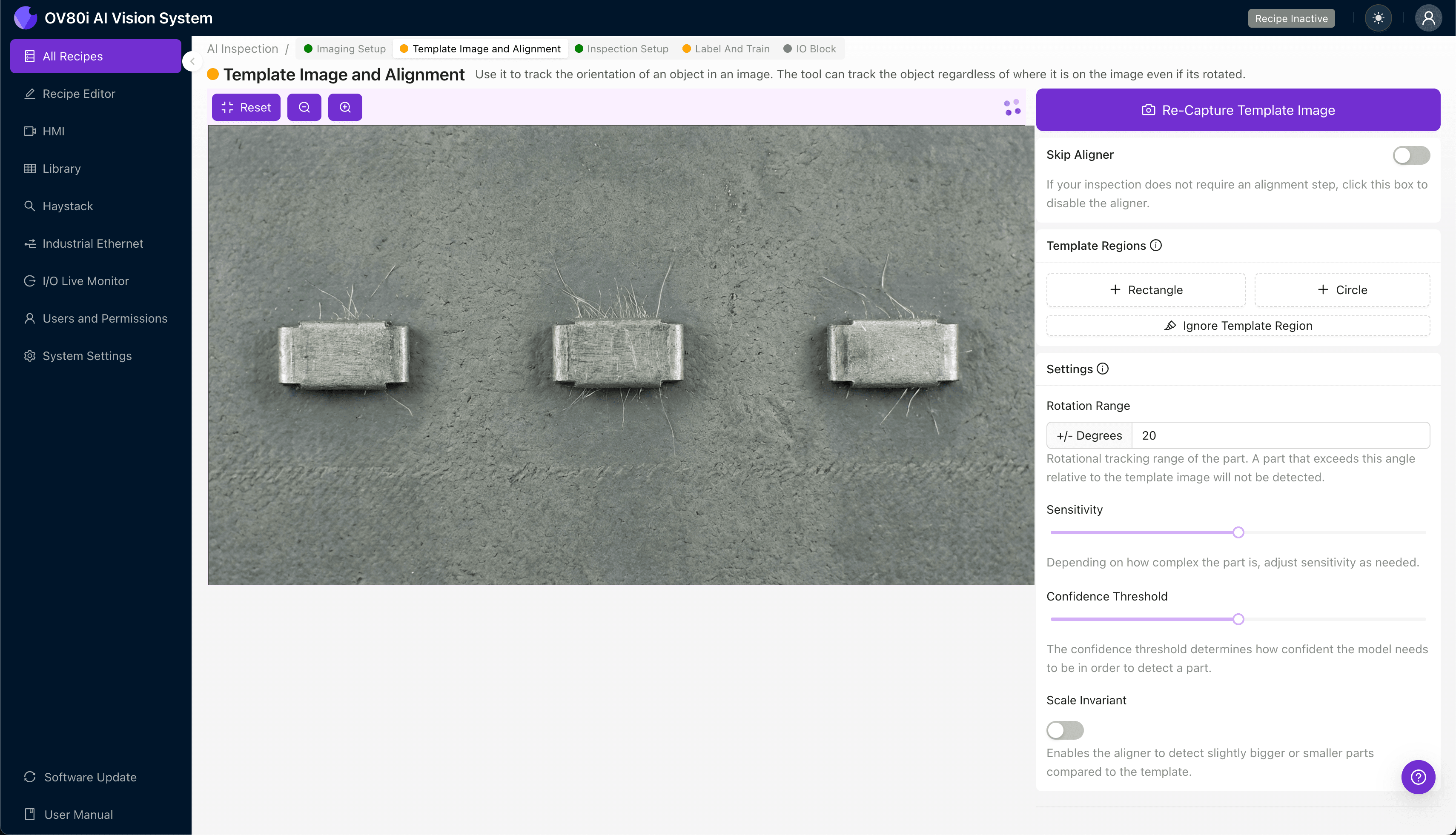
Step 2: Image Alignment
Navigate to "Template Image" in the configuration menu. Capture a Template using a known-good terminal positioned in standard orientation.
Click "+ Rectangle" to add an alignment region around the terminal's main body—this anchors the inspection frame regardless of minor placement variations.
Set the Rotation Range to 20 degrees to accommodate typical positioning tolerance on the conveyor or fixture.
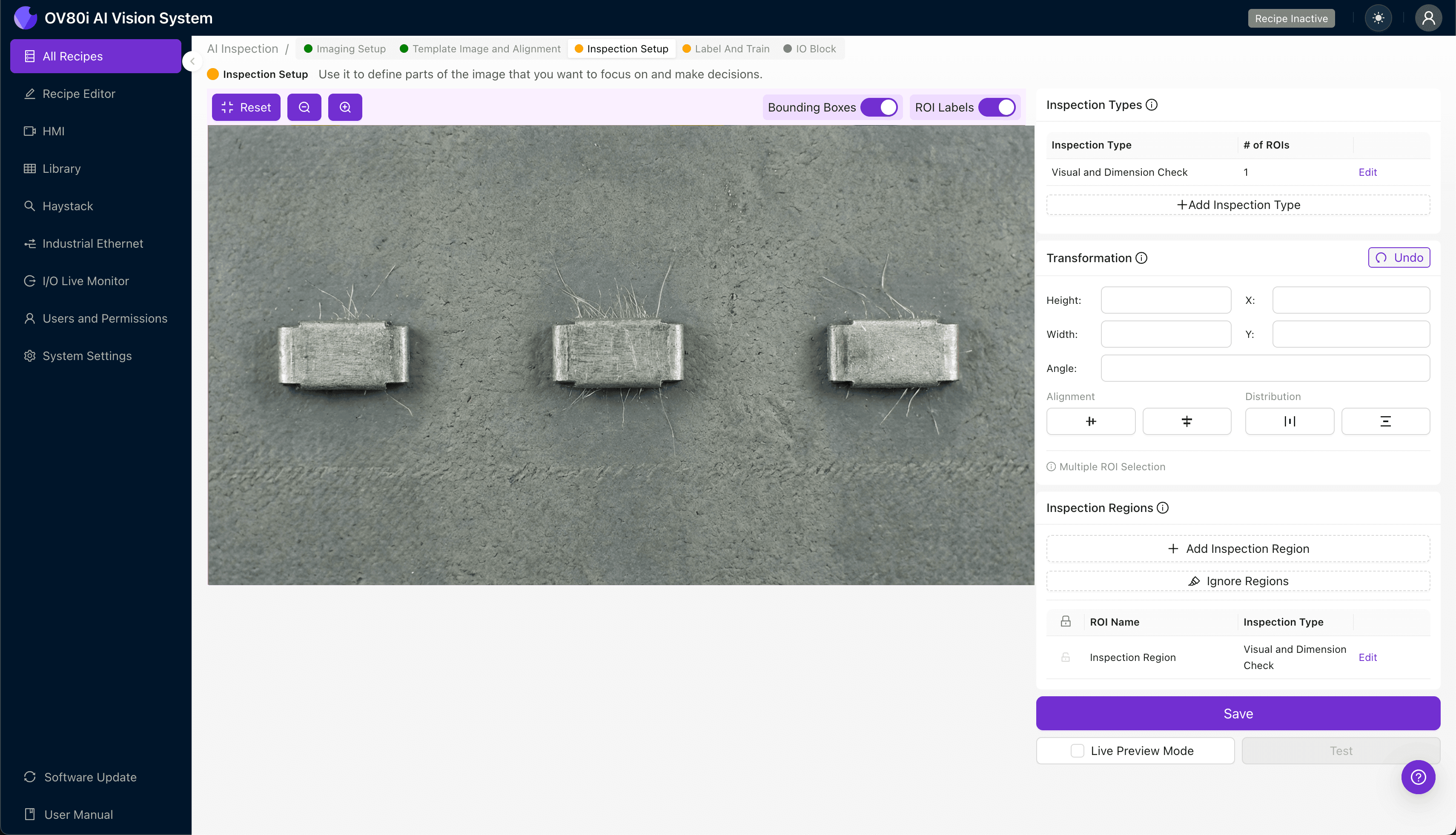
Step 3: Inspection Region Selection
Navigate to "Inspection Setup" to define your detection zones. Rename the default "Inspection Types" to meaningful labels such as "Whisker_Growth", "Surface_Nodules", and "Bridge_Risk_Zone".
Click "+ Add Inspection Region" to create your first detection area. Resize the yellow bounding box to cover critical surfaces—focus on terminal edges, crimp zones, and areas near adjacent conductors where bridging poses the greatest risk.
Click "Save" after defining all inspection regions.
Step 4: Labeling Data
The human-in-the-loop labeling process trains the AI to distinguish acceptable terminals from those with whisker defects. Quality engineers review captured images and classify each as Good or Bad based on established acceptance criteria.
Include representative samples across the full spectrum of defect severity—from early-stage hillocks to mature filament whiskers. Incorporate known failure modes from field returns and accelerated aging tests to build a robust training dataset.
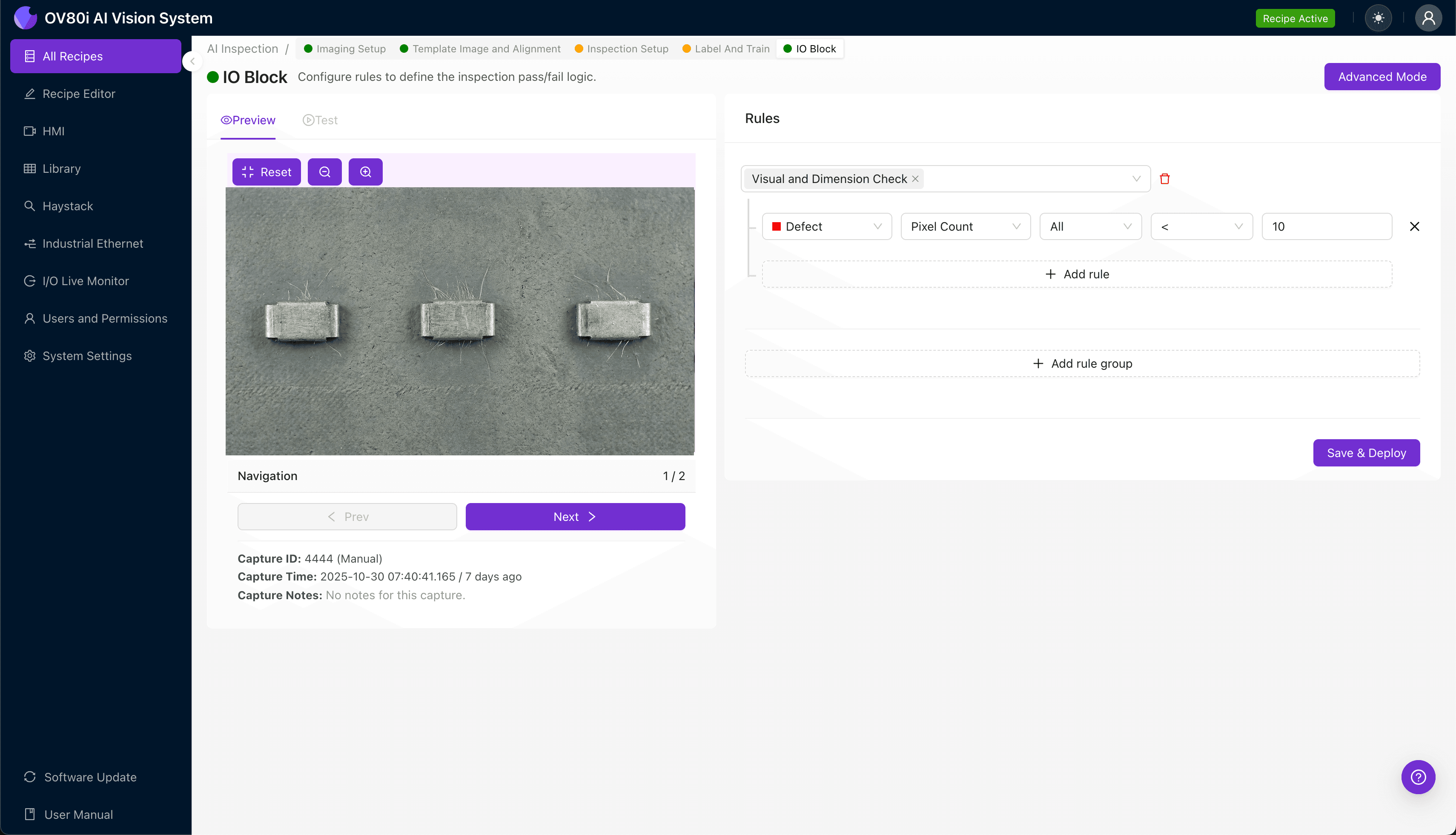
Step 5: Creating Rules
Configure pass/fail logic based on your defined Inspection Types. Set thresholds that trigger rejection when the AI confidence score for whisker detection exceeds your quality tolerance.
These rules gate automated acceptance on the production line, diverting suspect terminals for secondary review or immediate rejection without slowing throughput.
Key Outcomes & ROI
Implementing AI-powered whisker detection delivers measurable business impact across multiple dimensions.
- Reduced scrap and rework — catch defective terminals before they reach downstream assembly, eliminating costly board-level failures
- Higher throughput — 100% inspection at line speed removes the bottleneck of sampling-based manual QC
- Compliance and traceability — maintain complete inspection records for automotive, aerospace, and medical device regulatory requirements
- Process improvement insights — trend data reveals correlations between whisker incidence and upstream variables like plating bath chemistry or storage conditions
Conclusion
Tin whisker growth represents a uniquely challenging quality control problem—microscopic, unpredictable, and potentially catastrophic. Overview.ai's deep learning-powered inspection transforms this invisible threat into a manageable, measurable process parameter.
By deploying the OV80i for inline whisker detection, manufacturers gain the confidence that comes from inspecting every single terminal with superhuman consistency and precision.
Eliminate Tin Whisker Defects Today
Stop relying on manual inspection for microscopic defects. Deploy Overview.ai to catch tin whiskers instantly at full production speed.