Twinax Cable with a Kinked Outer Foil Shield: A Complete Visual Inspection Guide
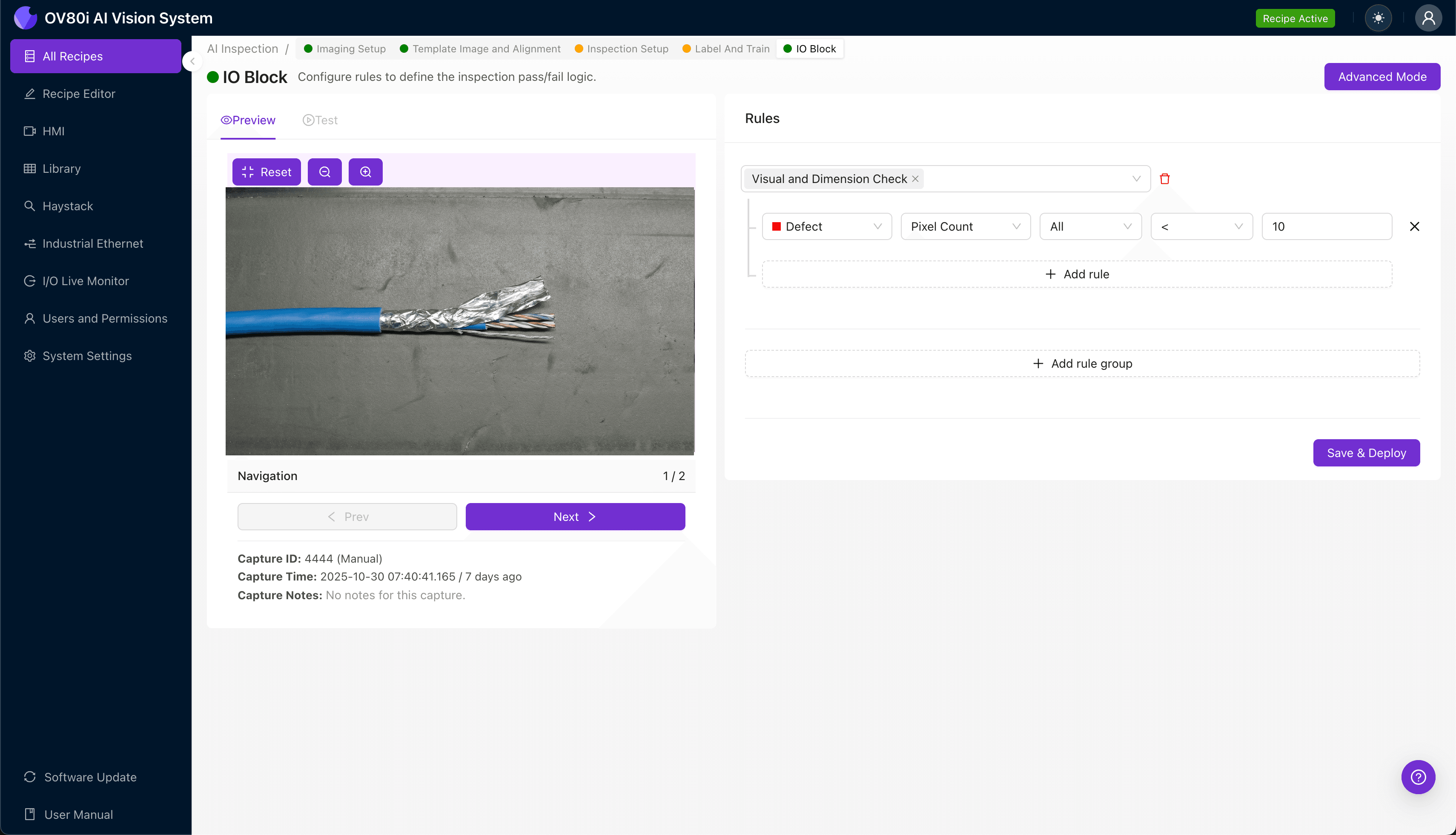
"Kinked outer foil shields in Twinax cables compromise signal integrity and EMI protection, yet human inspectors struggle to detect these subtle defects consistently. AI-powered visual inspection delivers real-time, accurate detection at full production line speed—eliminating fatigue-related misses and protecting product quality."
The Problem: Why Kinked Foil Shields Escape Manual Detection
Twinax cables are critical high-speed data transmission components used in data centers, telecommunications, and industrial networking applications. When the outer foil shield becomes kinked during manufacturing or handling, it compromises both signal integrity and electromagnetic interference (EMI) protection.
Common Defects in Kinked Outer Foil Shields:
- Sharp angular creases — Permanent deformation points that crack the foil's conductive layer
- Foil layer separation — Delamination between the foil and its bonded mylar backing
- Micro-tears at kink apex — Small ruptures that create gaps in shielding continuity
- Conductor displacement — Internal wire pair shifting caused by external shield damage
- Uneven foil tension — Loose or bunched shielding material adjacent to the kink zone
- Jacket deformation — Outer insulation distortion masking underlying foil damage
Human inspectors struggle to consistently identify these defects across high-volume production runs. Fatigue sets in after just 20-30 minutes of repetitive inspection, and subtle variations in foil damage are easily missed at production line speeds.
The Solution: Machine Vision and Deep Learning
Traditional rule-based vision systems fail with kinked foil shields because the defects present in countless variations—different angles, depths, and locations along the cable. Deep learning models, however, learn to recognize the concept of a kink rather than matching against rigid templates.
These AI-powered systems analyze thousands of pixel-level patterns simultaneously, detecting anomalies that would require microscopic examination by human inspectors.
Overview.ai's approach delivers consistent, objective inspection at full line speed—eliminating the variability inherent in manual quality control. The system never fatigues, never loses focus, and applies identical scrutiny to every cable that passes through the inspection zone.
Step 1: Imaging Setup
Position the Twinax cable sample with the kinked outer foil shield under the OV80i camera, ensuring the damaged section is fully visible within the field of view. Proper lighting is essential—use angled illumination to accentuate surface irregularities in the foil.
Click "Configure Imaging" to access the Camera Settings panel. Adjust exposure to prevent reflective hotspots on the metallic foil surface, and fine-tune gain to capture subtle shadow details in the kink region.
Click "Save" to lock in your optimized imaging parameters.
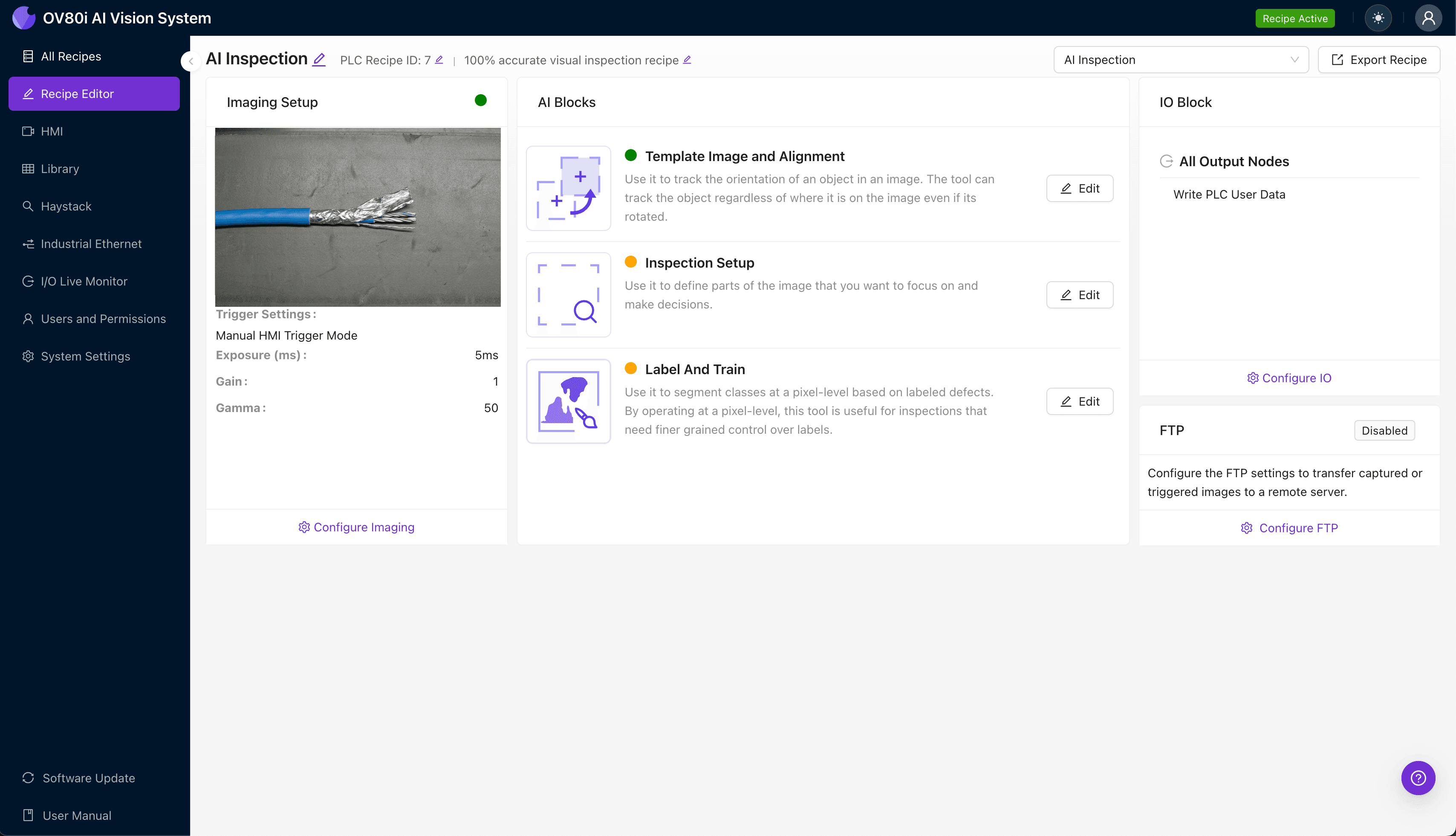
Step 2: Image Alignment
Navigate to the "Template Image" section and capture a Template of a properly positioned cable. This reference image ensures consistent alignment across all subsequent inspections.
Click "+ Rectangle" to add a region around the main cable body, encompassing the full inspection zone. Set the "Rotation Range" to 20 degrees to accommodate minor variations in cable positioning on the production line.
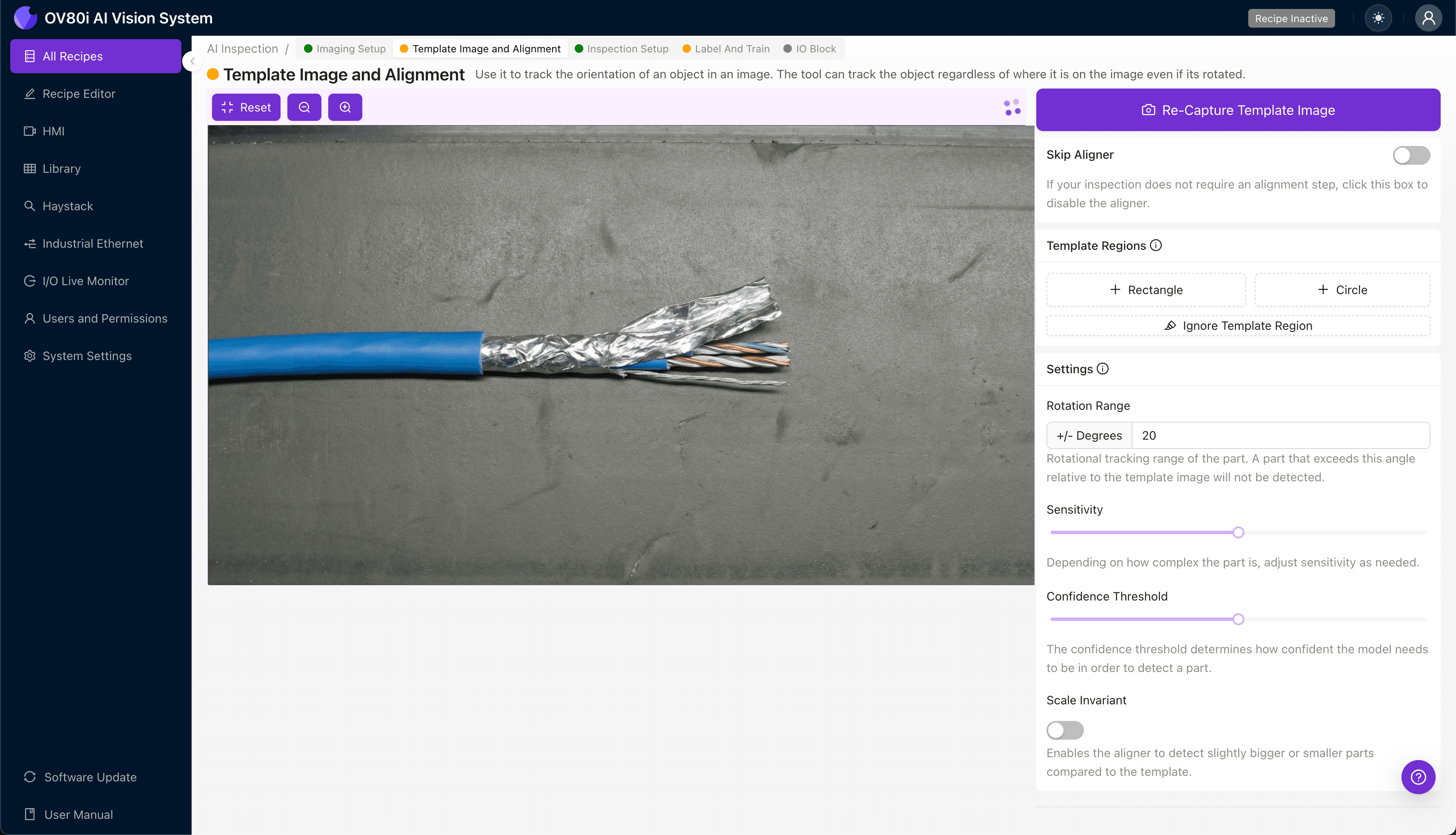
Step 3: Inspection Region Selection
Navigate to "Inspection Setup" to define your detection zones. Rename your "Inspection Types" to reflect the specific defect categories—for example, "Foil_Kink_Severe" and "Foil_Kink_Minor."
Click "+ Add Inspection Region" to create a new detection area. Resize the yellow bounding box to cover the critical defect areas—typically the outer foil shield surface and any visible transition zones where kinking commonly occurs.
Click "Save" to confirm your inspection configuration.
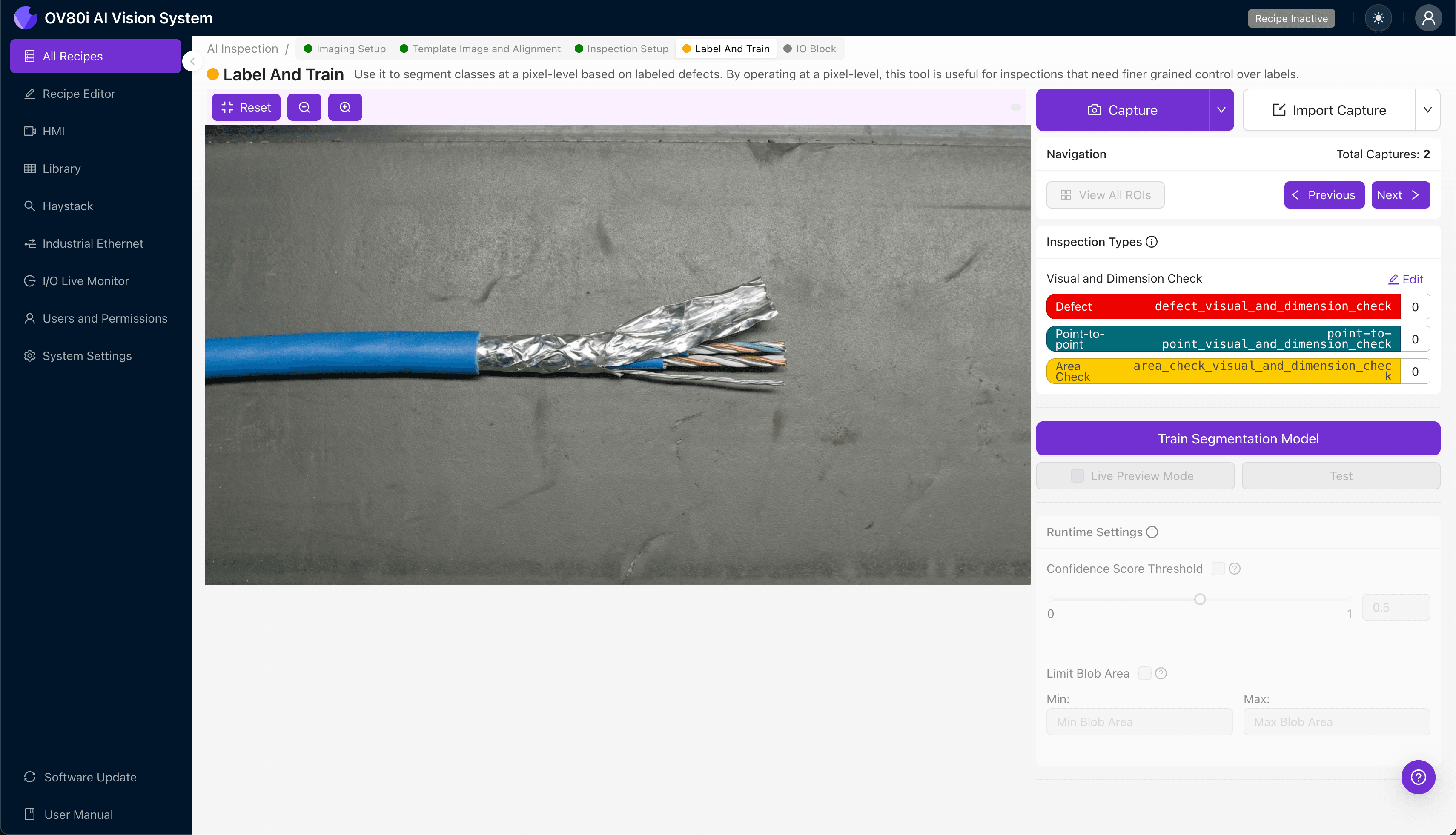
Step 4: Labeling Data
The human-in-the-loop labeling process is where your manufacturing expertise trains the AI model. Review captured images and label each as Good (acceptable foil condition) or Bad (kinked, damaged, or compromised shielding).
Include representative samples across the full spectrum of production variation—different cable colors, lighting conditions, and foil orientations. Most importantly, incorporate known failure modes: severe kinks, subtle creases, and borderline cases that have caused field returns.
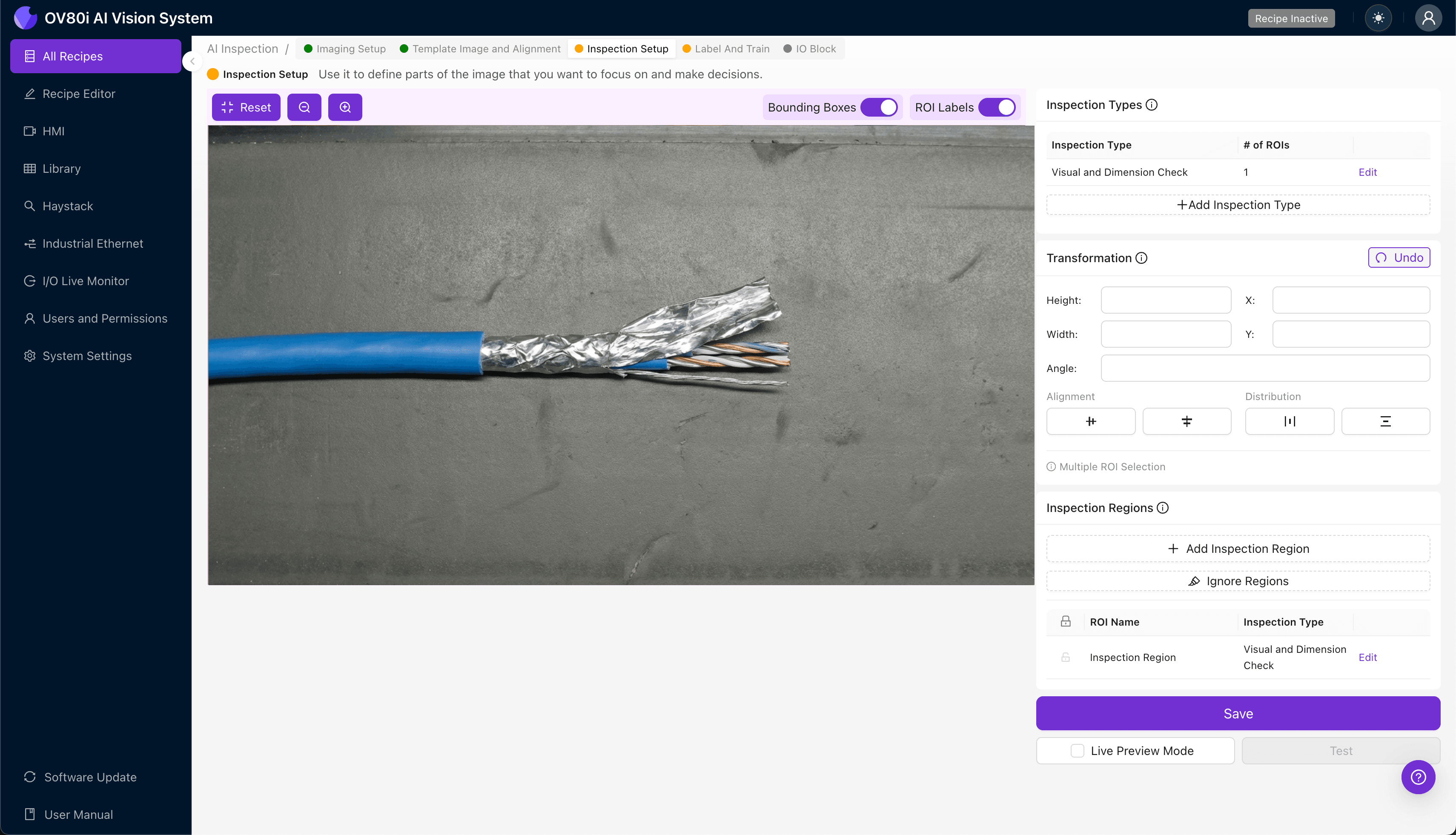
Step 5: Creating Rules
Set your pass/fail logic based on the Inspection Types you defined earlier. For example, configure the system to reject any cable flagged with "Foil_Kink_Severe" while triggering alerts for "Foil_Kink_Minor" detections.
Gate automated acceptance directly on the production line, enabling real-time sorting of conforming versus non-conforming cables without manual intervention.
Key Outcomes & ROI
Implementing AI-powered visual inspection for Twinax cable foil shield defects delivers measurable business impact:
- Reduced scrap rates — Catch defects at the source before value-added processing continues
- Higher throughput — Eliminate inspection bottlenecks with real-time, inline detection
- Compliance and traceability — Maintain complete inspection records for customer audits and quality certifications
- Process improvement insights — Identify upstream issues causing kinks (handling equipment, storage conditions, supplier quality)
Conclusion
Kinked outer foil shields in Twinax cables represent a critical quality concern that traditional inspection methods cannot reliably address. By implementing Overview.ai's machine vision platform, manufacturers gain the consistency, speed, and accuracy needed to protect both product quality and customer relationships.
Eliminate Foil Shield Defects Today
Stop relying on manual inspection. Deploy Overview.ai to catch kinked foil shields and other cable defects instantly.