Twinax Drain Wire with Unbalanced Tension: A Complete Visual Inspection Guide

"Unbalanced drain wire tension in twinax cables causes subtle defects that human inspectors consistently miss. Machine vision with deep learning catches these sub-millimeter deviations at full line speed, protecting EMI performance and ensuring reliable high-speed data transmission."
The Problem: Why Unbalanced Tension Defects Slip Through
Twinax cables are the backbone of high-speed data transmission in data centers, aerospace systems, and industrial networking applications. The drain wire—that uninsulated conductor running alongside the shielded pairs—must maintain precise tension balance to ensure proper grounding and electromagnetic interference (EMI) protection.
When drain wire tension becomes unbalanced during manufacturing, a cascade of quality issues emerges:
- Asymmetric wire positioning — drain wire pulls toward one conductor pair, compromising shield contact uniformity
- Inconsistent lay length — tension variations cause irregular spiral patterns that affect impedance matching
- Shield deformation — uneven pull forces create visible bunching or gaps in the foil/braid shield layer
- Conductor migration — excessive tension on one side displaces the twisted pairs from their optimal geometry
- Insulation stress marks — over-tensioned sections show subtle surface scoring or whitening
- Improper drain wire seating — loose sections fail to maintain continuous contact with the shield
Human inspectors struggle with these defects because many are subtle, measuring fractions of a millimeter in deviation. Inspector fatigue sets in quickly when examining hundreds of cable assemblies per shift, and the subjective nature of "acceptable tension" leads to inconsistent pass/fail decisions across different operators and shifts.
The Solution: Machine Vision + Deep Learning
Machine vision systems eliminate the subjectivity and fatigue that plague manual inspection of twinax assemblies. By capturing high-resolution images and analyzing them with trained deep learning models, these systems detect tension-related anomalies that fall below human perceptual thresholds.
Overview.ai's approach delivers consistent, objective inspection at full line speed—examining every single cable assembly without sampling compromises. The OV80i system learns what "good" drain wire tension looks like from your actual production data, then flags deviations with repeatable precision regardless of shift changes or production volume spikes.
Step 1: Imaging Setup
Position the twinax cable section under the OV80i camera, ensuring the drain wire and shield interface are clearly visible. Proper lighting angle is critical—side lighting often reveals tension-induced surface irregularities that top-down illumination misses.
Click "Configure Imaging" in the Overview.ai interface to access the camera controls. Adjust the Camera Settings including exposure time and gain to achieve clear visualization of the drain wire against the shield material without overexposing reflective foil surfaces.
Click "Save" once the image shows sharp detail across the entire inspection area.

Step 2: Image Alignment
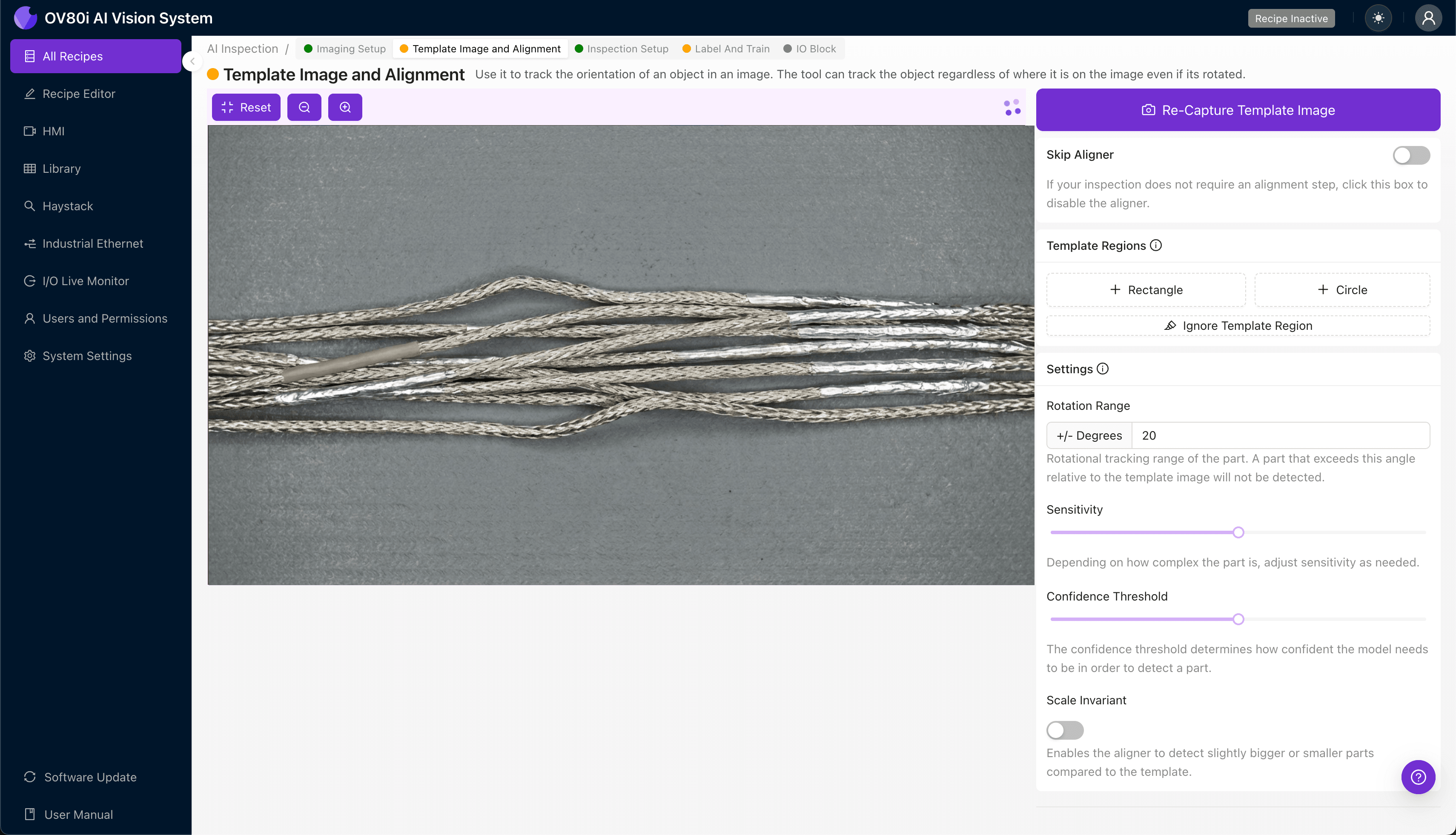
Navigate to the "Template Image" section within the configuration menu. Capture a Template image using a known-good cable sample with properly balanced drain wire tension.
Click "+ Rectangle" to add an alignment region around the main cable body, encompassing the drain wire and adjacent shield area. Set the "Rotation Range" to 20 degrees to accommodate normal variation in how cables present to the inspection station.
Step 3: Inspection Region Selection
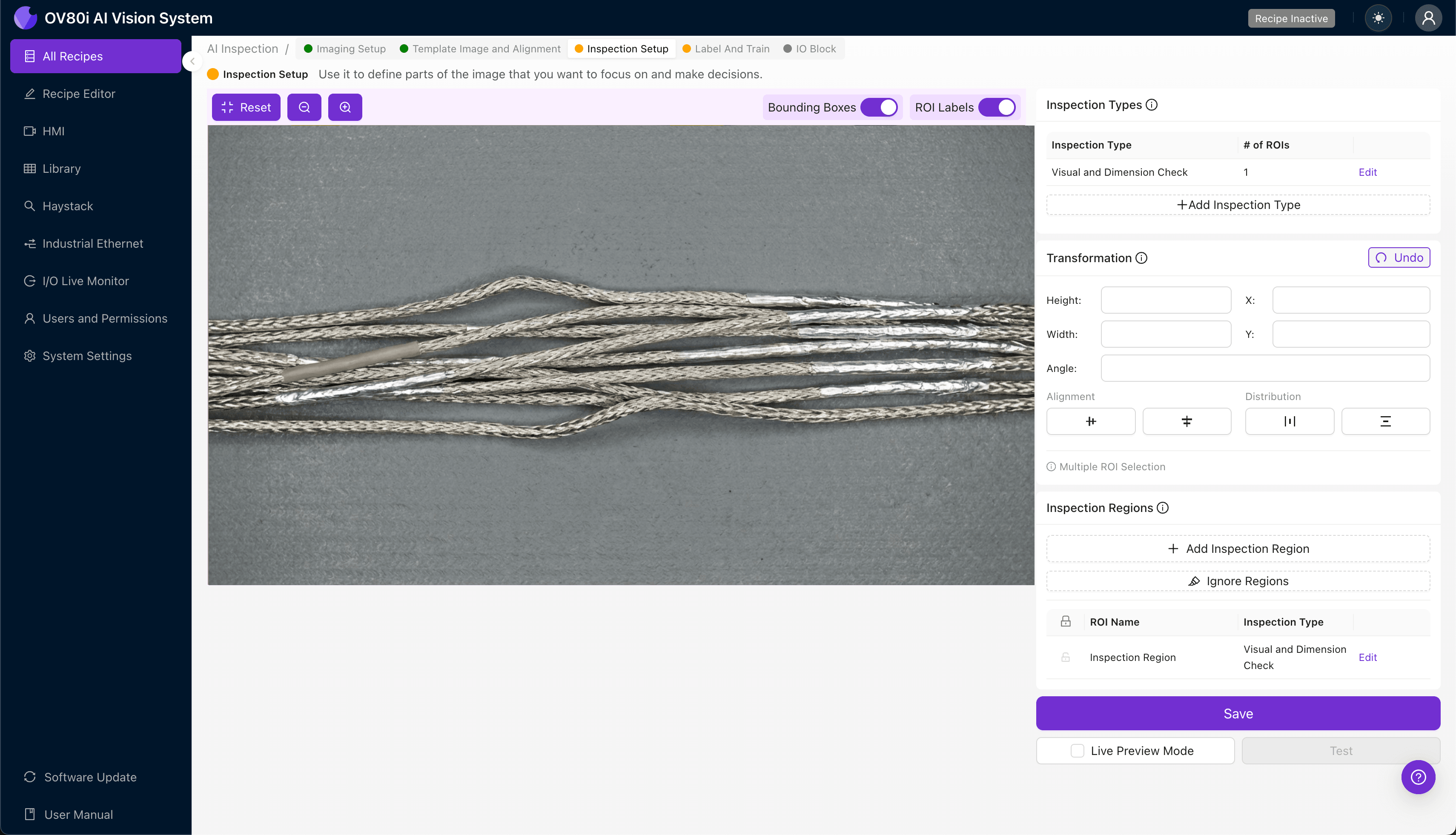
Navigate to "Inspection Setup" to define where the system should focus its analysis. Rename your "Inspection Types" to reflect the specific defects you're targeting—for example, "Drain Wire Position," "Shield Uniformity," and "Tension Marks."
Click "+ Add Inspection Region" for each defect category. Resize the yellow bounding box over the critical areas: the drain wire-to-shield contact zone, the transition points where tension variations typically manifest, and any visible insulation surfaces.
Click "Save" after defining all inspection regions.
Step 4: Labeling Data
The human-in-the-loop labeling process teaches the AI what constitutes acceptable versus defective tension balance. Review captured images and label each as Good or Bad based on your quality standards.
Include representative samples across the full range of acceptable variation—different cable batches, slight color variations, and minor cosmetic differences that don't affect function. Equally important: include known failure modes such as confirmed tension defects, customer returns, and intentionally produced bad samples.
The model's accuracy improves directly with label quality and diversity.
Step 5: Creating Rules
With your trained model ready, establish pass/fail logic based on your defined Inspection Types. Set confidence thresholds that match your quality requirements—tighter tolerances for aerospace applications, for instance.
Gate automated acceptance on the production line by connecting inspection results to your reject mechanism. Cables flagged for tension defects route automatically to quarantine or rework stations without slowing throughput.

Key Outcomes & ROI
Implementing automated visual inspection for twinax drain wire tension delivers measurable business impact:
- Reduced scrap rates — catch tension defects before downstream assembly operations add labor and material costs
- Higher throughput — 100% inspection at line speed eliminates the bottleneck of sampling-based manual checks
- Compliance and traceability — automatically logged inspection images and results satisfy aerospace, automotive, and data center customer audit requirements
- Process improvement insights — trend data reveals when tension control equipment drifts out of spec, enabling predictive maintenance before defect rates spike
Eliminate Drain Wire Defects Today
Stop letting subtle tension imbalances slip through manual inspection. Deploy Overview.ai to catch every defect at full production speed.