How to Detect Rolled O-Ring Defects in Waterproof Plugs Using AI Vision Inspection

"Rolled O-rings in waterproof plugs are nearly invisible to human inspectors but catastrophic in the field. AI-powered visual inspection catches these subtle seal defects with consistent precision at full production speed, eliminating moisture ingress failures before they reach your customers."
The Problem: Why Rolled O-Rings Slip Past Inspection
Waterproof plugs are critical components in automotive, industrial, and consumer electronics applications where environmental sealing is non-negotiable. A single defective O-ring can compromise the entire assembly, leading to moisture ingress, electrical failures, and costly warranty claims.
Rolled O-rings represent one of the most challenging defects to catch in waterproof plug manufacturing. The failure mode occurs when the elastomeric seal twists or folds during insertion into the plug's groove, compromising the sealing surface.
Common defects found in waterproof plugs with O-rings include:
- Rolled O-ring — The seal has twisted or folded during assembly, creating an uneven sealing surface
- Partially seated O-ring — The seal sits above the groove plane, preventing proper mating
- O-ring cuts or nicks — Surface damage from tooling or handling that compromises seal integrity
- Missing O-ring — Complete absence of the seal, often due to feeder or pick-and-place failures
- Contamination or debris — Foreign particles trapped in the groove or on the seal surface
- Incorrect O-ring size — Wrong durometer or diameter creating improper fit
Human inspectors struggle with these defects because rolled O-rings often appear nearly identical to properly seated seals under standard lighting. Inspector fatigue sets in quickly when examining thousands of identical black-on-black components per shift, and the subtle shadow differences that indicate a roll are easily missed at production speeds.
The Solution: AI-Powered Visual Inspection
Machine vision systems equipped with deep learning overcome the limitations of human inspection by analyzing every plug with consistent precision. Unlike rule-based systems that rely on explicit programming, AI models learn to recognize the subtle visual signatures of rolled O-rings—even variations that weren't explicitly defined during setup.
Overview.ai's approach delivers objective, repeatable inspection at full line speed. The system captures high-resolution images of every waterproof plug, processes them through trained neural networks, and makes pass/fail decisions in milliseconds—without fatigue, distraction, or shift-to-shift variability.
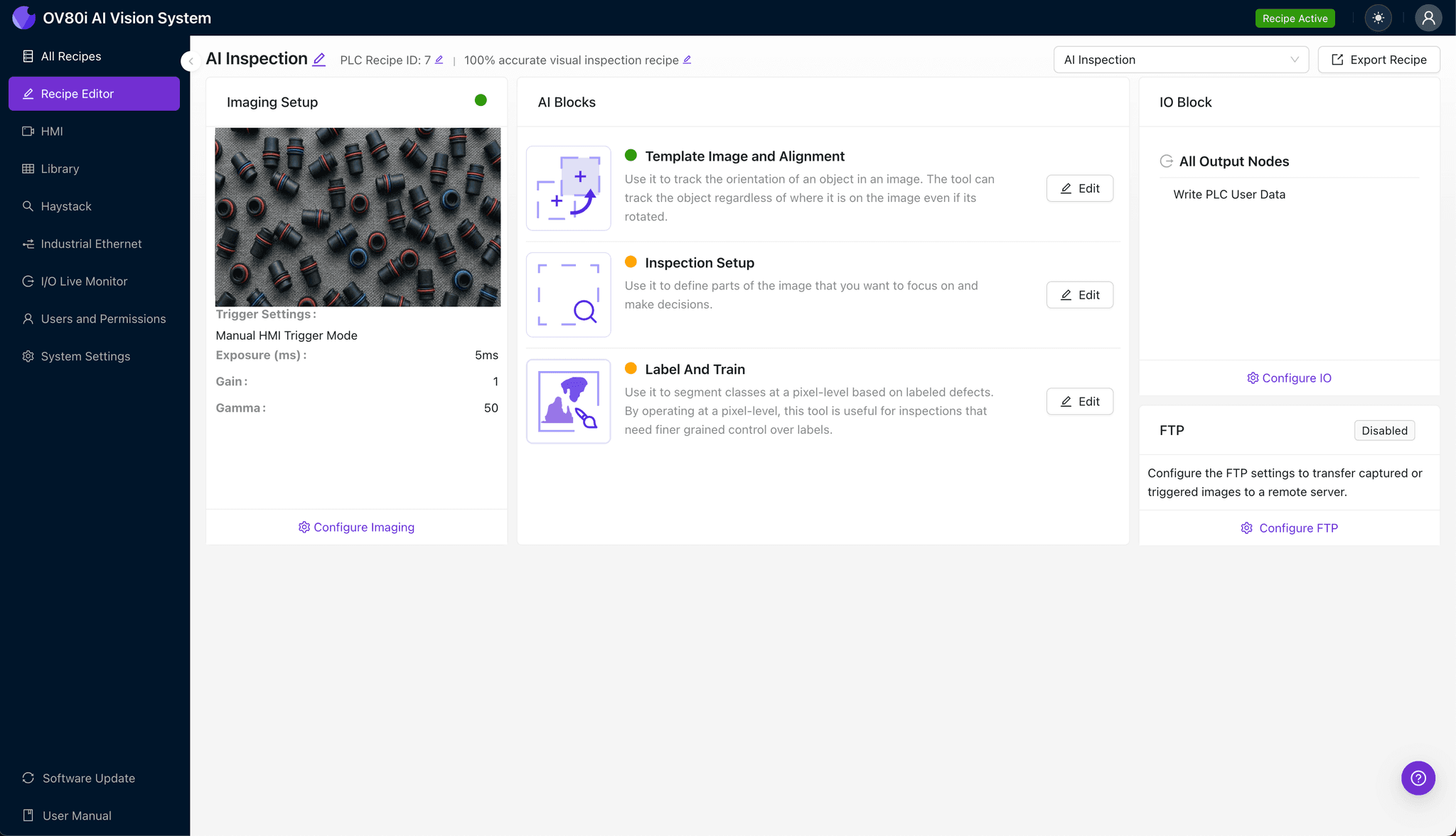
Step 1: Imaging Setup
Position the waterproof plug under the camera with the O-ring groove facing upward for optimal visibility. Proper lighting angle is critical—angled or diffuse illumination helps reveal the shadow patterns that distinguish rolled seals from properly seated ones.
Navigate to "Configure Imaging" in the Overview interface and adjust the Camera Settings. Fine-tune exposure and gain until the O-ring groove shows clear contrast against the plug body, then click "Save" to lock in your configuration.
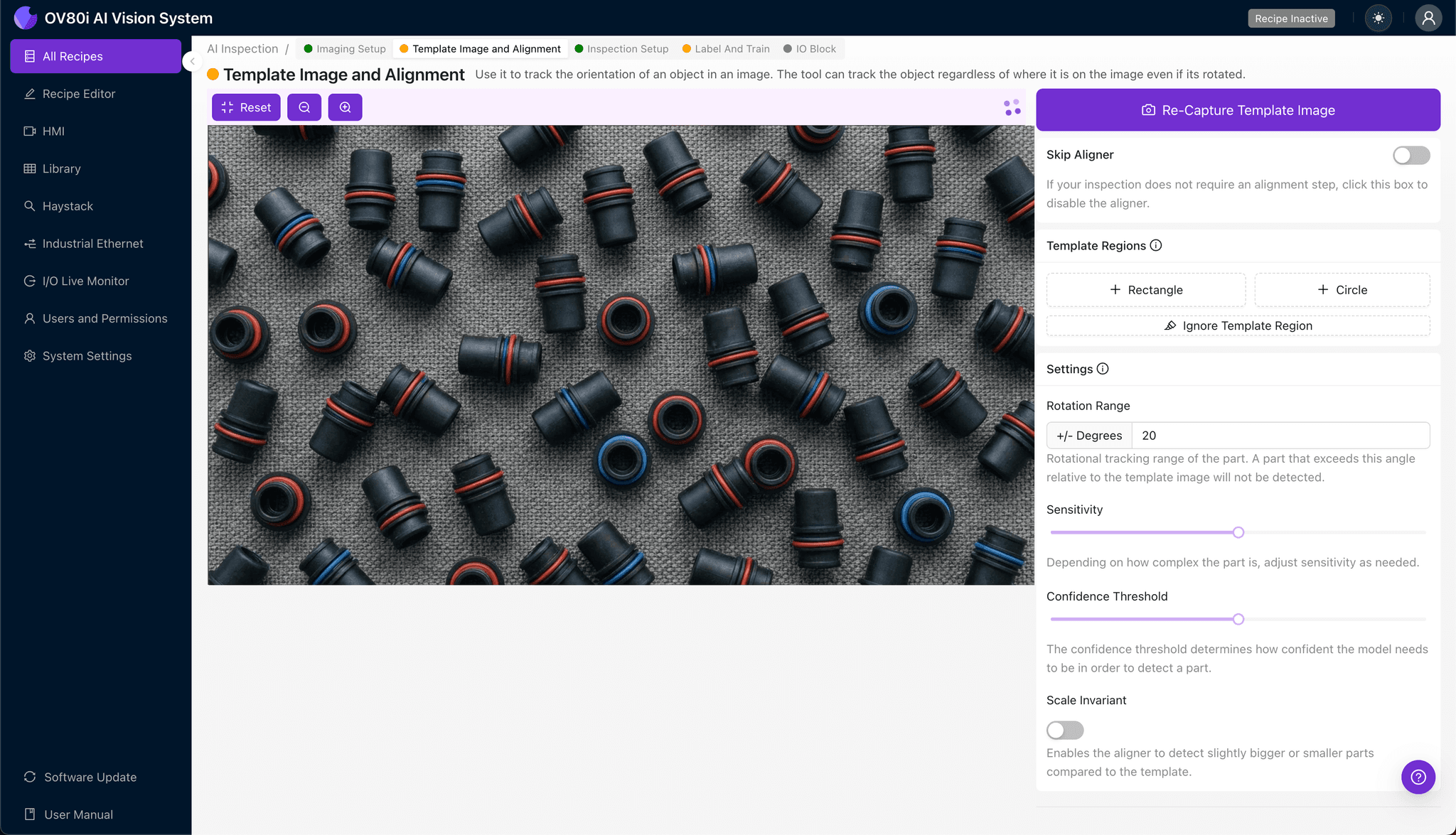
Step 2: Image Alignment
Navigate to the "Template Image" section and capture a reference image of a known-good waterproof plug. This template allows the system to locate and orient each part consistently, regardless of how it arrives at the inspection station.
Click "+ Rectangle" to draw a region around the main plug body, capturing the outer housing profile. Set "Rotation Range" to 20 degrees to accommodate normal variation in part presentation on the conveyor.
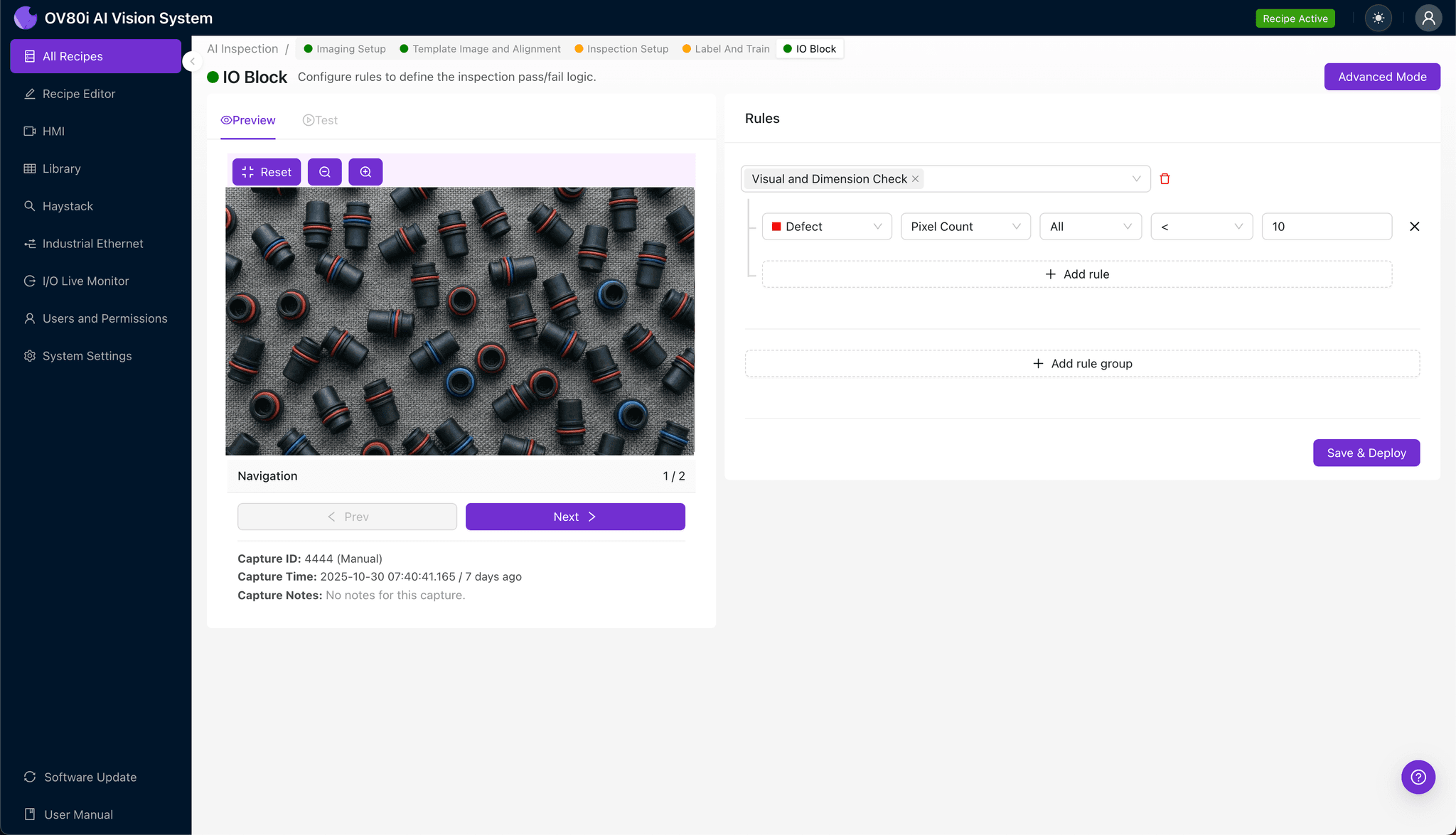
Step 3: Inspection Region Selection
Navigate to "Inspection Setup" to define where the AI should focus its analysis. Rename your "Inspection Types" to reflect the specific defects you're targeting—for example, "Rolled_O-Ring" and "Missing_Seal."
Click "+ Add Inspection Region" and resize the yellow bounding box to cover the O-ring groove and sealing surface. This tells the AI exactly where to concentrate its deep learning analysis. Click "Save" to confirm your regions.
Step 4: Labeling Data
The human-in-the-loop labeling process is where your inspection expertise trains the AI model. Review captured images and classify each as Good (properly seated O-ring) or Bad (rolled, missing, or damaged seal).
Include representative samples across your full range of acceptable variation and known failure modes. The more examples of subtle rolled O-rings you label, the better the model will perform at catching borderline defects in production.
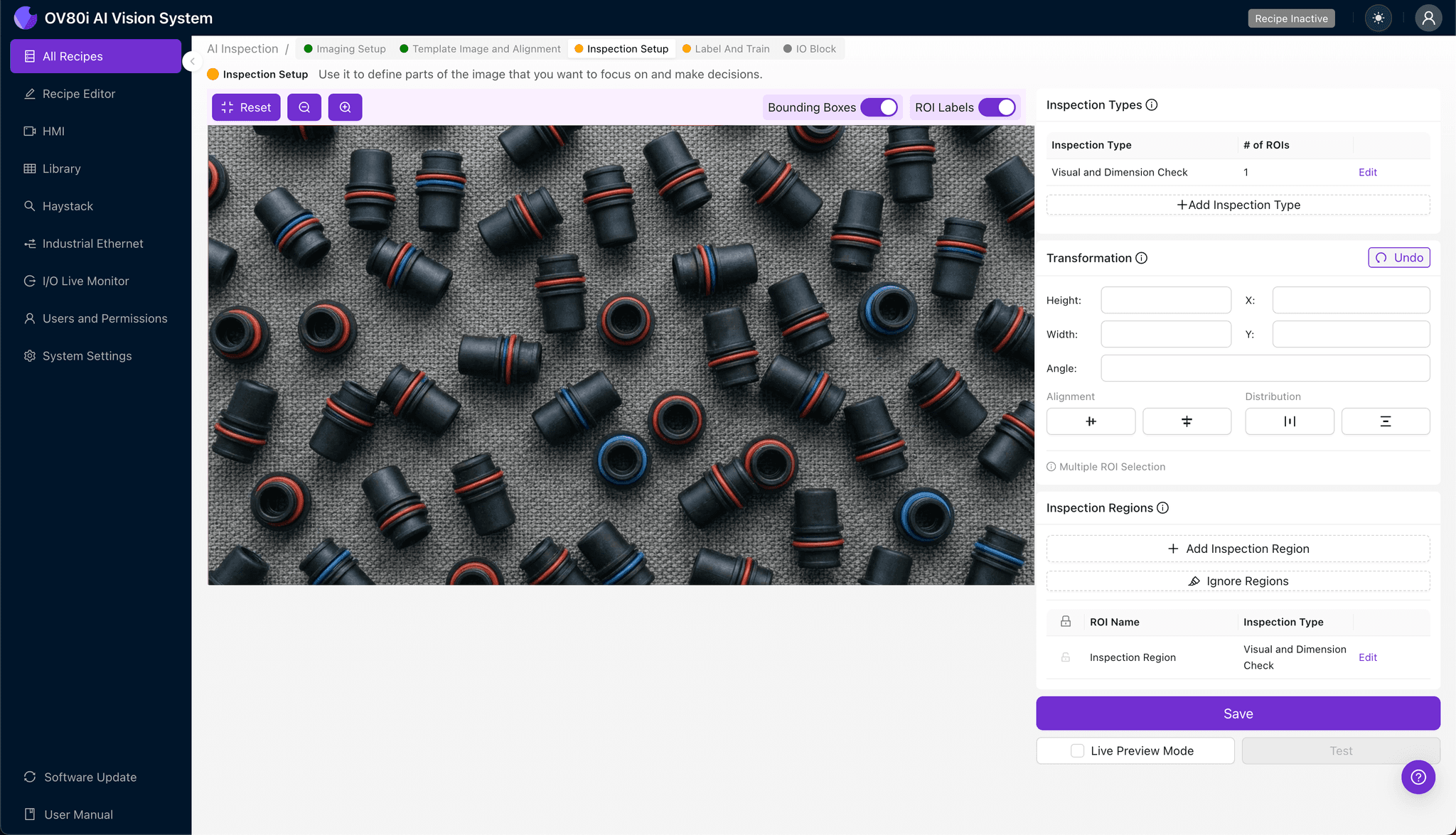
Step 5: Creating Rules
Configure your pass/fail logic based on the Inspection Types you defined earlier. Set thresholds that determine when a detected anomaly triggers a rejection versus when minor variation is acceptable.
These rules gate automated acceptance on the line, ensuring that only verified-good waterproof plugs proceed to the next assembly stage. Failed parts can be automatically diverted for rework or quarantine.

Key Outcomes & ROI
Implementing AI-powered inspection for waterproof plug O-rings delivers measurable business impact:
- Reduced scrap and rework — Catch rolled O-rings before they're assembled into higher-value products, avoiding downstream waste
- Higher throughput — Inspect 100% of production at line speed without creating bottlenecks or requiring additional headcount
- Compliance and traceability — Maintain complete image records for every inspected part, supporting automotive quality standards and customer audits
- Process improvement insights — Identify patterns in defect occurrence to pinpoint upstream issues with O-ring feeders, insertion tooling, or material lots
Waterproof plug failures in the field are expensive—not just in warranty costs, but in customer trust. Overview.ai's visual inspection platform gives you the consistent, objective quality control that manual inspection simply cannot match.
Stop Letting Rolled O-Rings Reach Your Customers
Deploy Overview.ai to catch O-ring defects instantly with 100% inline inspection at full production speed.