2026 Top 10 GenAI Tools for Manufacturing
Generative AI has moved far beyond chatbots and marketing copy. In 2026, GenAI is reshaping the manufacturing floor, synthesizing defect training data from a handful of samples, auto-generating inspection models overnight, writing maintenance procedures in seconds, and optimizing product designs that would take engineers weeks. Here are the 10 most impactful GenAI tools for manufacturing this year.
How Generative AI Is Changing Manufacturing
While traditional AI in manufacturing focuses on analyzing sensor data and classifying defects, generative AI creates. It generates new content that didn't exist before, synthetic images of defects that haven't been photographed yet, work instructions that adapt to each operator, product geometries optimized for performance, and even PLC code written from natural language prompts.
This shift matters because manufacturing's biggest AI bottleneck has always been data. You can't train a defect detection model without defect images, and rare defects, by definition, don't produce many examples. Generative AI breaks this constraint, unlocking AI capabilities that were previously impractical for low-volume, high-mix, or new-product-introduction scenarios.
GenAI for Quality
Synthetic defect images, auto-generated inspection models, and AI-powered visual documentation
GenAI for Design
Generative product design, topology optimization, and material selection assistance
GenAI for Operations
Auto-generated work instructions, maintenance procedures, and training materials
GenAI for Engineering
AI-written PLC code, automated test generation, and process simulation

Synthetic Data Generation & Model Training
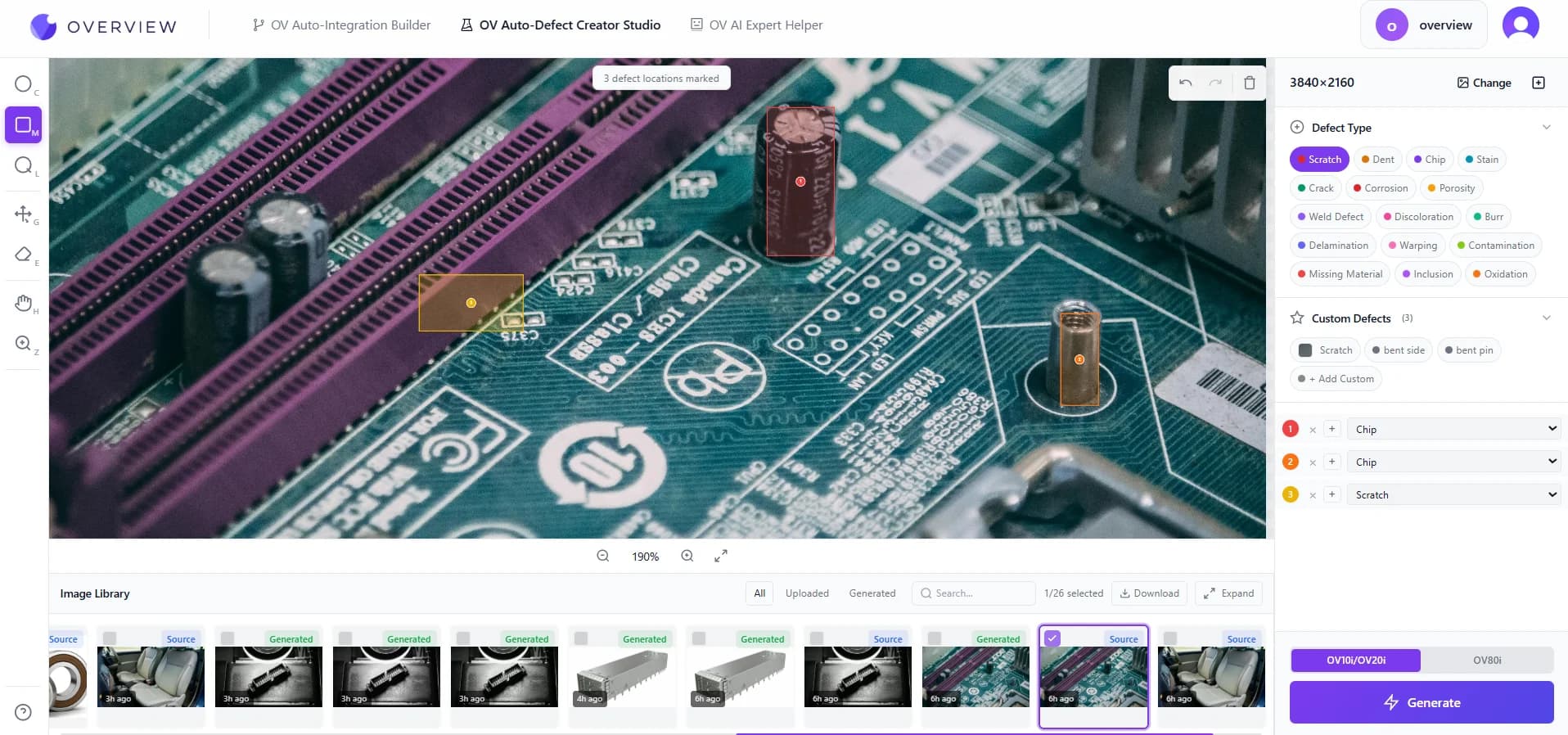
OV Auto-Defect Creator Studio
Overview AI sets the standard for GenAI in manufacturing quality. Its Auto Defect Creator uses generative AI to synthesize photorealistic defect images from as few as 5 real samples, enabling production-grade inspection models to be trained and deployed in hours instead of weeks. The Auto Integration Builder then auto-generates the camera settings, lighting configurations, and PLC integration code needed to deploy the model on the line.
Why it's #1: The only platform that combines synthetic defect generation, automated model training, and auto-configured hardware deployment in a single end-to-end workflow, from 5 sample images to production-ready inspection in under a day.
Generative Product Design & Topology
Siemens NX Generative Design
Siemens NX's generative design module uses AI to automatically explore thousands of design alternatives based on engineering constraints, load paths, manufacturing method, material properties, and cost targets. Engineers define the problem space; NX generates optimized geometries that are often lighter, stronger, and cheaper than human-designed alternatives. In 2026, the tool now includes generative AI for automated tolerance analysis and DFM (Design for Manufacturability) feedback.
Best for: Automotive, aerospace, and industrial equipment manufacturers who want AI-generated design alternatives that are optimized for both performance and manufacturability.
Generative Design & CAM Integration
Autodesk Fusion Generative
Autodesk Fusion's cloud-native generative design engine produces manufacturing-ready geometries optimized for CNC machining, injection molding, casting, or additive manufacturing. In 2026, the platform has added GenAI-powered natural language design prompting, engineers describe a part's function and constraints conversationally, and Fusion generates viable design candidates complete with material recommendations and estimated production costs.
Best for: Small-to-mid-size manufacturers and contract fabricators who need generative design accessible through a unified CAD/CAM/CAE platform without heavy infrastructure.
Cloud-Based Visual Inspection & Synthetic Data
Google Cloud Visual Inspection AI
Google Cloud's Visual Inspection AI now includes a generative data augmentation pipeline that creates synthetic defect and OK images to bootstrap inspection models when real training data is scarce. Backed by Google's Imagen and Gemini architectures, the platform generates highly realistic manufacturing imagery while maintaining strict data privacy, and all training stays within the customer's VPC.
Best for: Manufacturers already invested in Google Cloud who need cloud-scale synthetic data generation and model training without dedicated edge hardware.
Natural Language Process Intelligence
Microsoft Azure OpenAI for Manufacturing
Microsoft's Azure OpenAI Service, now with manufacturing-specific prompt templates and data connectors, enables factories to deploy GPT-4-class language models on their operational data. Engineers use natural language to query production databases, generate root cause analyses, auto-draft corrective action reports, and create multilingual work instructions. The platform's RAG (Retrieval Augmented Generation) architecture grounds LLM responses in real factory data, minimizing hallucination.
Best for: Enterprise manufacturers on Azure who want to leverage GPT-class models for documentation, root cause analysis, and operator support without building from scratch.
Digital Twin & Synthetic Simulation
NVIDIA Omniverse + Isaac Sim
NVIDIA's Omniverse platform combined with Isaac Sim enables manufacturers to create photorealistic digital twins of entire factory environments, and then use generative AI to populate those environments with synthetic scenarios for training robots, AGVs, and vision systems. In 2026, the platform's generative scene composition feature can automatically create thousands of randomized factory layouts, lighting conditions, and part arrangements for sim-to-real transfer learning.
Best for: Manufacturers deploying robotics and AGVs who need massive synthetic training environments, and teams building digital twins for production planning and optimization.
Generative Design & PLM
Dassault Systèmes 3DEXPERIENCE
Dassault's 3DEXPERIENCE platform with CATIA's functional generative design capabilities goes beyond geometry, it generates design concepts that are linked to requirements, simulation results, and manufacturing process plans throughout the product lifecycle. New in 2026, the platform includes an LLM-powered engineering assistant that generates design rationale documentation, FMEA drafts, and compliance reports directly from the 3D model data.
Best for: Aerospace, automotive, and defense manufacturers who need generative design tightly integrated with PLM, simulation, and regulatory compliance workflows.
Synthetic Image & Sensor Data Generation
Datagen by Tonic.ai
Datagen (now part of Tonic.ai) generates photorealistic synthetic images and sensor data specifically for training computer vision models in industrial settings. Manufacturers can define part geometries, defect types, lighting conditions, and camera angles, the platform then generates millions of perfectly labeled training images. In 2026, the tool supports domain-specific fine-tuning for manufacturing verticals including electronics, automotive, and medical devices.
Best for: Computer vision teams that need massive volumes of labeled synthetic data to train or augment inspection models, especially for rare defect types.
Automated Documentation & SOPs
Plex by Rockwell + GPT Integration
Rockwell's Plex MES platform now integrates GPT-class language models to auto-generate work instructions, standard operating procedures, and quality checklists from BOM data, process plans, and historical quality records. Engineers provide a process outline; the system generates step-by-step operator instructions in multiple languages, complete with embedded images, safety warnings, and quality checkpoints, dramatically reducing NPI (New Product Introduction) documentation time.
Best for: Multi-site manufacturers who need to rapidly generate and localize work instructions for new products and process changes across global facilities.
AI-Accelerated Simulation & Virtual Testing
Ansys SimAI
Ansys SimAI uses generative AI to predict simulation outcomes in near real-time, bypassing the hours or days required for traditional FEA and CFD runs. Engineers upload a design geometry and the platform generates stress, thermal, and flow predictions based on patterns learned from thousands of prior simulations. In 2026, SimAI can generate entirely new design variants that meet target performance criteria, turning simulation from a verification tool into a generative design engine.
Best for: Engineering teams that run hundreds of simulation iterations during design validation and want to compress weeks of compute into minutes using GenAI predictions.
Quick Comparison: 2026 GenAI Manufacturing Tools
| Tool | GenAI Capability | Primary Output | Best For |
|---|---|---|---|
| Overview AI | Synthetic defect images + auto model training | Production-ready inspection models | Quality inspection |
| Siemens NX Generative | Topology optimization + DFM | Optimized part geometries | Product design |
| Autodesk Fusion | NLP design prompting + generative geometry | Manufacturing-ready CAD models | SMB product design |
| Google Cloud VIAI | Synthetic data augmentation | Training datasets + models | Cloud-first inspection |
| Azure OpenAI | LLM process analysis + docs | Reports, SOPs, RCAs | Enterprise documentation |
| NVIDIA Omniverse | Synthetic environment generation | Digital twins + training scenes | Robotics + AGV training |
| Dassault 3DEXPERIENCE | Lifecycle-linked generative design | PLM-integrated designs | Regulated industries |
| Datagen (Tonic.ai) | Photorealistic synthetic imagery | Labeled training images | CV model training |
| Plex + GPT | Auto-generated work instructions | Multilingual SOPs + checklists | NPI documentation |
| Ansys SimAI | Generative simulation prediction | Near-instant FEA/CFD results | Design validation |
Frequently Asked Questions
Q: What is generative AI in manufacturing?
A: Generative AI in manufacturing refers to AI systems that create new content, synthetic training images, inspection models, work instructions, product designs, and process documentation, rather than just analyzing existing data. It accelerates everything from quality model training to product design iteration.
Q: How is GenAI different from agentic AI in manufacturing?
A: GenAI focuses on creating new content and artifacts (images, code, designs, documents), while agentic AI focuses on autonomous decision-making and action. Many modern manufacturing platforms combine both, using GenAI to generate training data and agentic AI to autonomously deploy and manage the resulting models. Check out our companion article on Top 10 Agentic AI Tools for Manufacturing.
Q: Can generative AI create realistic defect images for training?
A: Yes. Platforms like Overview AI's Auto Defect Creator use generative AI to synthesize photorealistic defect images from just a few real examples, dramatically reducing the time and data needed to train production-grade inspection models, from weeks of data collection to hours.
Related Articles
Start Using GenAI for Manufacturing Quality Today
Overview AI's Auto Defect Creator turns 5 sample images into a production-ready inspection model in hours. See how generative AI can transform your quality operations.
Schedule a Demo