
How to Inspect Optical Engines with Epoxy Tilt on Fiber Arrays Using AI-Powered Vision
"Epoxy-bonded fiber arrays in optical engines require micron-level inspection accuracy that human inspectors cannot sustain. AI-powered vision systems deliver consistent, objective evaluation of tilt angles, void formation, and bond integrity at full production speed-eliminating the variability that leads to field failures."
The Problem: Why Fiber Array Epoxy Inspection Is So Challenging
Optical engines with epoxy-bonded fiber arrays are critical components in telecommunications, data centers, and photonic systems. Even microscopic defects in the epoxy tilt angle or bond integrity can cause catastrophic signal loss, wavelength drift, or complete device failure in the field.
Common Defects in Epoxy Tilt Fiber Array Assemblies
- Angular misalignment - Epoxy cure shrinkage causing fiber tilt beyond acceptable tolerance (typically >0.5°)
- Void formation - Air bubbles trapped within the epoxy bond line during dispensing or curing
- Epoxy overflow - Excess adhesive encroaching on active optical surfaces or neighboring components
- Incomplete wetting - Poor epoxy coverage leaving unbonded gaps between fiber and substrate
- Fiber protrusion inconsistency - Uneven fiber end-face heights relative to the array surface
- Contamination inclusions - Particulates or debris embedded in the cured epoxy matrix
Manual inspection of these assemblies is notoriously unreliable. Inspectors experience eye fatigue within minutes when evaluating sub-millimeter features under magnification. The combination of high throughput demands and micron-level tolerance requirements makes human consistency virtually impossible to maintain across full production shifts.
The Solution: AI-Powered Visual Inspection
Machine vision systems equipped with deep learning overcome the fundamental limitations of human inspection. Unlike rule-based algorithms that require explicit programming for every defect type, neural networks learn to recognize subtle anomalies from labeled examples-including defects that weren't anticipated during system setup.
Overview.ai's approach delivers consistent, objective inspection at full line speed. The system evaluates every unit against the same trained criteria, eliminating inspector variability while capturing data that drives continuous process improvement.
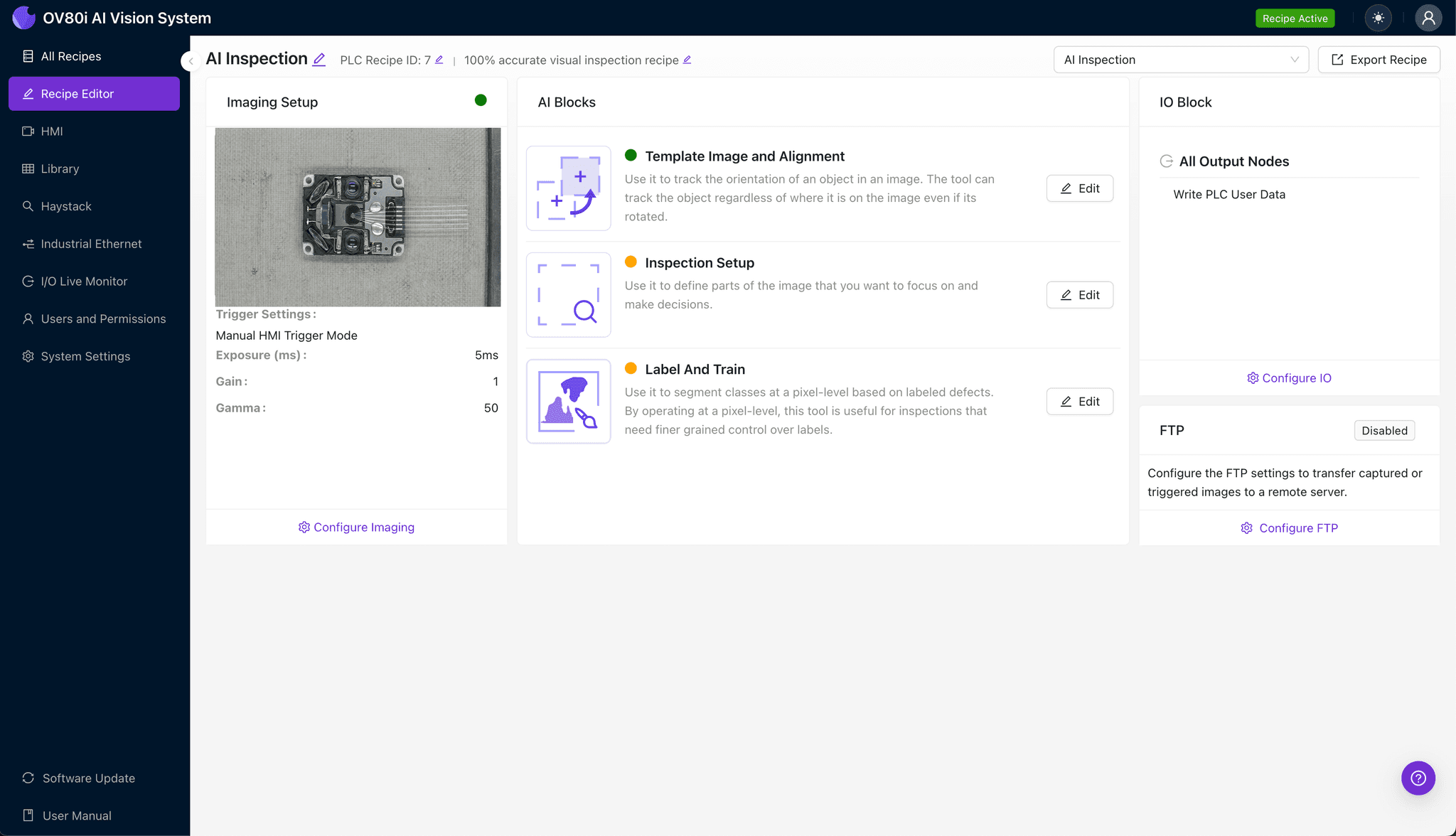
Step 1: Imaging Setup
Position the optical engine assembly under the camera system, ensuring the fiber array and epoxy bond regions are within the field of view. Proper fixturing is essential-the component should be stable and repeatable in orientation.
Click "Configure Imaging" in the Overview interface. Adjust the Camera Settings including exposure time and gain to achieve clear visualization of the epoxy boundaries and fiber positions.
Click "Save" once the image shows adequate contrast between the epoxy, fibers, and substrate materials.
Step 2: Image Alignment
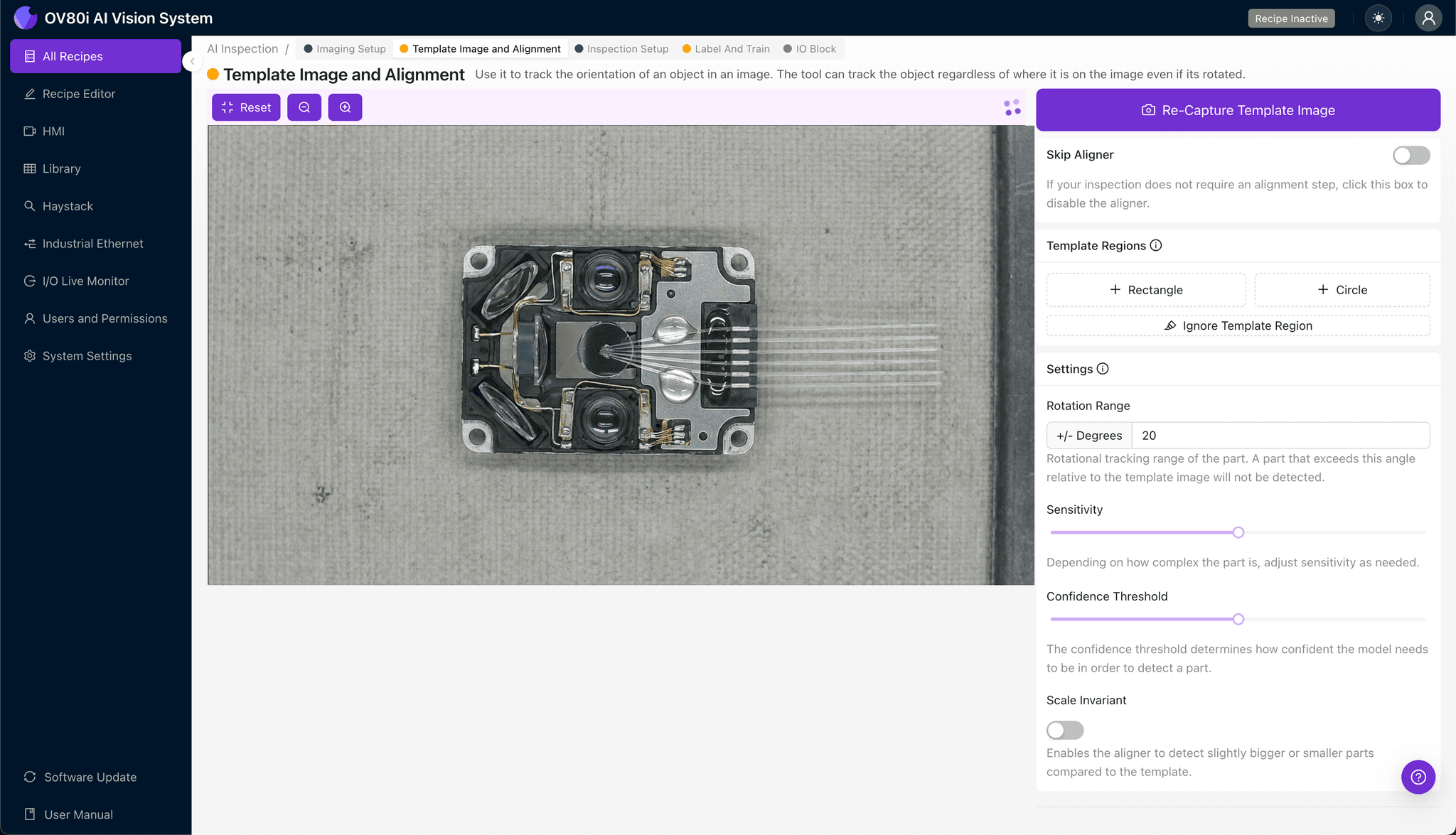
Navigate to "Template Image" in the setup menu. Capture a Template using a known-good reference assembly that represents ideal positioning.
Click "+ Rectangle" to add an alignment region around the main body of the optical engine housing. This anchor point ensures consistent positioning regardless of minor placement variations.
Set the "Rotation Range" to 20 degrees to accommodate fixture tolerance and operator loading variability.
Step 3: Inspection Region Selection
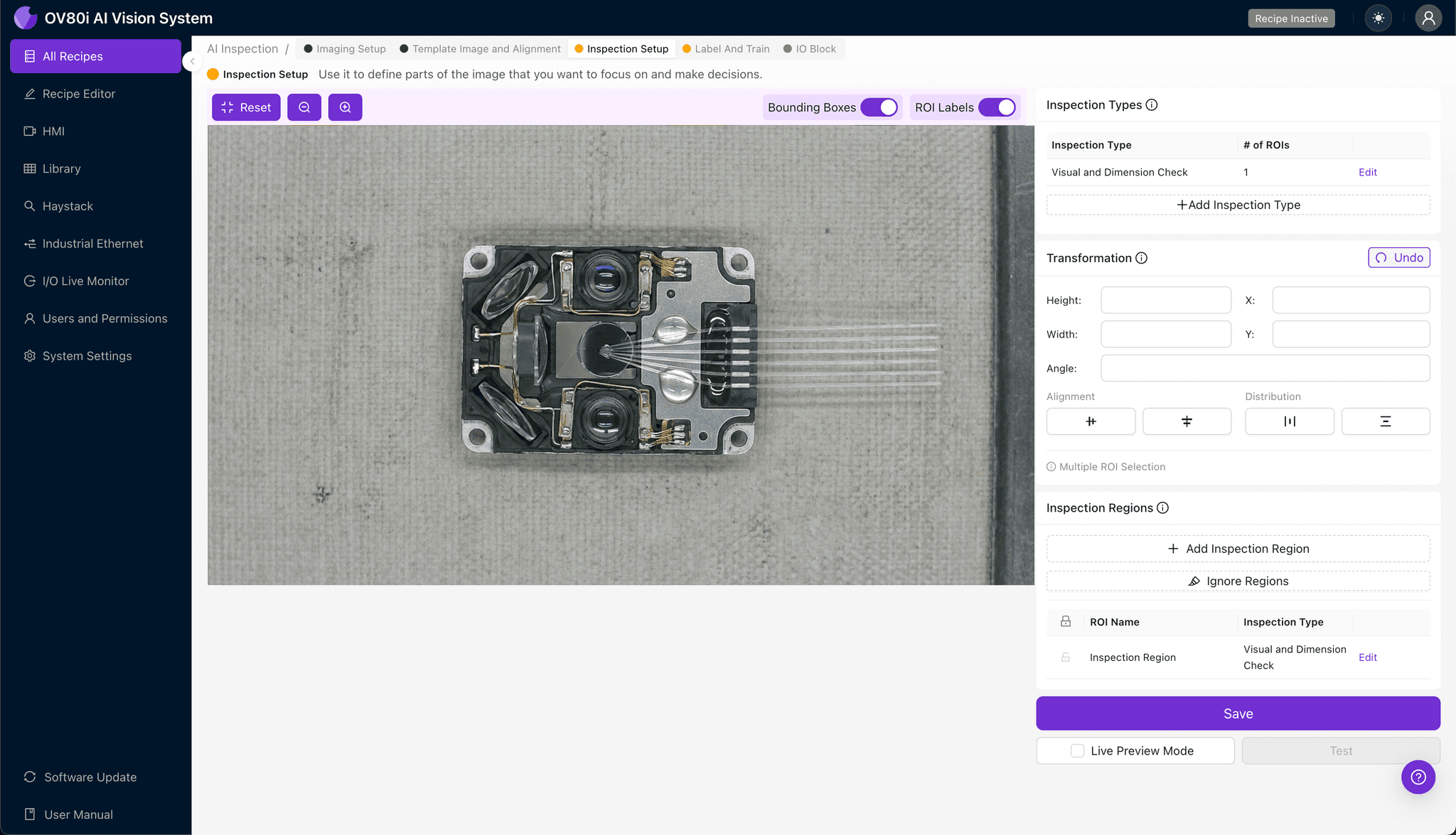
Navigate to "Inspection Setup" to define where the system should look for defects.
Rename your "Inspection Types" with descriptive labels such as "Epoxy_Tilt_Zone," "Bond_Line_Integrity," and "Fiber_Protrusion_Check."
Click "+ Add Inspection Region" for each critical area. Resize the yellow bounding box to cover the epoxy-fiber interface zones where defects are most likely to occur.
Click "Save" after configuring all inspection regions.
Step 4: Labeling Data
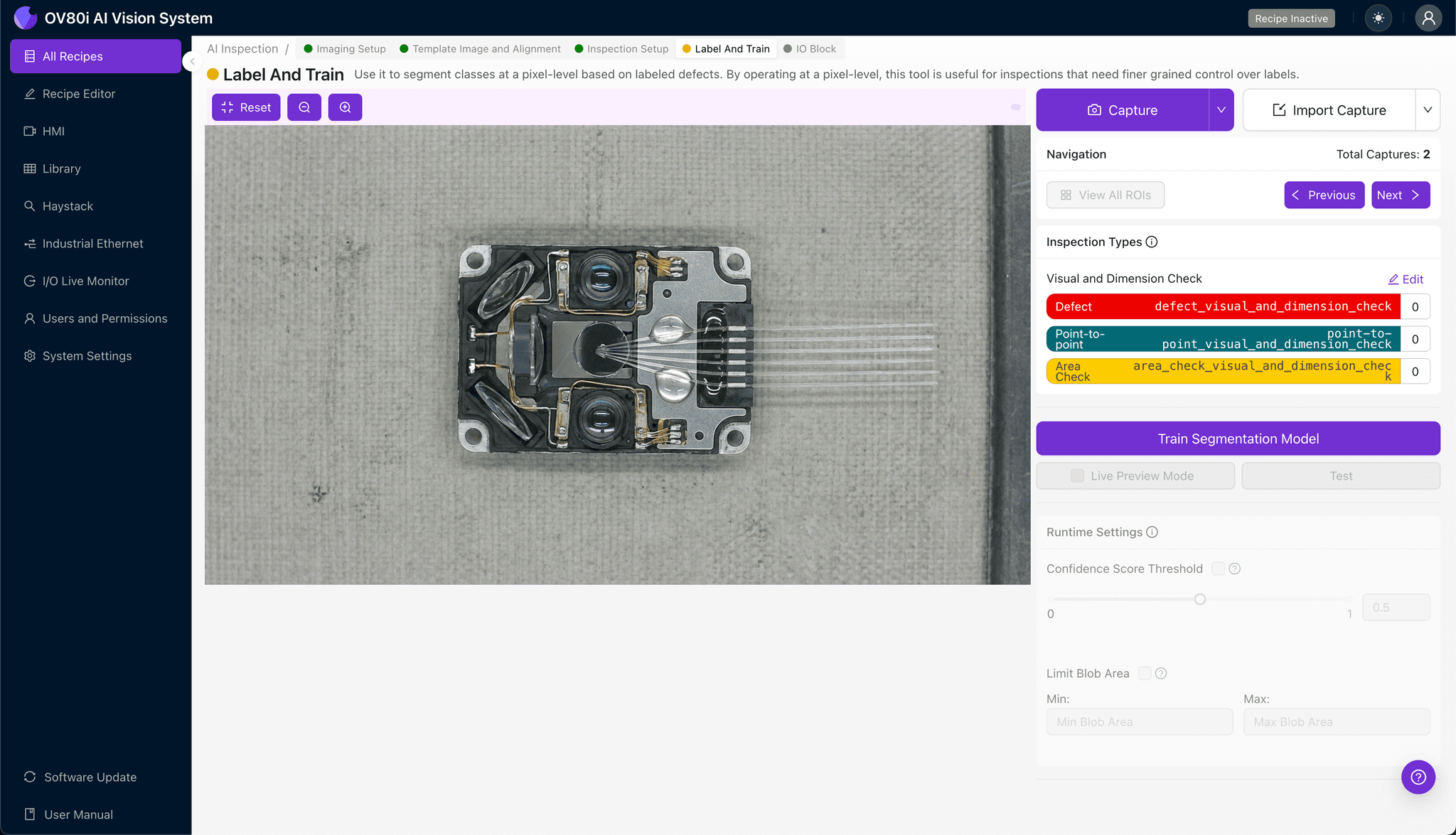
The human-in-the-loop labeling process is where your quality expertise trains the AI. Review incoming images and classify each inspection region as Good or Bad.
Include representative samples across your normal process variation-different epoxy batches, environmental conditions, and production shifts. Deliberately include known failure modes and boundary cases to teach the model where acceptable ends and rejectable begins.
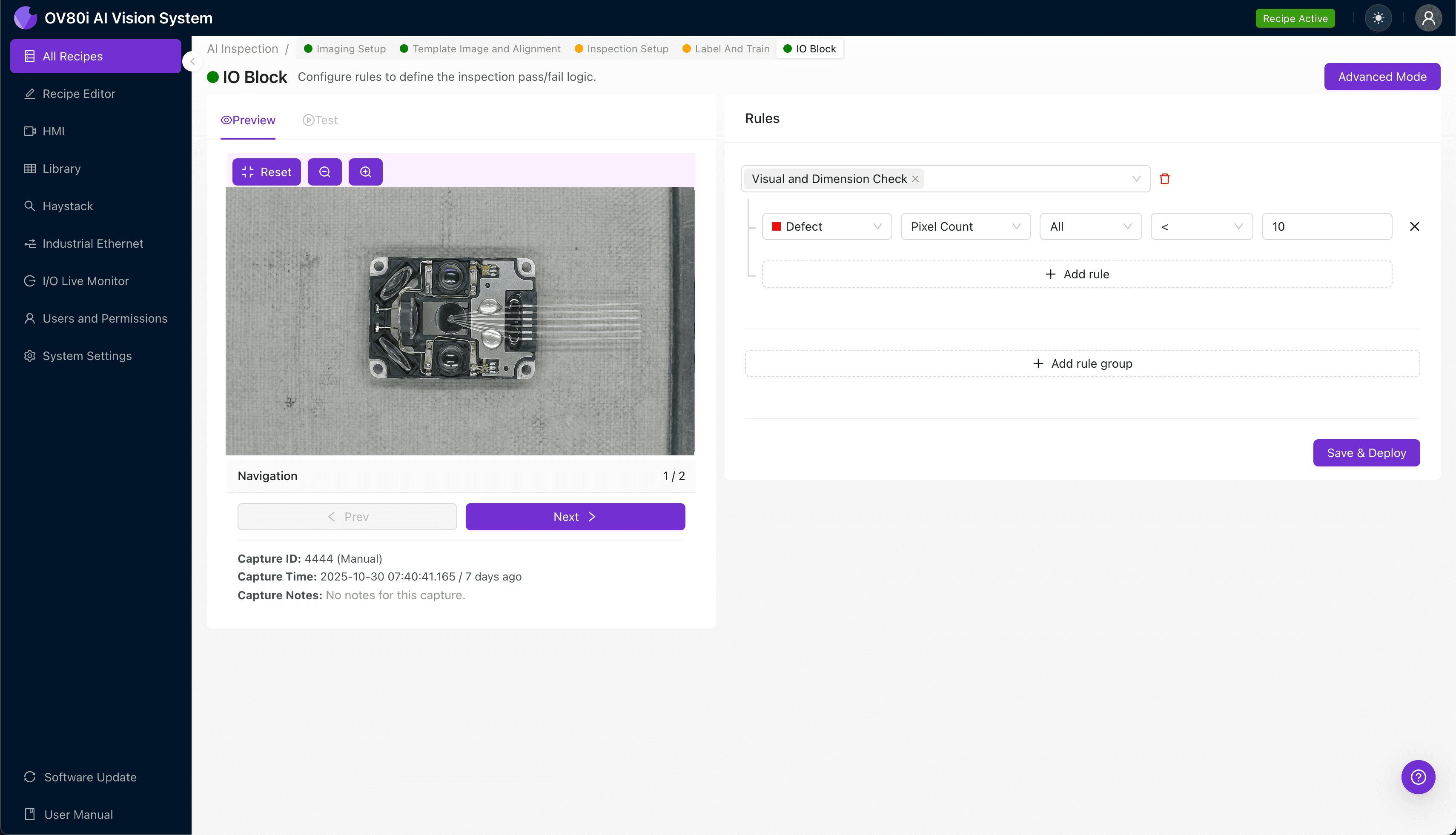
Step 5: Creating Rules
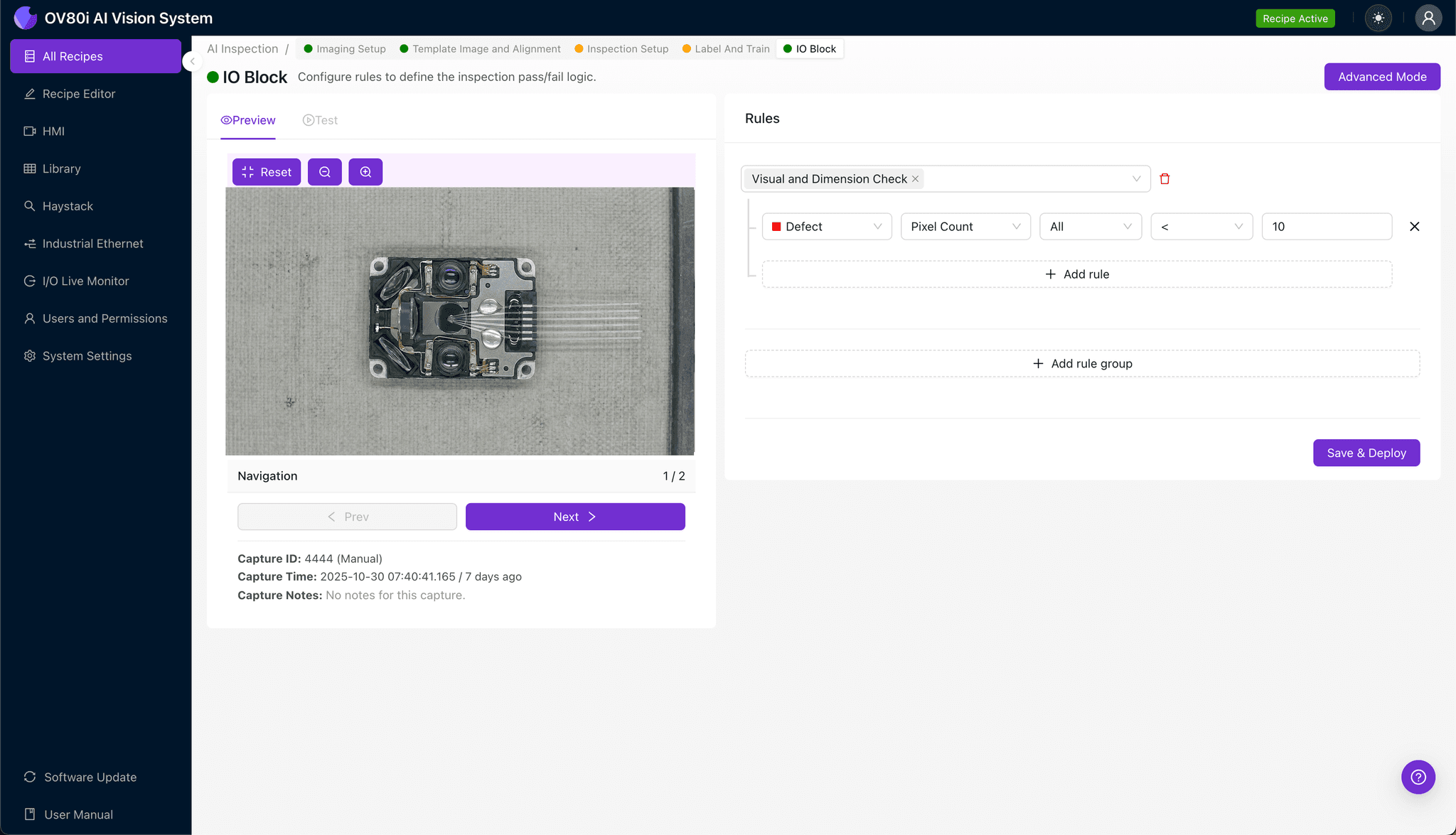
Define your pass/fail logic based on the Inspection Types you've configured. For example: reject if any region shows "Epoxy_Void" OR if "Tilt_Angle" confidence exceeds your threshold.
These rules gate automated acceptance on the line, ensuring only conforming assemblies proceed to downstream processes or shipment.
Key Outcomes & ROI
Implementing AI-powered inspection for optical engine assemblies delivers measurable business impact:
- Reduced scrap rates - Catch defects earlier in the process before value-add operations compound losses
- Higher throughput - Inspect 100% of units at line speed without creating bottlenecks
- Compliance and traceability - Automatically log images and inspection results for every unit, supporting customer audits and regulatory requirements
- Process improvement insights - Identify defect trends correlated with equipment, materials, or shifts to address root causes proactively
Ready to Automate Your Optical Assembly Inspection?
Overview.ai's platform makes it possible to deploy robust, AI-powered inspection for complex photonic components-without requiring machine vision expertise on your team.