The plain-English guide
Vision systems
Cameras that inspect every part at line speed, and decide pass or fail in milliseconds.
Here is what a vision system is made of, the types you will meet, and where it earns its keep on the line.
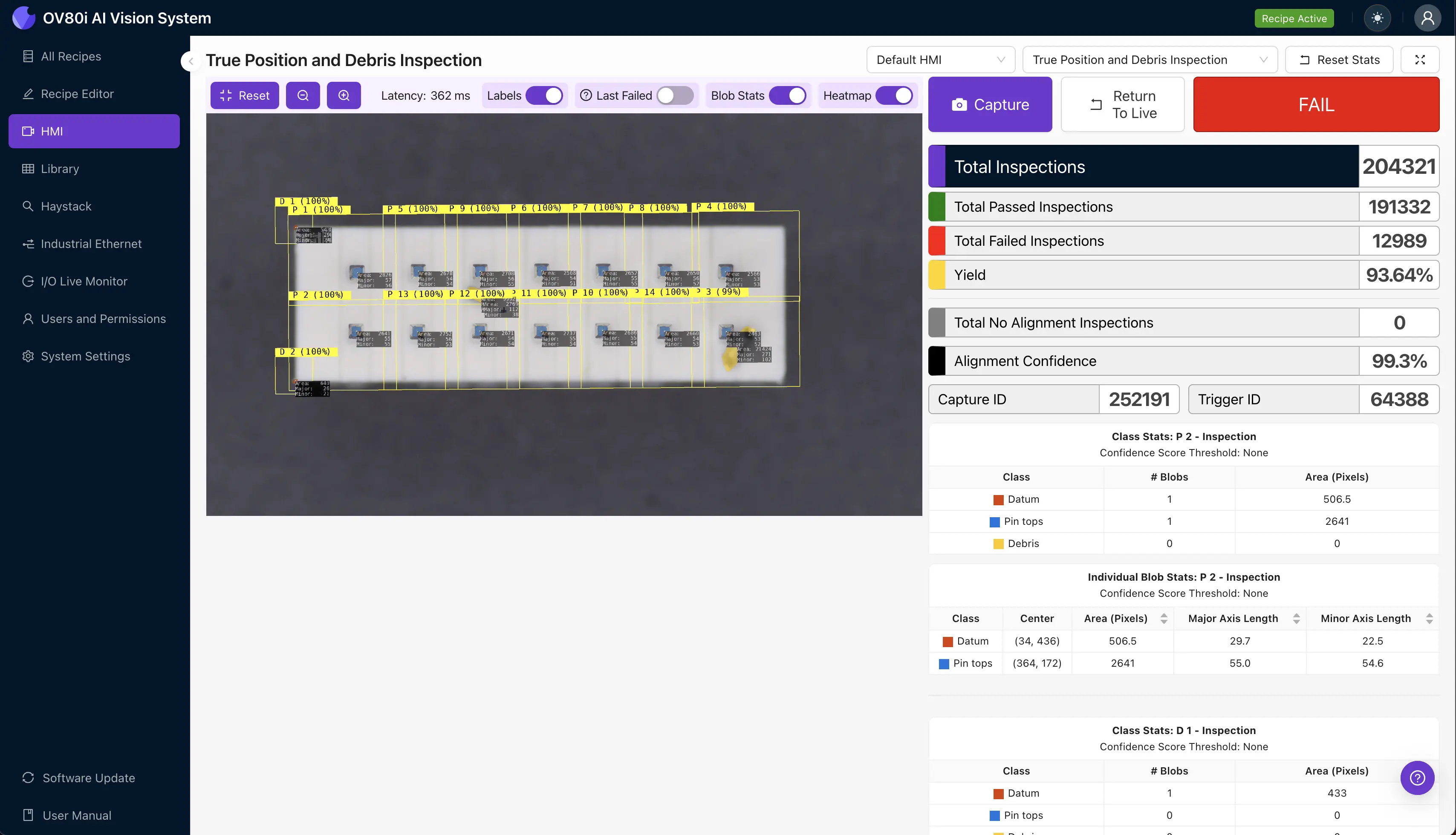
What is a vision system?
Hardware and software that captures images of a product, analyzes them automatically, and makes a pass or fail decision. On a production line it does the job a human inspector would, at line speed, on every part, without tiring or drifting. Vision system, machine vision system, and industrial vision system all mean the same thing.
Anatomy
The parts of a vision system
Every vision system, simple or advanced, is built from the same building blocks.
Camera or sensor
Captures the image. Resolution and frame rate set the smallest feature you can resolve and how fast you can run.
Lighting
The most underrated part. The right illumination makes a defect obvious instead of invisible. Most failed inspections trace back to lighting.
Lens and optics
Set the field of view, working distance, and focus. They control how much of the part you see and how sharply.
Processor and software
Where the decision happens. Rule-based tools or a trained AI model classify the part as good or bad, fast enough to act before it moves on.
Communication and I/O
Connects the result to the line. The system triggers a reject or signals a PLC over EtherNet/IP, PROFINET, or OPC UA.
Line integration
Mounting, triggering, and timing so the system inspects the right part at the right moment, every cycle.
Taxonomy
Types of vision systems
By dimension
1D, 2D, and 3D
1D reads a single line for continuous web or sheet. 2D is the workhorse for inspection, code reading, and measurement. 3D adds height and shape for volume, warpage, and seating checks.
By architecture
Smart camera vs PC-based
A smart camera puts the sensor, compute, and lighting in one unit. A PC-based system connects separate cameras to an industrial computer, adding flexibility at the cost of more parts to integrate and maintain.
By decision method
Rule-based vs AI
Rule-based machine vision follows fixed thresholds an engineer programs. AI vision learns from example images, so it handles variable surfaces and cosmetic defects that resist fixed rules. This axis has changed the most.
The shift
Traditional vs AI vision
| Capability | Traditional (rule-based) | AI vision |
|---|---|---|
| Best for | Predictable parts, clear features | Variable surfaces, cosmetic and rare defects |
| Setup | Engineer programs rules and thresholds | Train on example images of good and bad parts |
| New defect types | Often needs reprogramming | Add examples and retrain |
| Tolerance to variation | Low, sensitive to part changes | High, learns the acceptable range |
| Who operates it | Vision engineer or integrator | Your quality team, in a browser |
Neither is universally better, and many lines run both. AI made the hard cases, cosmetic and variable defects, practical to automate. It is also the most deployable form of physical AI on the line today. See the defects AI vision can detect.
What a pass and a fail look like
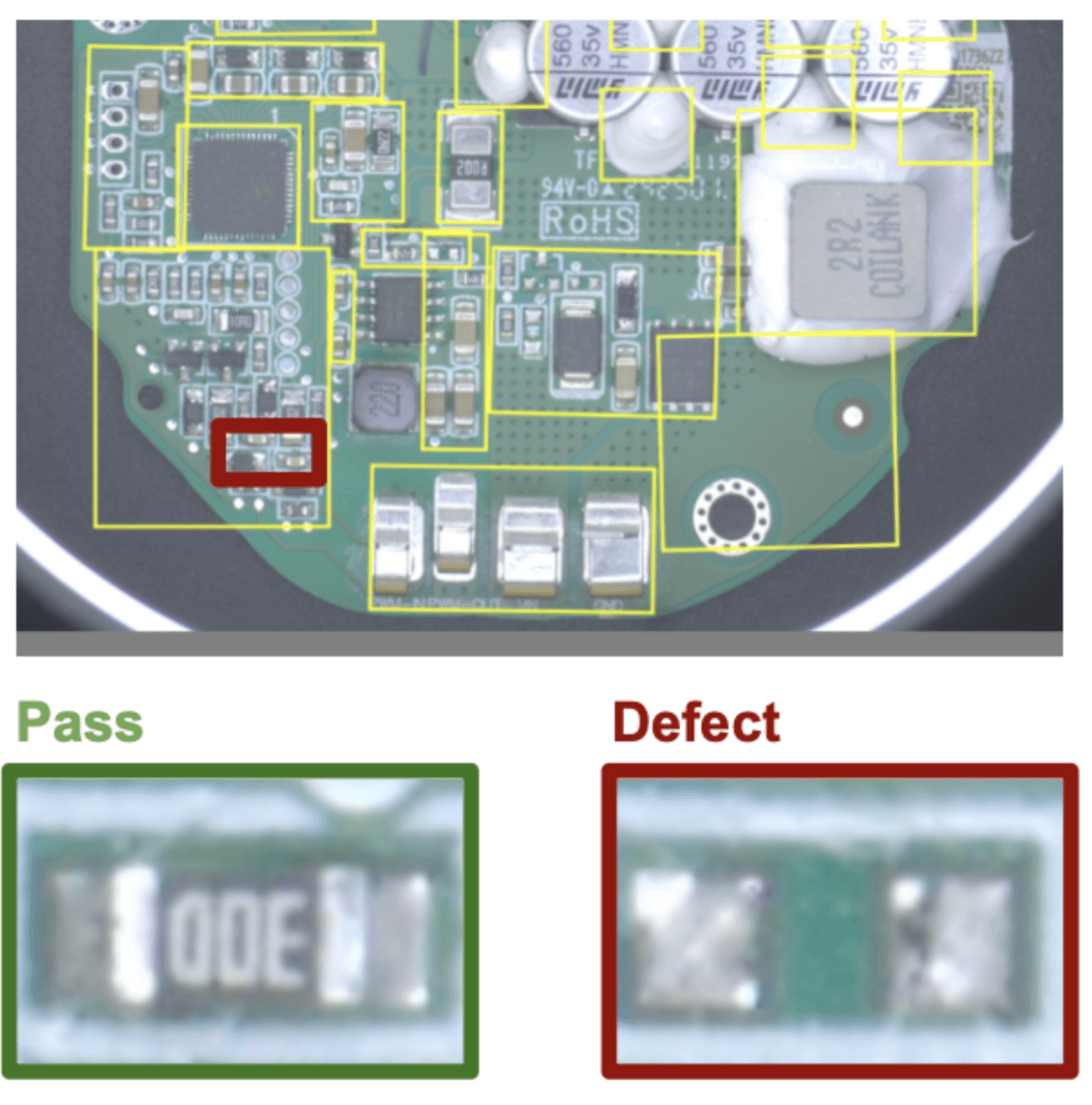
Every part gets a call, with a confidence score
A vision system draws a region of interest on each part and returns pass or fail in milliseconds. Here it clears a clean board and flags a solder bridge on a defective one, the kind of fault that is easy to miss by eye at line speed.
On the line
What vision systems do
The same core technology covers a wide range of inspection jobs.
Where Overview fits
An AI vision system in a single smart camera
Overview puts the sensor, edge compute, lighting, and AI software in one IP67 unit. Your team trains it on your parts in a browser and runs it in days, with no integrator and no cloud.
Deploy in days
Browser-based setup by your own team, not a multi-week integration.
Runs at the edge
Inference on an integrated NVIDIA GPU. Works offline, data stays on site.
Built for variable defects
Deep-learning inspection for cosmetic and variable defects, plus measurement.












Manufacturers running Overview AI in production
Manufacturers running Overview AI in production
FAQ
Frequently asked questions
What is a vision system?
A vision system is hardware and software that captures images of a product, analyzes them automatically, and makes a pass or fail decision. In manufacturing it replaces or supports manual visual inspection. A typical system combines a camera or sensor, lighting, a processor, inspection software, and a connection to the line so it can act on the result.
What is the difference between a vision system and a machine vision system?
The terms are used interchangeably. "Machine vision system" emphasizes the industrial, automated context, while "vision system" is the broader phrase. Both describe the same idea: a camera-based system that inspects parts and makes automated decisions on a production line.
What are the main types of vision systems?
Vision systems are grouped a few ways: by dimension (1D, 2D, and 3D), by architecture (all-in-one smart cameras versus PC-based systems with separate cameras and a controller), and by decision method (rule-based machine vision versus AI or deep-learning vision). Most modern lines use 2D smart cameras, with 3D and AI added where the application needs them.
What is the difference between traditional and AI vision systems?
Traditional vision systems use fixed rules and measurements that an engineer programs, which works well for predictable parts and clear features. AI vision systems learn from example images, so they handle variable surfaces, cosmetic defects, and parts that are hard to describe with rules. AI systems are usually faster to set up for complex defects and adapt better to new defect types.
How long does it take to deploy a vision system?
It depends on the architecture. PC-based systems built by an integrator often take weeks of programming and a site acceptance test. An all-in-one AI smart camera like Overview can be set up by your own quality team in one to three days through a browser, with no programming required.
Do vision systems need the cloud to work?
No. Edge vision systems run the analysis on the device itself, so inspection keeps working with no internet connection and your images stay in your facility. Overview systems run fully at the edge on an integrated NVIDIA GPU.
Bài viết liên quan
See a vision system on your parts
Tell us what you need to inspect and a vision engineer will show you how Overview catches it, typically with a system running on your line within days.