The plain-English guide
Physical AI
AI that perceives the real world and acts on it, on the factory floor, today.
Here is what physical AI actually is, the loop it runs on, and why AI vision inspection is the form already paying for itself on production lines.
What is physical AI?
Artificial intelligence that perceives the real world and acts on it, instead of working only with text and data. It spans robots, cobots, autonomous systems, and machine vision. For the full picture of the models behind it, see what physical AI and world models are.
How it works
The perceive, predict, act loop
Every physical AI system, simple or advanced, runs the same loop. Break any step and it stops being physical AI.
Perceive
Sensors take in the real world. In inspection that is a camera capturing every part at line speed, the input the whole system reasons from.
Predict
A trained model interprets what it sees and decides what it means. Good or bad, in tolerance or out, the right part in the right place or not.
Act
The decision changes something physical. A reject is triggered, a part is diverted, a robot or PLC is signaled. Perception that does not act is just a dashboard.
The spectrum
Where physical AI is on the line today
Available now
AI vision inspection
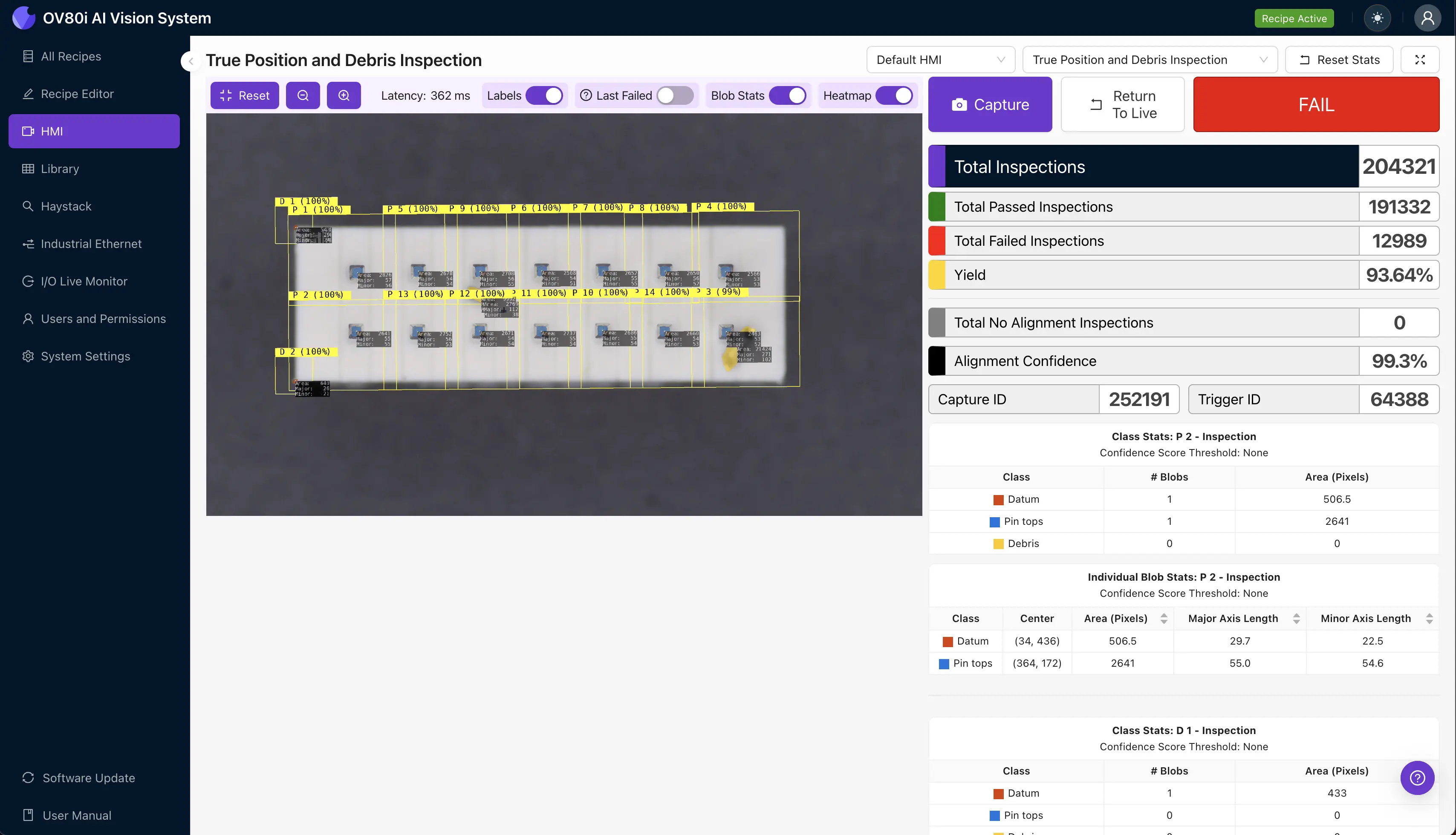
A camera perceives a part and makes an accept or reject decision at the edge, in milliseconds, on an existing line. The most deployable form of physical AI and the natural place to start.
Maturing
Cobots and guided automation
Collaborative robots that pick, place, and assemble alongside people. They depend on a trustworthy perception layer to know what they are acting on.
Emerging
Autonomous systems and humanoids
General-purpose robots that move through a plant and handle varied tasks. Promising, but years from broad production use, and only as good as the perception feeding them.
The entry point
Why inspection is where physical AI starts
| Question | Robots and humanoids | AI vision inspection |
|---|---|---|
| Time to value | Months to years of integration | Days, on an existing line |
| Changes to the line | New cells, safety, floor space | A camera over the parts you already make |
| Who runs it | Robotics integrators | Your quality team, in a browser |
| Maturity in production | Early and narrow | Proven and in use today |
| What it depends on | A trusted perception layer | It is the perception layer |
Inspection is not a dead end on the road to automation, it is the perception layer the rest of physical AI is built on. See how it plays out on the floor in physical AI for quality inspection.
The hard part
The bottleneck is data, and world models solve it
Physical AI is only as good as what it learns from, and a high-quality factory produces very few defects, which leaves little to train on. World models change that. They generate realistic synthetic defects on clean reference parts, so an inspection model can be trained before real defect data exists at scale. A new line can go live in days instead of waiting weeks for failures to appear.
On the line
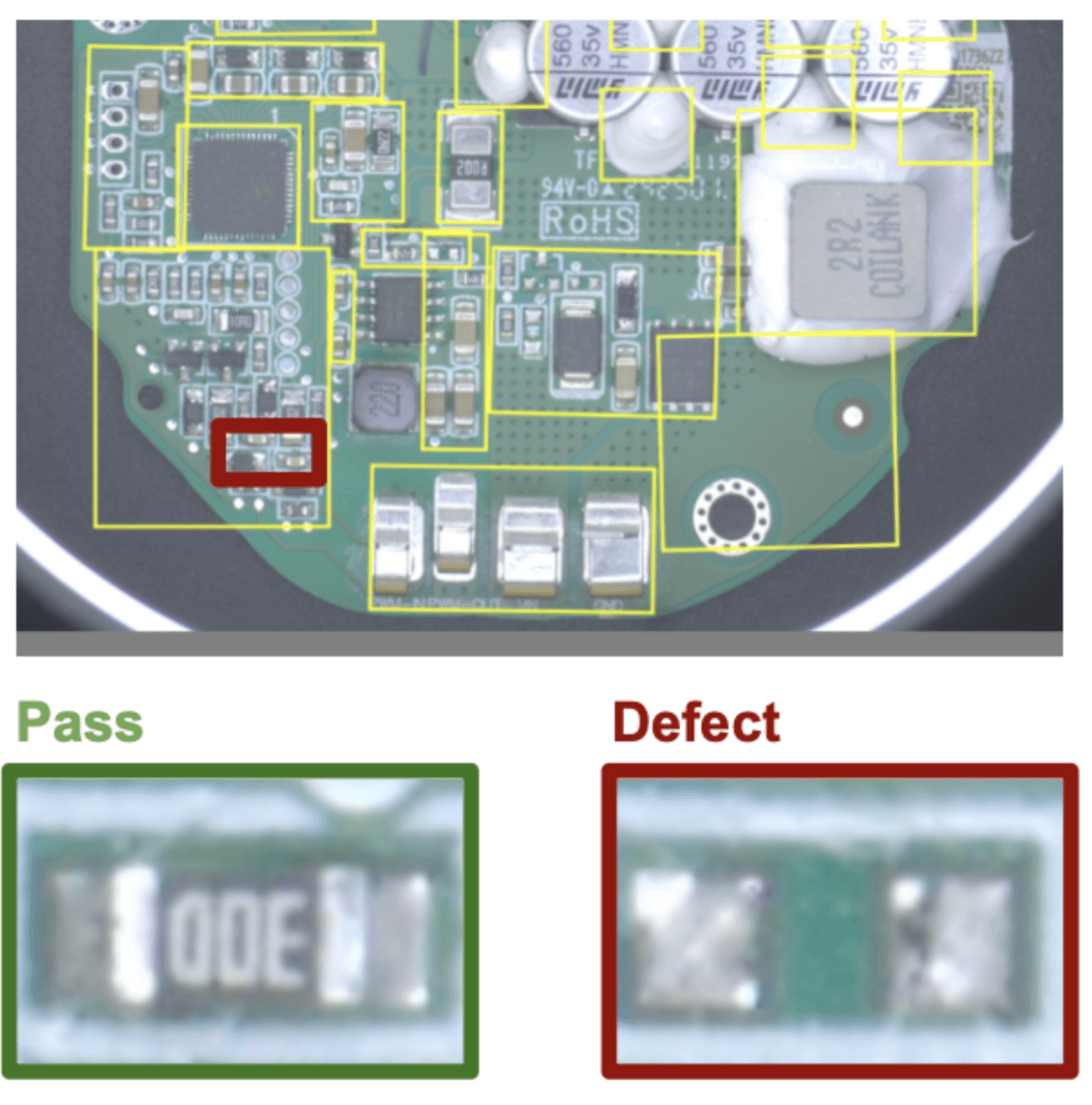
What physical AI inspects today
The same perceive, predict, act loop covers a wide range of inspection jobs.
Where Overview fits
Physical AI for inspection, in a single smart camera
Overview puts the sensor, edge compute, lighting, and AI software in one IP67 unit. It perceives parts, decides pass or fail on an integrated NVIDIA GPU, and acts on the line over standard industrial protocols. No integrator, no cloud.
Perceives and acts
Sees every part and signals robots and PLCs over EtherNet/IP, PROFINET, and OPC UA.
Runs at the edge
Inference on an integrated NVIDIA GPU. Works offline, data stays on site.
Trained on synthetic defects
World-model defect generation means a new line can go live in days, not months.
OV Auto-Defect Creator Studio
The world-model layer. A clean line produces almost no defects, so the training set is the bottleneck rather than the model. This generates photorealistic defects on images of your own good parts, which is what turns weeks of waiting into a model you can deploy now.
OV10i, OV20i, OV80i and OVX
The perceive and act layer. Camera, lighting, NVIDIA GPU, and I/O in one IP67 housing, deciding in under 10 ms and telling the line over a standard protocol. No cloud round trip, and no separate controller to integrate.
Haystack
The layer that closes it. Synthetic data gets a model into production; the real examples the line then produces are what sharpen it. Haystack surfaces the images the model was least sure about, so the next retrain is aimed at what it actually got wrong.












Manufacturers running physical AI in production
Manufacturers running physical AI in production
FAQ
Frequently asked questions
What is physical AI?
Physical AI is artificial intelligence that perceives the real world and acts on it, as opposed to software-only AI that works with text and data. It spans robots, cobots, autonomous systems, and machine vision. In a factory, physical AI senses what is happening on the line and makes a decision that changes something in the physical world.
What is the difference between physical AI and generative AI?
Generative AI produces content such as text, images, or code from a prompt. Physical AI perceives the physical world through sensors and acts on it, often in real time. They share underlying model techniques, but physical AI is judged on whether it makes the right decision about a real object, not on the fluency of an output.
Is AI vision inspection physical AI?
Yes, and it is the most deployable form available today. An AI vision system perceives a part with a camera and makes a real-world accept or reject decision at the edge, in milliseconds, on the line. It is physical AI working in production now, while humanoid robots are still years from broad factory use.
Do I need robots to use physical AI?
No. Robots and humanoids get the headlines, but they are not the entry point for most manufacturers. AI vision inspection deploys in days, needs no robot, and delivers value on an existing line. It can also feed accept and reject signals to robots and PLCs when you are ready to automate further.
What are world models and why do they matter for physical AI?
A world model is an AI that understands how a scene behaves, so it can generate realistic variations of it. In manufacturing this solves the hardest problem in inspection: clean factories produce very few defects, so there is little to train on. World models generate synthetic defects on good reference parts, so an inspection model can be trained before real defect data exists at scale.
How do I start with physical AI in manufacturing?
Start with perception, not robots. Put an AI vision system on one line where a defect is costing you, train it on your parts, and let it make a clear accept or reject decision. That is physical AI delivering value in days. From there the same decision can drive downstream automation when you are ready.
Go deeper
Sim-to-Real Transfer
How a model trained on generated data holds up on the real line, and what closes the gap when it does not.
Read more →OV Auto-Defect Creator Studio
The synthetic defect engine: physics-aware generation on images of your own parts, annotated as it renders.
Read more →What Is Machine Vision
The perception layer physical AI is built on, and the technology inside it.
Read more →Related Articles
What Is Physical AI? World Models Explained
The definitive guide to physical AI, world models, and the perceive, predict, act loop.
Read More →World Models and Synthetic Data
Why the factories with the highest standards have the least defect data, and what to do about it.
Read More →Top 10 Physical AI Companies to Watch in 2026
The companies building the foundation layer, and the ones deploying it in production.
Read More →Put physical AI on your line this quarter
Tell us what you need to inspect and a vision engineer will show you how Overview perceives it and acts on it, typically with a system running on your line within days.