Guidance and alignment
Vision guided robotics
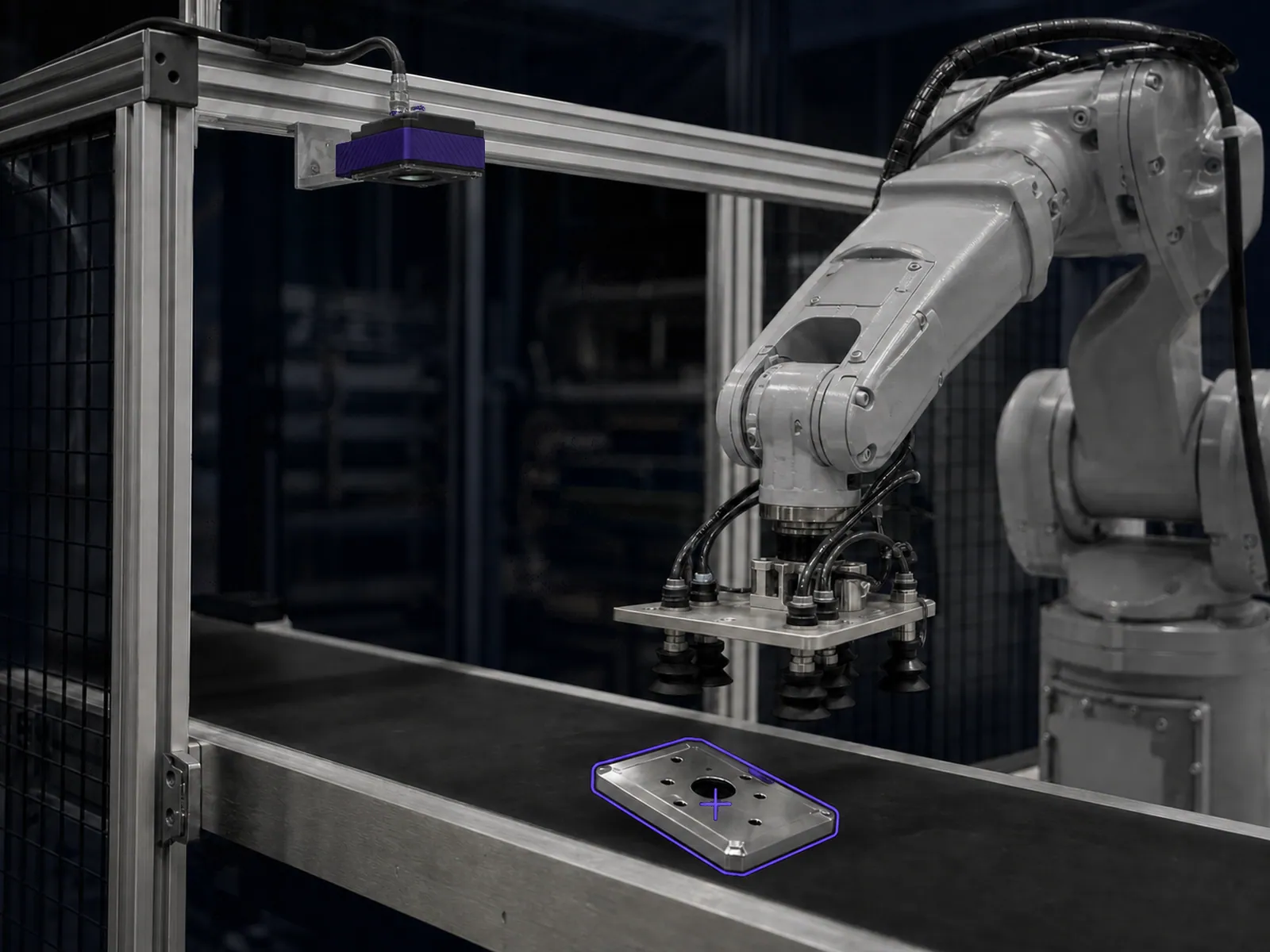
The camera finds the part, so the fixture does not have to hold it perfectly.
Vision guidance replaces precise mechanical fixturing with a coordinate. That is usually cheaper, and it is what lets a robot cope with parts that arrive slightly differently every time.
What is vision guided robotics?
Vision guided robotics is using a camera to locate a part, then giving the robot a position to act on. Instead of a fixture holding the part in exactly one place, the camera measures where it actually is and the robot adapts. The output is a coordinate, not a pass or fail, which is what separates guidance from inspection.
What it checks
What the camera provides
Part position
Where the part actually is in the frame, converted into the robot coordinate frame so the robot can reach it. The core output, and the whole reason to add vision.
Orientation
How far the part is rotated from nominal, so the gripper approaches at the right angle instead of fighting the part.
Pick point selection
Which feature to grip when the part offers several, and which to avoid. Matters most on parts that are not symmetrical.
Presence and pose validation
Confirming there is a part to pick at all, and that it is lying in a way the gripper can handle and not on its side.
Placement verification
Checking after the move that the part actually landed where it was meant to, which turns an open loop into a closed one.
Tray and fixture mapping
Locating every pocket in a tray once, so the robot works through it without a separate trigger per position.
The hard parts
Where vision guidance gets difficult
Guidance is more demanding than inspection in one specific way: a wrong answer moves a robot. These are the four things that decide whether it works.
Calibration is the accuracy
The camera measures in pixels and the robot moves in millimetres. The transform between them is what makes the number meaningful, and it is where most of the real error lives. A well-calibrated modest camera beats a poorly calibrated excellent one every time.
Depth is not free
A single 2D camera gives you position in a plane. If the part can also vary in height, or tilt, a flat image cannot tell you, and the robot will approach at the wrong distance. That is when a second view or a 3D method stops being optional.
Latency is part of the tolerance
On a moving line, the part has travelled between the capture and the grip. Either the timing is deterministic enough to compensate, or the part is stationary when it is measured. Guessing here produces intermittent misses that are miserable to debug.
Bin picking is a different problem
Locating one part on a flat surface is well understood. Locating one in a pile, where parts occlude each other and lie at arbitrary angles, is substantially harder and generally needs 3D. Worth separating the two before scoping a project.














Manufacturers running Overview AI in production
Manufacturers running Overview AI in production
FAQ
Frequently asked questions
What is vision guided robotics?
It is using a camera to tell a robot where something is. The camera captures the scene, software locates the part and works out its position and orientation, and that result is converted into the robot coordinate frame so the robot can pick, place, or work on it. The point is that the part no longer has to arrive in exactly the same place every time, which removes the need for expensive precision fixturing and lets one cell handle more variation.
How accurate is vision guidance?
Accuracy is set by three things, and the camera is only one of them. Pixel size at the part determines the finest position you could theoretically resolve. The calibration between camera space and robot space determines how much of that resolution survives into a real move. And the mechanical repeatability of the robot and gripper caps the result regardless. In practice calibration quality dominates, which is why a carefully calibrated modest setup routinely outperforms an expensive uncalibrated one.
Do I need 3D for vision guided robotics?
Not always, and 2D is cheaper and simpler where it fits. If parts lie flat on a known surface at a known height, a single 2D camera gives you position and rotation, which is enough for most pick and place. You need 3D when height varies, when parts can tilt, or when they are stacked or in a bin so they occlude each other. Deciding this early matters, because it changes the cost of the cell substantially.
Can it replace fixturing entirely?
It replaces precision fixturing, not all fixturing. You usually still want something that constrains the part to a rough area and a known orientation range, because that keeps the part in the field of view and keeps the search tractable. What vision removes is the need for that fixture to be accurate to a tolerance, which is where most of the cost and most of the changeover time in fixturing actually sits.
Does the robot have to stop for the camera?
It depends on how deterministic your timing is. The straightforward approach is to capture while the part is stationary, which removes all timing questions. Capturing on the move is possible and common, but then the part has travelled between the exposure and the grip, so that offset has to be known and compensated. If the latency varies, the compensation cannot be right, and the symptom is intermittent misses rather than consistent failure.
Tell us what the robot needs to find
Describe the part and what you need to catch. You get the optics and an honest answer on whether it is solvable, before anyone talks to you about hardware.