Packaging and print
Label inspection
Present is the easy question. Correct, straight, and legible are the ones that matter.
A missing label stops a pallet. A wrong or skewed one can mean a recall. What vision checks, why reflective film is the recurring problem, and how the criteria get agreed.
What is label inspection?
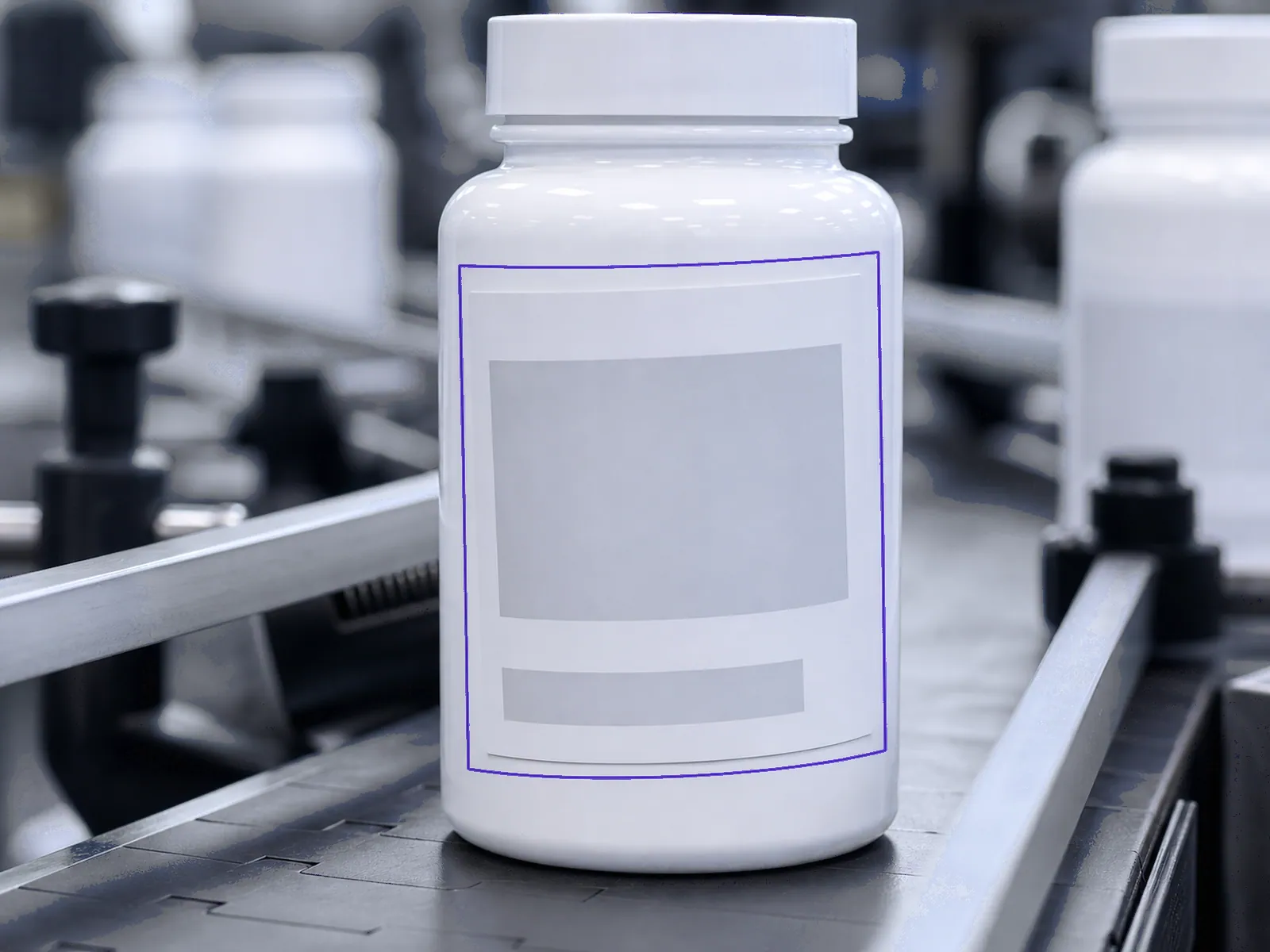
Label inspection is verifying that the right label is present, positioned within tolerance, printed legibly, and carrying the correct content. Those are four separate checks with four different failure modes, and only the first one is easy. The rest is where the recalls come from.
What it checks
The four checks, in increasing difficulty
Presence
Is a label there at all. The simplest case, and often the one with the clearest immediate cost, because a missing label usually stops the product from shipping.
Placement
Is it within tolerance for position and rotation. Needs an agreed number: how many millimetres of offset and how many degrees of skew are actually acceptable.
Print quality
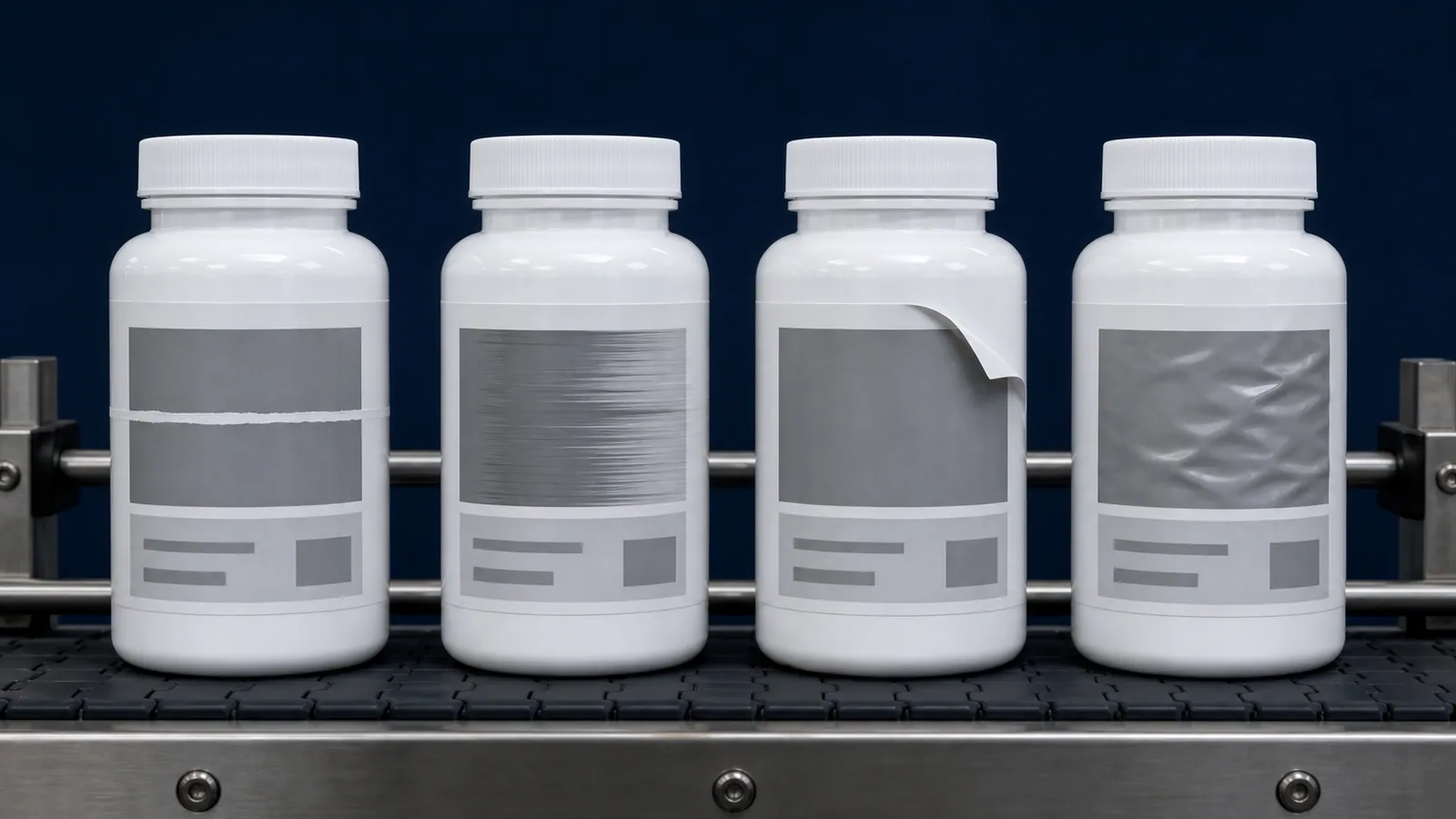
Is it legible and complete. Streaks, voids, smearing, low contrast, and ribbon wrinkle all produce a label that is present and correctly placed but useless.
Correct content
Is it the right label for this product and batch. This is where a mix-up becomes a recall, and it means reading the label, not merely looking at it.
Code legibility
Can the barcode or 2D code actually be read, and does it grade acceptably. A code that scans on your line but not at a distributor is still a failure.
Wrinkle and lift
Is the label flat and adhered. A lifted corner catches in downstream equipment and a wrinkle can obscure part of the code.
The hard parts
Why labels are harder than they look
Labels seem like an easy vision job and the presence check genuinely is. The other three run into the same handful of problems.
Reflective and glossy film
Most labels are on film or coated stock that behaves like a mirror. A point light source produces a highlight that can obscure print or read as a defect. Diffuse illumination is usually the fix, and it is worth planning for rather than discovering.
Curved and deformable surfaces
A label on a bottle or a pouch is curved, so it is unevenly lit and geometrically distorted. Print near the edges is foreshortened, and a single view may not see the whole label at all on a small-diameter container.
Placement tolerance is a decision, not a measurement
Vision can measure offset to a fraction of a millimetre, but it cannot tell you what is acceptable. That number has to come from the people who own the spec, and pinning it down before the system is built avoids most of the arguments afterwards.
Print defects are appearance judgments
A faint streak is either acceptable or not depending on whether the label still does its job. That is exactly the kind of boundary a trained model learns from examples better than a threshold describes, provided the accepted examples span the real range.








Manufacturers running Overview AI in production
Manufacturers running Overview AI in production
FAQ
Frequently asked questions
What does label inspection check?
Four things, and they are worth separating because they fail differently. Presence, which is whether a label is there. Placement, whether it is within tolerance for position and rotation. Print quality, whether it is legible and complete. And content, whether it is the correct label for that product and batch. Many lines also grade the barcode, because a code that reads on your scanner but fails at a distributor is still a defect that comes back to you.
Can vision read the label as well as check it is there?
Yes, and on most lines you want both. Checking presence and placement is a geometric task. Reading the label to confirm it is the right one for the batch is character and code recognition, which catches the mix-up that a presence check passes happily. The second is what prevents a mislabelled batch shipping, and it is usually the check with the largest downside if it is missing.
Why is glossy label stock a problem?
Because it reflects the light source. A bright point light on a glossy surface produces a specular highlight, and wherever that highlight lands the camera sees the lamp, not the label. Print underneath it is unreadable, and the highlight edge can itself look like a defect. Diffuse illumination spreads the reflection out so the label surface is what the camera actually records, which is why lighting choice usually matters more here than camera choice.
How tight can placement tolerance be?
Tighter than most specs require, so the limit is usually the specification rather than the vision. With enough pixels across the label, offset and rotation can be measured to a fraction of a millimetre and a fraction of a degree. The practical question is what tolerance is genuinely acceptable, because setting it tighter than the process can hold produces false rejects, and that number has to come from whoever owns the spec.
Does it work on curved containers?
Yes, with planning. A label on a curve is distorted and unevenly lit, so the geometry is either corrected before reading or the model is trained on the distortion as it really appears. On a small-diameter container a single camera may not see the whole label, in which case you either rotate the container past the camera or use more than one view. Neither is unusual; both are cheaper to plan than to retrofit.
Related
OCR and Character Verification
Reading lot codes, date codes, and serials, including low-contrast direct marks.
Read more →Packaging Inspection
Seals, closures, fill, and pack integrity on the same line.
Read more →Machine Vision Applications
The full set of inspection tasks, by part and by defect.
Read more →See it on your labels
Describe the part and what you need to catch. You get the optics and an honest answer on whether it is solvable, before anyone talks to you about hardware.