
Top 10 Physical AI Companies to Watch in 2026
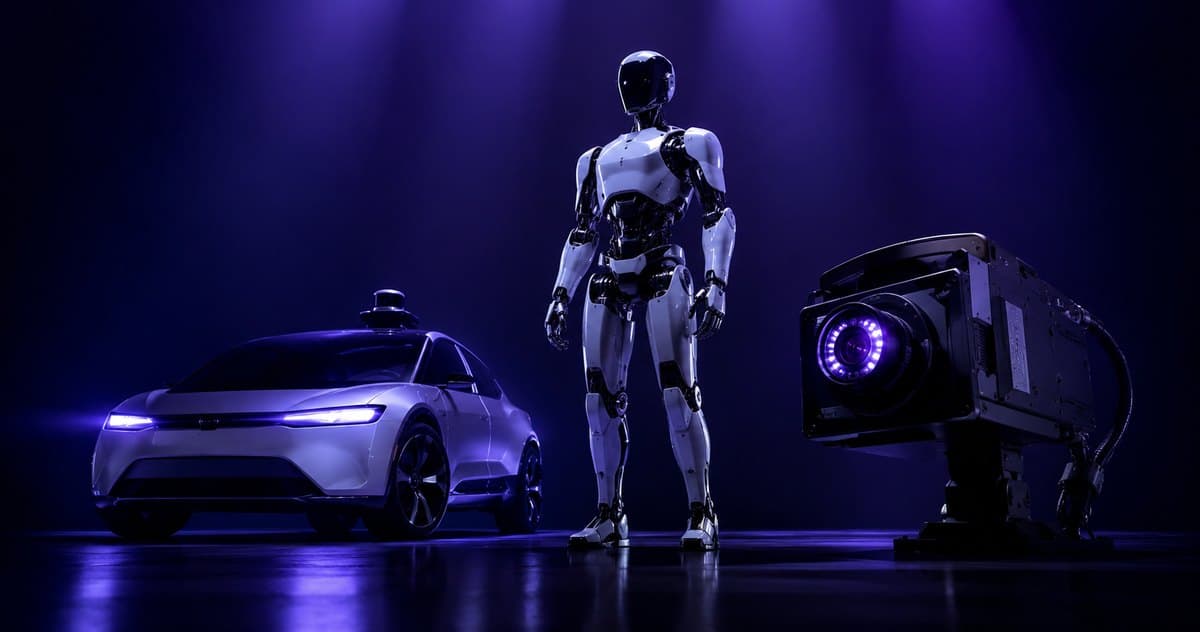
Physical AI is the defining theme of 2026: AI that perceives, reasons, and acts in the real world. This ranked list of the top physical AI companies covers the leaders in world models, robotics foundation models, autonomous vehicles, humanoid robots, and AI vision inspection for manufacturing. These are the physical AI companies turning world models and foundation models into robots, vehicles, and factory floor systems that actually ship.
We ranked these companies by how directly they advance the physical AI loop of perceive, predict, and act, and by how much of their technology is deployed in the real world today rather than in a demo. New to the topic? Start with our guide to physical AI in manufacturing, or the deeper dive on physical AI and world models.
The foundation layer
These companies build the world models, the general robot policies, and the silicon that other people’s physical AI runs on. Their output is capability that other companies deploy.
NVIDIA
World models & computeBuilds the Cosmos world foundation models, Isaac robotics stack, and the Jetson edge GPUs that most physical AI runs on. The closest thing to an operating system for the field.
Physical Intelligence
Robotics foundation modelsBuilding a single foundation model that can control many different robots across many tasks, aiming to be the GPT moment for physical manipulation.
Skild AI
Robotics foundation modelsTraining a general robot brain designed to transfer skills across hardware and environments, reducing the need to program each robot from scratch.
The applied layer
These companies run physical AI against real consequences today. The differences between them are mostly about domain and how hard the environment is, not about which is further ahead.
Overview AI
Factory floor vision inspectionRuns physical AI where it pays for itself fastest: real-time defect detection on the production line, deciding at the edge in under 10 ms. Uses world-model-style synthetic defect generation to reach a deployed inspection in days rather than months, which is what makes this the most deployable form of physical AI available right now.
Tesla
Autonomy & humanoidsFull Self-Driving is one of the largest deployed physical AI systems in the world, and Optimus extends the same vision-and-control stack from cars to humanoid robots.
Waymo
Autonomous vehiclesRuns fully driverless robotaxi fleets at scale, with a mature perceive-predict-act loop and one of the deepest real-world driving datasets in existence.
Wayve
Embodied driving AITakes an end-to-end, world-model-driven approach to autonomous driving that learns to drive in new cities without hand-coded rules or HD maps.
Figure
Humanoid robotsDevelops general-purpose humanoid robots for warehouses and manufacturing, pairing foundation models with real manipulation in cluttered human environments.
Covariant
Warehouse roboticsBrings foundation-model perception and grasping to picking robots, letting them handle the long tail of unfamiliar items in fulfillment centers.
Boston Dynamics
Mobile robotsThe benchmark for dynamic legged and mobile manipulation, increasingly layering learned policies on top of its famous control engineering.
The two layers of the physical AI market
Two layers are forming. At the foundation are the world model and robotics-brain builders that give machines a general sense of how reality works. On top sit the applied players in autonomy, humanoids, warehouses, and manufacturing that turn that capability into a job that gets done on a real line, road, or floor.
Manufacturing is where the return on physical AI is most immediate, because a vision inspection system pays for itself in scrap and rework avoided from day one. The same world-model techniques powering robots and cars also let a factory generate synthetic defects and train inspection models without waiting for failures to occur. We break that down in World Models Explained: How Synthetic Data Trains the Factories of the Future.
See physical AI inspection in action
Overview AI deploys real-time defect detection on the production line, trained on synthetic data and running at the edge.
Company rankings reflect Overview AI's editorial view as of June 2026 and are not an endorsement or a financial recommendation.
Frequently Asked Questions
What is physical AI?
Physical AI is AI that perceives, reasons, and acts in the real world. It covers world models, robotics foundation models, autonomous vehicles, humanoid robots, and AI vision inspection for manufacturing, turning foundation models into robots, vehicles, and factory floor systems that actually ship.
How were these physical AI companies ranked?
Companies were ranked by how directly they advance the physical AI loop of perceive, predict, and act, and by how much of their technology is deployed in the real world today rather than in a demo.
What are the two layers of the physical AI market?
At the foundation are the world model and robotics-brain builders that give machines a general sense of how reality works. On top sit the applied players in autonomy, humanoids, warehouses, and manufacturing that turn that capability into a job that gets done on a real line, road, or floor.
Why is manufacturing where physical AI pays off fastest?
A vision inspection system pays for itself in scrap and rework avoided from day one. The same world-model techniques powering robots and cars also let a factory generate synthetic defects and train inspection models without waiting for failures to occur.
See Overview AI on your parts
Send us a photo of your part or defect and a vision engineer will tell you whether Overview can catch it, with most systems deployed on the line in days.
Related Articles
Top 10 Industrial AI Vision Systems in 2026 (Buyer's Guide)
A side-by-side look at the best industrial AI vision systems for manufacturing in 2026: accuracy, integration, deployment speed, and ROI compared.
Read More →2026 Top 10 Zero-Defect Manufacturing Technologies
The 10 technologies making zero-defect production achievable at scale in 2026, from AI vision inspection to closed-loop process control.
Read More →2026 Top 10 GenAI Tools for Manufacturing
The top generative AI tools transforming manufacturing in 2026, from synthetic training data to AI-generated inspection models.
Read More →