
What Is Physical AI? World Models and the Next Wave of Industrial Intelligence
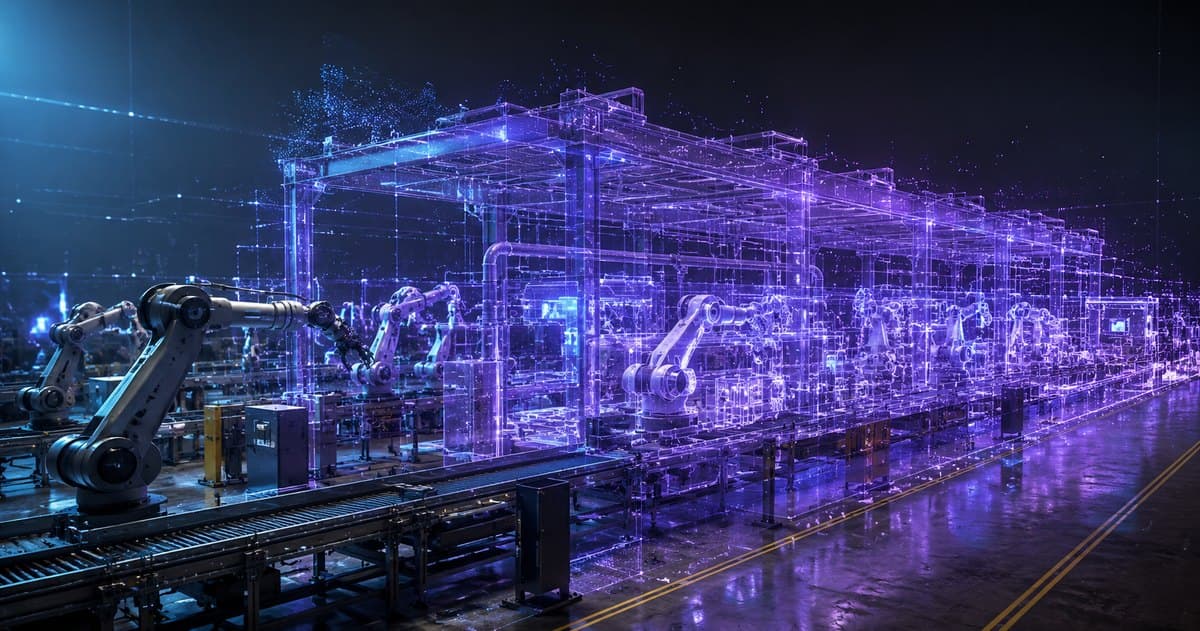
Physical AI is artificial intelligence that perceives, reasons about, and acts in the real world. Physical AI and world models are the next wave of industrial AI, powering robotics, autonomous systems, and AI vision inspection in manufacturing. This guide explains what physical AI is, how world models work, and why embodied AI is reshaping the factory floor in 2026.
What is physical AI? A definition
Physical AI is artificial intelligence connected to the physical world through sensors and actuators. Where a large language model operates on text and an image generator operates on pixels, physical AI operates on reality: it takes in camera frames, depth maps, force readings, and motion, then produces actions such as classifying a part, steering a vehicle, or moving a robotic arm.
The distinction matters because the real world is unforgiving. A chatbot can produce a wrong sentence and a user shrugs. A physical AI system that misjudges a weld, a lane, or a grasp causes scrap, recalls, or worse. That higher bar is why physical AI depends on training and validation techniques that traditional digital AI never needed.
What is a world model in physical AI?
A world model is an AI model that learns how the physical world looks and behaves well enough to predict what happens next and to generate realistic synthetic scenarios. If a language model predicts the next word, a world model predicts the next frame, the next state of a scene, or the consequence of an action.
That predictive ability unlocks two things physical AI needs badly. First, simulation: teams can train and stress-test a system inside the world model before it ever touches real hardware. Second, synthetic data: the model can generate the rare and dangerous situations that almost never show up in real data, so the AI learns to handle them anyway.
Read cameras, depth, force, and motion from the real world.
Use a world model to anticipate what happens next.
Classify, steer, grip, or reject in real time.
Why physical AI and world models are exploding in 2026
Three forces converged. Foundation models proved that a single large model can generalize across tasks. Edge compute got powerful enough to run those models next to the machine instead of in a distant data center. And world model research matured to the point where generated scenes are realistic enough to actually train production systems.
The result is a wave of physical AI across three domains: autonomous vehicles that reason about traffic, humanoid and industrial robots that manipulate the world, and vision inspection systems that catch defects on the factory floor. All three share the same loop: perceive, predict with a world model, act.
Physical AI in manufacturing: AI vision inspection on the factory floor
Manufacturing is where physical AI is already paying for itself. Vision inspection is a textbook physical AI task: a camera perceives a part, a model decides pass or fail, and the line acts on that decision in milliseconds. The hard part has always been data, because high-quality factories produce very few defects, which leaves little to train on.
World models change that equation. Instead of waiting weeks for rare defects to appear, manufacturers can generate synthetic defects on clean reference parts and train inspection models before real defect data exists at scale. This is the approach Overview AI takes: real-time AI vision inspection running at the edge, trained on synthetic defects so a new line can go live in days. We cover exactly how that works in World Models Explained: How Synthetic Data Trains the Factories of the Future.
The future of physical AI and world models
The companies building physical AI are racing to make world models more accurate, edge inference faster, and the perceive-predict-act loop tighter. For a look at who is leading, see our Top 10 Physical AI Companies to Watch in 2026. For manufacturers, the takeaway is simpler: the bottleneck is no longer the model, it is the data, and world models are how you solve it.
Bring physical AI to your production line
Overview AI runs vision inspection at the edge and uses synthetic defect generation to deploy in days, not months.
Frequently Asked Questions
What is physical AI?
Physical AI is artificial intelligence that perceives, reasons about, and acts in the physical world. Unlike text or image generators that operate purely on digital data, physical AI is connected to sensors and actuators such as cameras, robots, and vehicles, and is judged by how well it performs real-world tasks.
What is a world model?
A world model is an AI model that learns an internal representation of how the physical world looks and behaves, so it can predict what happens next and generate realistic synthetic scenarios. World models let physical AI systems be trained and tested in simulation before they touch real hardware.
How is physical AI used in manufacturing?
In manufacturing, physical AI powers vision inspection systems that detect defects, verify assemblies, and guide robots in real time. World models and synthetic data let manufacturers train these inspection models without waiting for rare defects to appear on the line.
See how Overview AI inspects physical AI
Send us a photo of your part or defect and a vision engineer will tell you whether Overview can catch it, with most systems deployed on the line in days.
Related Articles
World Models Explained: How Synthetic Data Trains the Factories of the Future
How world models and synthetic defect generation solve the biggest bottleneck in factory AI: not enough defect data.
Read More →Synthetic Defect Data for HVMM Manufacturing
How synthetic defect generation broke the per-variant data bottleneck that gated AI vision in high-volume medium-mix manufacturing.
Read More →OV Auto-Defect Creator Studio: Create Synthetic Training Data for Vision AI
Generate realistic synthetic defect images across five specialized modes when real defect samples are scarce.
Read More →