
The 2026 Taco Bell Cyclospora Outbreak: Inspection Gaps in Fresh-Cut Lettuce
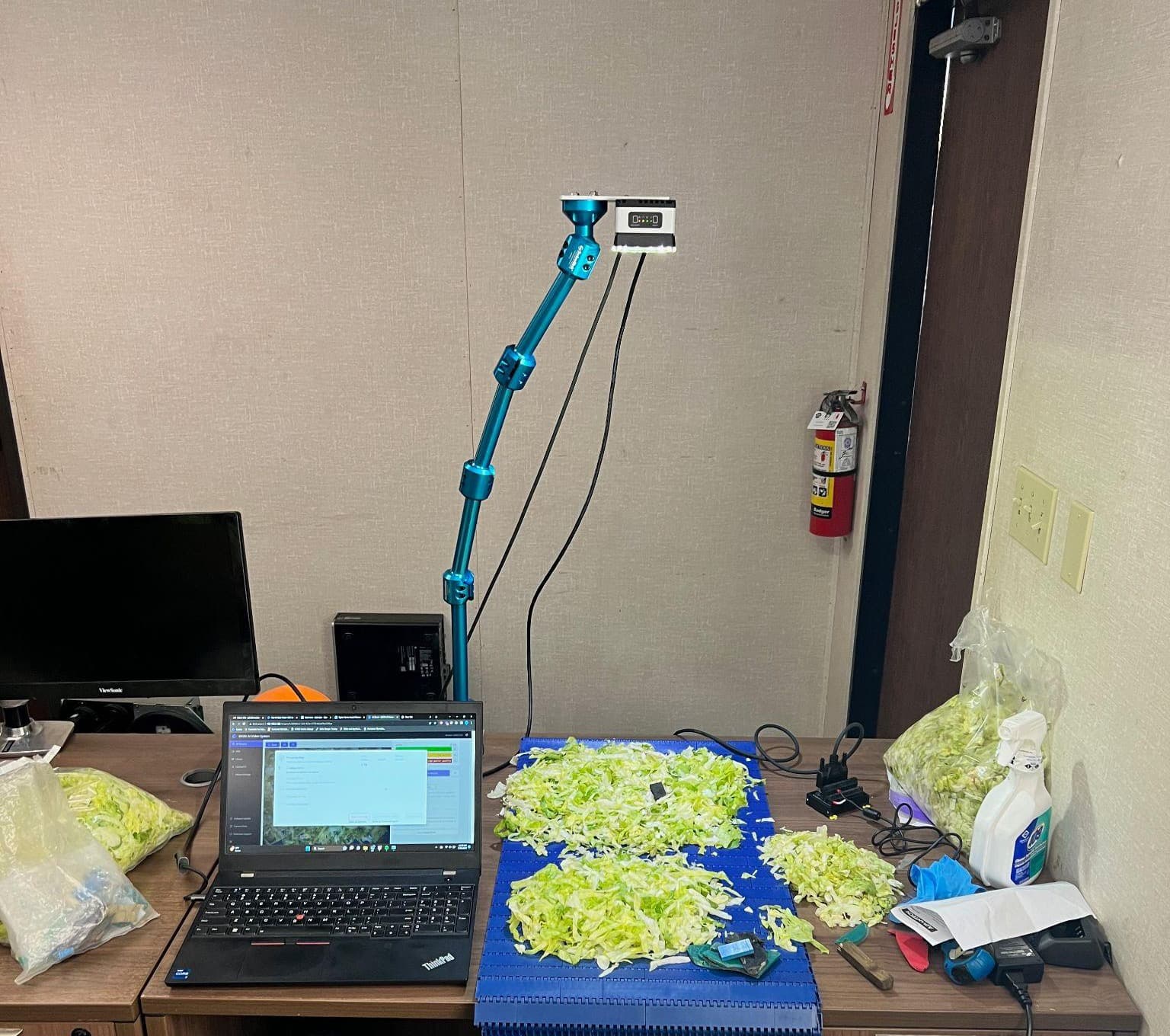
An Overview AI OV20i inspecting shredded iceberg lettuce on our bench, the same station used to test defect classification, bag seal integrity, and foreign object detection on retail lettuce.
A multistate Cyclospora outbreak that the CDC and FDA have linked to shredded iceberg lettuce served at Taco Bell, traced to supplier Taylor Farms, has put fresh-cut produce back in the headlines, on track to become one of the largest outbreaks of its kind on record in the United States. For quality and food safety engineers, the useful story is underneath the headline: leafy greens are one of the hardest categories to inspect, and manual sampling leaves a wide gap between what leaves the line and what a plant actually knows about it. This is an honest look at where automated optical inspection fits, what it can catch, and what it cannot.
What We Know About the 2026 Outbreak
The facts below are drawn from public statements by the U.S. Centers for Disease Control and Prevention (CDC) and the Food and Drug Administration (FDA). The investigation is ongoing, and nothing here is intended to assign fault for the event.
- •Source. The CDC and FDA linked the outbreak to shredded iceberg lettuce served at some Taco Bell locations in Indiana, Kentucky, Michigan, Ohio, and West Virginia.
- •Supplier. FDA's traceback investigation identified the supplier as Taylor Farms, with the lettuce sourced from central Mexico. Taylor Farms voluntarily removed the affected product from the market.
- •Scale. More than 1,600 illnesses were reported among people who ate at the implicated locations, with roughly 7,000 cases confirmed or under investigation nationwide, making it one of the largest cyclosporiasis outbreaks on record in the United States.
- •The pathogen. Cyclospora is a microscopic parasite spread through contaminated water or produce. It is not visible to the eye or to any optical camera, a point we return to below.
Why Leafy Greens Are the Hardest Thing on the Line to Inspect
The useful lesson is structural, not about any one company. A shredded lettuce line combines a raw agricultural input, a short shelf life, and high throughput in a product form that is impossible to inspect by eye at line speed. That is a worst case for traditional inspection for four reasons at once.
- •Throughput outruns people. Thousands of pounds per hour move past any point. Manual inspectors spot-check a fraction, and attention degrades over a shift.
- •The product has no fixed shape. Shredded leaf is a random, overlapping pile, so rule-based vision that depends on fixed geometry and thresholds has nothing stable to lock onto.
- •Defects look like the product. A browning edge, a wilted piece, or a fragment of core is a subtle shift against a background of the same material. That is pattern recognition, not thresholding.
- •Foreign material hides. Soil, field debris, wood, and plastic blend into a green mass, especially under variable lighting.
What Optical Inspection Can and Cannot Do
The honest part first
No camera can see Cyclospora, E. coli, Listeria, or any other pathogen. These hazards are microscopic. Any vendor claiming a vision system detects a parasite or bacterium on a lettuce leaf is selling something that does not exist. Optical inspection does not replace supplier verification, wash chemistry, cold chain control, or environmental monitoring.
What it does well is catch the visible contamination vectors and quality defects that raise the microbial load entering your process and correlate with a higher risk downstream. Removing organic defects and foreign material before and during washing lowers the bio-burden entering the flume, which is exactly the condition under which antimicrobial wash steps perform best. Vision is a layer that makes the rest of your program more effective.
| Defect / Contaminant | Why It Matters | How Vision Detects It |
|---|---|---|
| Foreign material (soil, debris, wood, plastic) | Carries environmental contaminants into the flume and the finished pack. | Pixel-level anomaly detection against learned normal product. |
| Browning and decay | Breaking-down tissue creates micro-environments where microbes cling and multiply. | Color and texture classification on good versus bad samples. |
| Core and stem fragments | Higher organic load, and rigid edges that can puncture packaging. | Shape and color profiling within each inspection region. |
| Seal defects on bagged product | A compromised seal breaks the modified atmosphere and invites recontamination. | Learned inspection of the seal zone on flexible film. |
| Foreign objects sealed in the bag | A single foreign object in a finished pack is a recall event on its own. | Anomaly detection on the sealed package before it ships. |
Our Leafy Green Benchmark
To pressure-test these claims on real product, we set up an Overview AI OV20i over a bench of retail shredded iceberg lettuce, using the camera's integrated lighting for a repeatable image. This was internal R&D on generic retail lettuce, not a study of any producer's product. Two distinct applications ran on the same station.
Application 1: Good versus defective classification
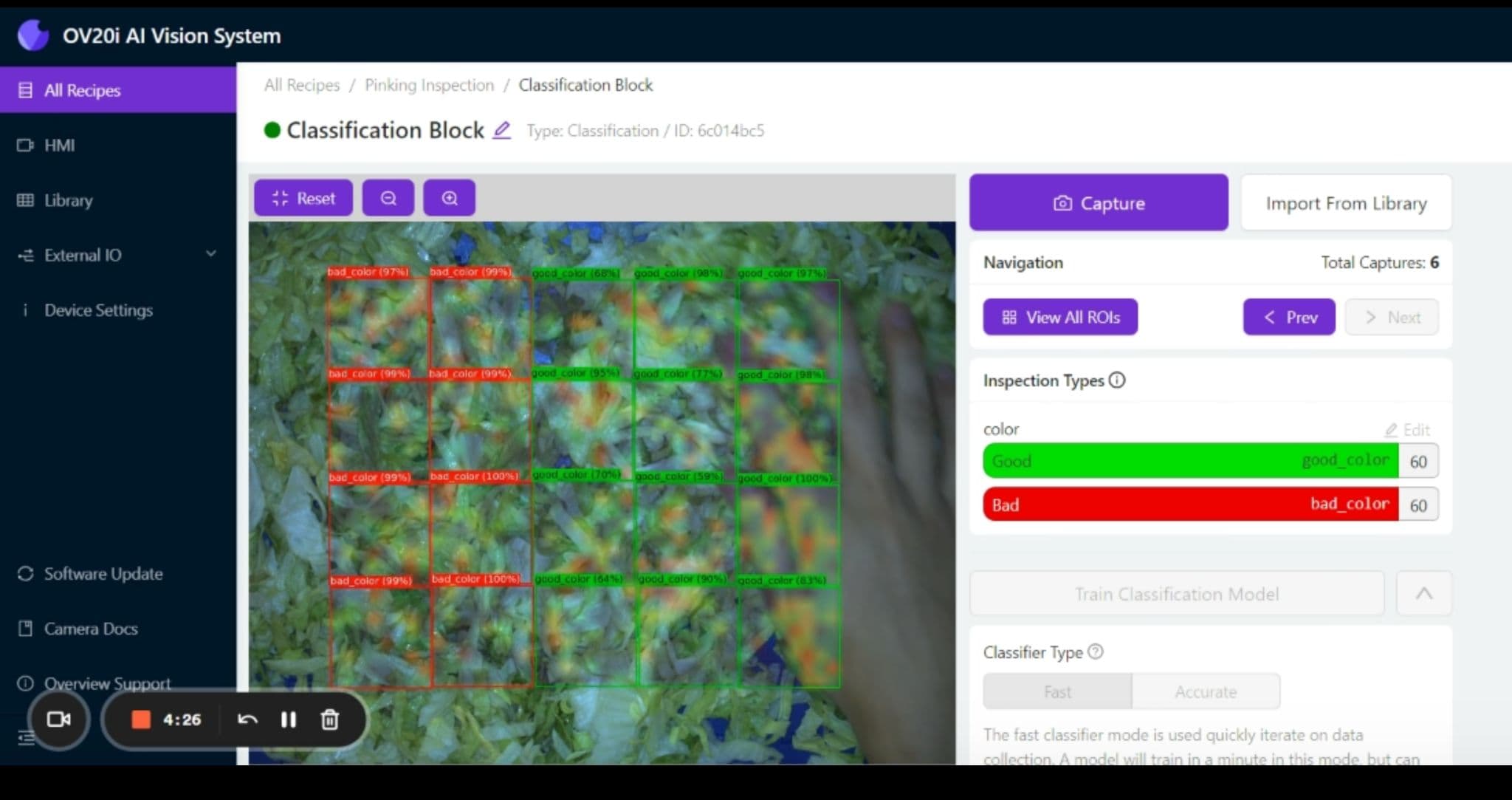
A 20-region grid separating good product from discolored and defective lettuce, with per-region confidence and an attention heatmap.
We divided the field of view into a 20-region grid and trained a classifier to separate good product from discoloration and defects. The number that matters for an engineer is not the accuracy in isolation, it is the effort curve: the model became useful after only a few minutes of labeling and training, run in the browser by a non-specialist. The heatmap also shows which pixels drove each decision, which matters when a QA team has to trust and defend an automated call.
Application 2: Bag seal integrity and foreign object detection
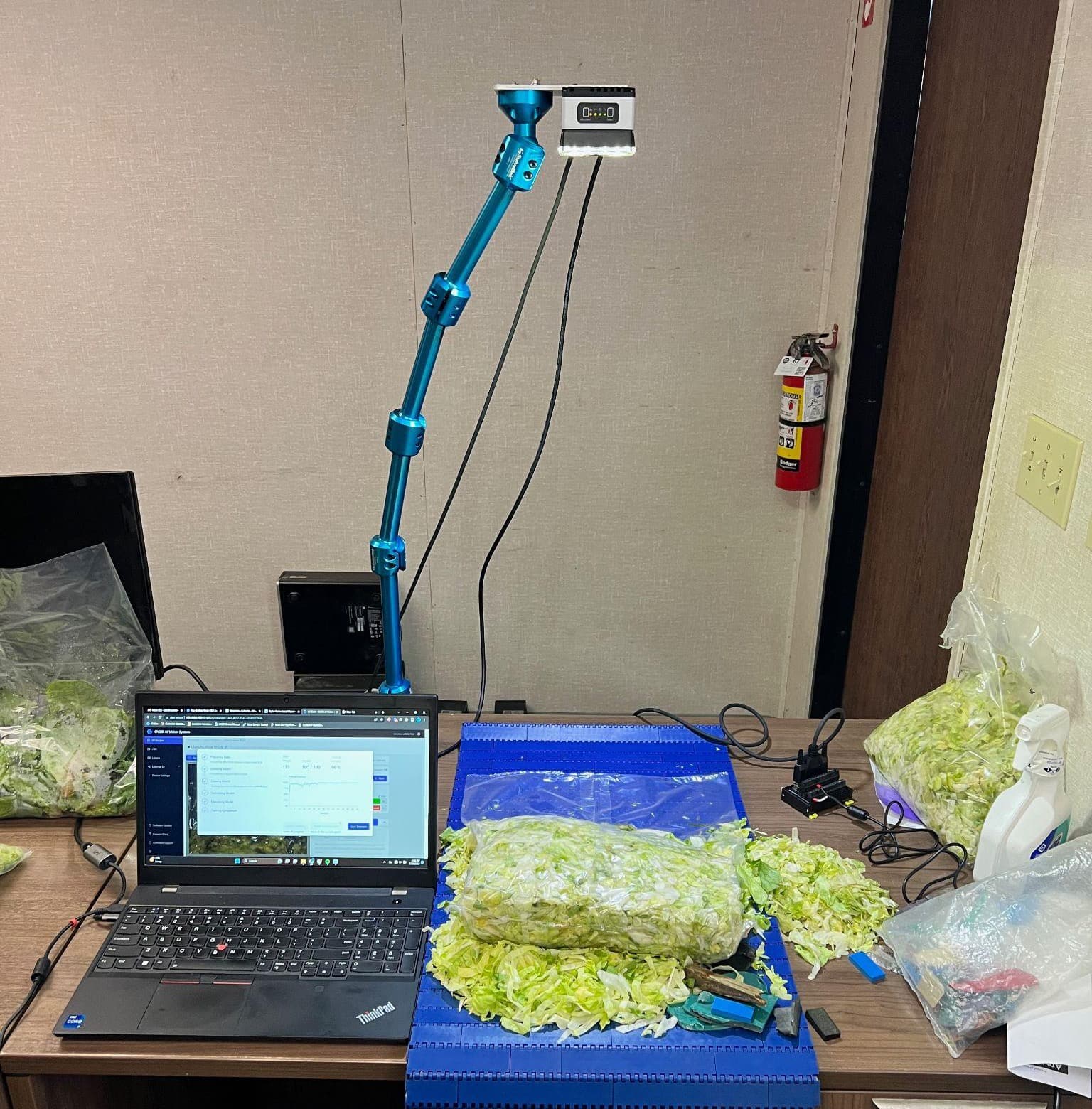
The same station verifying seal integrity and screening for foreign objects on bagged product.
On the same bench we ran a second application on bagged product: verifying seal integrity and detecting foreign objects. Both are common late-stage failure modes in fresh-cut packaging, and both are recall triggers on their own. Running both inspections on one platform at the point of packing means the last thing that happens before product ships is a full check rather than a sample. The takeaway is not that one camera solves food safety, it is that the two failure modes most amenable to optical inspection, product defects and packaging integrity, can be covered on a single station and trained in minutes.
Where Vision Belongs in the Line
- 1Incoming and pre-wash. Catch foreign material and heavy defects before the flume, so wash chemistry works against a lower starting bio-burden.
- 2Post-shred, pre-pack. Classify discoloration, decay, and core or stem fragments across the full stream so defective product is diverted before packaging.
- 3Final pack. Verify seal integrity, check for foreign objects, and keep an image record of every pack for traceability.
Every inspection also produces a durable image record. Instead of a paper log of a sampled percentage, a plant gets a searchable visual history of what actually shipped, which changes how a traceback or an audit plays out. The economics are asymmetric: the downside of a single missed lot dwarfs the cost of inspecting every pack, which is the core argument for moving from sampling to full-stream optical inspection wherever the defect is visible.
Frequently Asked Questions
Q: What caused the 2026 Taco Bell cyclospora outbreak?
A: According to the CDC and FDA, the outbreak was linked to shredded iceberg lettuce served at some Taco Bell locations in Indiana, Kentucky, Michigan, Ohio, and West Virginia. FDA's traceback investigation identified the supplier as Taylor Farms, with the lettuce sourced from central Mexico. The investigation remains ongoing.
Q: Can a vision system detect Cyclospora or other pathogens on lettuce?
A: No. These hazards are microscopic and cannot be seen by any optical camera. Vision detects the visible contamination vectors and quality defects that raise microbial load, such as foreign material, soil, decay, and physical damage. It is a complementary control alongside supplier testing, washing, and antimicrobial treatment, not a replacement for them.
Q: What defects can AI vision catch on fresh-cut leafy greens?
A: Discoloration and browning, decay and soft rot, core and stem fragments, wilting, and foreign material such as soil, field debris, wood, and plastic. On packaged product it also verifies seal integrity and detects foreign objects sealed inside bags.
Q: How long does it take to train a vision model on a produce line?
A: In our own benchmark on shredded lettuce, a classifier across a 20-region grid reached usable accuracy after a few minutes of labeling and training. Production models are typically built and validated in under an hour, directly in the browser.
See how Overview AI inspects fresh-cut produce inspection
Send us a photo of your part or defect and a vision engineer will tell you whether Overview can catch it, with most systems deployed on the line in days.
Related Articles
AI Vision for CPG Packaging Inspection
How AI vision systems inspect consumer packaged goods at production speed, from seal integrity to foreign material.
Read More →What Defects Can AI Vision Systems Detect?
A comprehensive guide to the defect types AI vision systems reliably identify in production environments.
Read More →Train a Defect Detection Model in One Hour
How to build and deploy a production-ready defect detection model in under an hour with minimal samples.
Read More →