
Detecting Micro-Cracks in Ceramic Ferrules: A Machine Vision Walkthrough
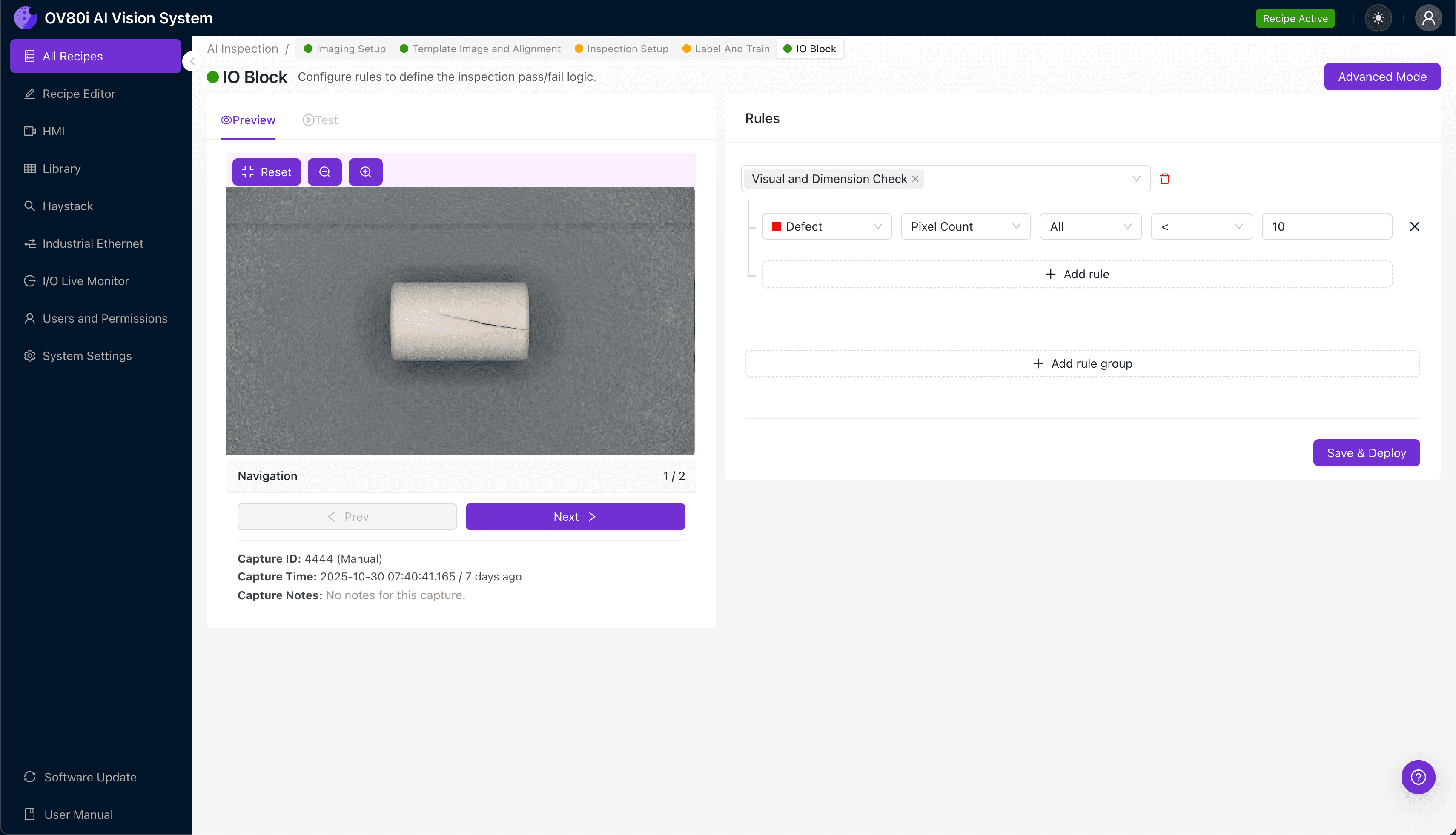
"Micro-cracks in ceramic ferrules measuring just 10-50 microns are nearly impossible for human inspectors to catch consistently. Overview.ai's deep learning approach delivers reliable detection at production line speeds, eliminating inspector fatigue and lighting-dependent variability."
The Problem: Why Micro-Cracks in Ceramic Ferrules Are So Difficult to Catch
Ceramic ferrules are precision components critical to fiber optic connectivity, telecommunications infrastructure, and high-performance electronic assemblies. When micro-cracks develop in these components, the consequences ripple through entire production lines and end-user applications.
Common Defects Found in Ceramic Ferrules with Micro-Cracks:
- Hairline surface fractures – Ultra-fine cracks along the outer diameter that compromise structural integrity
- Radial micro-cracks – Fractures extending from the bore hole toward the ferrule's outer edge
- Subsurface stress fractures – Internal cracks caused by thermal shock during sintering or rapid cooling
- Chipping at the end face – Small material losses around the polished fiber interface surface
- Bore concentricity deviations – Micro-cracks that cause misalignment of the central fiber channel
- Circumferential ring cracks – Circular fractures that form due to improper press-fitting or handling stress
Human inspectors struggle with micro-crack detection due to the microscopic scale of these defects—often measuring just 10-50 microns in width. Inspector fatigue sets in quickly when examining hundreds of white ceramic components per hour, and lighting angle variations can make cracks appear and disappear between inspections.
The Solution: Machine Vision and Deep Learning for Consistent Detection
Traditional rule-based machine vision systems often fail with ceramic ferrule inspection because micro-cracks don't follow predictable patterns. Deep learning changes this equation entirely by training neural networks to recognize the subtle visual signatures of cracks across varying lighting conditions, ferrule orientations, and crack morphologies.
Overview.ai's approach delivers consistent, objective inspection at production line speeds—eliminating the variability inherent in human inspection. The system learns from labeled examples of both acceptable and defective ferrules, building a robust detection model that improves over time with additional data.
Step 1: Imaging Setup
Begin by placing the ceramic ferrule under the OV80i camera system, ensuring the component is positioned with the critical inspection surfaces visible. The white ceramic material requires careful attention to lighting angle to maximize crack visibility through shadow contrast.
Click "Configure Imaging" to access the Camera Settings panel. Adjust the exposure to prevent the bright ceramic surface from washing out, and fine-tune the gain to enhance micro-crack contrast without introducing excessive noise.
Click "Save" to lock in your optimized imaging parameters.
Step 2: Image Alignment
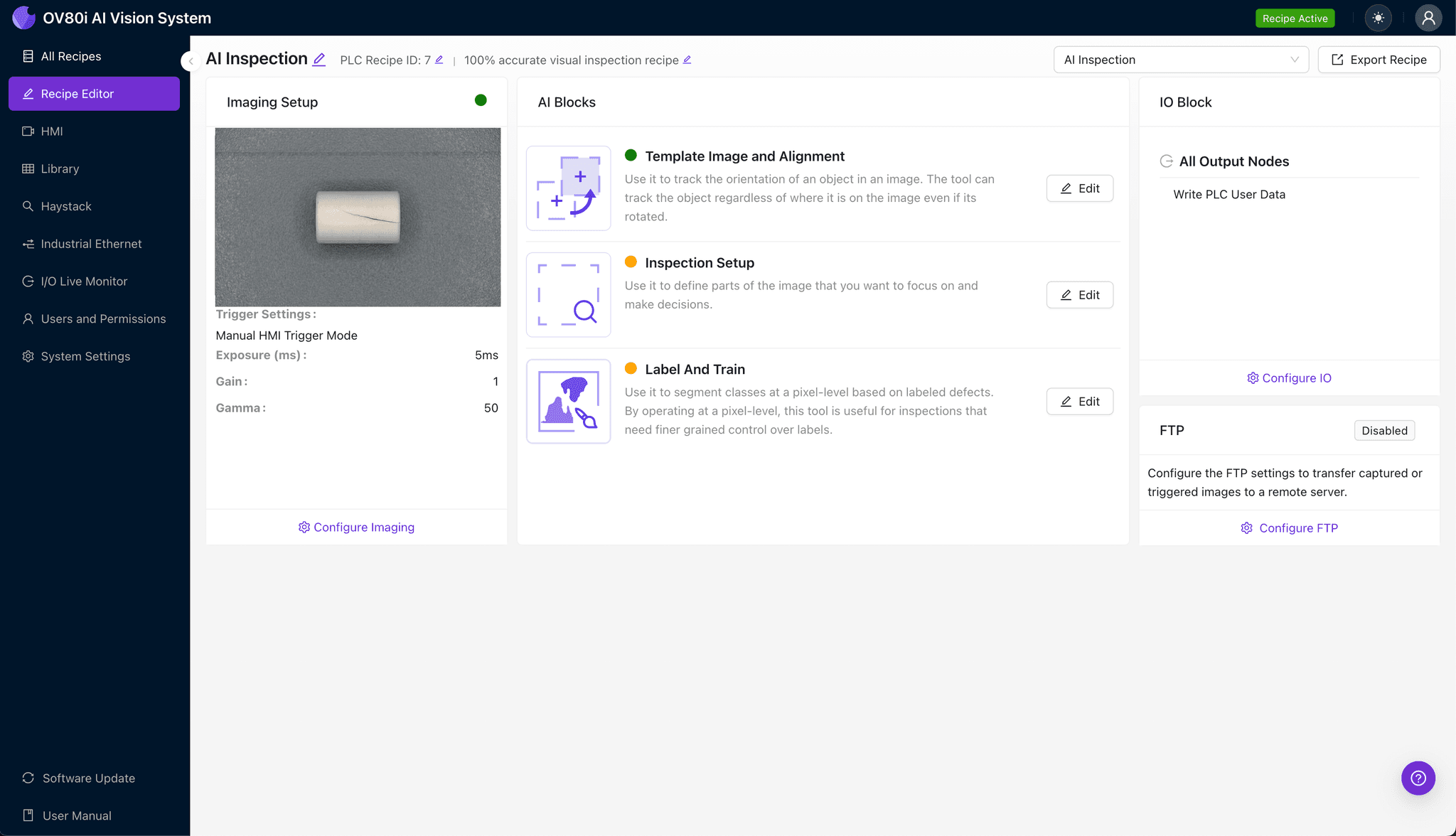
Navigate to the "Template Image" section within the configuration interface. Capture a Template image of a representative ceramic ferrule positioned in standard orientation.
Add a "+ Rectangle" region around the main cylindrical body of the ferrule, encompassing the full inspection area. Set the "Rotation Range" to 20 degrees to accommodate normal variation in how ferrules arrive at the inspection station.
Step 3: Inspection Region Selection
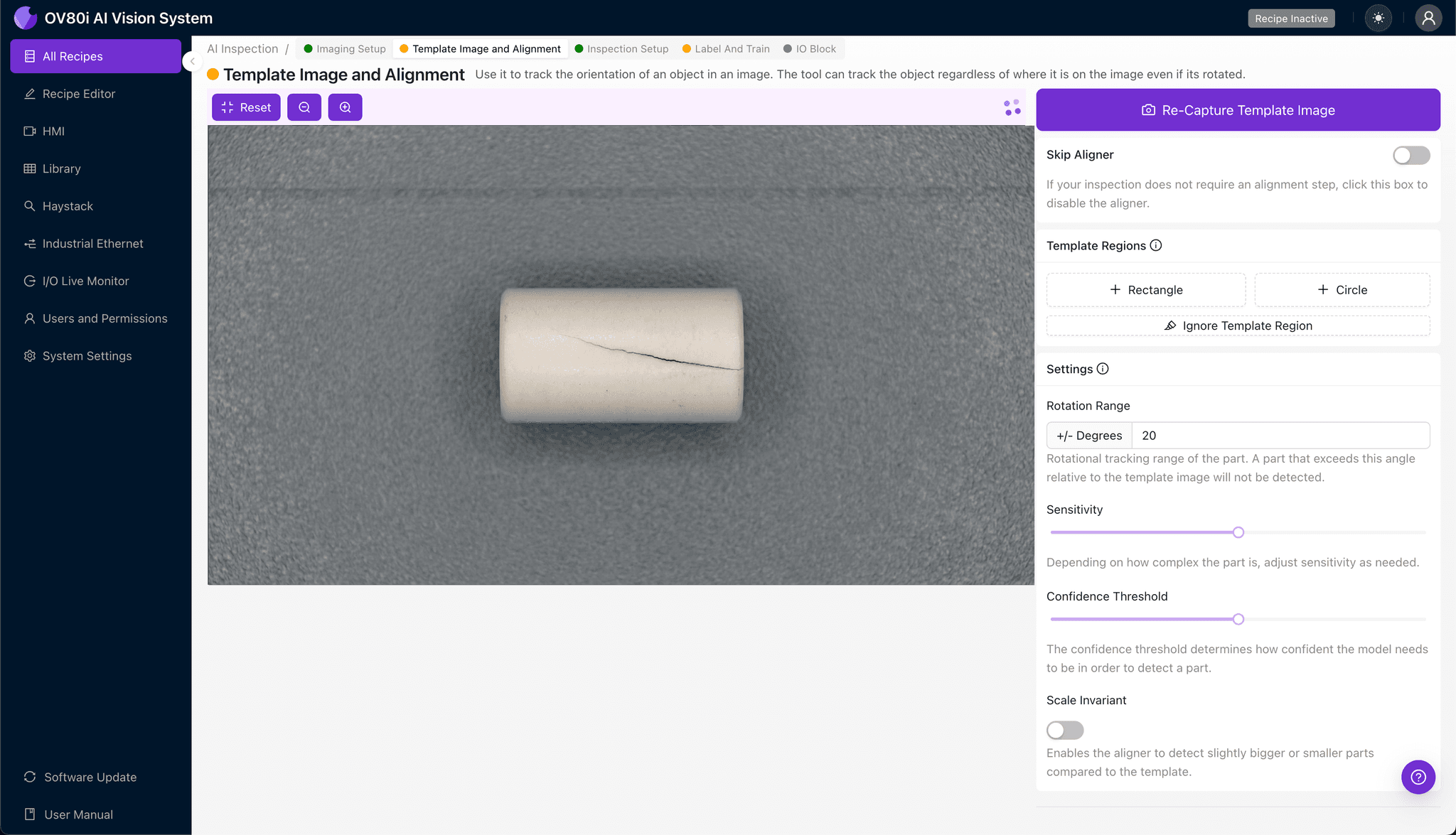
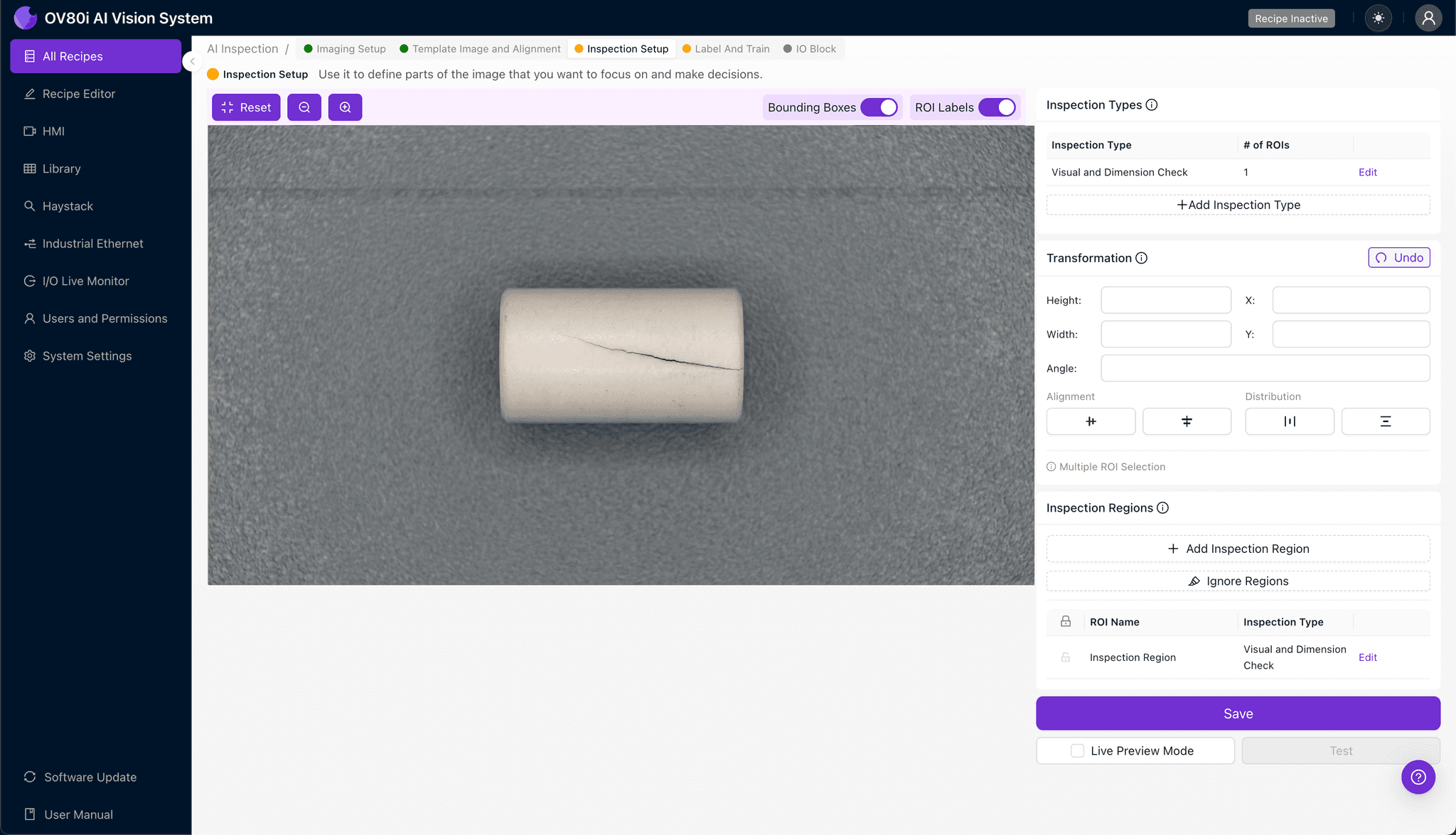
Navigate to "Inspection Setup" to define where the system should focus its analysis. Rename your "Inspection Types" to reflect the specific defects you're targeting—for example, "End_Face_Cracks" and "Body_Micro_Fractures."
Click "+ Add Inspection Region" to create your first zone. Resize the yellow bounding box to cover critical defect areas: the polished end face, the bore opening, and the outer cylindrical surface where stress cracks commonly appear.
Click "Save" after defining each inspection region.
Step 4: Labeling Data
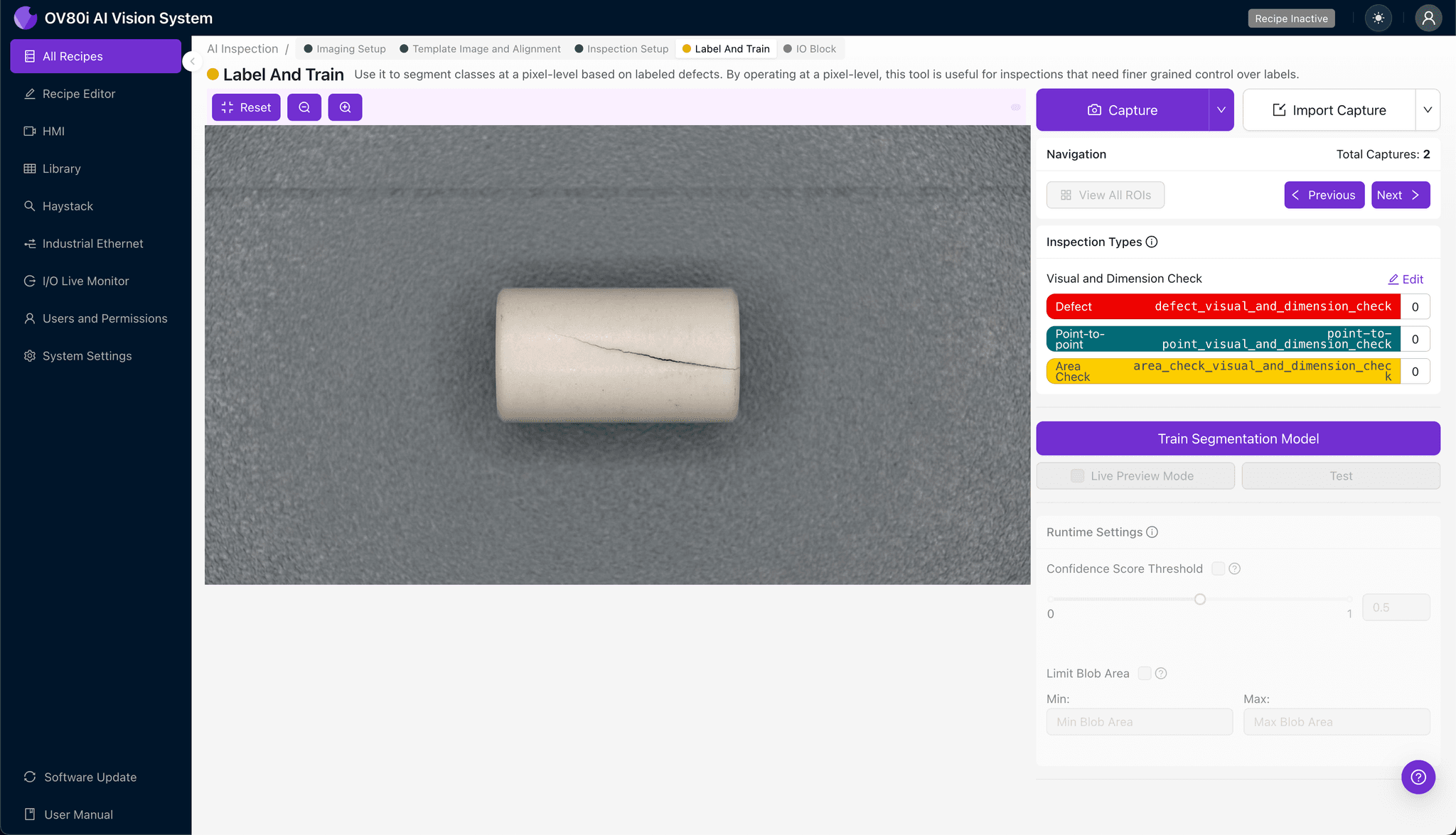
The human-in-the-loop labeling process is where your team's expertise directly trains the AI model. Production operators and quality engineers review captured images, marking each ferrule as Good or Bad based on established acceptance criteria.
Include representative samples across the full spectrum of acceptable variation—different lighting angles, minor surface blemishes that pass inspection, and slight color variations. Equally important: label known failure modes including hairline cracks, chips, and stress fractures to teach the model exactly what constitutes a reject.
Step 5: Creating Rules
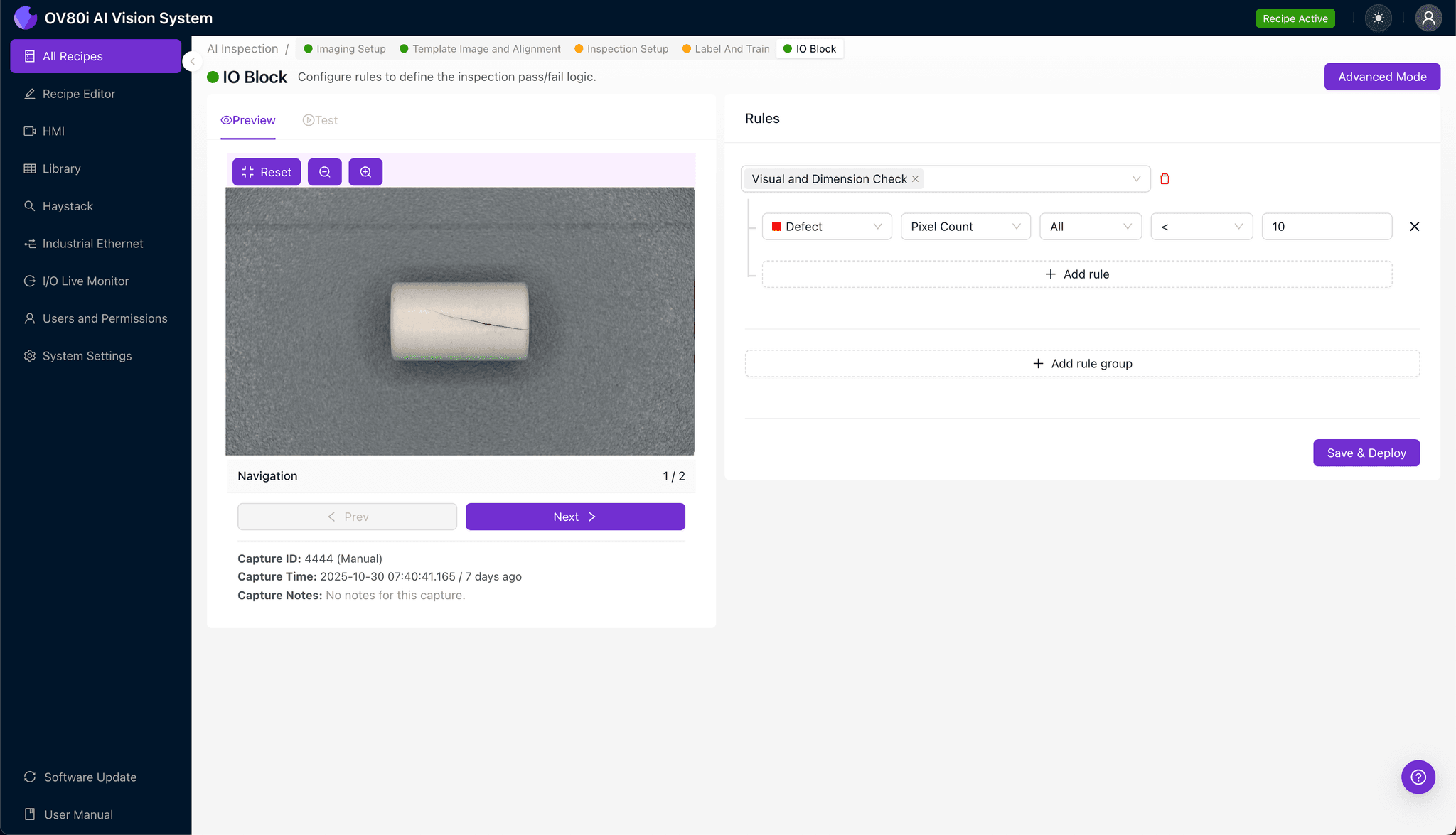
With your labeled dataset established, configure the pass/fail logic based on your defined Inspection Types. Set confidence thresholds that balance false positive rates against escape risk—ceramic ferrules destined for medical or aerospace applications may require more conservative rejection criteria.
Gate automated acceptance directly on the production line, enabling real-time sorting of conforming ferrules while flagging or ejecting defective units without manual intervention.
Key Outcomes & ROI
Implementing AI-powered visual inspection for ceramic ferrule micro-crack detection delivers measurable business impact:
- Reduced Scrap Rates – Catch micro-cracked ferrules before they advance to costly downstream assembly operations
- Higher Throughput – Inspect 100% of production at line speed without creating inspection bottlenecks
- Compliance & Traceability – Maintain complete image records for every inspected unit, supporting ISO and customer audit requirements
- Process Improvement Insights – Identify upstream process drift by analyzing defect frequency trends over time
Conclusion
Micro-cracks in ceramic ferrules represent exactly the type of subtle, high-stakes defect where AI-powered inspection outperforms human capabilities. Overview.ai's deep learning approach transforms what was once an inconsistent, fatigue-prone manual process into a reliable, data-driven quality gate.
Ready to eliminate micro-crack escapes from your ceramic ferrule production? Contact Overview.ai to schedule a demo with your actual components.
Eliminate Micro-Crack Escapes Today
Stop relying on manual inspection for critical ceramic ferrule quality. Deploy Overview.ai to catch micro-cracks instantly at production speed.