
Detecting Coaxial Cable Decentralized Center Conductor Defects with AI-Powered Visual Inspection
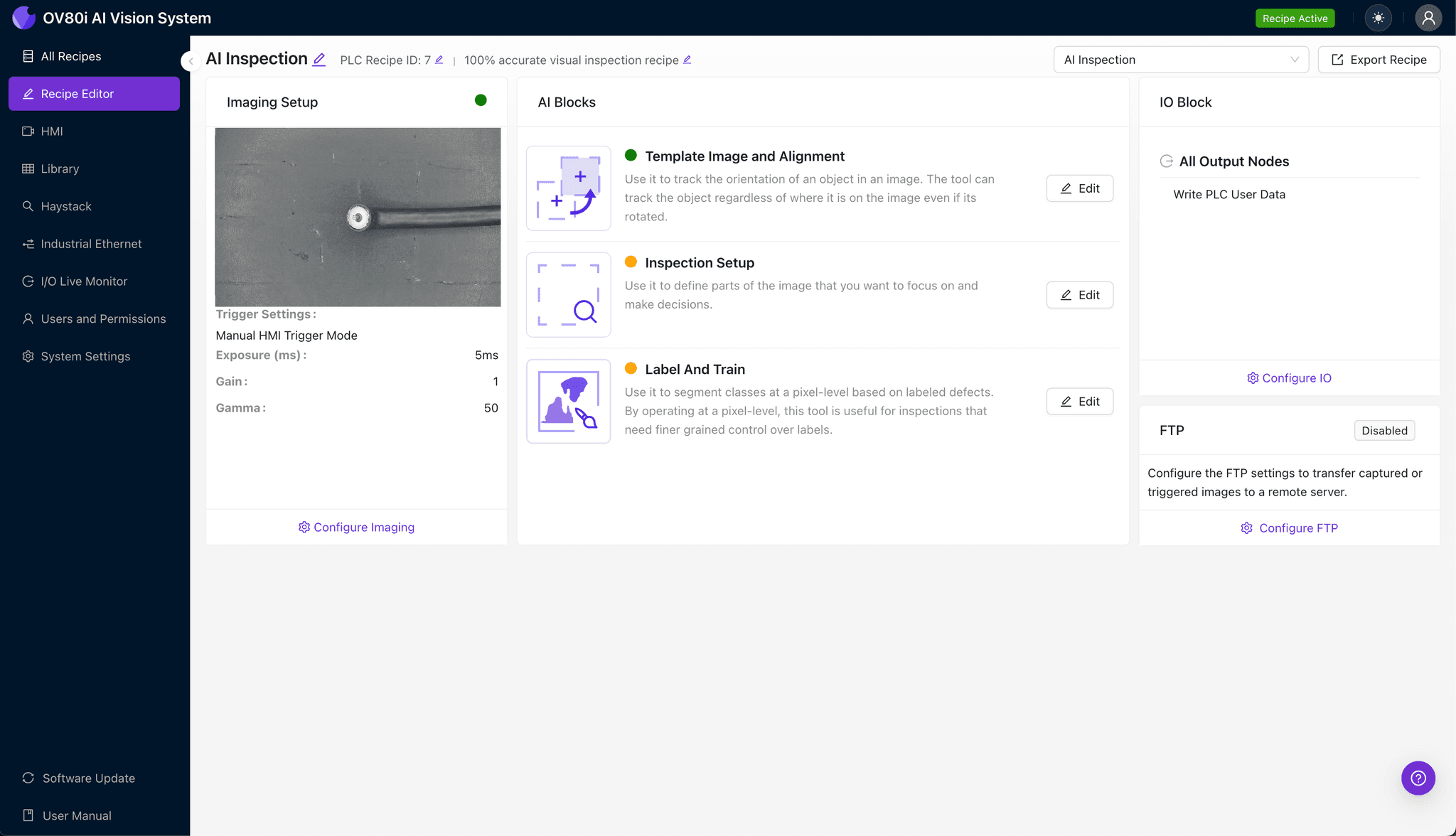
"A decentralized center conductor in coaxial cable compromises impedance characteristics and signal integrity. Overview.ai's machine vision system detects these geometric anomalies with sub-pixel accuracy at full production speed—eliminating the inconsistency of human inspection."
The Problem: Why Center Conductor Concentricity Matters
A decentralized center conductor in coaxial cable represents one of the most critical quality defects in cable manufacturing. When the inner conductor shifts from its intended central position, it compromises the cable's impedance characteristics and signal integrity.
Common Defects Associated with Decentralized Center Conductors:
- Eccentric conductor positioning — center conductor offset from the geometric center of the dielectric
- Inconsistent dielectric thickness — uneven insulation distribution around the conductor
- Impedance variation — deviation from the specified 50Ω or 75Ω characteristic impedance
- Ovality of the dielectric core — non-circular cross-section affecting signal propagation
- Conductor migration — progressive shifting during the extrusion process
- Air gap formation — voids between conductor and dielectric caused by misalignment
Human visual inspection struggles to detect these defects consistently. Inspector fatigue sets in quickly when examining continuous cable production, and the subtle nature of concentricity variations makes reliable detection at production speeds virtually impossible.
The Solution: Machine Vision and Deep Learning
Machine vision systems equipped with deep learning algorithms excel at detecting geometric anomalies that escape human perception. These systems analyze cross-sectional images with sub-pixel accuracy, identifying conductor displacement patterns that would require magnification and measurement tools for manual verification.
Overview.ai's approach delivers consistent, objective inspection at full line speed—eliminating the variability inherent in human judgment. By training neural networks on labeled examples of acceptable and defective cable samples, the system learns to recognize the subtle visual signatures of decentralized conductors across varying production conditions.
Step 1: Imaging Setup
Position the coaxial cable cross-section under the camera, ensuring the cut end faces directly upward for optimal imaging. The cable should be secured in a fixture that prevents movement and maintains consistent orientation.
Click "Configure Imaging" to access the Camera Settings panel. Adjust the exposure to clearly distinguish the center conductor from the surrounding dielectric, and fine-tune the gain to achieve proper contrast without introducing noise.
Click "Save" to lock in your imaging parameters.
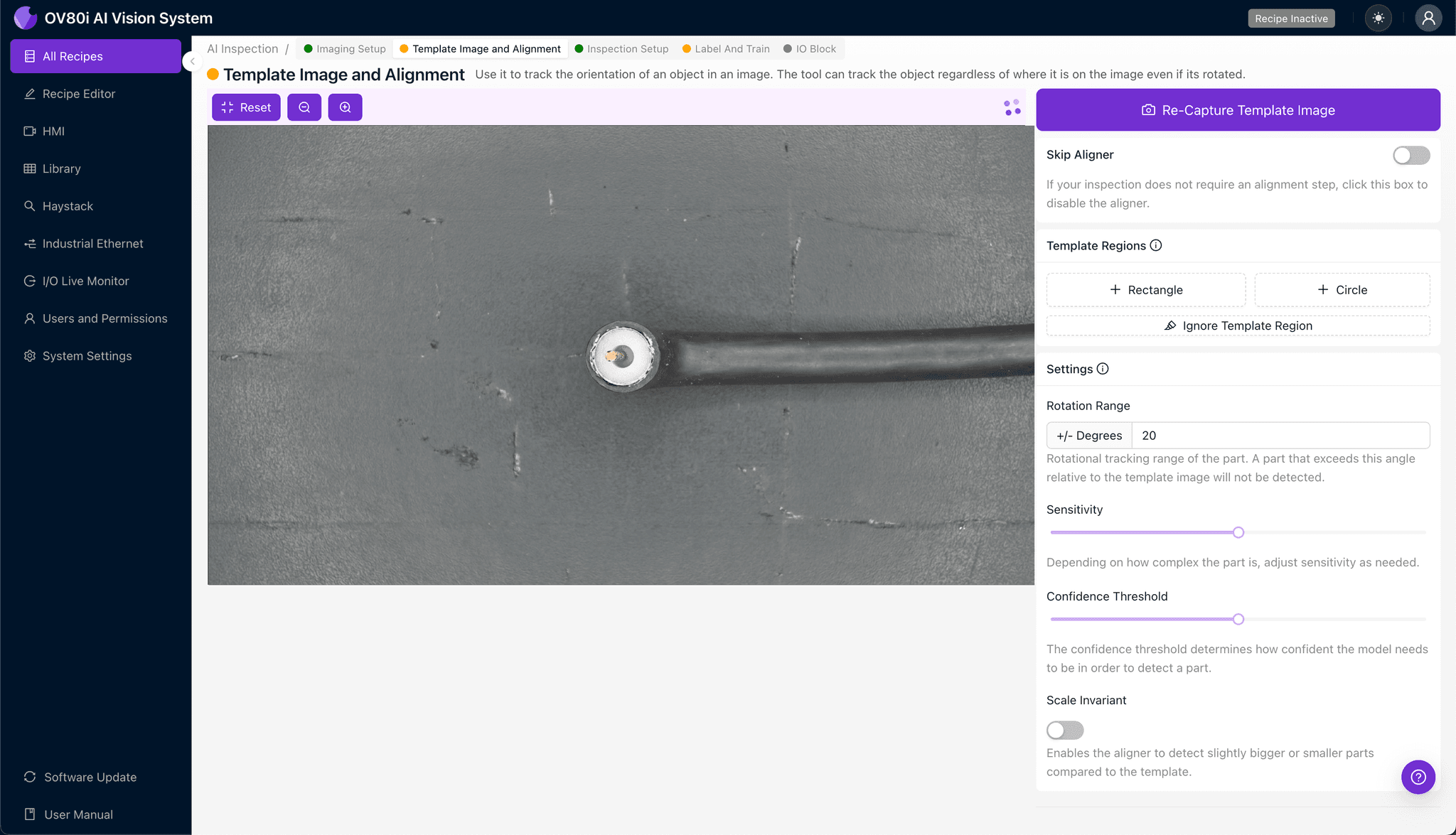
Step 2: Image Alignment
Navigate to "Template Image" in the configuration menu. Capture a Template using a known-good cable sample with proper concentricity.
Click "+ Rectangle" to add a region around the main body of the cable cross-section. This defines the area the system will use for alignment.
Set the "Rotation Range" to 20 degrees to accommodate minor variations in cable positioning during inspection.
Step 3: Inspection Region Selection
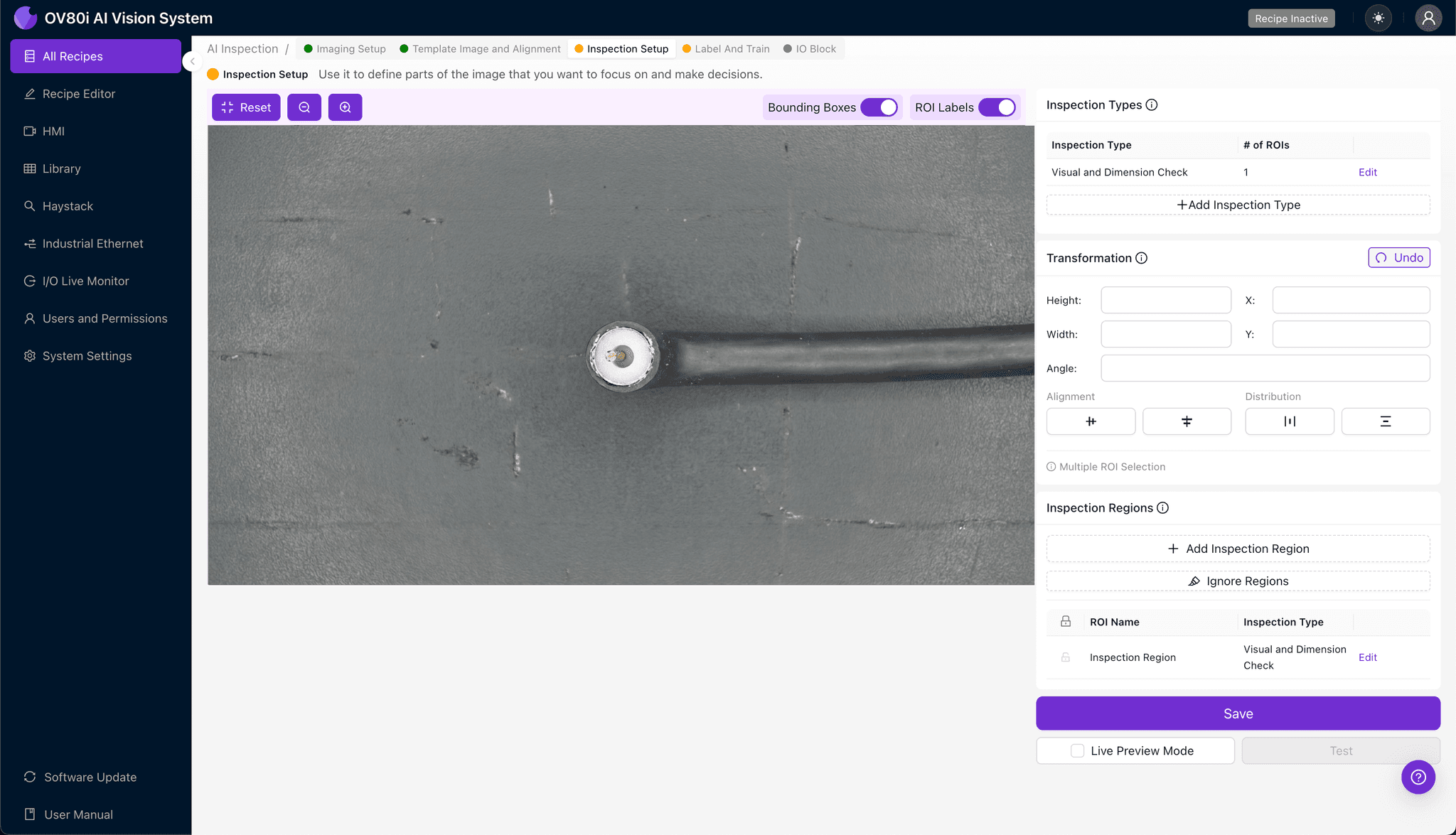
Navigate to "Inspection Setup" from the main menu. Rename your "Inspection Types" to reflect the specific defects you're targeting—such as "Center Conductor Position" and "Dielectric Uniformity."
Click "+ Add Inspection Region" to define your areas of interest. Resize the yellow bounding box to cover the critical defect areas, focusing on the interface between the center conductor and dielectric material.
Click "Save" to confirm your inspection regions.
Step 4: Labeling Data
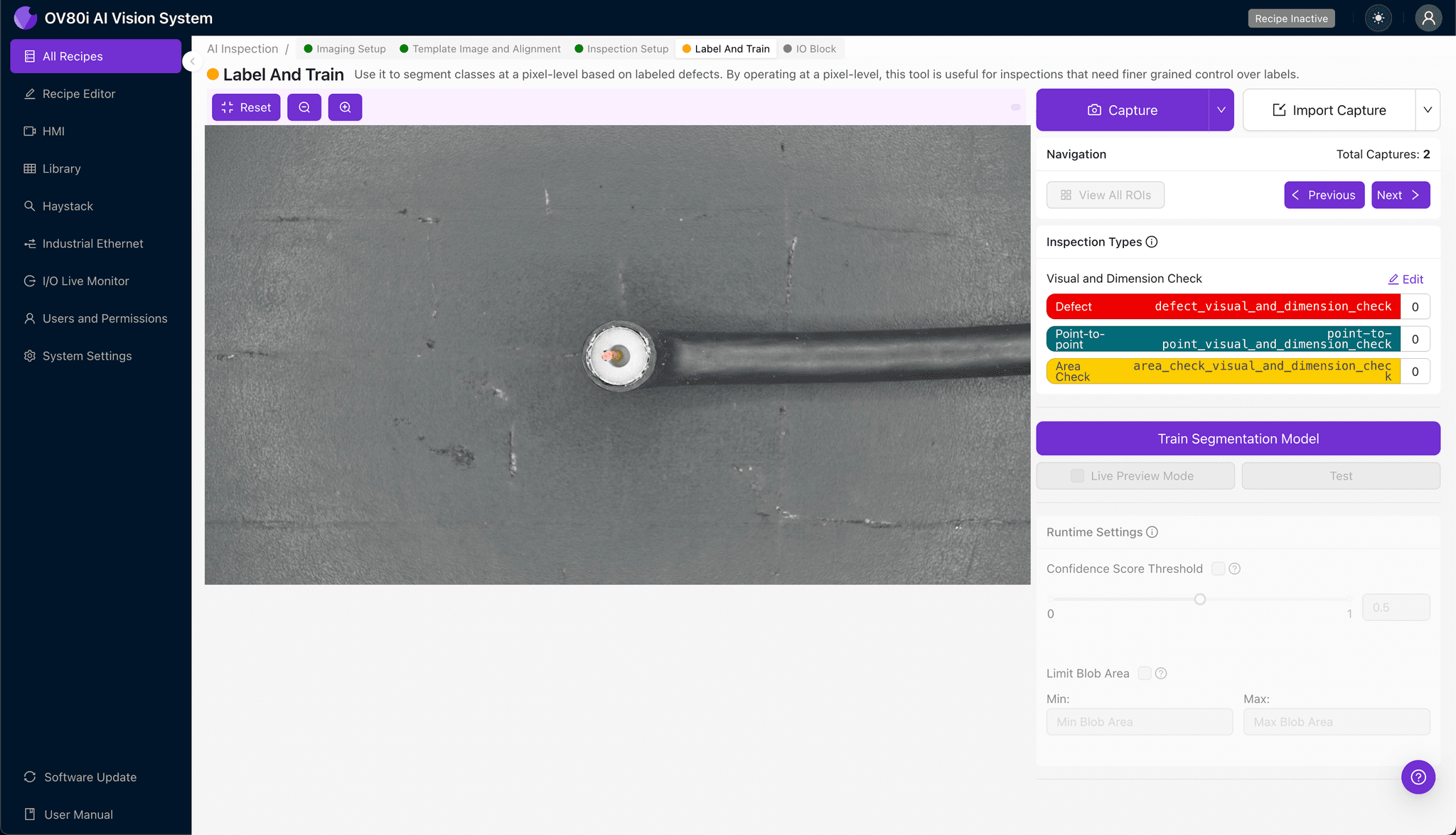
The human-in-the-loop labeling process is essential for training accurate detection models. Collect a diverse set of production images representing the full range of quality variations you encounter.
Label each image as Good or Bad based on your quality specifications. Include representative samples of acceptable tolerance variations alongside known failure modes—cables with documented concentricity measurements outside specification.
The more comprehensively you label edge cases, the more robust your trained model becomes.
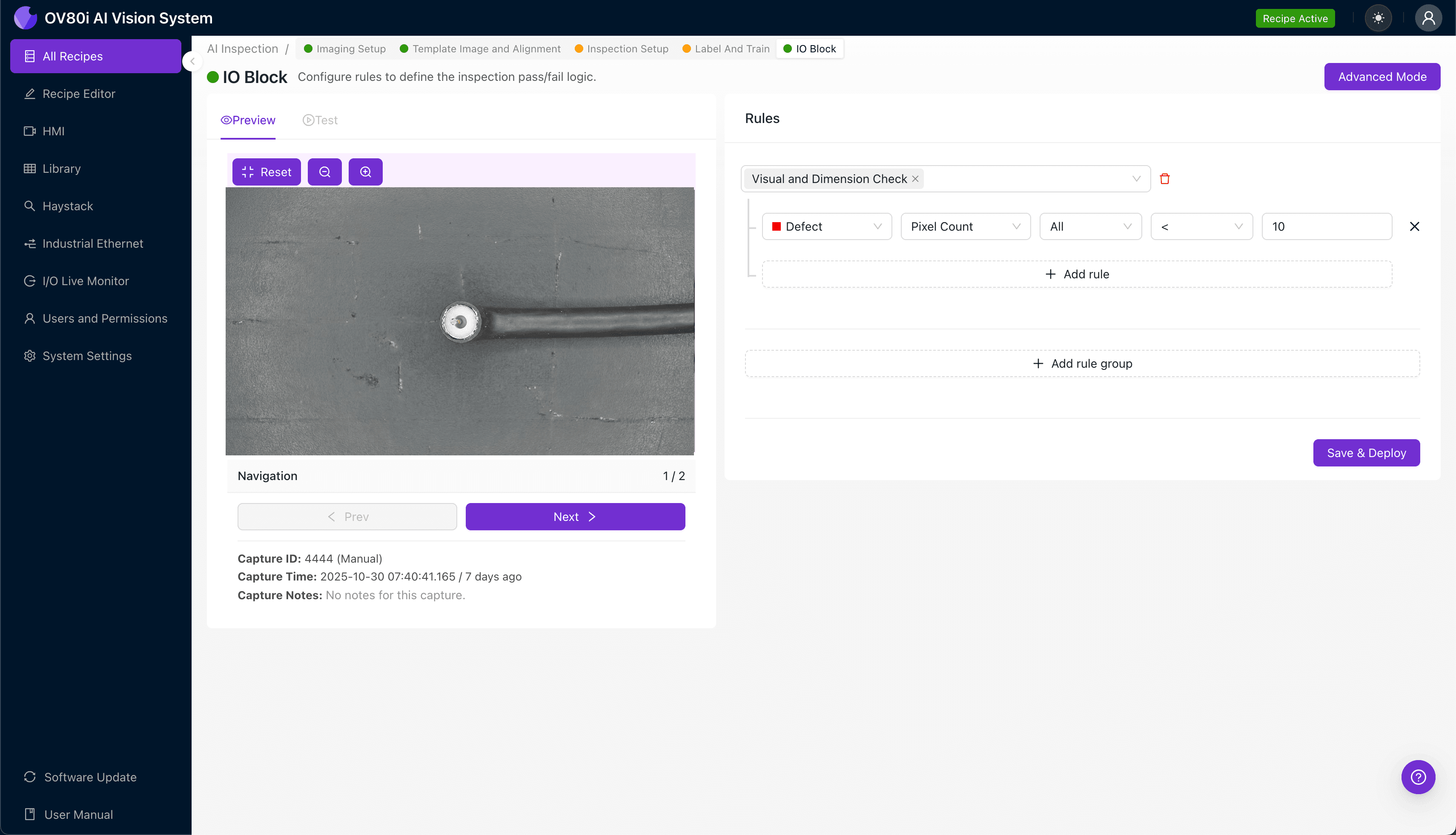
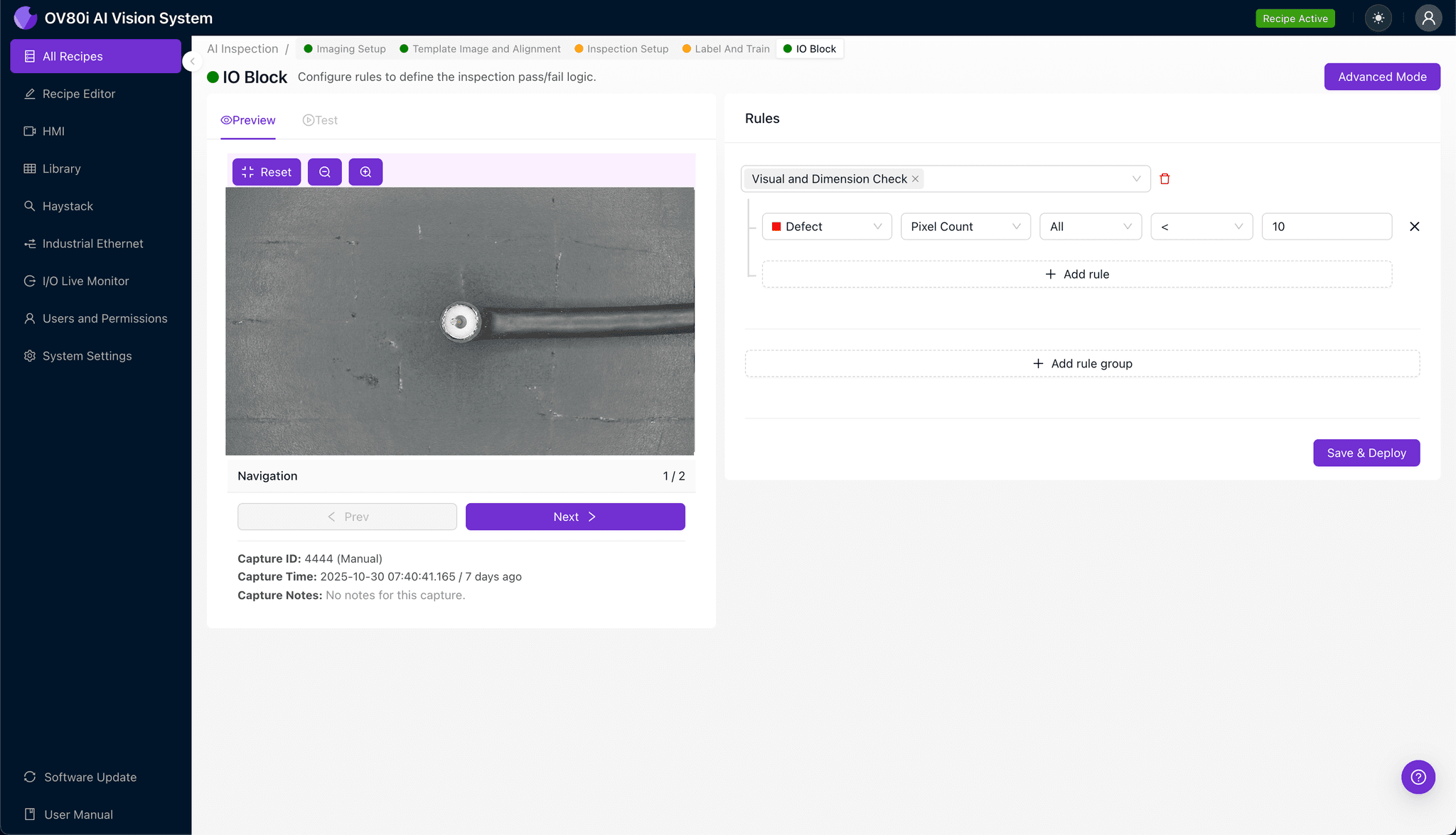
Step 5: Creating Rules
Set your pass/fail logic based on the Inspection Types you defined earlier. Configure threshold values that align with your quality standards and customer specifications.
Gate automated acceptance on the production line by connecting inspection results to your reject mechanism. Cables flagged as defective can be automatically diverted for further analysis or scrapped.
Key Outcomes & ROI
Implementing AI-powered visual inspection for coaxial cable concentricity delivers measurable business value:
- Reduced scrap rates — catch decentralization defects before additional processing adds cost to defective material
- Higher throughput — inspect 100% of production without creating bottlenecks or slowing line speed
- Compliance and traceability — maintain detailed inspection records for quality audits and customer documentation requirements
- Process improvement insights — analyze defect trends to identify upstream issues in extrusion or conductor feeding systems
Conclusion
Detecting decentralized center conductors requires precision that human inspectors simply cannot maintain across production volumes. Overview.ai's visual inspection platform transforms this challenging quality control task into a reliable, automated process—protecting your customers from defective cables while optimizing your manufacturing efficiency.
Eliminate Defects Today
Stop relying on manual inspection. Deploy Overview.ai to catch defects instantly.