How to Detect Desiccant Pack Burst Seams with AI-Powered Visual Inspection
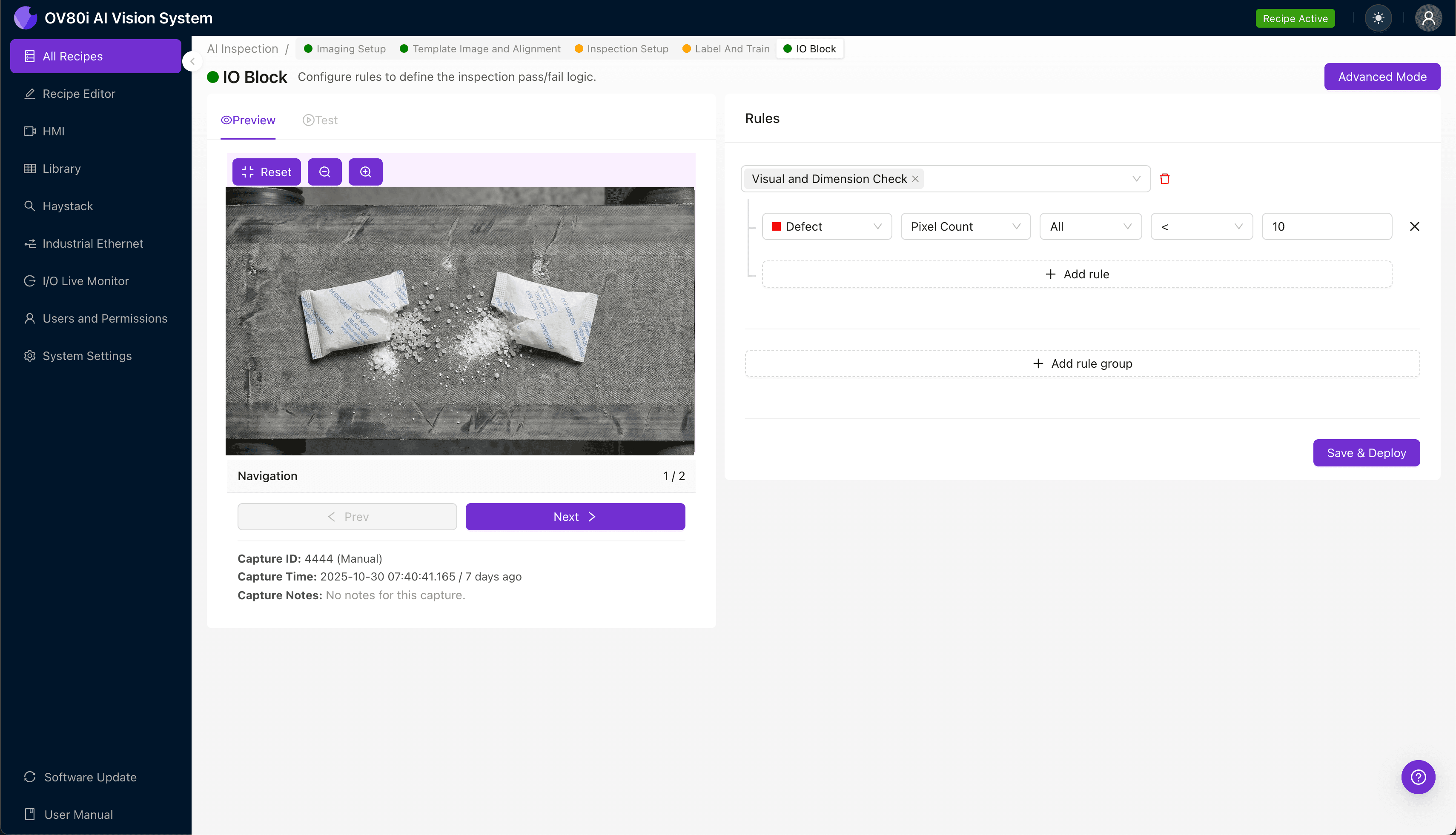
"Burst seams in desiccant packs cause product contamination and batch rejections that manual inspection cannot reliably prevent. AI-powered visual inspection delivers consistent, real-time detection of seam defects at full production speed—catching every failure that human inspectors would miss."
The Problem: Why Burst Seam Detection Matters
Desiccant packs are critical moisture-control components used across pharmaceutical, electronics, and food packaging industries. When a seam fails, the consequences range from product contamination to complete batch rejection—and these defects are notoriously difficult to catch at production speeds.
Common Defects in Desiccant Packs with Burst Seams
- Partial seam separation — Incomplete seal failure where edges begin to peel but remain loosely attached
- Full seam rupture — Complete breach of the heat-sealed edge, exposing desiccant beads
- Granule leakage — Silica gel or clay particles escaping through compromised seals
- Seal discoloration — Heat damage or contamination at the seam indicating imminent failure
- Wrinkling or puckering — Uneven seal formation that creates weak points prone to bursting
- Edge delamination — Separation of material layers at the seam boundary
Manual inspection simply cannot keep pace with modern production demands. Human inspectors experience fatigue-induced accuracy drops after just 20-30 minutes of repetitive visual tasks, and subtle seam defects measuring fractions of a millimeter are easily missed at line speeds exceeding 200 units per minute.
The Solution: Machine Vision + Deep Learning
Traditional rule-based machine vision struggles with desiccant pack inspection because seam defects vary dramatically in size, shape, and location. Deep learning changes everything—neural networks trained on thousands of defect images learn to recognize failure patterns that would require impossibly complex manual programming.
Overview.ai's approach delivers what human inspectors cannot: consistent, objective evaluation of every single unit at full production speed. The system never gets tired, never loses focus, and never lets a borderline defect slip through because it's running behind quota.
Step 1: Imaging Setup
Position your desiccant pack sample—including one with a visible burst seam—directly under the OV80i camera array. Proper lighting is essential; angled illumination often reveals subtle seam irregularities that flat lighting would obscure.
Click "Configure Imaging" in the Overview interface to access your Camera Settings. Adjust exposure to capture crisp seam edges without blowing out highlights on reflective packaging material, and fine-tune gain to balance sensitivity with noise reduction.
Click "Save" once your image clearly displays both intact seams and the burst seam defect with sharp contrast.
Step 2: Image Alignment
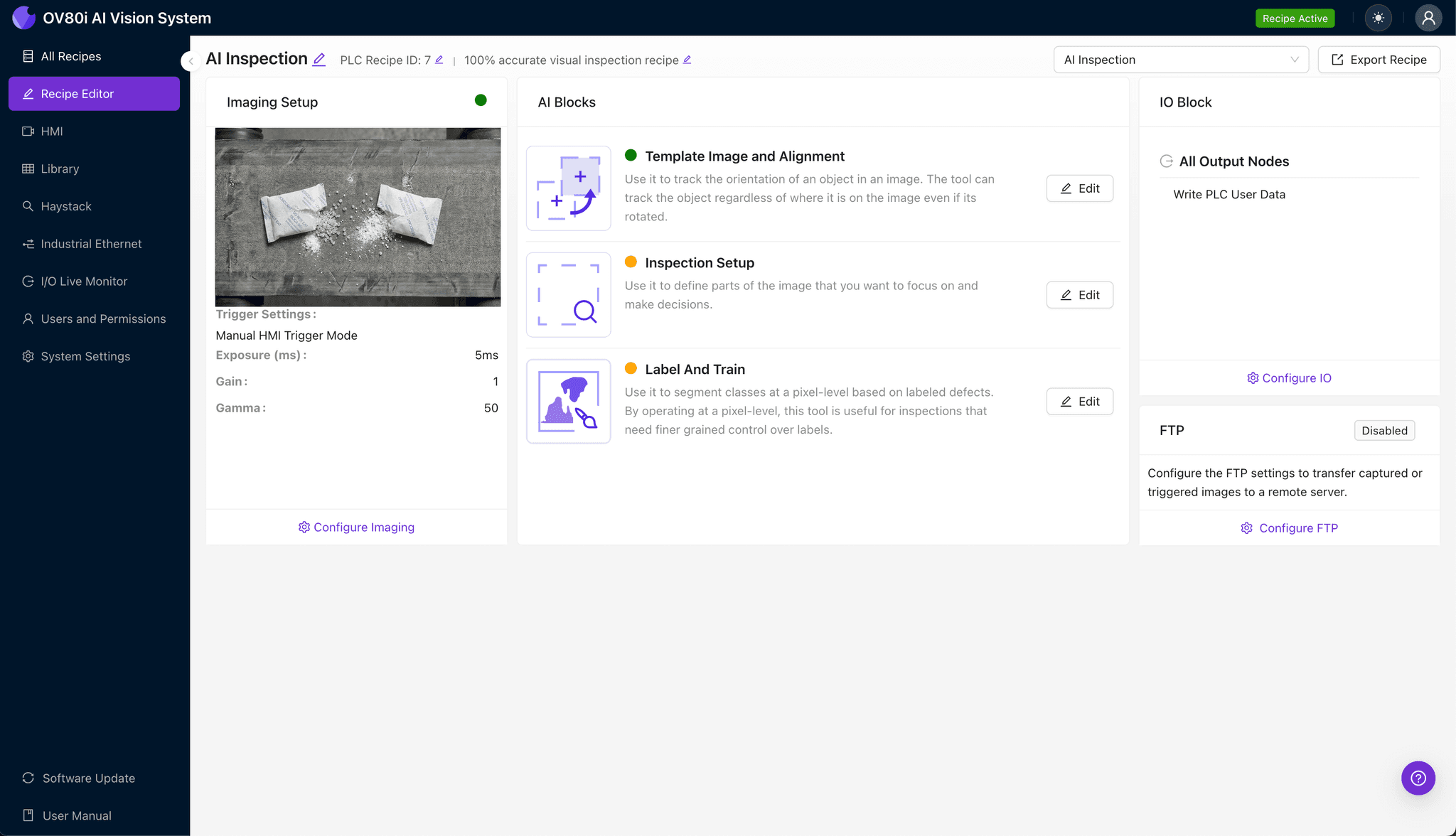
Navigate to the "Template Image" section to establish your reference frame. Capture a Template image of a properly-positioned desiccant pack that represents your standard inspection orientation.
Click "+ Rectangle" to add an alignment region around the main body of the pack. This region should encompass the full perimeter while excluding any variable background elements.
Set the "Rotation Range" to 20 degrees to accommodate natural variation in how packs present on the conveyor. This ensures the system locks onto each unit regardless of minor positional differences.
Step 3: Inspection Region Selection
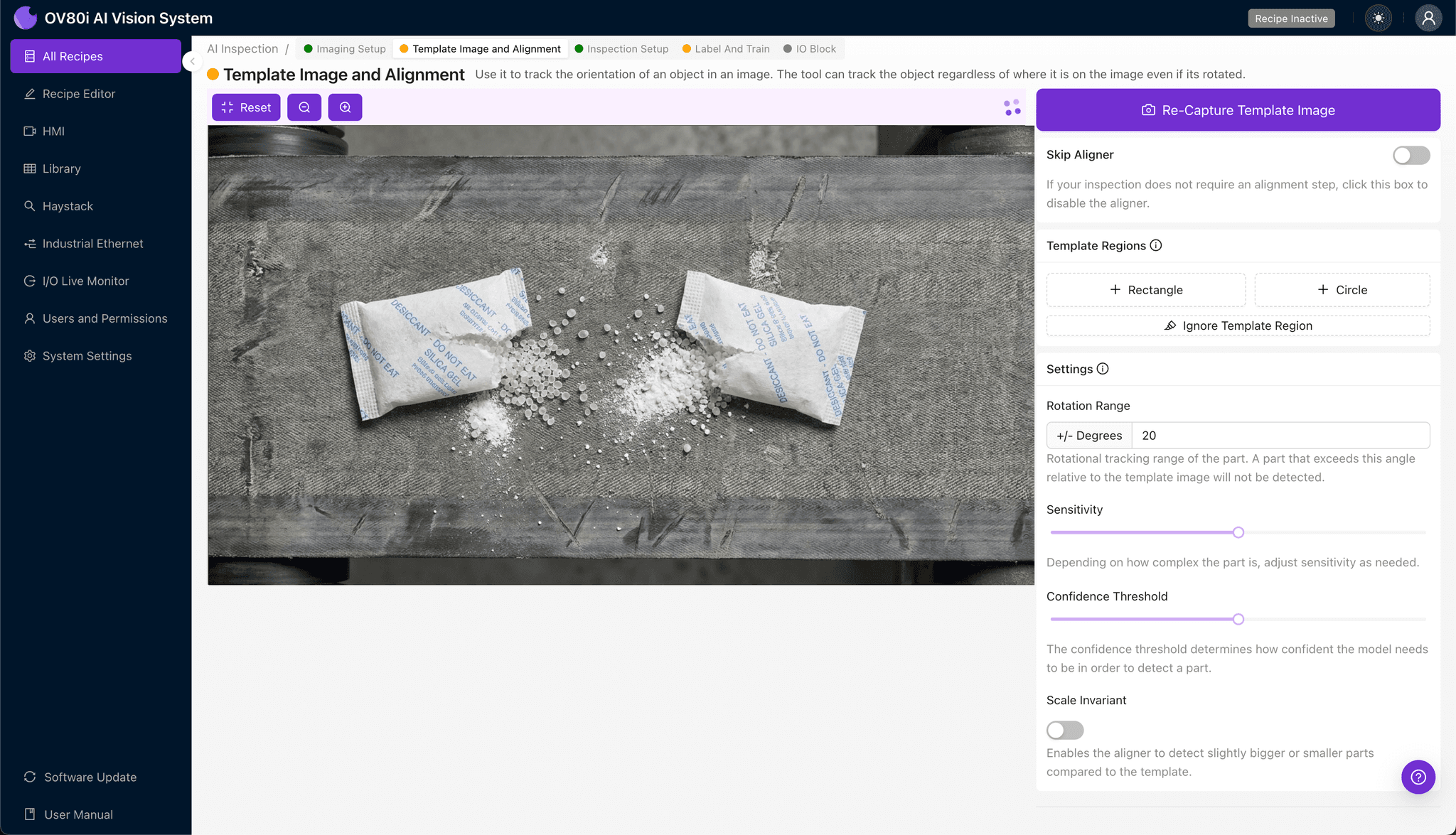
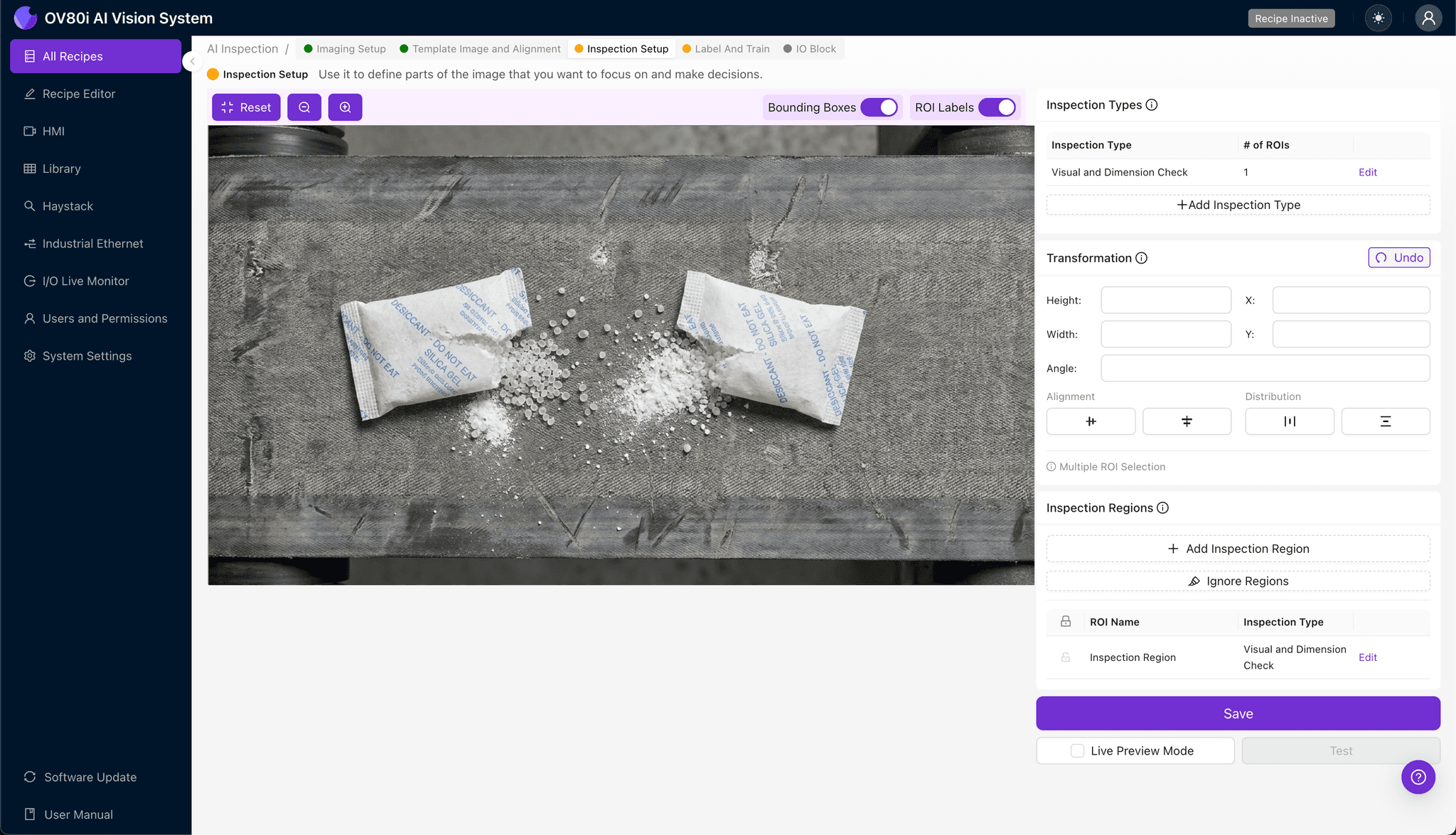
Navigate to "Inspection Setup" to define exactly where the system should look for defects. This targeted approach maximizes detection accuracy while minimizing false positives from irrelevant image areas.
Rename your "Inspection Types" with descriptive labels like "Top_Seam_Integrity," "Bottom_Seam_Integrity," and "Side_Seal_Check." Clear naming conventions simplify troubleshooting and reporting down the line.
Click "+ Add Inspection Region" for each critical area. Resize the yellow bounding box to cover all four seam edges where burst failures typically occur—pay special attention to corner junctions where heat sealing is most prone to inconsistency.
Click "Save" to lock in your inspection zones.
Step 4: Labeling Data
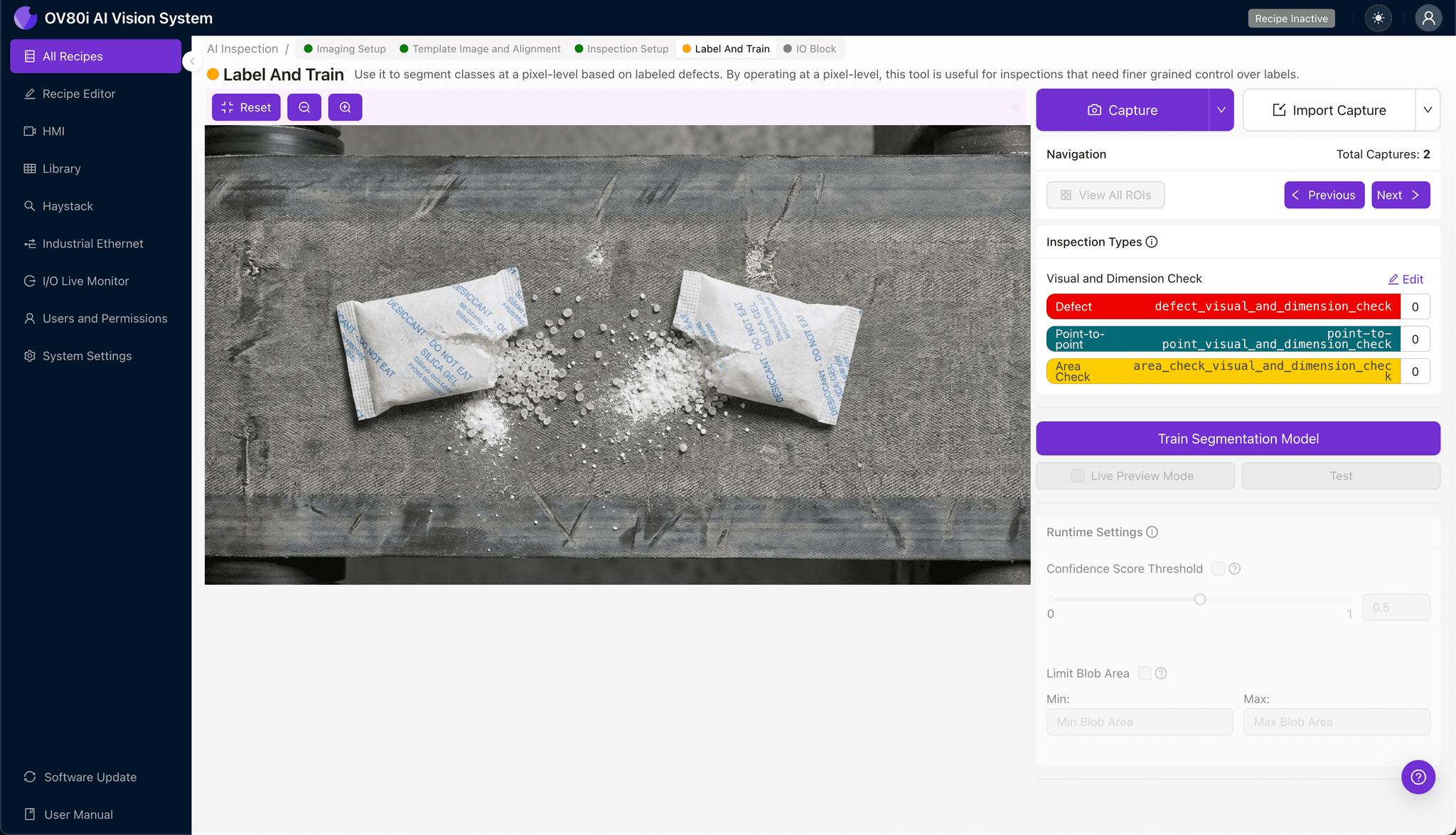
This is where human expertise trains the AI. The human-in-the-loop labeling process transforms your quality team's knowledge into machine intelligence that scales infinitely.
Review captured images and label each as Good (intact seams) or Bad (burst, separated, or compromised seams). Be thorough and consistent—the model learns directly from your judgment calls.
Include representative samples across the full spectrum of acceptable variation, plus known failure modes like partial separations, pinhole leaks, and edge delamination. The more diverse your training set, the more robust your deployed model becomes.
Step 5: Creating Rules
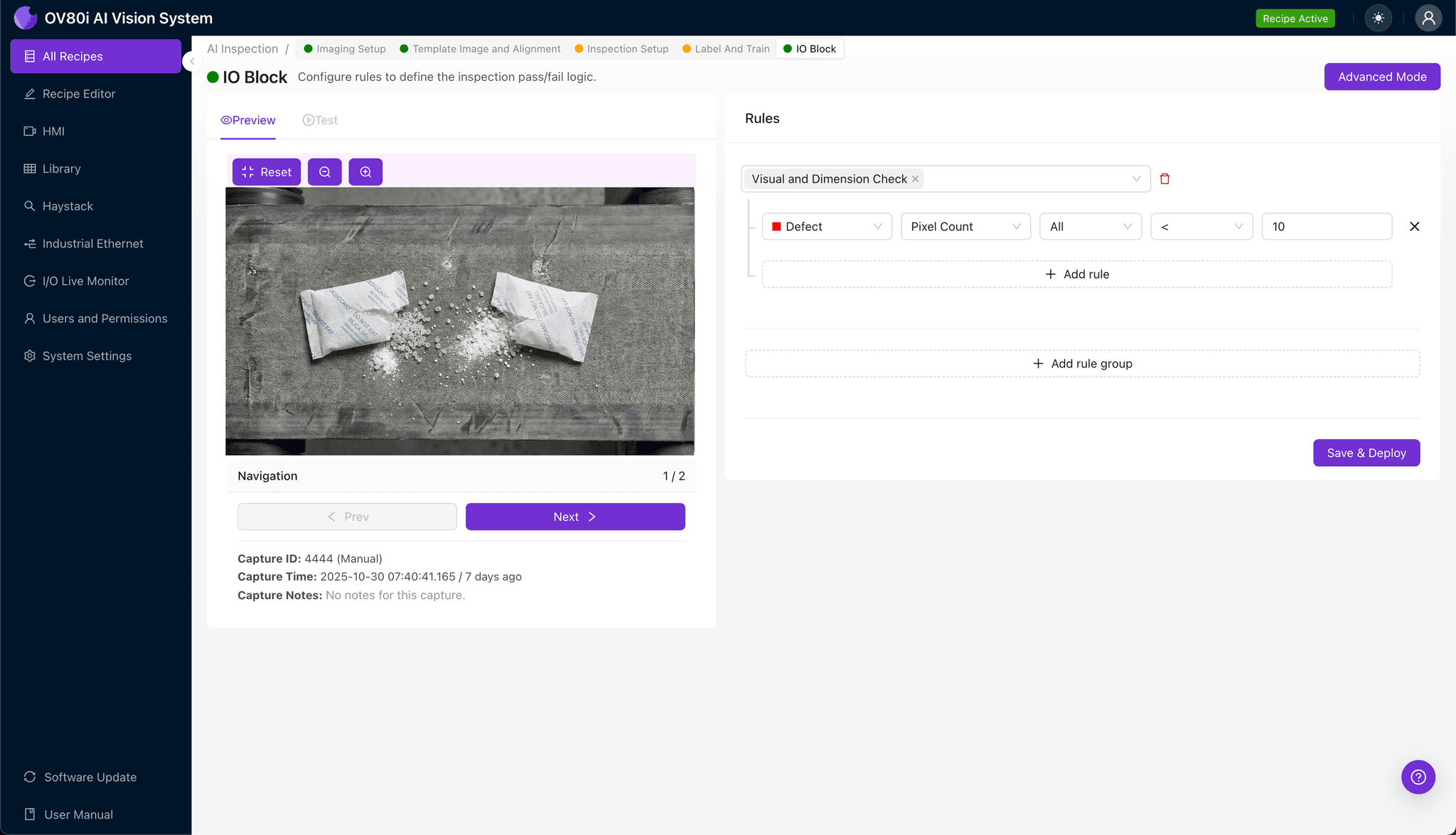
With your trained model ready, set pass/fail logic based on each Inspection Type you defined. For example, any detection of "Burst_Seam" with confidence above 85% triggers an automatic reject.
Configure these rules to gate automated acceptance directly on the production line. Failed units can be diverted to a reject bin or flagged for secondary human review, depending on your quality protocol requirements.
Key Outcomes & ROI
Implementing AI-powered burst seam detection delivers measurable returns across your operation:
- Reduced scrap rates — Catch defects before they contaminate downstream products or trigger costly batch rejections
- Higher throughput — Inspect 100% of units at full line speed without creating bottlenecks or adding headcount
- Compliance and traceability — Automatically log every inspection result with timestamped images for audit-ready documentation
- Process improvement insights — Identify patterns in seam failures that point to upstream issues like heat sealer calibration drift or material inconsistencies
Ready to Eliminate Burst Seam Escapes?
Overview.ai's visual inspection platform transforms desiccant pack quality control from a liability into a competitive advantage. Stop relying on fatigued inspectors and start catching every defect, every time.