
Fiber Pigtail with Excessive Bend-Radius Fatigue: A Complete Visual Inspection Walkthrough
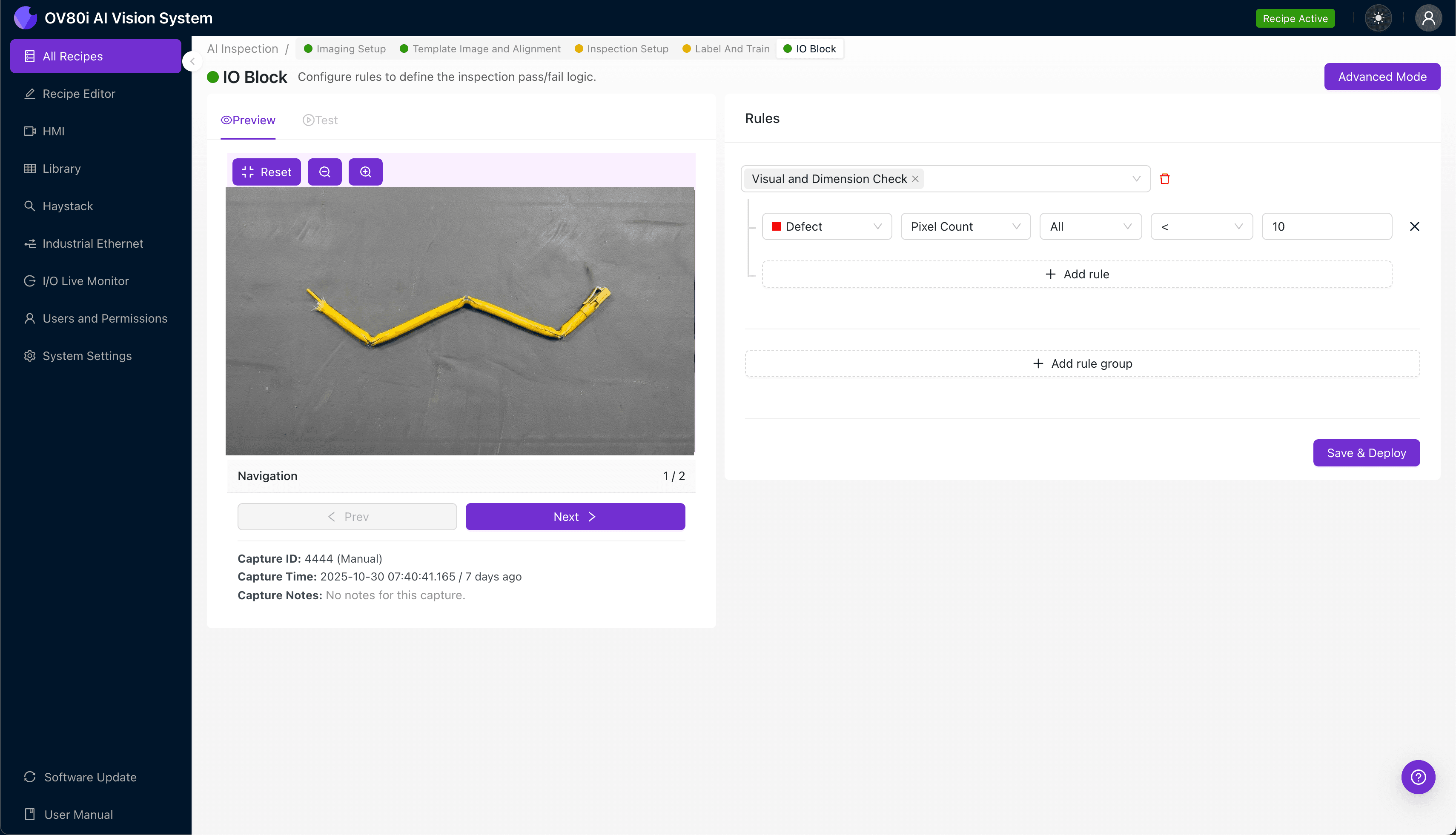
"Fiber pigtails suffering from bend-radius fatigue develop subtle defects like micro-cracks and stress whitening that human inspectors frequently miss. AI-powered visual inspection detects these critical flaws consistently at full line speed, protecting signal integrity and preventing field failures."
The Problem: Why Bend-Radius Fatigue Defects Slip Through
Fiber pigtails are critical interconnect components in telecommunications and data center infrastructure, where even minor damage can cause catastrophic signal loss. When these delicate optical fibers experience excessive bend-radius stress during manufacturing, handling, or installation, the resulting fatigue creates defects that compromise performance and reliability.
Common Defects Found in Bend-Radius Fatigued Fiber Pigtails:
- Micro-cracks in the fiber cladding – hairline fractures that propagate under thermal cycling
- Buffer coating delamination – protective layer separation at stress concentration points
- Core ovality distortion – geometric deformation affecting signal transmission
- Stress whitening marks – visible discoloration indicating internal structural damage
- Jacket kinking or permanent deformation – outer sheath damage revealing underlying stress
- Ferrule-to-fiber bond separation – adhesive failure at the connector interface due to repeated flexing
Human inspectors struggle to identify these defects consistently. The subtle nature of micro-cracks and early-stage stress indicators makes them nearly invisible under standard lighting conditions. Inspector fatigue compounds the problem—after hours of examining nearly identical pigtails, detection rates plummet while false accepts increase.
The Solution: Machine Vision + Deep Learning
Machine vision systems equipped with deep learning algorithms excel at detecting the subtle, often microscopic indicators of bend-radius fatigue. Unlike rule-based systems that require explicit programming for every defect type, neural networks learn to recognize the complex visual patterns associated with fiber stress damage—including defects that weren't explicitly defined during training.
Overview.ai's approach delivers consistent, objective inspection at full line speed. The system never experiences fatigue, never takes shortcuts, and applies identical scrutiny to the first pigtail of the day as the ten-thousandth—ensuring that critical telecommunications components meet specification every single time.
Step 1: Imaging Setup
Position the fiber pigtail under the OV80i camera system, ensuring the critical bend zones and connector interfaces are within the field of view. For transparent or semi-transparent fiber materials, consider backlighting configurations to reveal internal stress patterns and micro-fractures.
Navigate to "Configure Imaging" in the Overview.ai interface. Adjust the Camera Settings—increase exposure to capture subtle stress whitening, and fine-tune gain to balance sensitivity against noise in the fiber cladding regions.
Click "Save" to lock in your optimized imaging parameters.
Step 2: Image Alignment
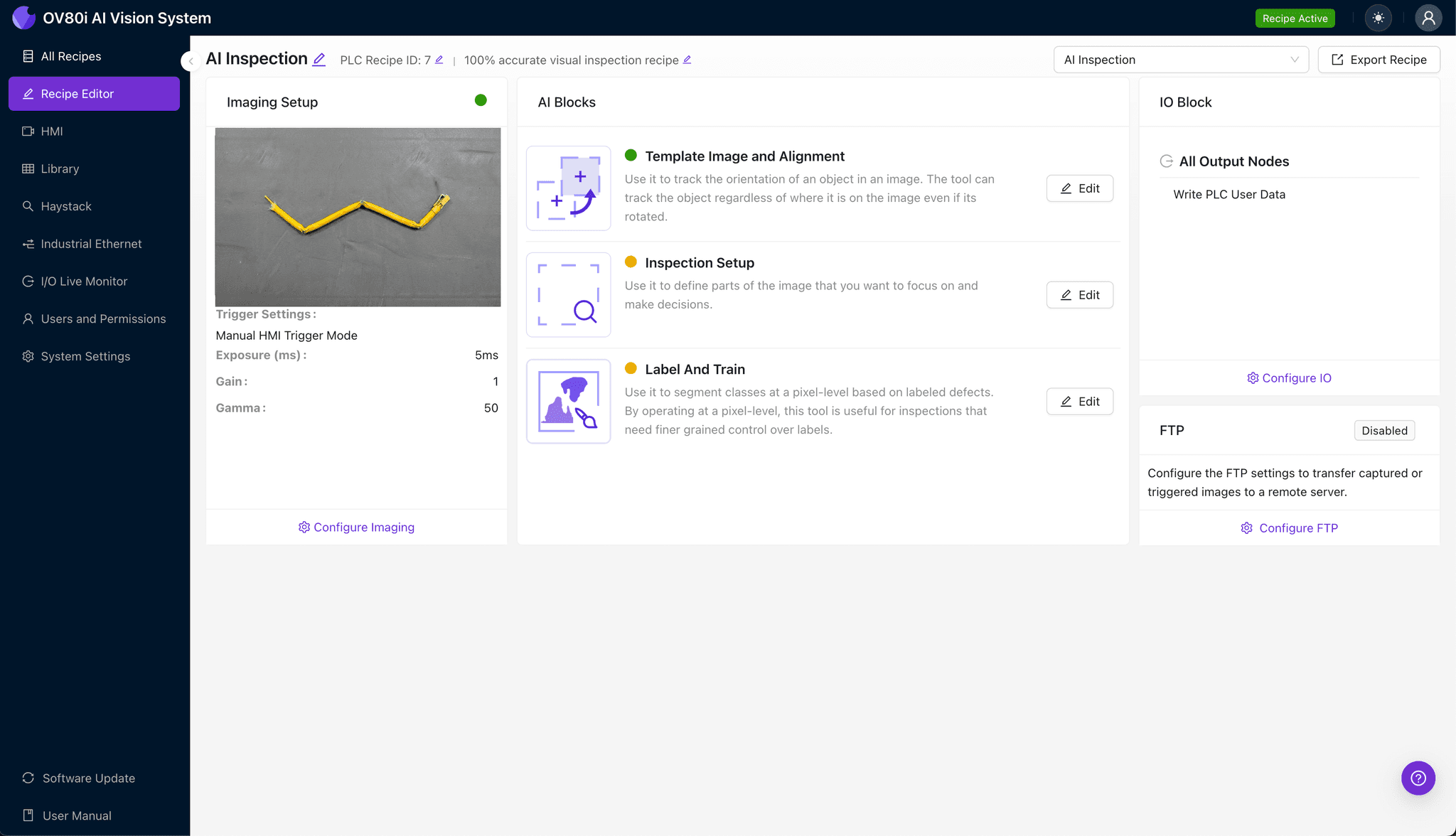
Navigate to "Template Image" and capture a reference image of a known-good fiber pigtail in its standard inspection orientation. This template ensures consistent positioning across all subsequent inspections, even when parts arrive with slight placement variations.
Click "+ Rectangle" to add an alignment region around the main body of the pigtail—typically encompassing the ferrule and the first 15-20mm of fiber where bend stress is most concentrated. Set the "Rotation Range" to 20 degrees to accommodate normal variation in part presentation on the line.
Step 3: Inspection Region Selection
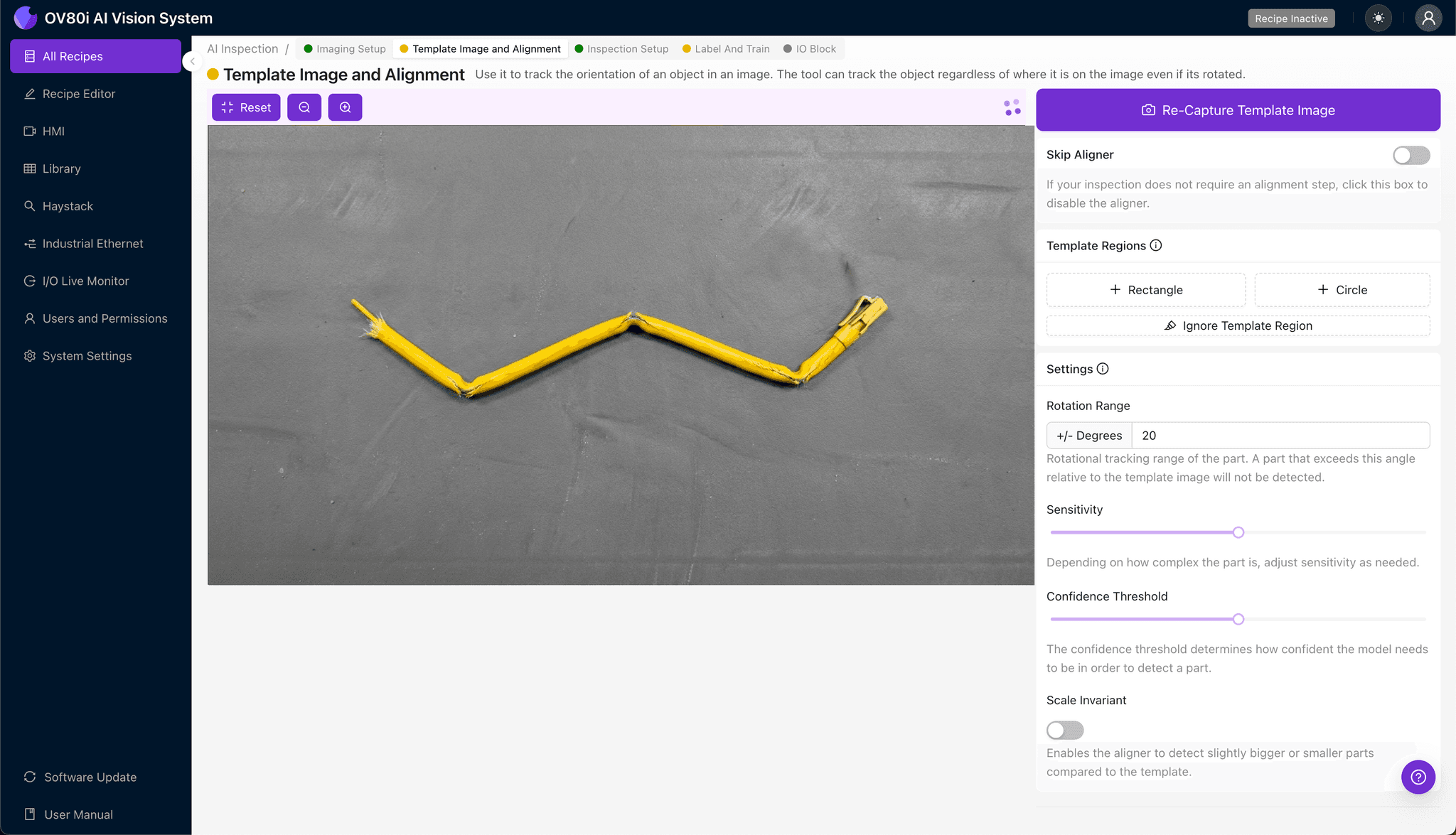
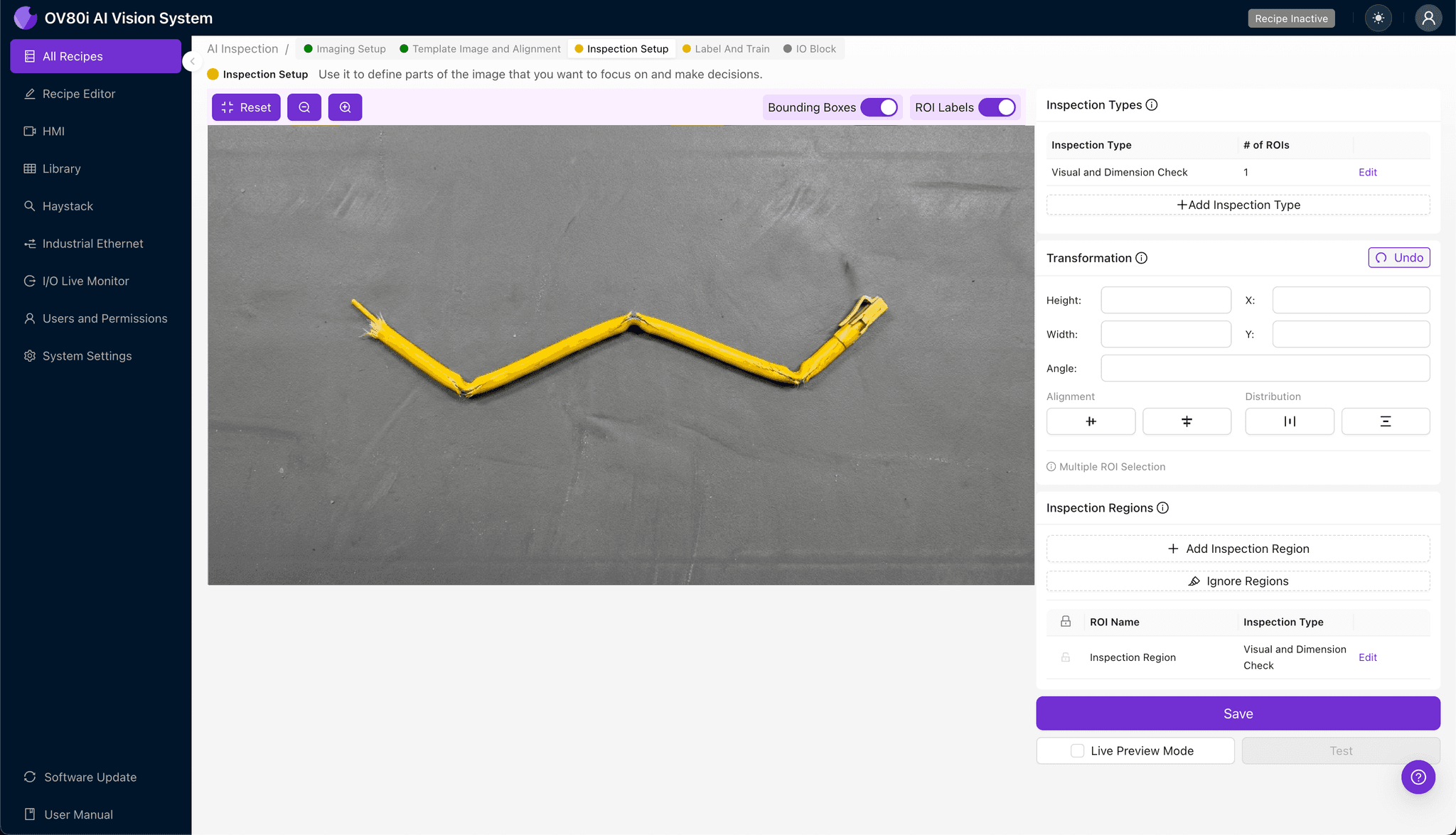
Navigate to "Inspection Setup" to define where the system should focus its analysis. Rename your "Inspection Types" to reflect the specific defect categories: "Cladding_Micro_Cracks," "Buffer_Delamination," "Stress_Whitening," and "Ferrule_Bond_Integrity."
Click "+ Add Inspection Region" for each critical zone. Resize the yellow bounding box to cover the high-stress areas—the bend radius apex, the buffer-to-ferrule transition, and any points where the fiber contacts routing guides.
Click "Save" after defining all inspection regions.
Step 4: Labeling Data
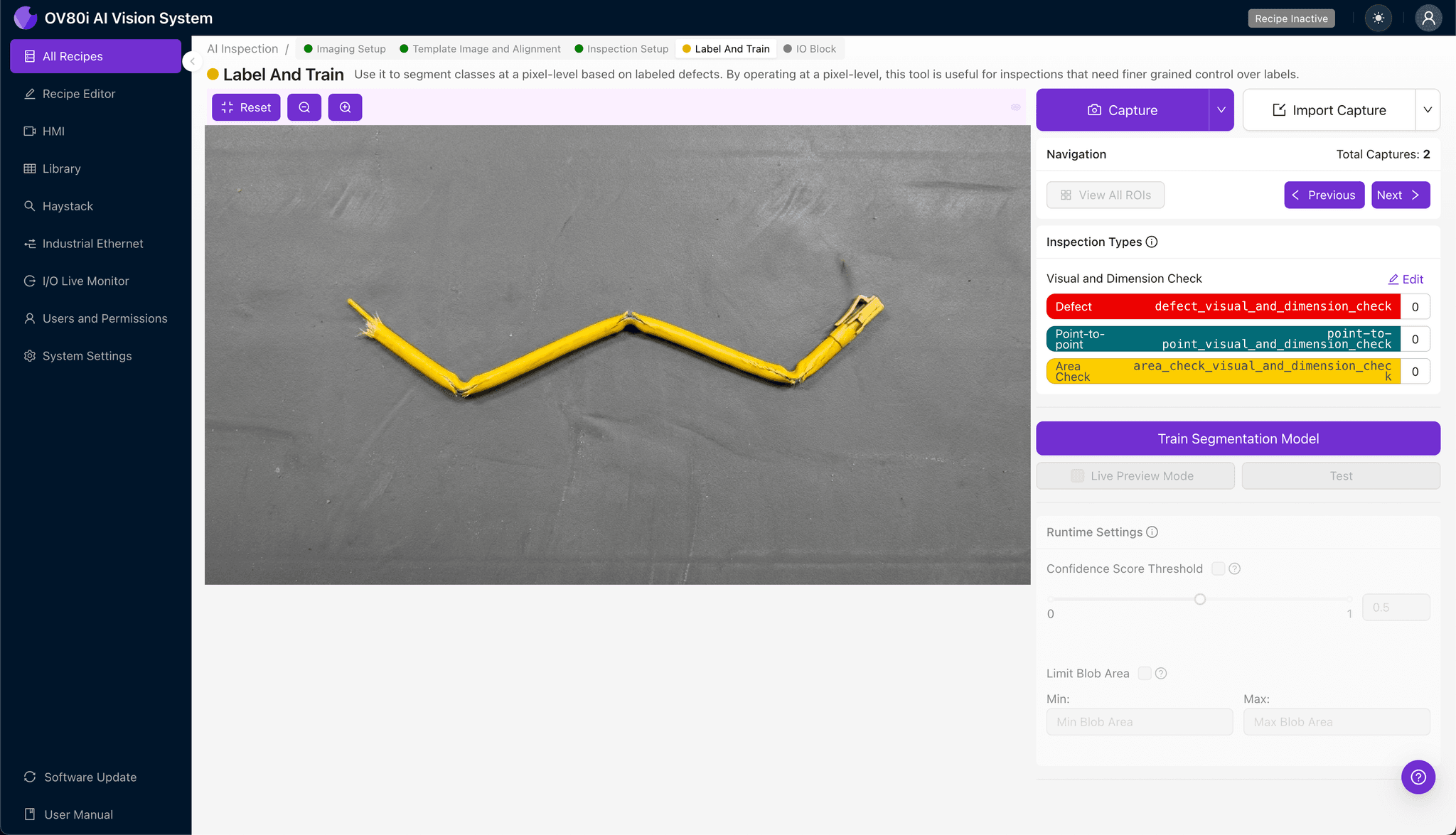
The human-in-the-loop labeling process is where your domain expertise trains the AI model. As production images flow through the system, operators review and categorize each pigtail as Good or Bad within each inspection region.
Include representative samples across the full spectrum of acceptable variation, as well as known failure modes from historical quality records. The more comprehensive your labeled dataset—including borderline cases and subtle early-stage fatigue indicators—the more robust your trained model will perform in production.
Step 5: Creating Rules
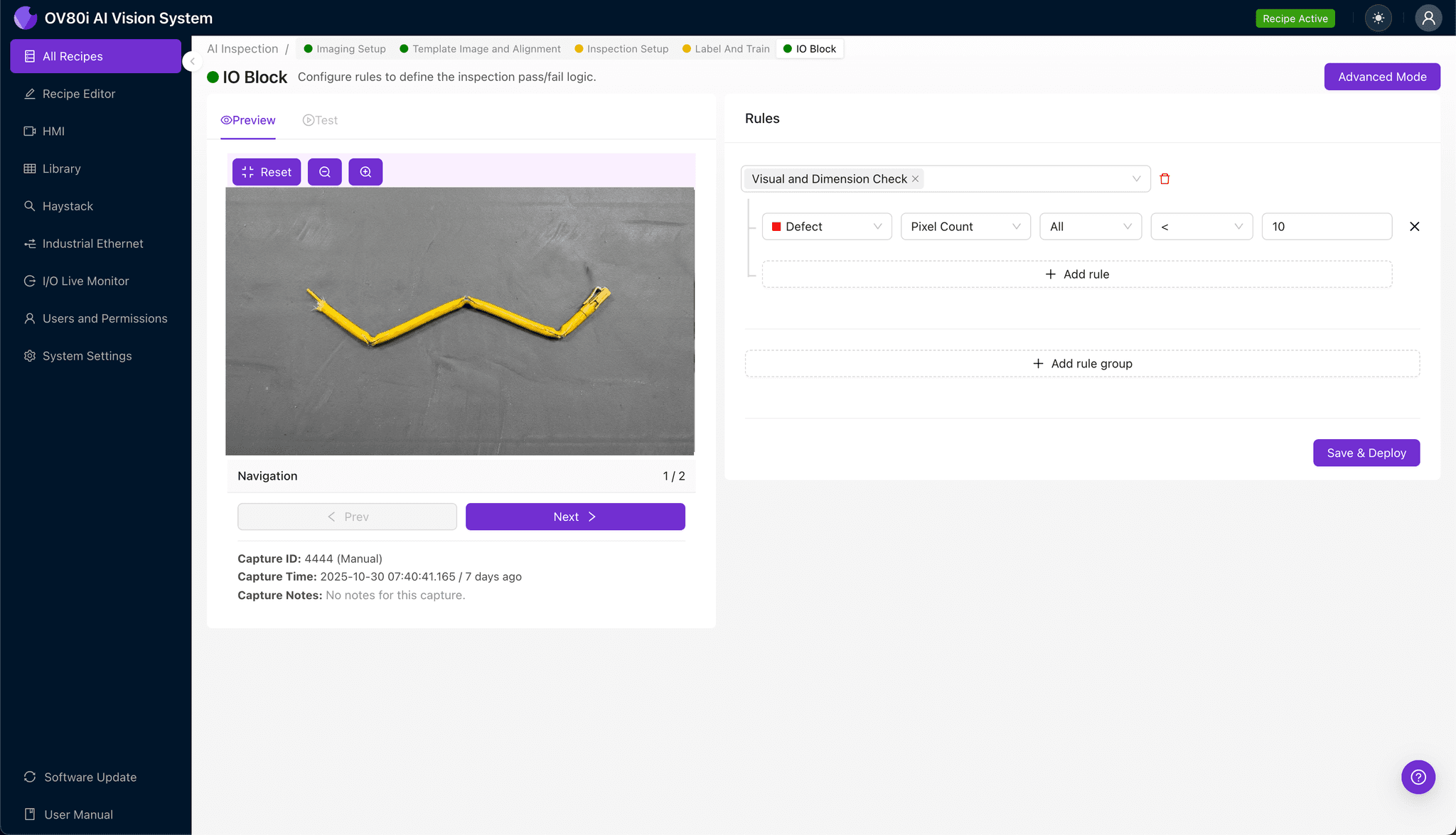
With inspection types defined and the model trained, establish your pass/fail logic based on business requirements. Configure rules that flag any detection of micro-cracks or delamination as automatic failures, while allowing configurable thresholds for minor stress indicators.
Gate automated acceptance on the line by connecting inspection outcomes to your reject mechanism. Parts that pass all inspection criteria proceed automatically; flagged units divert for secondary review or scrapping, ensuring zero suspect pigtails reach your customers.
Key Outcomes & ROI
Implementing automated visual inspection for fiber pigtail bend-radius fatigue delivers measurable business impact:
- Reduced scrap rates – catch stress damage before costly downstream assembly operations
- Higher throughput – inspect 100% of production at line speed without bottlenecks
- Enhanced compliance and traceability – maintain complete inspection records for telecom industry audits and customer quality requirements
- Process improvement insights – identify upstream handling or routing issues causing elevated bend stress through defect trend analysis
Conclusion
Fiber pigtail bend-radius fatigue represents exactly the type of subtle, high-consequence defect where AI-powered visual inspection delivers transformative value. By combining precision imaging, deep learning detection, and systematic rule-based gating, Overview.ai enables manufacturers to protect both product quality and brand reputation—one pigtail at a time.
Eliminate Fiber Pigtail Defects Today
Stop relying on manual inspection for critical telecommunications components. Deploy Overview.ai to catch bend-radius fatigue defects instantly.