
Fiber Splitter with Imbalanced Insertion Loss: A Complete Visual Inspection Walkthrough
"Imbalanced insertion loss in fiber splitters stems from microscopic defects at splice points and waveguide interfaces—anomalies too subtle for reliable human detection. AI-powered visual inspection catches these defects in milliseconds, enabling 100% inline quality control without bottlenecking production throughput."
The Problem: Why Imbalanced Insertion Loss Defects Slip Through
Fiber splitters are critical passive components in optical networks, dividing light signals across multiple output ports with precise power ratios. When insertion loss becomes imbalanced across these ports, network performance degrades, causing signal integrity failures and costly field returns.
Common Defects Found in Fiber Splitters with Imbalanced Insertion Loss
- Contaminated fusion splice points — microscopic particulates or residue at splice interfaces causing asymmetric signal attenuation
- Fiber core misalignment — off-center coupling between input and output fibers creating uneven power distribution
- Micro-cracks in waveguide substrates — hairline fractures in PLC (planar lightwave circuit) chips disrupting light propagation paths
- Epoxy curing anomalies — incomplete or uneven adhesive bonding around fiber-to-chip interfaces
- Protective coating delamination — separation of buffer coatings exposing fibers to mechanical stress
- Connector end-face scratches — surface damage on polished ferrule tips introducing variable back-reflection
Human inspectors struggle to identify these defects consistently. Microscopic anomalies at splice points measure in microns—well below reliable visual detection thresholds.
Fatigue sets in quickly when operators examine dozens of splitters per hour, and subjective judgment introduces pass/fail variability across shifts.
The Solution: Machine Vision + Deep Learning
Automated visual inspection eliminates the inconsistency inherent in manual quality control. Deep learning models trained on thousands of labeled defect images learn to recognize subtle patterns that indicate imbalanced insertion loss before functional testing.
Unlike rule-based machine vision, AI-powered systems adapt to new defect variations without extensive reprogramming. They detect anomalies humans would miss while maintaining consistent judgment across millions of inspections.
Overview.ai's Approach
Overview.ai delivers objective, repeatable inspection at production line speeds. The OV80i system captures high-resolution images of every fiber splitter, analyzes critical regions in milliseconds, and flags suspect units—enabling 100% inline inspection without bottlenecking throughput.
Step 1: Imaging Setup
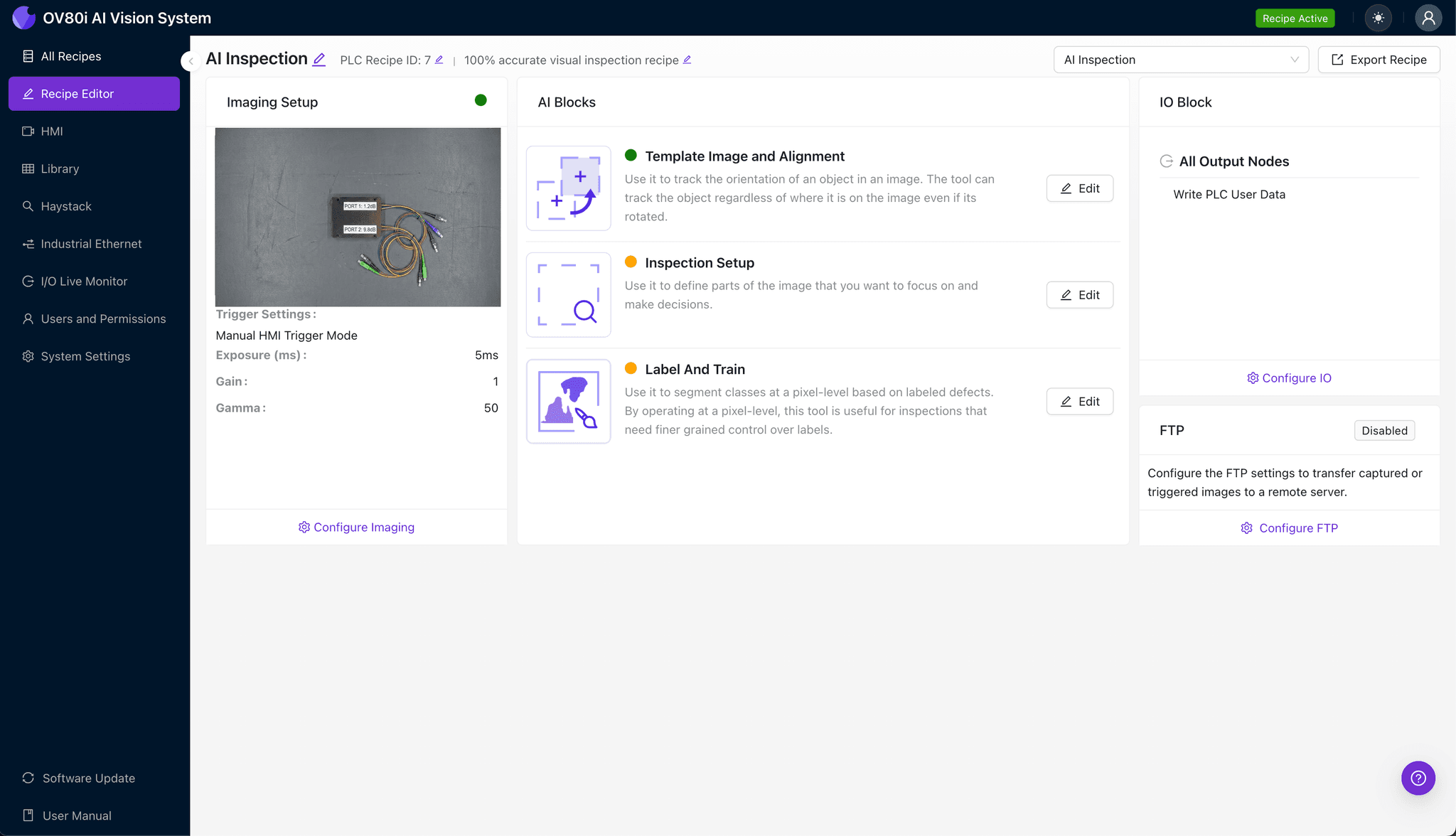
Position the fiber splitter under the OV80i camera system, ensuring the PLC chip, splice points, and connector interfaces are within the field of view. Consistent part placement is essential for repeatable inspection results.
Click "Configure Imaging" in the Overview.ai interface. Adjust Camera Settings including exposure time and gain to optimize contrast on translucent waveguide structures and reflective fiber surfaces.
Click "Save" to lock in your imaging configuration.
Step 2: Image Alignment
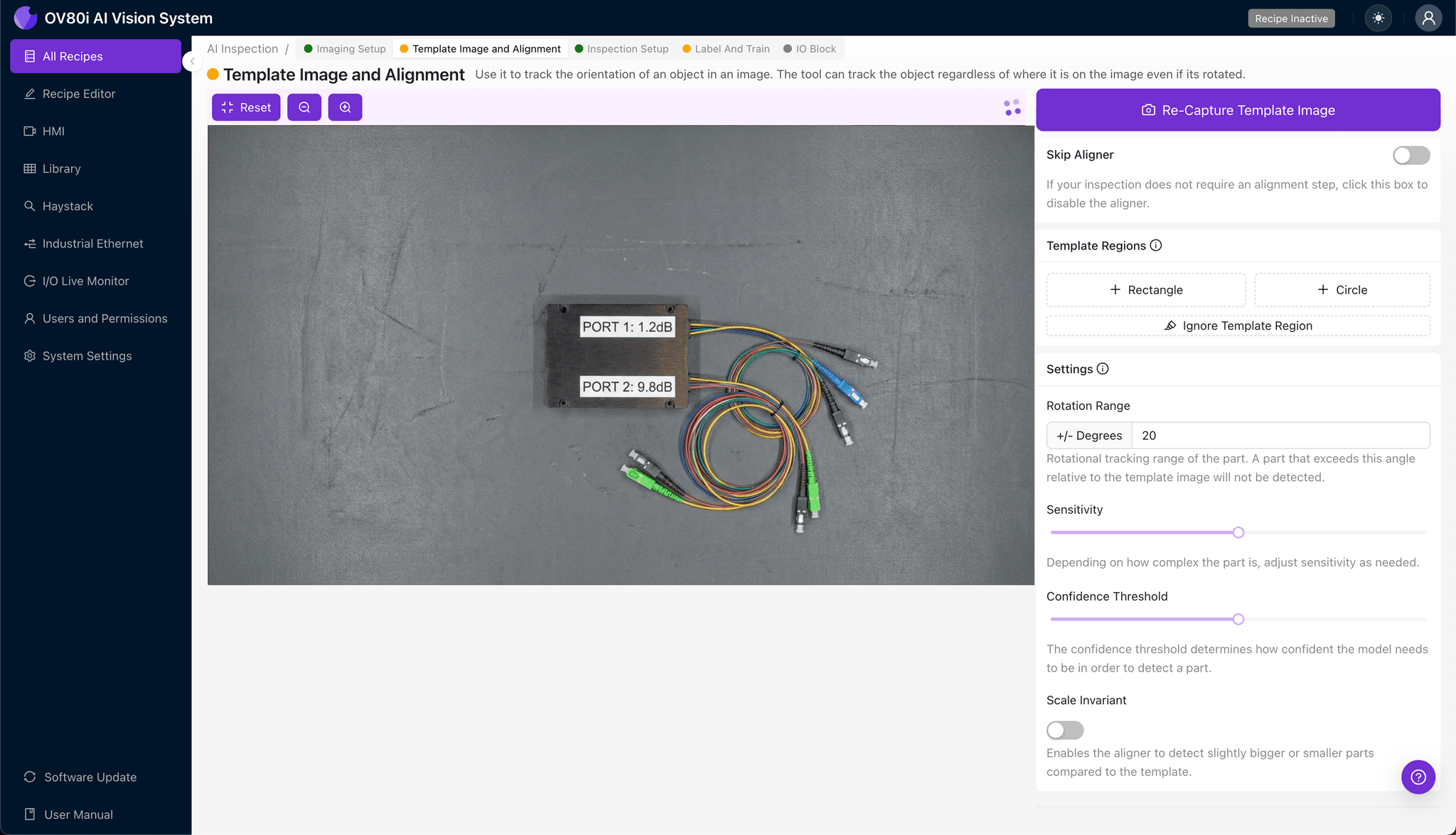
Navigate to "Template Image" in the software menu. Capture a Template of a properly positioned fiber splitter to serve as the alignment reference.
Click "+ Rectangle" and draw a region around the main body of the splitter housing. This defines the area the system uses for part localization.
Set "Rotation Range" to 20 degrees to accommodate minor orientation variations as parts enter the inspection station.
Step 3: Inspection Region Selection
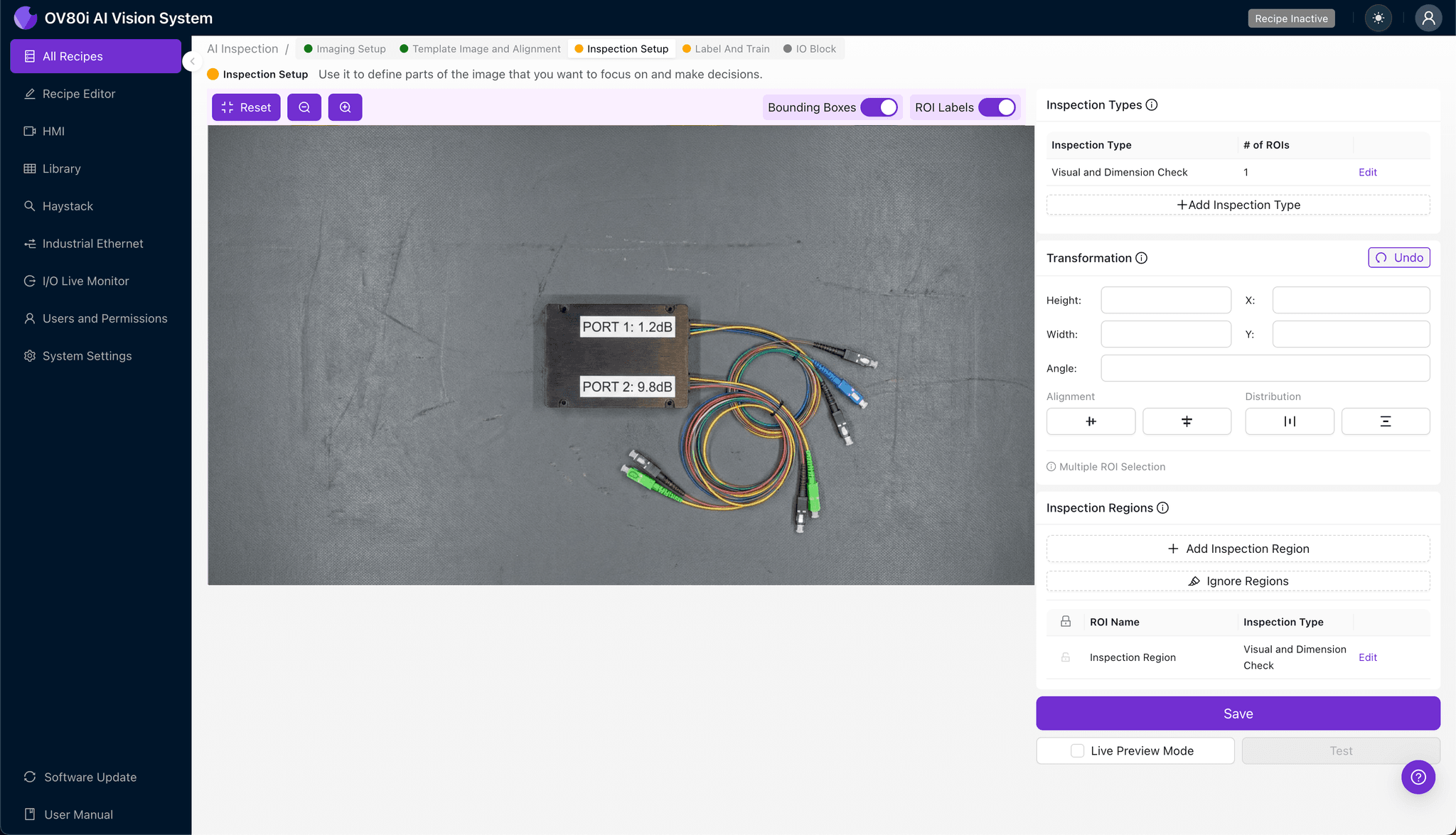
Navigate to "Inspection Setup" to define where the system should look for defects. Rename your "Inspection Types" to match specific defect categories—such as "Splice Point Contamination," "Core Alignment," and "Substrate Cracks."
Click "+ Add Inspection Region" for each critical area. Resize the yellow bounding box to cover fusion splice zones, waveguide channels, and connector end-faces.
Click "Save" after defining all inspection regions.
Step 4: Labeling Data
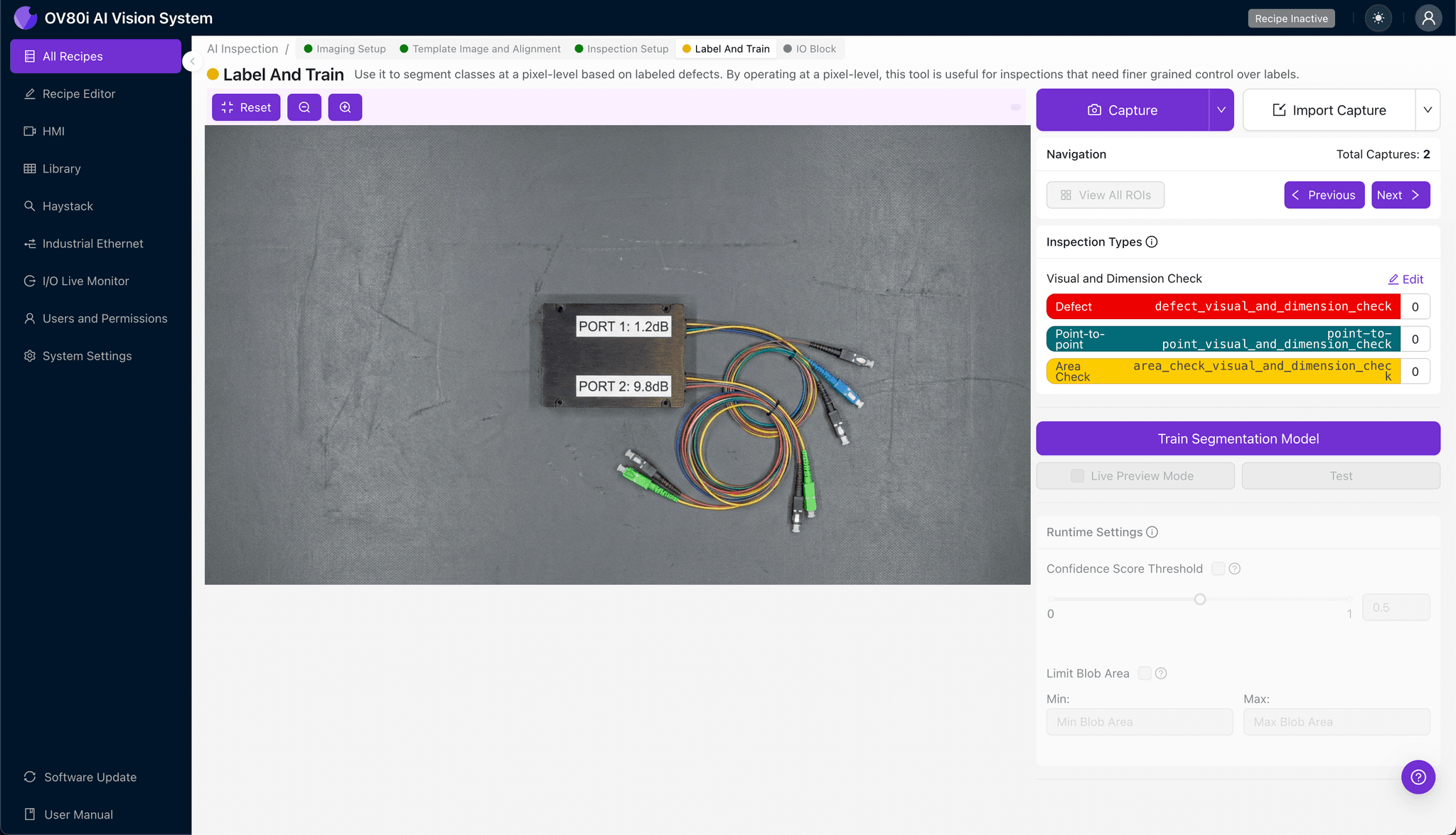
The human-in-the-loop labeling process trains the deep learning model to distinguish acceptable parts from defective ones. Production operators and quality engineers review captured images, applying their domain expertise to build the training dataset.
Label images as Good or Bad based on established quality criteria. Include representative samples of all known failure modes—contamination patterns, alignment deviations, and substrate damage—to ensure the model generalizes effectively across real-world variation.
Step 5: Creating Rules
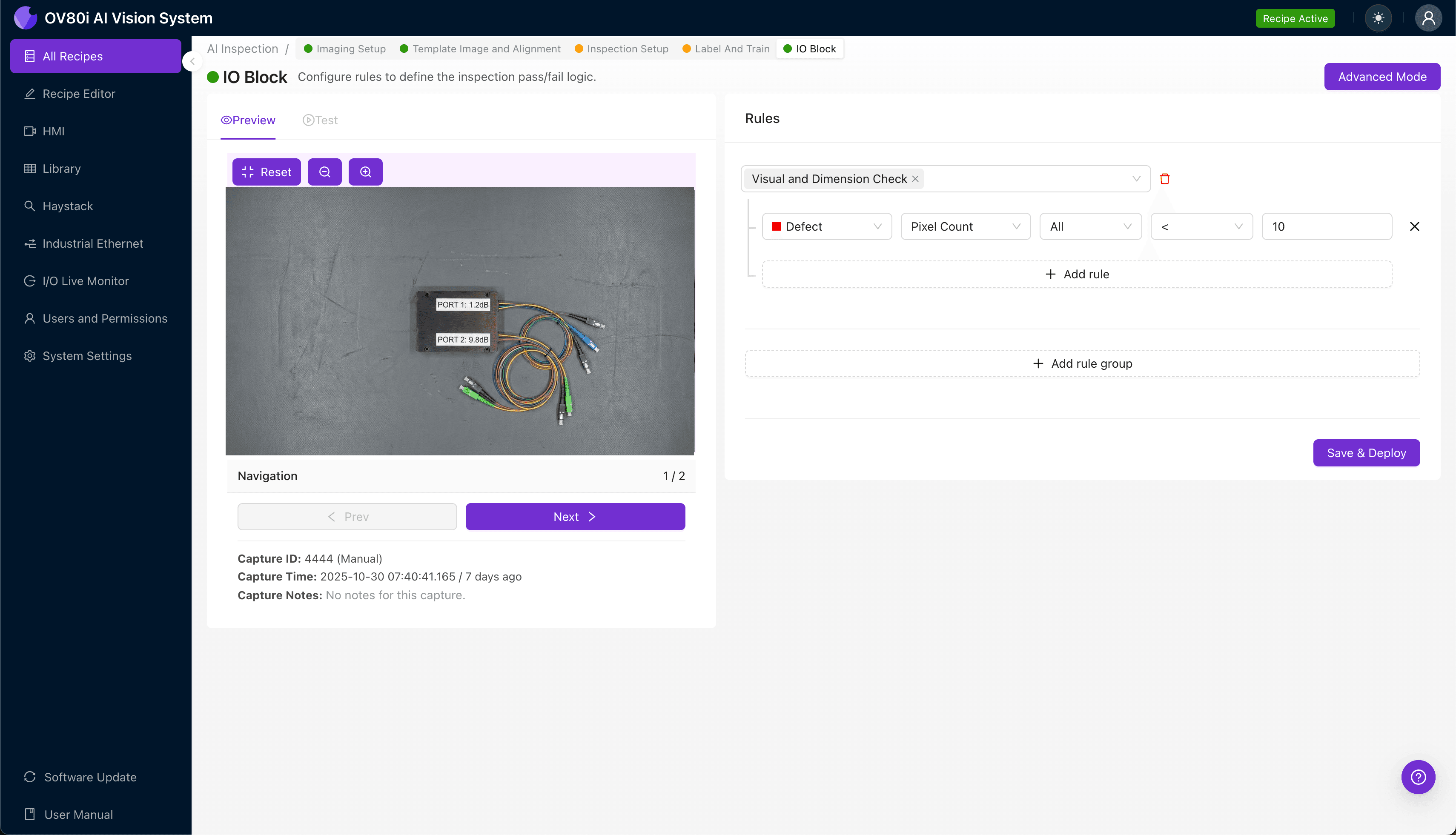
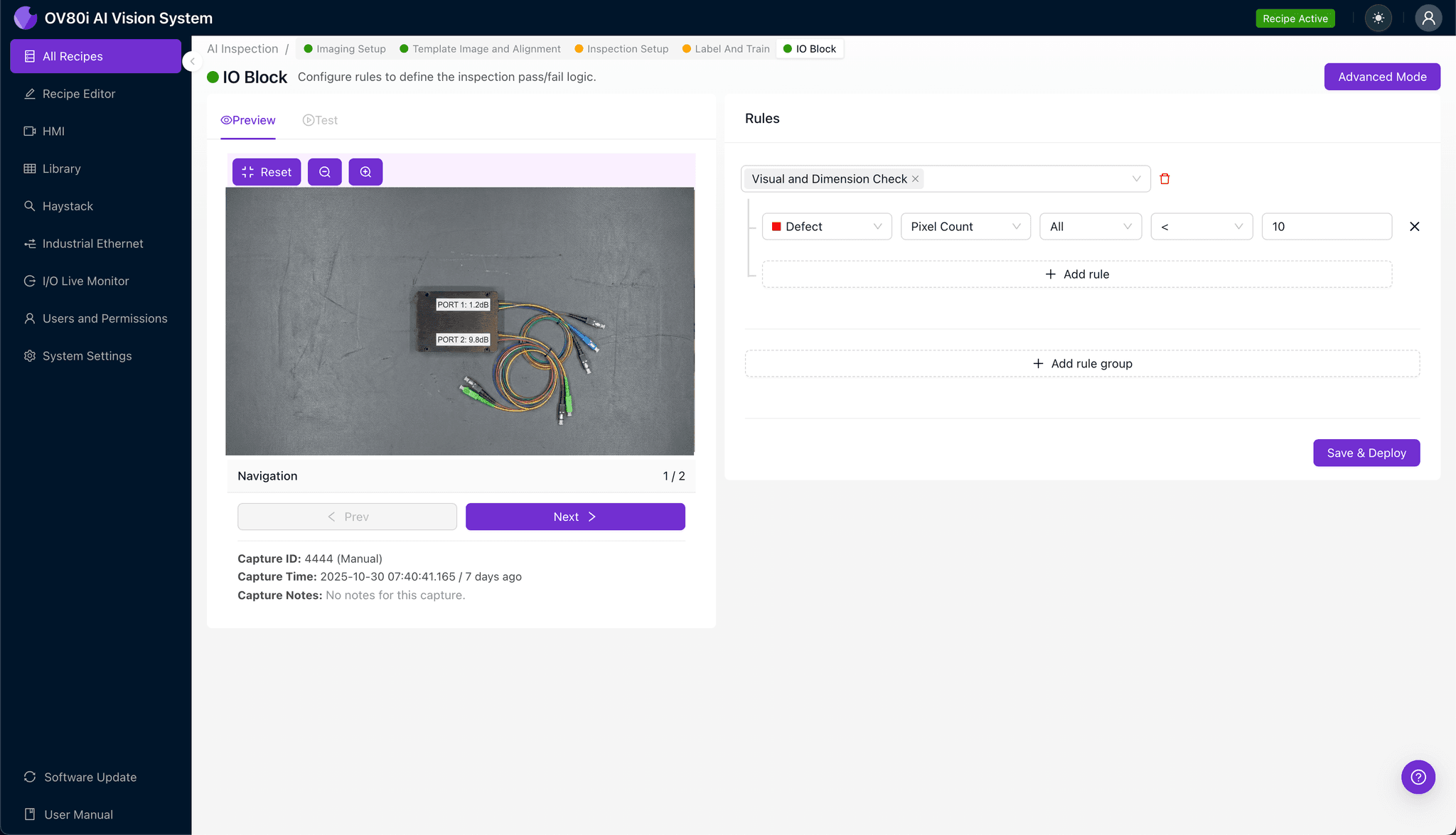
Configure pass/fail logic based on your defined Inspection Types. Set confidence thresholds that balance escape rate against false rejection costs for your specific quality requirements.
Gate automated acceptance on the production line by integrating inspection results with your PLC or MES system. Suspect units route automatically to secondary review or functional testing stations.
Key Outcomes & ROI
Implementing AI-powered visual inspection for fiber splitters delivers measurable business impact:
- Reduced scrap rates — catch defects before functional testing eliminates wasted test time and prevents shipping nonconforming product
- Higher throughput — 100% inline inspection removes manual sampling bottlenecks while maintaining quality gates
- Compliance and traceability — automated image logging creates auditable records for ISO 9001 and customer quality requirements
- Process improvement insights — defect trend analytics reveal upstream manufacturing issues, enabling root cause correction before yield loss compounds
Conclusion
Fiber splitters with imbalanced insertion loss represent a challenging inspection problem—but one that AI-powered machine vision solves effectively. Overview.ai's approach combines deep learning flexibility with production-ready reliability, helping manufacturers ship higher-quality optical components while reducing inspection costs.
Ready to automate your fiber optic component inspection? Contact Overview.ai to schedule a demo with your actual production samples.
Eliminate Fiber Splitter Defects Today
Stop relying on manual inspection for critical optical components. Deploy Overview.ai to catch insertion loss defects instantly.