
How to Inspect High-Speed Headers with Loose Press-Fit Tails Using AI Vision
"High-speed headers with loose press-fit tails cause intermittent failures that escape traditional inspection. Deep learning vision systems detect subtle seating defects by learning the holistic signature of properly assembled joints, delivering 100% inline inspection at full production speed."
The Problem: Why Traditional Inspection Falls Short
High-speed headers with loose press-fit tails are critical interconnect components in automotive, aerospace, and industrial electronics. When these connectors fail, the consequences range from intermittent signal loss to catastrophic system failures in the field.
The press-fit interface between the header body and tail section presents unique inspection challenges due to tight tolerances and subtle defect signatures.
Common Defects in High-Speed Headers with Press-Fit Tails
- Insufficient press depth — tail not fully seated into header body, creating loose mechanical connection
- Excessive press depth — over-insertion causing pin deformation or housing stress fractures
- Angular misalignment — tail cocked at improper angle relative to header centerline
- Retention clip damage — bent or missing retention features that secure the press-fit joint
- Pin displacement — contact pins shifted during press operation, affecting electrical continuity
- Housing cracks — micro-fractures in plastic housing from insertion force variations
Human inspectors struggle with these defects because many occur at sub-millimeter scales. Fatigue sets in quickly when operators examine hundreds of parts per hour, and the subtle differences between a marginal press-fit and an acceptable one become impossible to judge consistently across shifts.
The Solution: Machine Vision Powered by Deep Learning
Traditional rule-based vision systems fail on press-fit headers because "loose" isn't a simple geometric measurement. The defect manifests as a combination of subtle visual cues—slight gaps, shadow variations, and angular deviations that require contextual understanding.
Deep learning models excel here because they learn the holistic "signature" of a properly seated press-fit tail versus a compromised one, just as an expert would.
Overview.ai's approach delivers consistent, objective inspection at full line speed. The OV80i system evaluates every single unit against the same learned standard, eliminating the variability inherent in manual sampling and providing real-time quality data for process control.
Step 1: Imaging Setup
Position the high-speed header with the press-fit tail junction clearly visible to the camera. The tail-to-body interface is your primary region of interest, so orient the part to maximize visibility of this critical zone.
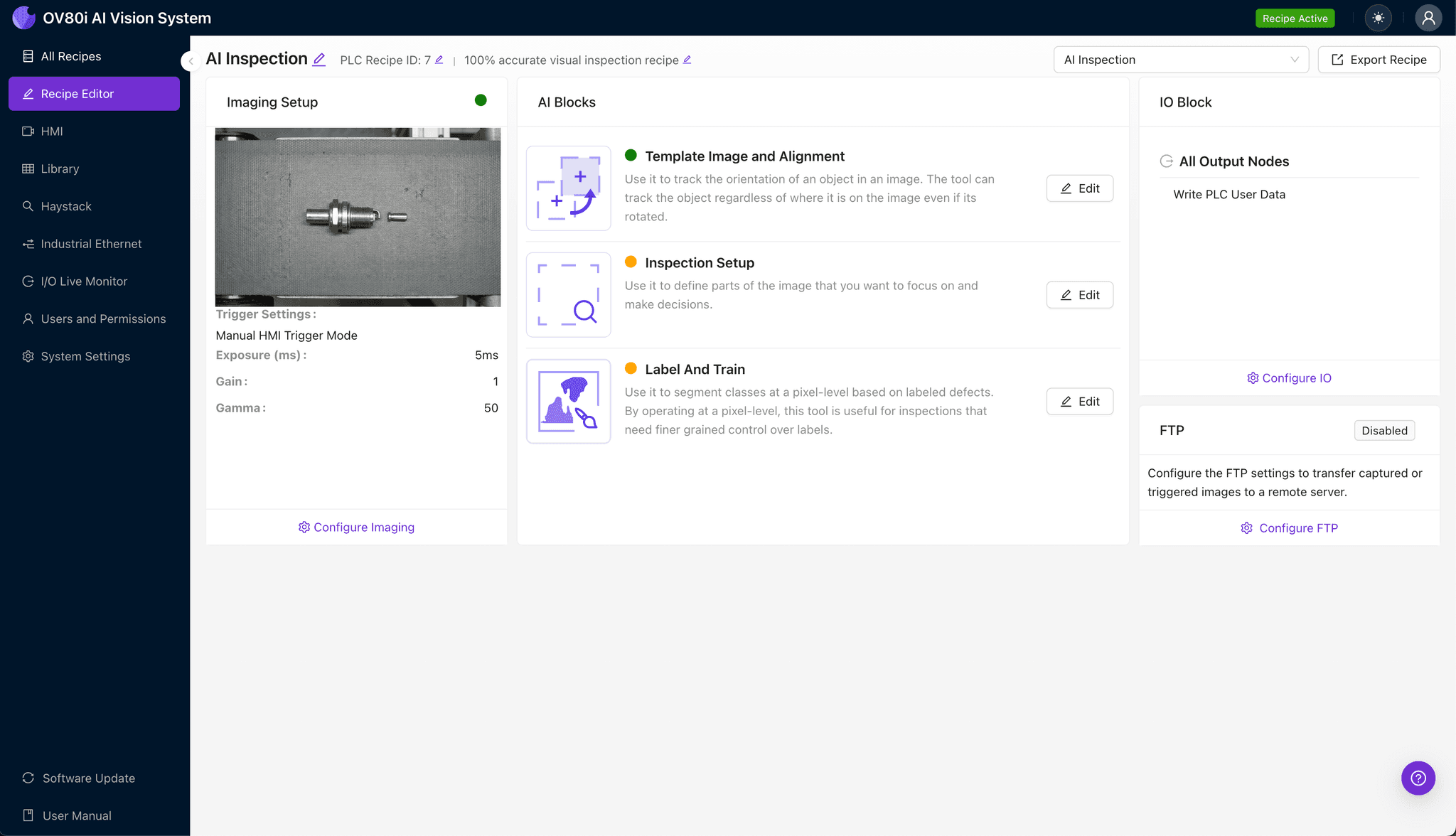
Click "Configure Imaging" in the Overview interface. Adjust Camera Settings including exposure time and gain to ensure the press-fit seam and any potential gaps are clearly rendered without overexposure on reflective pin surfaces.
Click "Save" once the image shows crisp detail across the entire header assembly.
Step 2: Image Alignment
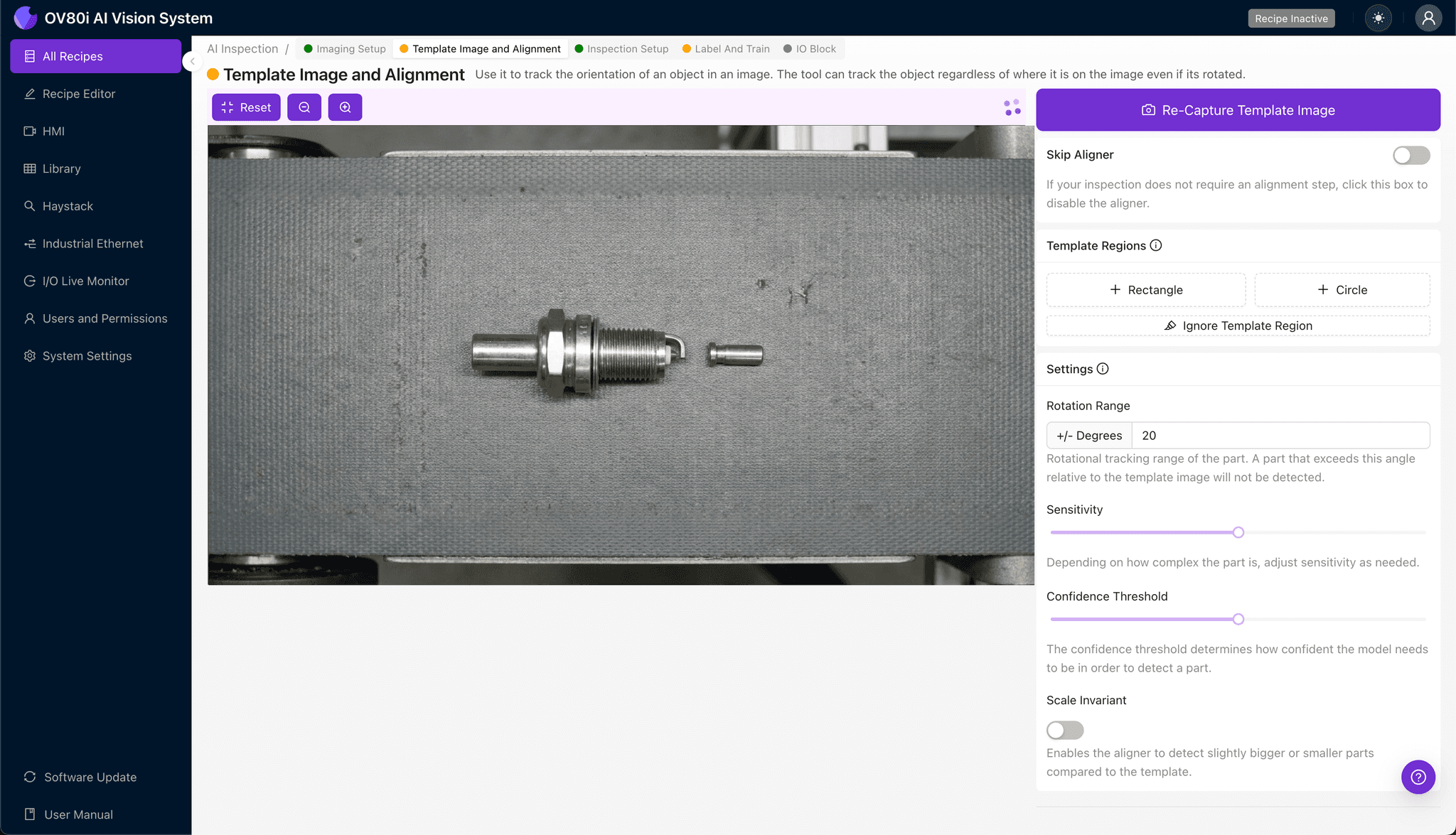
Navigate to "Template Image" in the configuration menu. Capture a Template using a known-good header positioned in its standard orientation on the inspection fixture.
Click "+ Rectangle" to add an alignment region around the main header body. This anchor region should encompass stable geometric features that won't vary between good and bad parts.
Set the "Rotation Range" to 20 degrees to accommodate normal variation in part placement while maintaining reliable alignment to your inspection zones.
Step 3: Inspection Region Selection
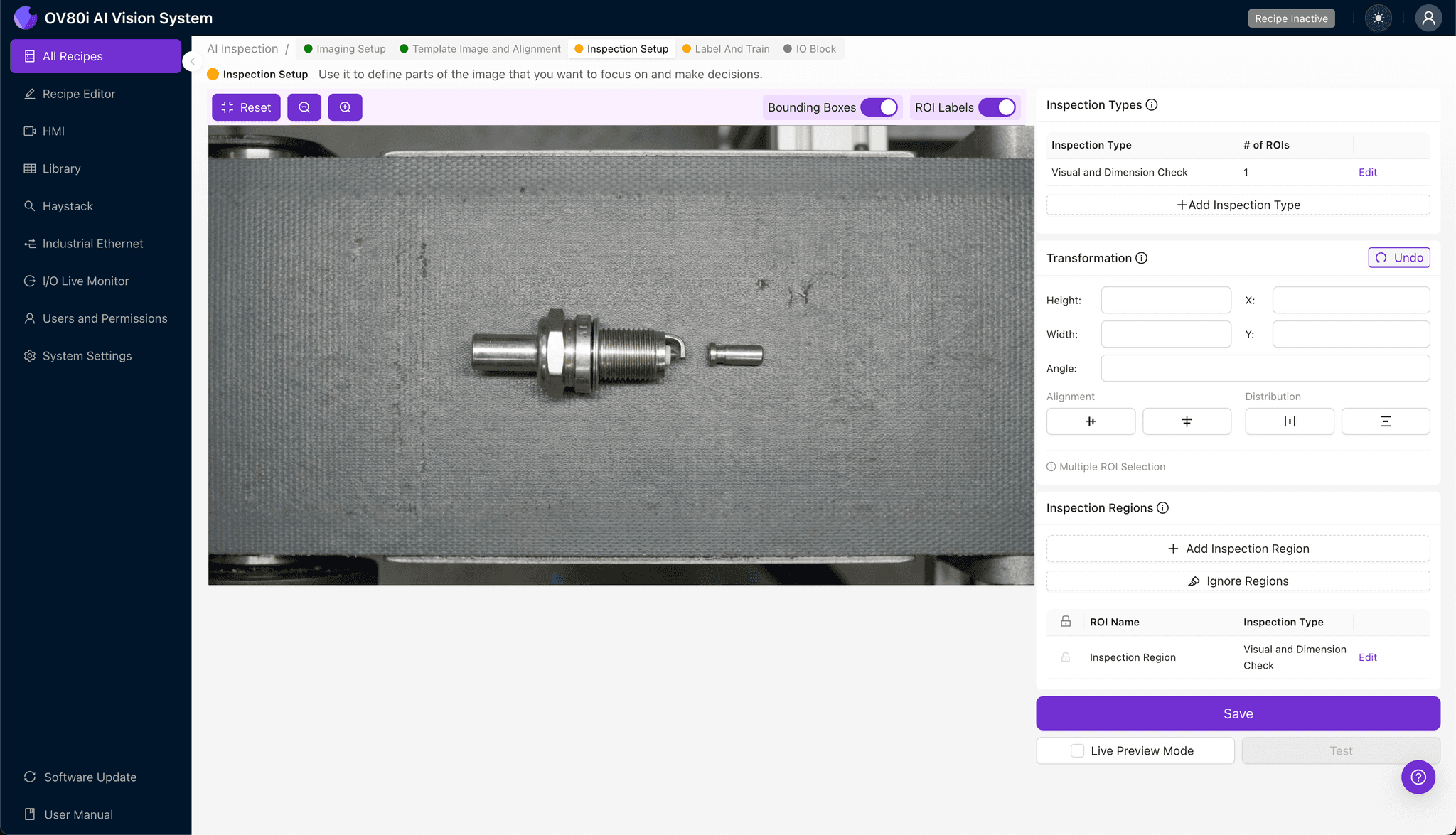
Navigate to "Inspection Setup" from the main menu. Rename your "Inspection Types" to reflect the specific defects you're targeting—for example, "Press-Fit Seating" and "Tail Alignment."
Click "+ Add Inspection Region" to create your first zone. Resize the yellow bounding box to cover the press-fit interface where the tail meets the header body.
Add additional inspection regions for secondary critical areas such as retention clip condition and pin position. Click "Save" after defining all regions.
Step 4: Labeling Data
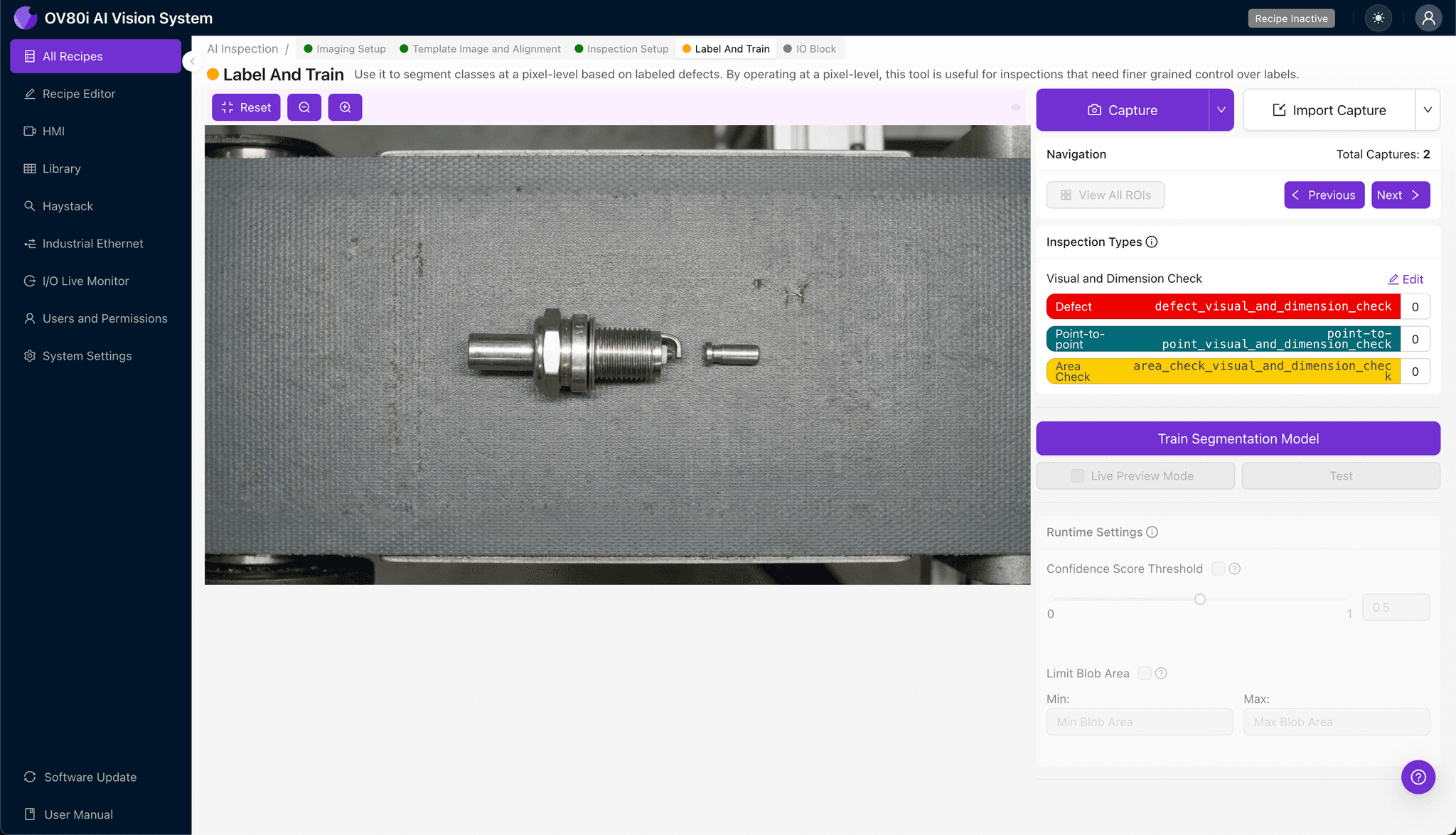
This human-in-the-loop step trains the AI to recognize your specific quality standards. Review incoming images and label each as Good or Bad based on your acceptance criteria.
Include representative samples across normal production variation—different header colors, slight fixture position differences, and acceptable cosmetic marks. Critically, incorporate known failure modes including examples of insufficient press depth, angular misalignment, and retention clip damage.
The model learns from this curated dataset, so invest time in accurate, comprehensive labeling to achieve production-ready accuracy.
Step 5: Creating Rules
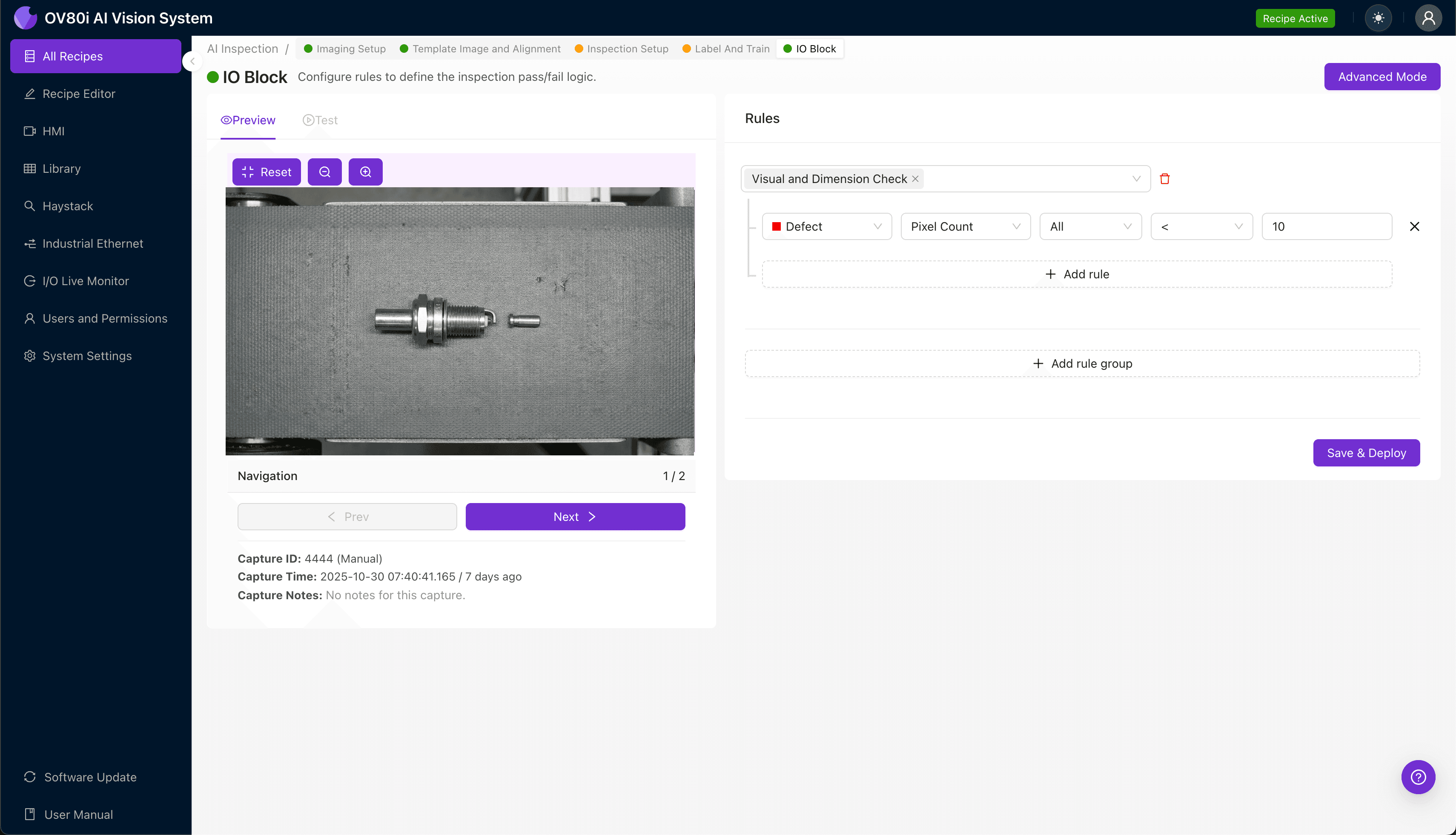
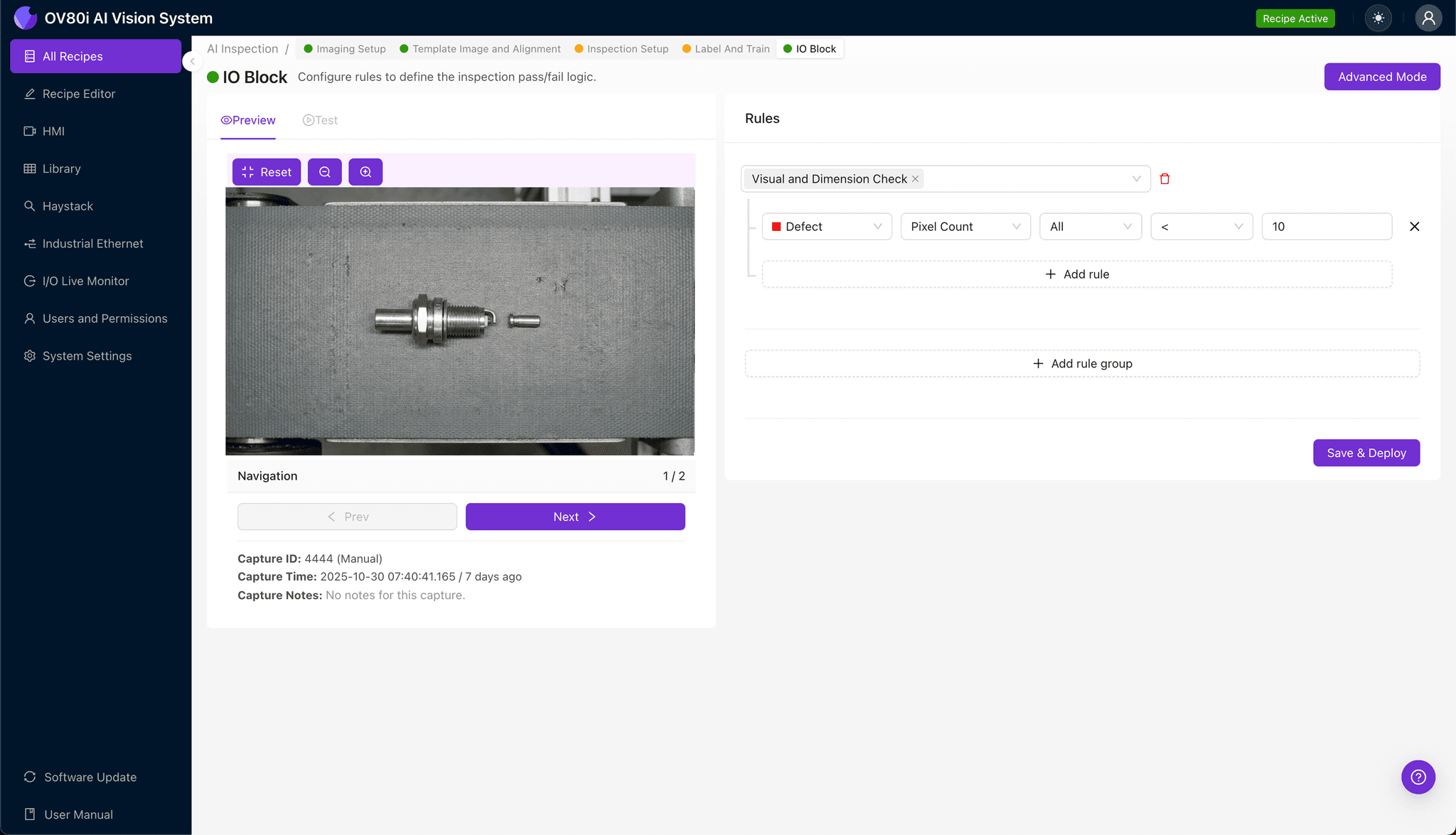
Define your pass/fail logic based on the Inspection Types you've configured. Set threshold criteria—for instance, any detection of "Loose Press-Fit" triggers an automatic reject.
Configure the system to gate automated acceptance on the line. Parts passing all inspection criteria proceed to packaging; flagged units divert to a reject bin or secondary review station for disposition.
Key Outcomes & ROI
Implementing AI-powered inspection for high-speed headers with press-fit tails delivers measurable business impact:
- Reduced scrap rates — catch press-fit defects before downstream assembly multiplies waste costs
- Higher throughput — 100% inline inspection eliminates sampling bottlenecks and manual station delays
- Compliance and traceability — automatic image logging creates auditable quality records for automotive and aerospace customers
- Process improvement insights — trend data reveals press force drift, tooling wear, and fixture issues before they cause batch failures
Conclusion
High-speed headers with loose press-fit tails represent exactly the inspection challenge where AI vision outperforms traditional methods. The defects are subtle, the tolerances are tight, and the stakes are high.
Overview.ai's deep learning approach transforms this difficult inspection into a reliable, scalable process. Ready to eliminate press-fit escapes from your line?
Eliminate Press-Fit Defects Today
Stop relying on manual inspection for critical connector assemblies. Deploy Overview.ai to catch subtle seating defects instantly.