
How to Detect Flux Residue on Mezzanine Connector Contacts Using AI-Powered Visual Inspection
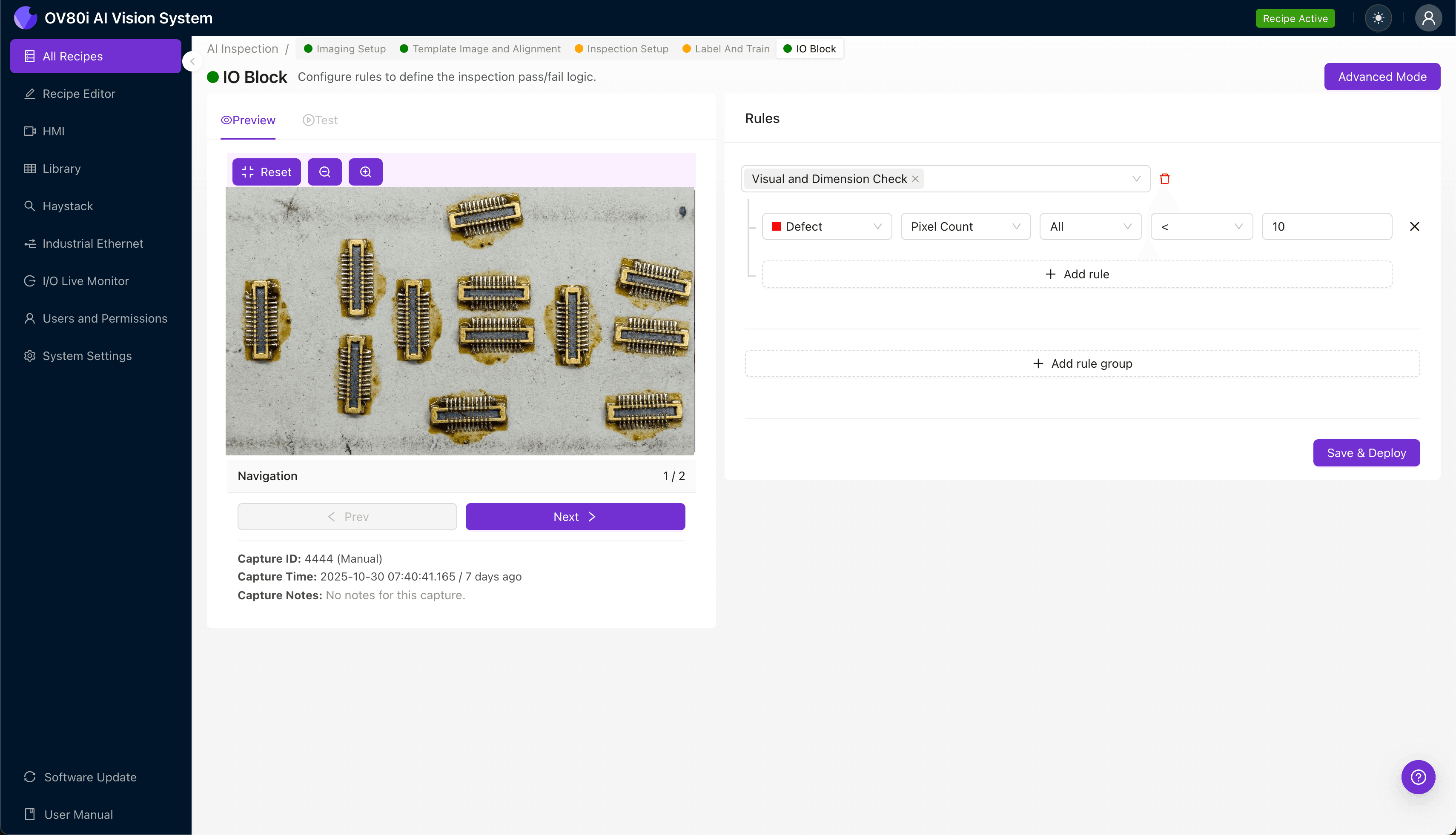
"Flux residue on mezzanine connector contacts creates intermittent failures and costly field returns that manual inspection consistently misses. AI-powered visual inspection using deep learning delivers consistent, objective detection at full line speed—catching subtle contamination that human inspectors cannot reliably identify."
The Problem: Why Flux Residue Defects Slip Through Manual Inspection
Mezzanine connectors are critical components in high-density electronic assemblies, providing reliable board-to-board connections in applications ranging from telecommunications equipment to aerospace systems. When flux residue remains on the contacts after soldering, it creates a ticking time bomb that can compromise signal integrity, cause intermittent failures, and lead to costly field returns.
Common Defects Found in Mezzanine Connectors with Flux Residue on Contacts:
- White crystalline residue deposits — dried flux forming visible buildup on contact surfaces
- Sticky or tacky residue films — partially activated flux that attracts dust and contaminants
- Corrosive flux entrapment — acidic residues trapped between contact pins causing long-term degradation
- Bridging residue patterns — flux spanning adjacent contacts creating potential short circuits
- Discolored or oxidized contacts — chemical reactions between flux and metal plating
- Residue in contact valleys — flux pooling in the recessed areas between connector pins
Manual inspection of mezzanine connectors is notoriously unreliable due to the fine pitch of contacts (often 0.5mm or less) and the subtle visual differences between clean and contaminated surfaces. Human inspectors experience eye fatigue within hours, leading to detection rates that can drop by 30% or more during extended shifts—and the microscopic nature of flux residue makes consistent identification nearly impossible at production speeds.
The Solution: Machine Vision and Deep Learning for Consistent Defect Detection
Traditional rule-based machine vision systems struggle with flux residue detection because the defect presents in countless variations—different colors, textures, patterns, and locations. Deep learning changes the game by training neural networks to recognize the "essence" of flux contamination across all its manifestations, much like an expert inspector who has seen thousands of examples.
Overview.ai's approach leverages this AI capability to deliver consistent, objective inspection at full line speed. Unlike human inspectors who need breaks and whose judgment varies throughout the day, the OV80i system applies the same rigorous standards to every single connector—whether it's the first unit of the morning or the ten-thousandth unit at midnight.
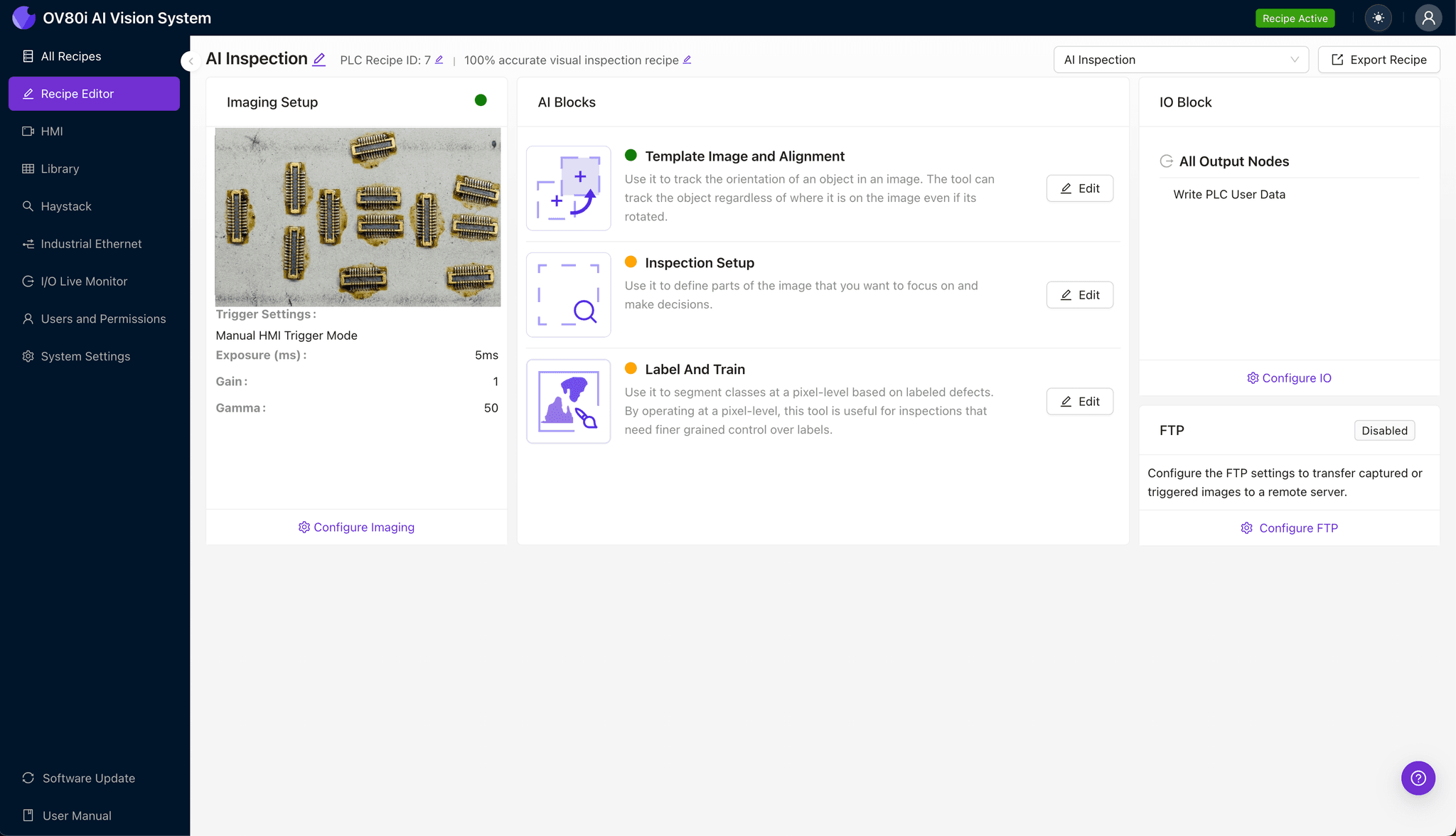
Step 1: Imaging Setup
Position the mezzanine connector with flux residue on contacts under the OV80i camera system, ensuring the contact array faces the lens with proper illumination. The lighting angle is critical—angled lighting often reveals flux residue more effectively than direct overhead illumination.
Click "Configure Imaging" in the Overview.ai software interface. Adjust the Camera Settings including exposure time and gain to ensure the contacts appear sharp and the residue shows sufficient contrast against clean surfaces.
Click "Save" to lock in your optimized imaging parameters.
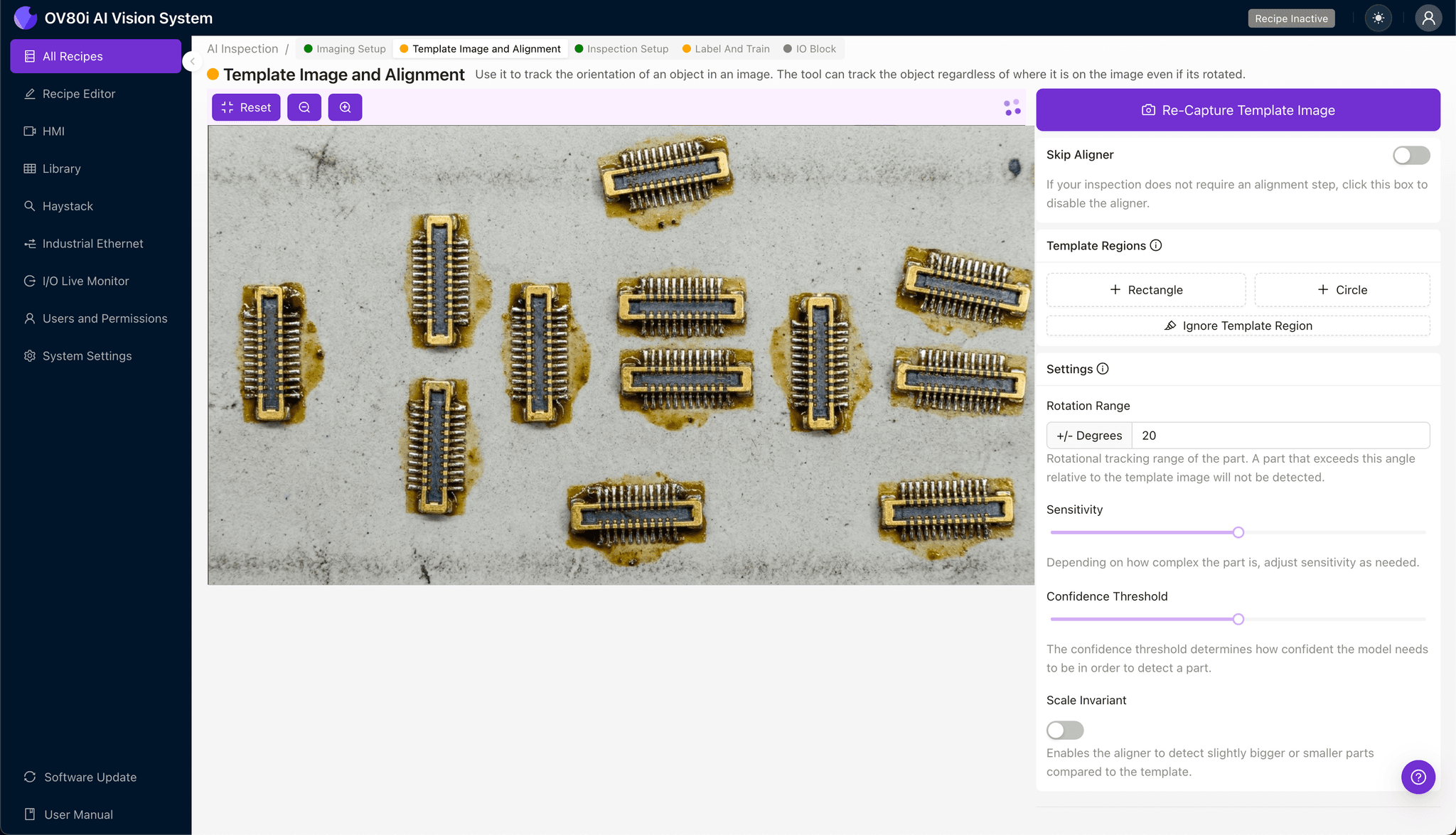
Step 2: Image Alignment
Navigate to the "Template Image" section within the software. Capture a Template image of a properly positioned connector that will serve as the alignment reference for all subsequent inspections.
Click "+ Rectangle" to add an alignment region around the main body of the mezzanine connector. Set the "Rotation Range" to 20 degrees to accommodate slight orientation variations as connectors move through the inspection station.
Step 3: Inspection Region Selection
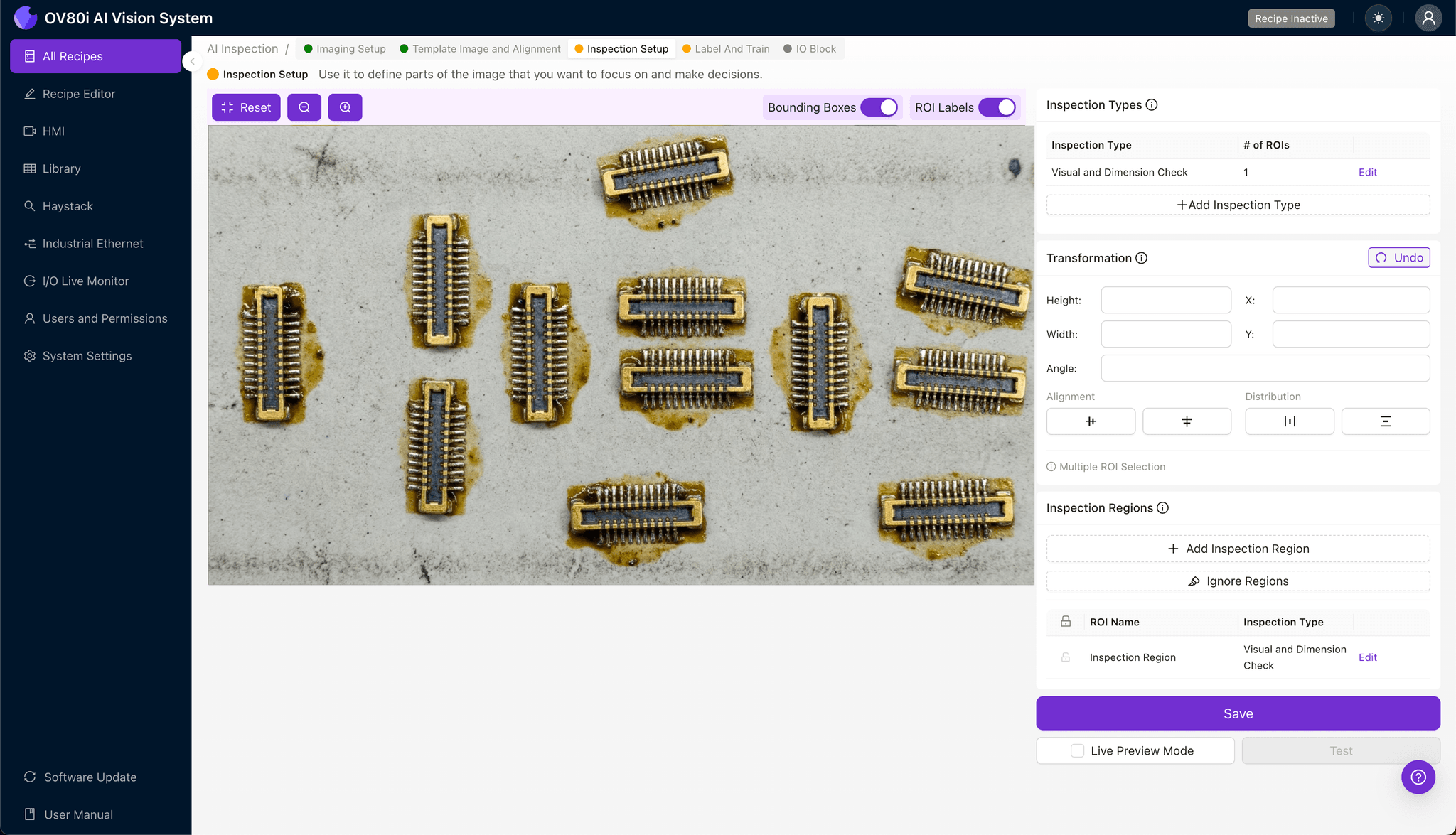
Navigate to "Inspection Setup" in the main menu. Rename your "Inspection Types" to reflect the specific defects you're targeting—for example, "Contact Flux Residue," "Pin Contamination," or "Bridging Residue."
Click "+ Add Inspection Region" to define your areas of interest. Resize the yellow bounding box to cover the critical contact surfaces where flux residue typically accumulates—focus on the mating surfaces and the valleys between pins.
Click "Save" to confirm your inspection regions.
Step 4: Labeling Data
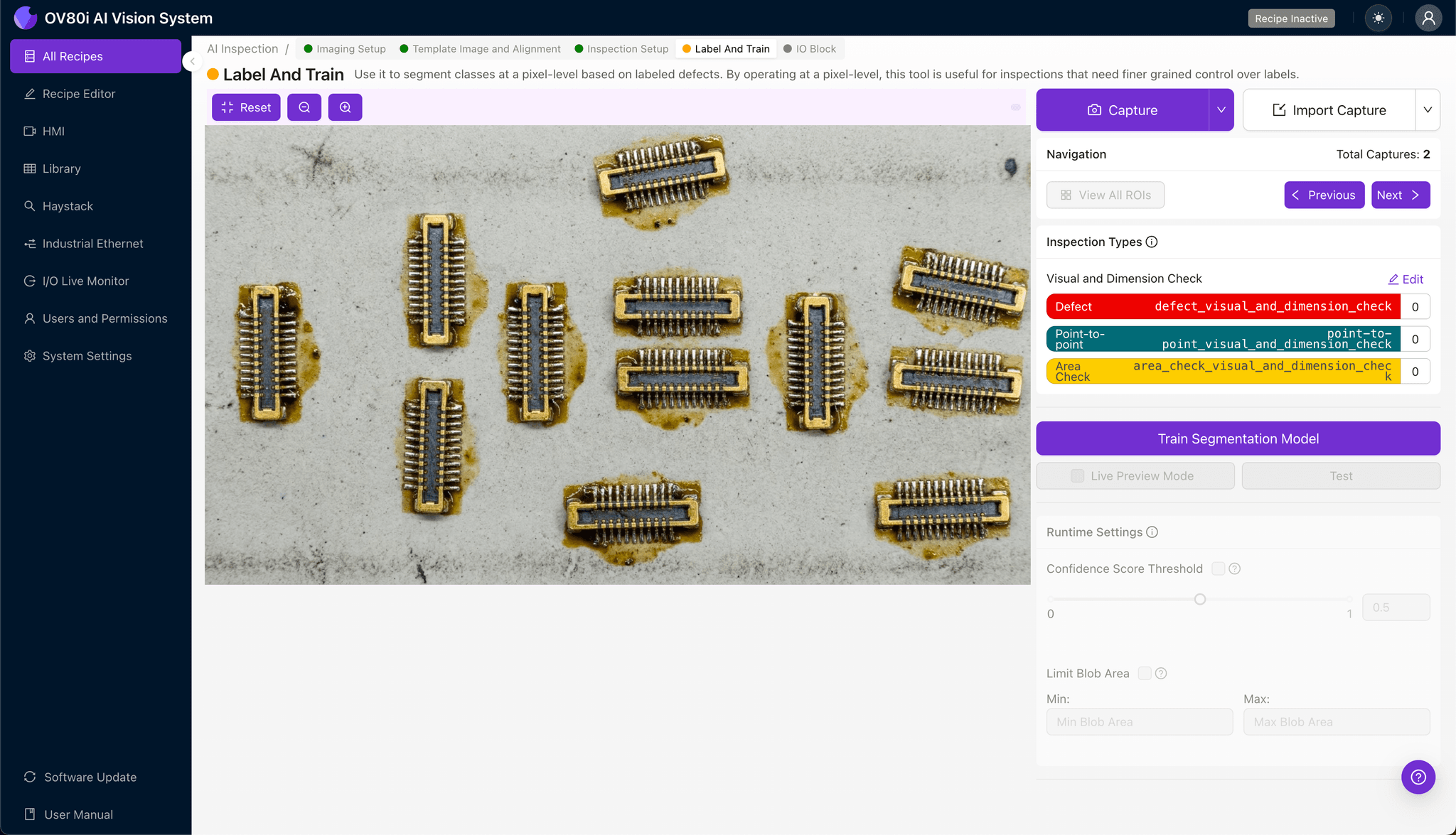
This human-in-the-loop process is where you teach the AI what flux residue looks like on your specific connectors. Review incoming images and label each as Good (clean contacts) or Bad (flux residue present).
Include representative samples across the full spectrum of acceptable parts and known failure modes. The more variation you capture—different residue amounts, locations, and appearances—the more robust your trained model will become.
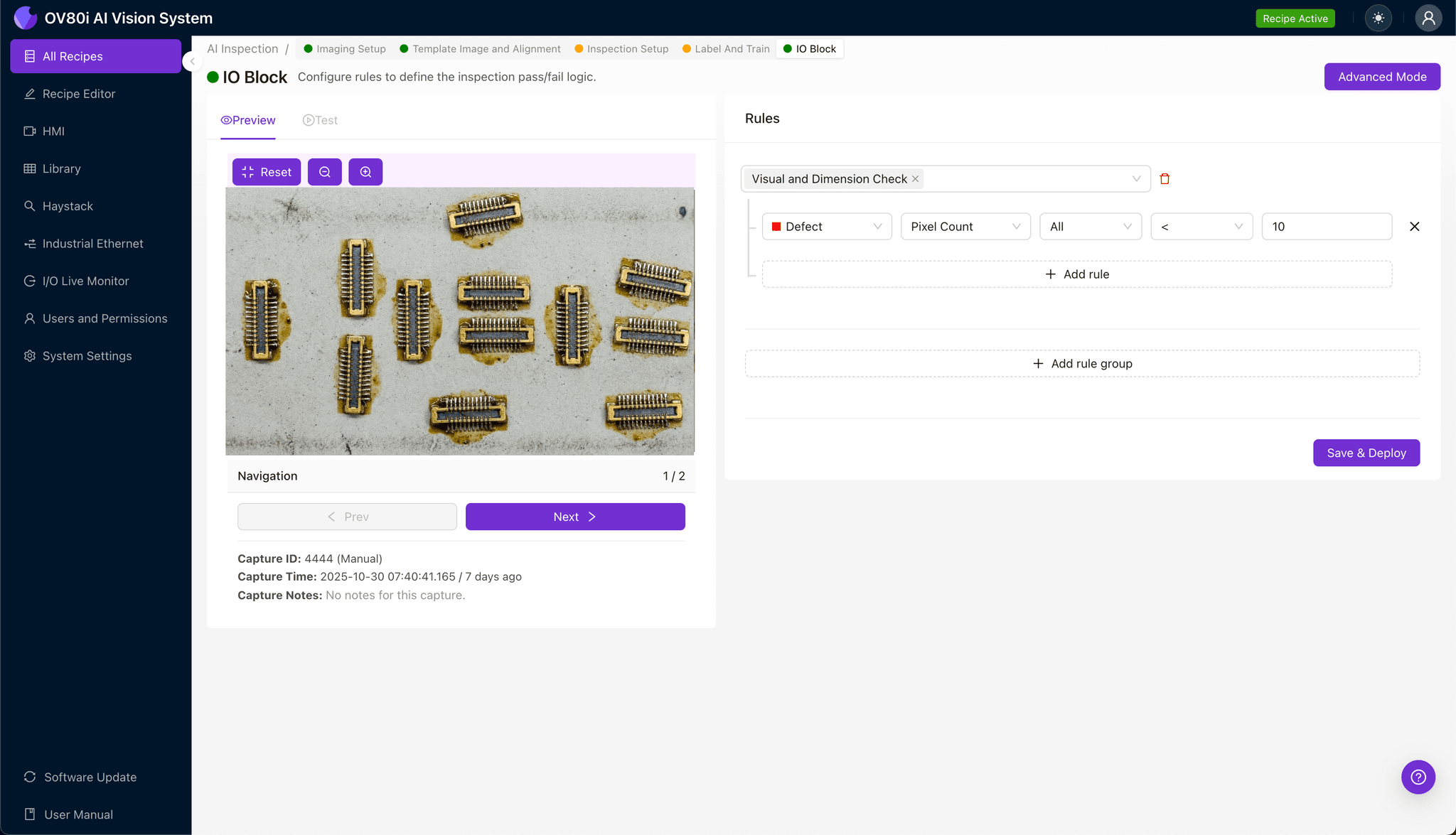
Step 5: Creating Rules
Set your pass/fail logic based on the Inspection Types you've defined. For example, you might reject any connector where the "Contact Flux Residue" inspection returns a defect confidence above 85%.
These rules gate automated acceptance on the line, ensuring contaminated connectors are diverted for cleaning or rejection before they reach downstream assembly or final shipping.
Key Outcomes & ROI
Implementing AI-powered visual inspection for flux residue detection delivers measurable business impact:
- Reduced Scrap and Rework — Catch contaminated connectors before they cause failures in assembled products, cutting waste by up to 40%
- Higher Throughput — Inspect 100% of production at line speed without creating bottlenecks or requiring inspection sampling
- Compliance and Traceability — Automatically log inspection images and results for IPC, automotive, or aerospace quality documentation requirements
- Process Improvement Insights — Identify upstream soldering process drift by tracking flux residue trends before they become critical quality escapes
Conclusion
Flux residue on mezzanine connector contacts represents exactly the kind of subtle, variable defect that AI-powered inspection was designed to catch. By implementing Overview.ai's deep learning approach, manufacturers can eliminate the inconsistency of manual inspection while achieving the detection sensitivity that modern electronics reliability demands.
Ready to see how automated visual inspection can transform your connector quality control? Contact Overview.ai to schedule a demonstration with your actual production samples.
Eliminate Flux Residue Defects Today
Stop relying on manual inspection. Deploy Overview.ai to catch flux contamination on every connector instantly.