VNA Test Cable with Unstable Phase: Automated Defect Detection Using AI Vision Systems
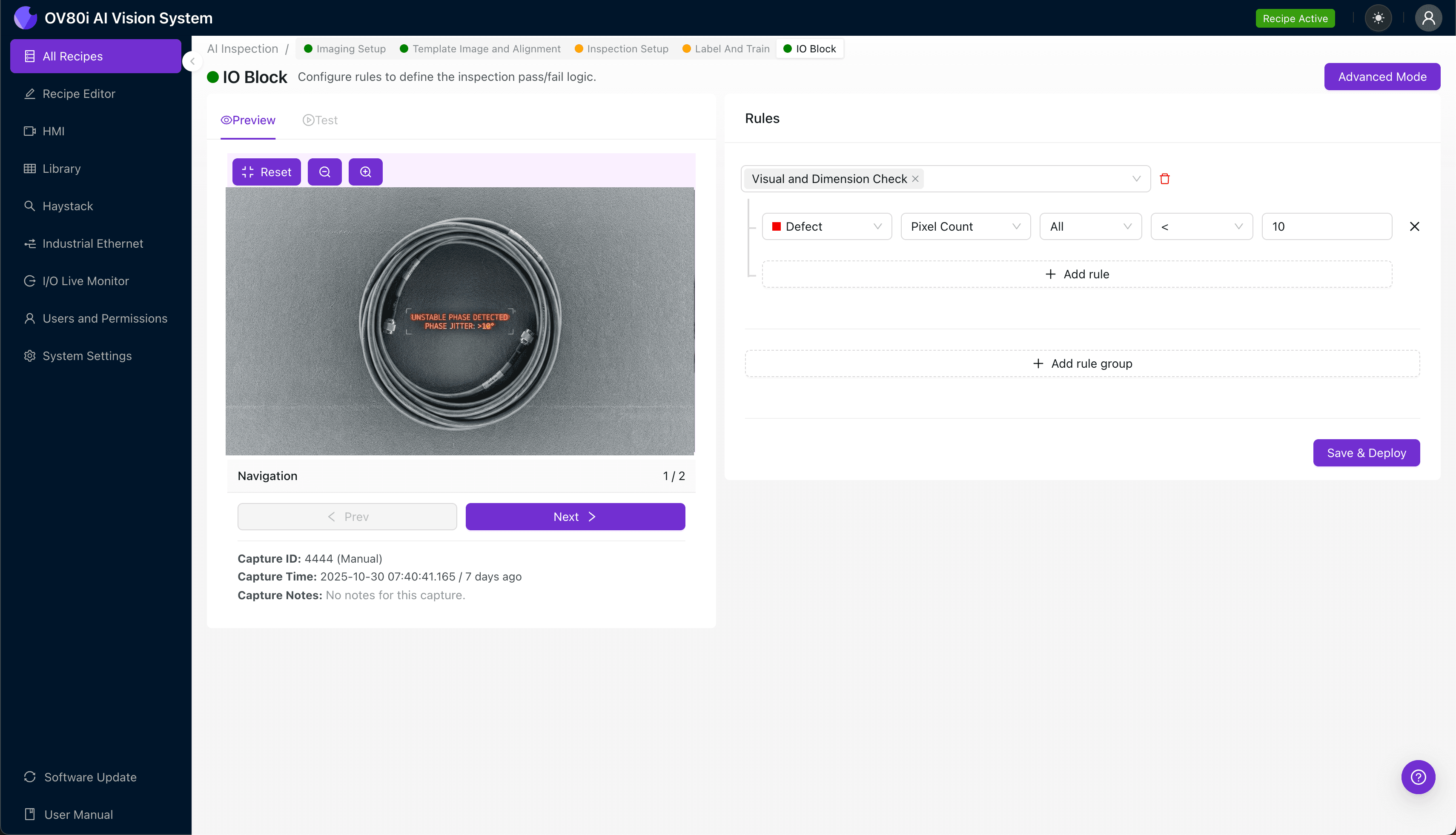
"Unstable phase in VNA test cables compromises every measurement taken—cascading quality issues across entire manufacturing runs. AI-powered visual inspection catches the sub-millimeter defects causing phase drift before cables ever reach electrical test."
The Problem: Why Phase Instability Haunts RF Manufacturing
VNA test cables are the backbone of accurate network analyzer measurements, yet unstable phase performance remains one of the most elusive quality issues in RF cable assembly. When phase stability degrades, every measurement taken with that cable becomes suspect—compromising downstream product quality across entire manufacturing runs.
Common Defects Contributing to Unstable Phase in VNA Test Cables:
- Connector concentricity errors – Misaligned center conductors create impedance discontinuities that shift with cable movement
- Inconsistent dielectric crimp pressure – Variations in PTFE or foam dielectric compression cause localized impedance variations
- Solder joint micro-fractures – Hairline cracks at connector interfaces flex during use, altering electrical path length
- Shield braid coverage gaps – Incomplete or uneven outer conductor coverage allows EMI ingress and phase drift
- Cable jacket stress points – Overtightened strain reliefs or kinks introduce mechanical memory affecting phase repeatability
- Contamination at mating surfaces – Flux residue, particulates, or oxidation on connector faces degrade return loss and phase consistency
Human inspectors struggle to catch these defects consistently. Many phase-related issues stem from sub-millimeter variations invisible to the naked eye, and inspector fatigue during repetitive cable inspection leads to escape rates that climb throughout each shift.
The Solution: Machine Vision + Deep Learning for Phase-Critical Cable Inspection
Traditional automated optical inspection (AOI) relies on rigid rule-based algorithms that fail when defect presentations vary—which they always do in cable assemblies. Deep learning changes the game by training models on thousands of real-world examples, enabling systems to recognize defect patterns rather than exact pixel matches.
Overview.ai's approach delivers consistent, objective inspection at line speed without the variability of human judgment. The OV80i platform learns what "good" looks like for your specific cable assemblies, then flags anomalies with superhuman consistency—whether it's the first unit of the morning or the ten-thousandth of a late-night shift.
Step 1: Imaging Setup
Position the VNA test cable assembly under the OV80i camera system, ensuring the connector interfaces and critical cable sections are within the field of view. Consistent fixturing is essential—consider a simple V-block or cable cradle to maintain repeatable positioning.
Navigate to "Configure Imaging" in the Overview interface. Adjust Camera Settings including exposure time and gain to achieve sharp, well-lit images that reveal surface details on both the metallic connectors and cable jacket.
Click "Save" to lock in your imaging parameters.
Step 2: Image Alignment
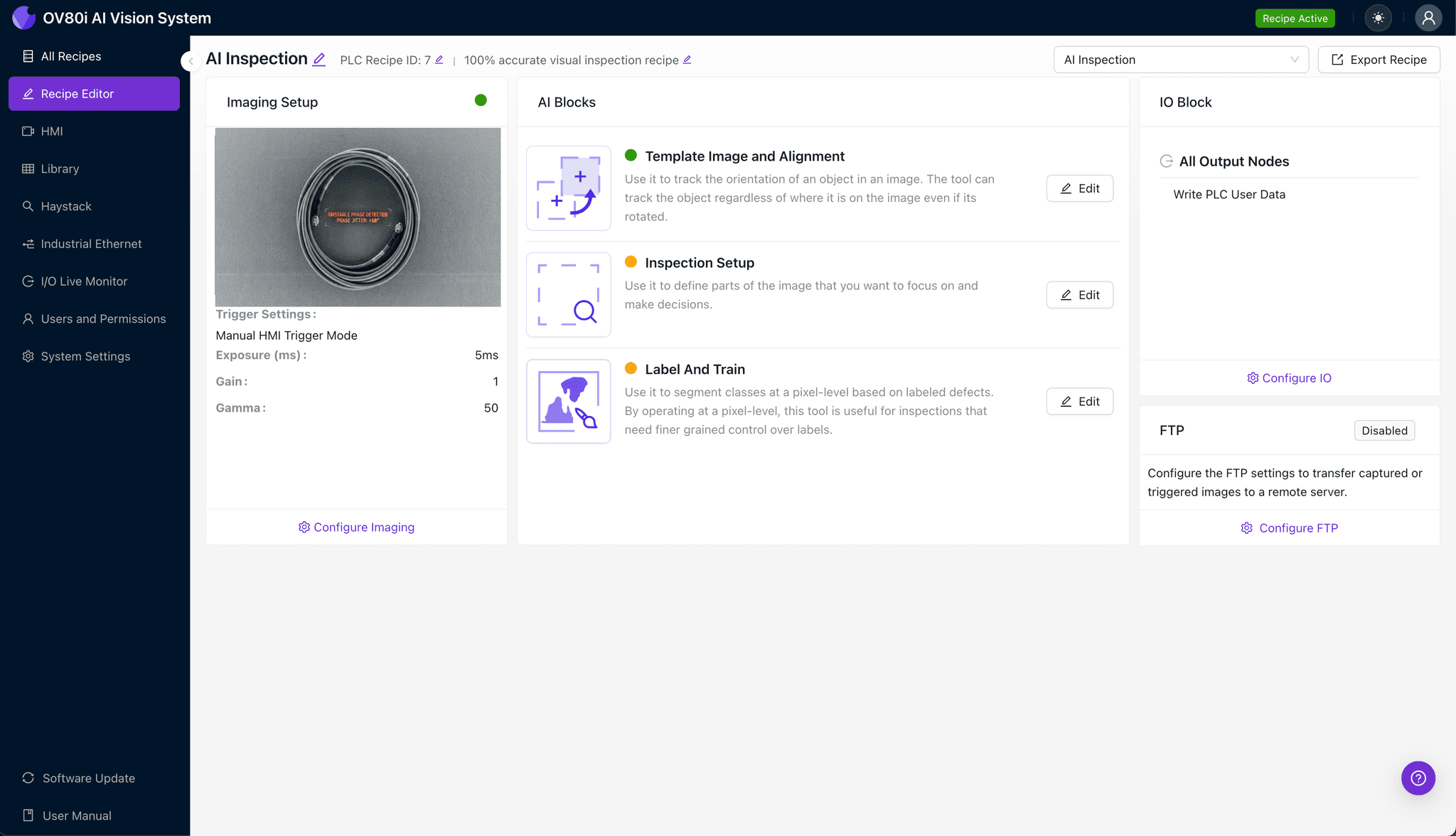
Navigate to "Template Image" and capture a reference image of a known-good cable assembly. This template anchors the system's understanding of proper part positioning.
Click "+ Rectangle" to add an alignment region around the main connector body or a distinctive cable feature. Set the "Rotation Range" to 20 degrees to accommodate minor variations in how cables land in the fixture—ensuring robust alignment even when placement isn't pixel-perfect.
Step 3: Inspection Region Selection
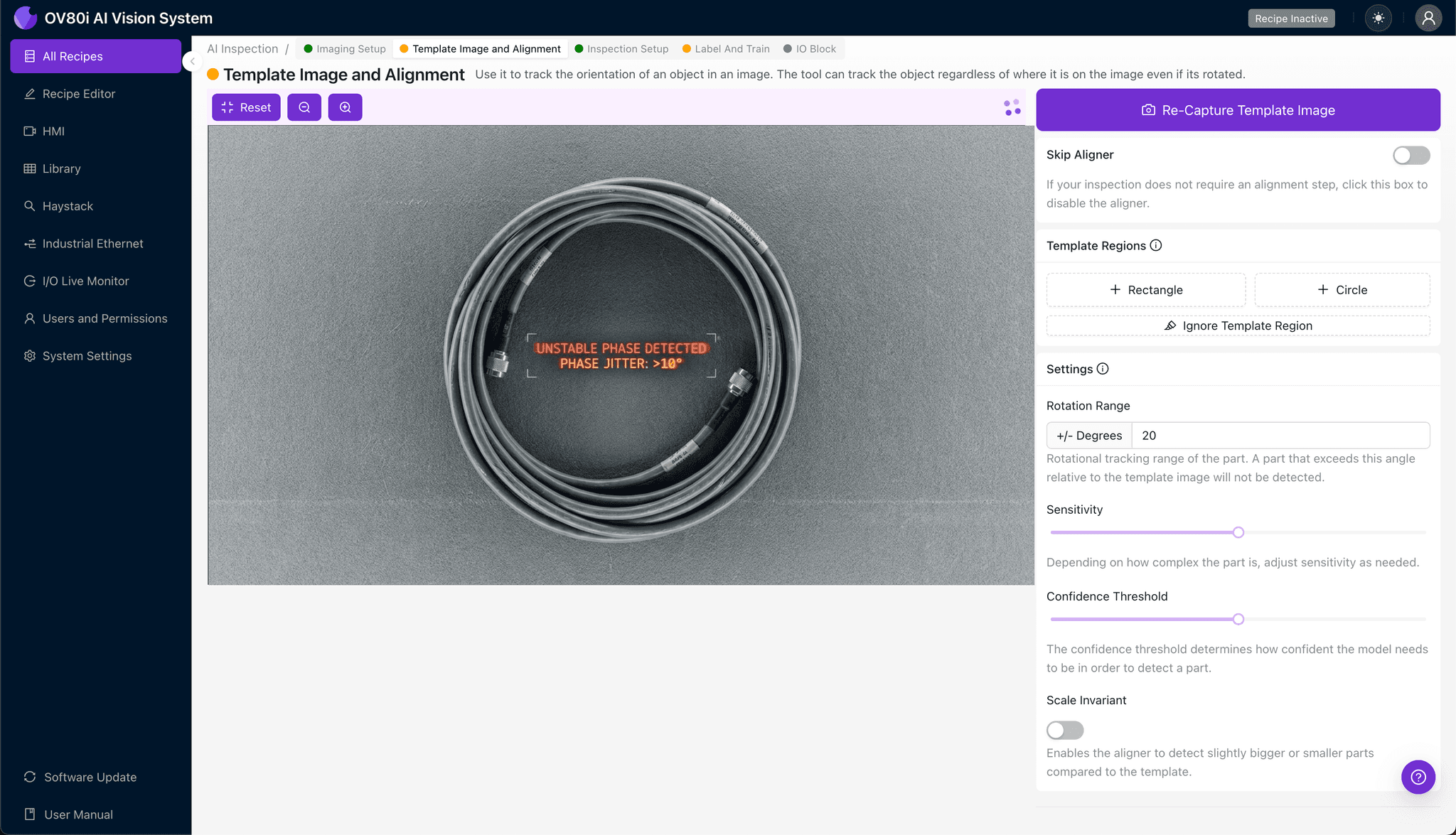
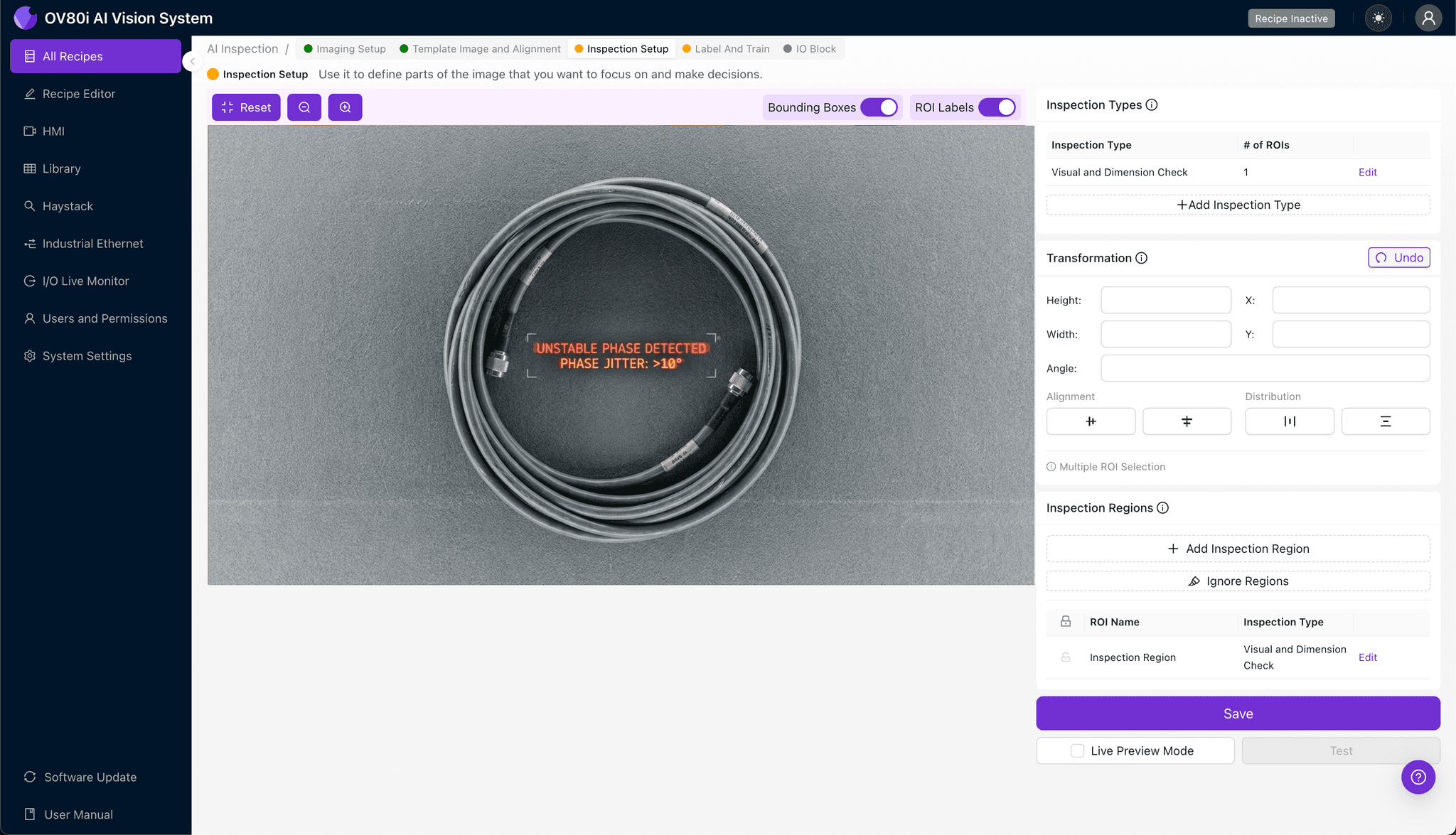
Navigate to "Inspection Setup" to define where the system should look for defects. Rename your "Inspection Types" with descriptive labels like "Connector_Face_Quality," "Solder_Joint_Integrity," or "Shield_Braid_Coverage."
Click "+ Add Inspection Region" for each critical area. Resize the yellow bounding box to cover defect-prone zones: the connector mating surface, the solder transition area, and any visible dielectric or shield sections.
Click "Save" after configuring all regions.
Step 4: Labeling Data
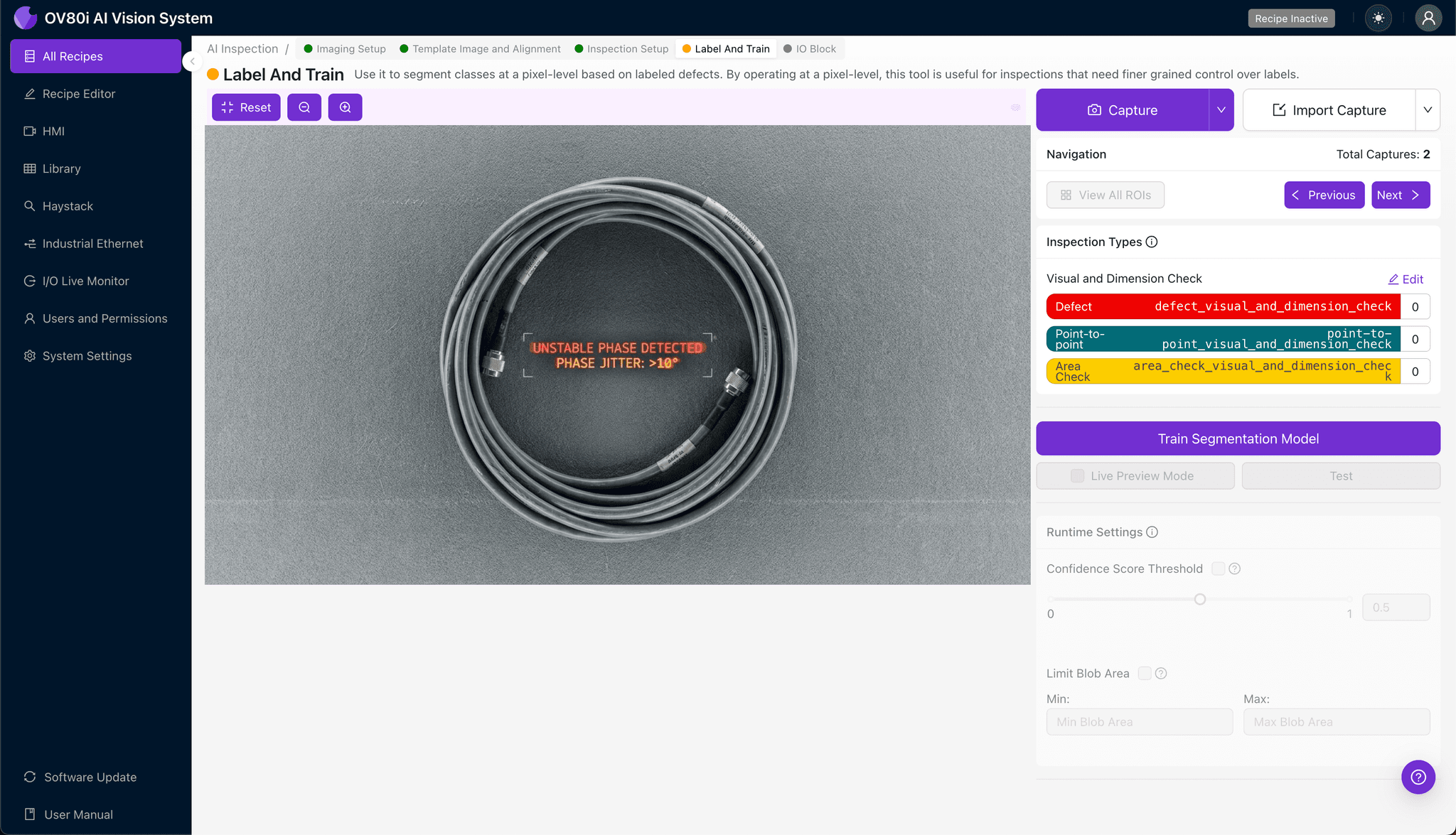
This is where human expertise trains the AI. The platform presents unlabeled images for your quality engineers to classify—creating the "ground truth" the model learns from.
Label each image as Good or Bad based on your existing quality standards. Include representative samples across the full range of acceptable variation, plus known failure modes like the micro-fractures and coverage gaps identified earlier.
The more diverse your labeled dataset, the more robust your trained model becomes.
Step 5: Creating Rules
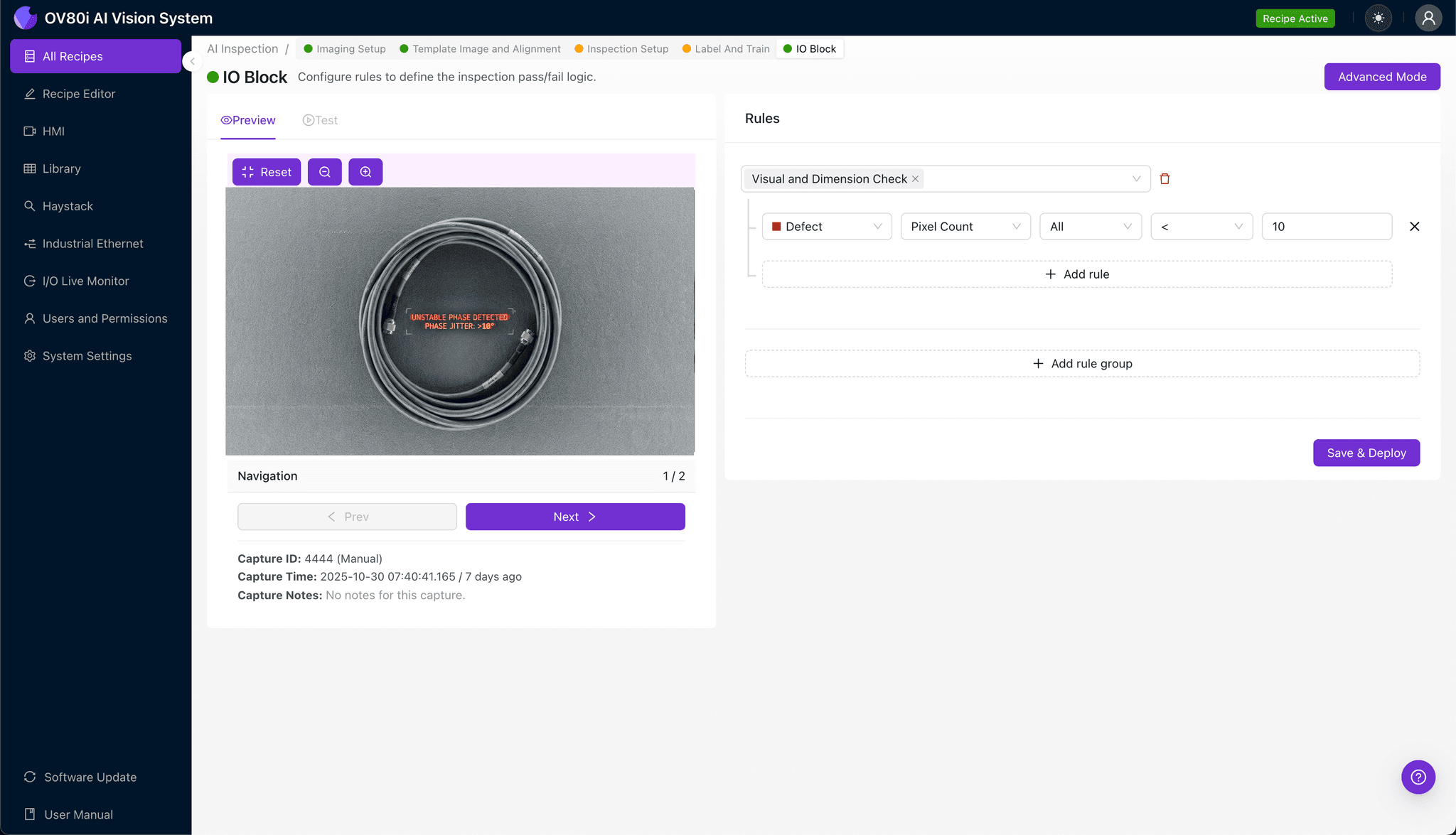
With inspection regions defined and the model trained, establish your pass/fail logic based on each Inspection Type. You might require all regions to pass, or allow minor cosmetic variations while enforcing zero tolerance on connector face defects.
These rules gate automated acceptance on your production line—cables meeting criteria proceed automatically, while flagged units route to secondary inspection or reject bins without slowing throughput.
Key Outcomes & ROI
Deploying AI-powered inspection for VNA test cable assemblies delivers measurable business impact:
- Reduced scrap rates – Catch defects at the source before cables proceed to electrical test or customer shipment
- Higher throughput – Inspect 100% of units at line speed without creating bottlenecks or adding headcount
- Enhanced compliance and traceability – Automatically log images, inspection results, and timestamps for every unit—simplifying audits and customer quality requirements
- Process improvement insights – Trend data reveals which defect types spike and when, enabling root-cause analysis and upstream process corrections
Conclusion
Unstable phase in VNA test cables isn't just a quality problem—it's a measurement integrity crisis that cascades through every product tested with faulty cables. By deploying Overview.ai's deep learning-powered visual inspection, manufacturers gain the consistency and speed that human inspectors simply cannot sustain.
The result: cables you can trust, data you can defend, and a quality system that improves with every unit inspected.
Eliminate Phase Instability Defects Today
Stop relying on manual inspection for critical RF cable assemblies. Deploy Overview.ai to catch phase-causing defects instantly.