
Overview AI Launches OV Auto-Defect Creator Studio, Powered by NVIDIA, to Accelerate Visual Inspection
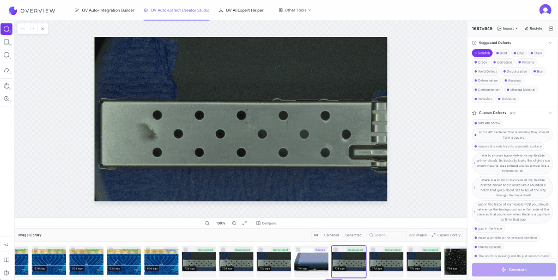
Using the NVIDIA Defect Image Generation skill, the new studio lets manufacturers save and apply existing defects onto new good parts synthetically, build reusable defect libraries, and bring new AI inspection models online in minutes instead of weeks.
Overview AI today announced OV Auto-Defect Creator Studio, a new synthetic defect generation product powered by NVIDIA that helps manufacturers deploy vision AI inspection models in quality inspection agents dramatically faster.
The studio gives quality and manufacturing teams a new way to solve one of the hardest bottlenecks in factory AI: getting enough realistic defect examples to train a reliable inspection model. Instead of waiting weeks for rare defects to appear naturally on the production line, engineers can use OV Auto-Defect Creator Studio to generate hyper-realistic synthetic defects, apply them to new but similar products and SKUs, and train inspection models before real defect data exists at scale. The OV Auto-Defect Creator Studio integrates with the NVIDIA Defect Image Generation skill powered by NVIDIA Cosmos and NVIDIA TAO to create high-fidelity, controllable defect images.
At Amphenol, this workflow has helped reduce time to first inference from approximately three weeks to under 30 minutes per product across more than 300 products on lines producing electrical connectors. The result is a faster path from new product introduction to production-ready AI inspection.
The problem: Quality inspection AI agents are limited by only as good as the defect data
Visual inspection AI agents have become a powerful tool for manufacturing inspection, but deployment speed is often limited by data collection. For every new product, quality teams traditionally need to capture enough examples of real defects, label those images, train the model, validate performance, and then deploy the inspection to the line.
That process is especially difficult in medium-mix and high-volume manufacturing. Defects are often rare, product designs change frequently, and new SKUs may look similar to previous products while still requiring their own inspection setup. The better the factory gets at preventing defects, the harder it becomes to collect enough defect data for the next model.
This creates a paradox for manufacturers: the factories with the highest quality standards often have the least defect data available when they need to launch a new inspection.
The solution: synthetic defect generation
OV Auto-Defect Creator Studio changes that workflow.
The studio allows manufacturers to take known defect types from existing products and synthetically apply them to new but similar parts, products, and SKUs. A missing pin, contamination, scratch, dent, weld issue, misalignment, surface mark, or assembly defect can be recreated on a new good part without waiting for that defect to occur naturally.
Over time, manufacturers can build a reusable library of known defects. When a new product launches, quality engineers can apply that library to the new product's good images, creating a realistic synthetic training set in minutes. That synthetic dataset can then be used to train or update the AI inspection model and deploy it back to the production line.
How OV Auto-Defect Creator Studio works
OV Auto-Defect Creator Studio is built for quality engineers and manufacturing teams, not data science teams.
The workflow starts with good images from a new product or SKU. Inside the studio, engineers select the inspection area and apply known defect types from a defect library. Those generated images can then be labeled and used to train the inspection model. Once trained, the model is deployed to Overview AI cameras accelerated by NVIDIA Jetson Orin NX for real-time inference on the production line.
The result is a closed-loop workflow:
- Upload good images from the new product into the OV Auto-Defect Creator Studio
- Select known defects from the library
- Use the NVIDIA Defect Image Generation skill to generate synthetic defects on the new SKU
- Post-train or update the inspection model on the Overview.ai platform
- Deploy the model to Overview AI cameras (i.e. OV80i NVIDIA edge GPU)
- Add newly discovered real defects back into the library over time and re-train the model
This turns defect knowledge into a reusable manufacturing asset.
Amphenol proof point: faster deployment across NVIDIA connector cage lines
Amphenol is using Overview AI's platform on production lines for connector cages and related interconnect products. With OV Auto-Defect Creator Studio, quality teams can move faster when a new product or SKU is introduced by reusing proven inspection knowledge from prior programs. Instead of waiting weeks to collect a full range of production examples for each new product, teams can use curated libraries of known quality conditions and synthetic generation to create realistic training data immediately.
Across more than 300 products, this workflow has helped reduce time to first inference from approximately three weeks to under 30 minutes per product, a 12.4x improvement.
For high-volume manufacturing environments where product changeovers are frequent and quality standards are exceptionally high, that speed helps quality inspection agents keep pace with production.
Why this matters for AI infrastructure manufacturing
Modern AI infrastructure depends on increasingly complex electromechanical components, including connectors, cages, interconnects, and assemblies where small defects can create downstream performance and reliability issues.
As product cycles accelerate, manufacturers need inspection systems that can move at the speed of new product introduction. Traditional AI inspection workflows often require too much time before a model is ready for production. OV Auto-Defect Creator Studio helps close that gap by letting teams generate the defects they need before those defects appear at production scale.
For manufacturers, this means faster launches, more consistent inspection coverage, and a repeatable way to carry defect knowledge from one product generation to the next.
The biggest bottleneck in AI vision deployment is not the model anymore. It is getting enough realistic defect data fast enough. OV Auto-Defect Creator Studio lets manufacturers take the defects they already understand and reuse that knowledge across every new product launch. Powered by the NVIDIA Defect Image Generation skill, we can create hyper-realistic synthetic defects, train models faster, and help quality teams bring inspections online in minutes instead of weeks.
Availability
OV Auto-Defect Creator Studio is available through Overview AI for manufacturing customers deploying AI vision inspection across complex product lines, designed to work with Overview AI cameras for real-time edge inference.
Learn more about NVIDIA's open source collection of physical AI agent skills and tools here.
Manufacturers interested in using OV Auto-Defect Creator Studio for new product introductions, defect library creation, or faster AI inspection deployment can contact Overview AI to evaluate availability for their applications.
See OV Auto-Defect Creator Studio in action
Bring your reference images. We will build a working pilot defect library in a single session.
Frequently Asked Questions
What is OV Auto-Defect Creator Studio?
OV Auto-Defect Creator Studio is a synthetic defect generation product from Overview AI, powered by the NVIDIA Defect Image Generation skill. It allows manufacturers to take known defect types from existing products and apply them to new SKUs synthetically, creating realistic training data before real defects appear at production scale.
How much faster does the studio make AI inspection deployment?
At Amphenol, the workflow reduced time to first inference from approximately three weeks to under 30 minutes per product across more than 300 products. That is a 12.4x improvement in deployment speed, achieved by eliminating the wait for real defect data to accumulate naturally on the production line.
What NVIDIA technology powers the defect generation?
OV Auto-Defect Creator Studio integrates with the NVIDIA Defect Image Generation skill, which is powered by NVIDIA Cosmos and NVIDIA TAO. These tools create high-fidelity, controllable defect images that are realistic enough to train production-grade inspection models.
Does OV Auto-Defect Creator Studio require data science expertise?
No. The studio is designed for quality engineers and manufacturing teams. The workflow starts with uploading good images from a new product, selecting known defect types from a library, and generating the synthetic training set. No ML programming or model architecture knowledge is required.
See how Overview AI inspects AI defect detection
Send us a photo of your part or defect and a vision engineer will tell you whether Overview can catch it, with most systems deployed on the line in days.
Related Articles
OV Auto-Defect Creator Studio
A detailed look at how the defect creation studio fits into the full Overview AI workflow.
Read More →Synthetic Defect Data in High-Volume Manufacturing
How synthetic data generation addresses the rare-defect training problem in high-mix production.
Read More →Reduce AI Inspection Training Time
Practical techniques for cutting model training time without sacrificing accuracy.
Read More →