
How to Inspect Selective Gold Zone with a Blurred Boundary Using AI-Powered Machine Vision
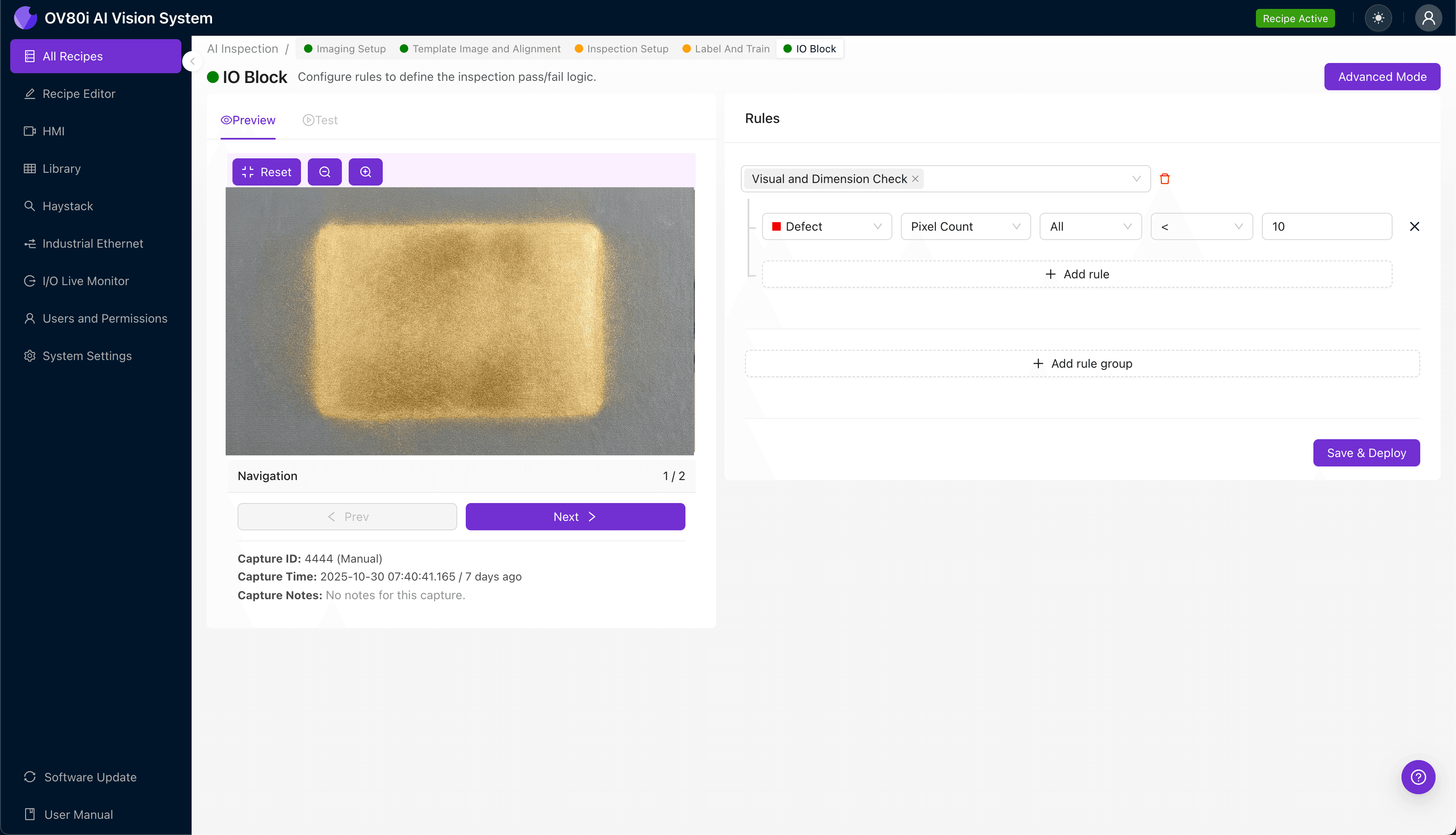
"Blurred boundaries on selective gold zones create ambiguous pass/fail decisions that human inspectors struggle to evaluate consistently. Deep learning-based machine vision solves this by learning acceptable boundary variation from labeled examples, delivering objective inspection at full line speed."
The Problem: Why Blurred Gold Zone Boundaries Challenge Quality Control
Selective gold plating is critical in electronics manufacturing, providing reliable contact surfaces while minimizing precious metal usage. However, when the boundary between plated and unplated zones becomes blurred or irregular, it creates inspection challenges that can compromise product quality and yield.
Common Defects Found in Selective Gold Zones with Blurred Boundaries
- Gold migration - precious metal spreading beyond intended deposition areas
- Incomplete coverage - gaps or thin spots within the designated gold zone
- Boundary diffusion - gradual transition zones instead of crisp demarcation lines
- Plating overlap - gold encroaching onto adjacent functional areas
- Edge irregularity - wavy or inconsistent boundary profiles
- Thickness variation - uneven deposition causing color or reflectivity gradients near edges
Human inspectors struggle with these defects because the blurred boundaries create ambiguous pass/fail decisions. Inspector fatigue compounds the problem-after hours of examining nearly identical parts, consistency drops dramatically, and subtle boundary variations slip through undetected.
The Solution: Machine Vision and Deep Learning
Traditional rule-based machine vision systems fail at inspecting blurred boundaries because they rely on hard-coded edge detection thresholds. Deep learning changes this equation entirely by learning what "acceptable" boundary variation looks like from labeled examples.
Overview.ai's approach delivers consistent, objective inspection at full line speed. The OV80i system captures high-resolution images of every part and applies trained neural networks to evaluate boundary quality-eliminating the subjectivity that plagues manual inspection.
Step 1: Imaging Setup
Position the selective gold-plated component under the OV80i camera, ensuring the gold zone boundary is fully visible and well-lit. Proper lighting is essential-angled illumination often highlights boundary transitions better than direct overhead lighting.
Click "Configure Imaging" in the Overview.ai interface to access camera settings. Adjust exposure to capture the gold's reflective surface without washout, and fine-tune gain to reveal subtle boundary gradients.
Click "Save" once the gold zone and its blurred boundary are clearly distinguishable in the preview.
Step 2: Image Alignment
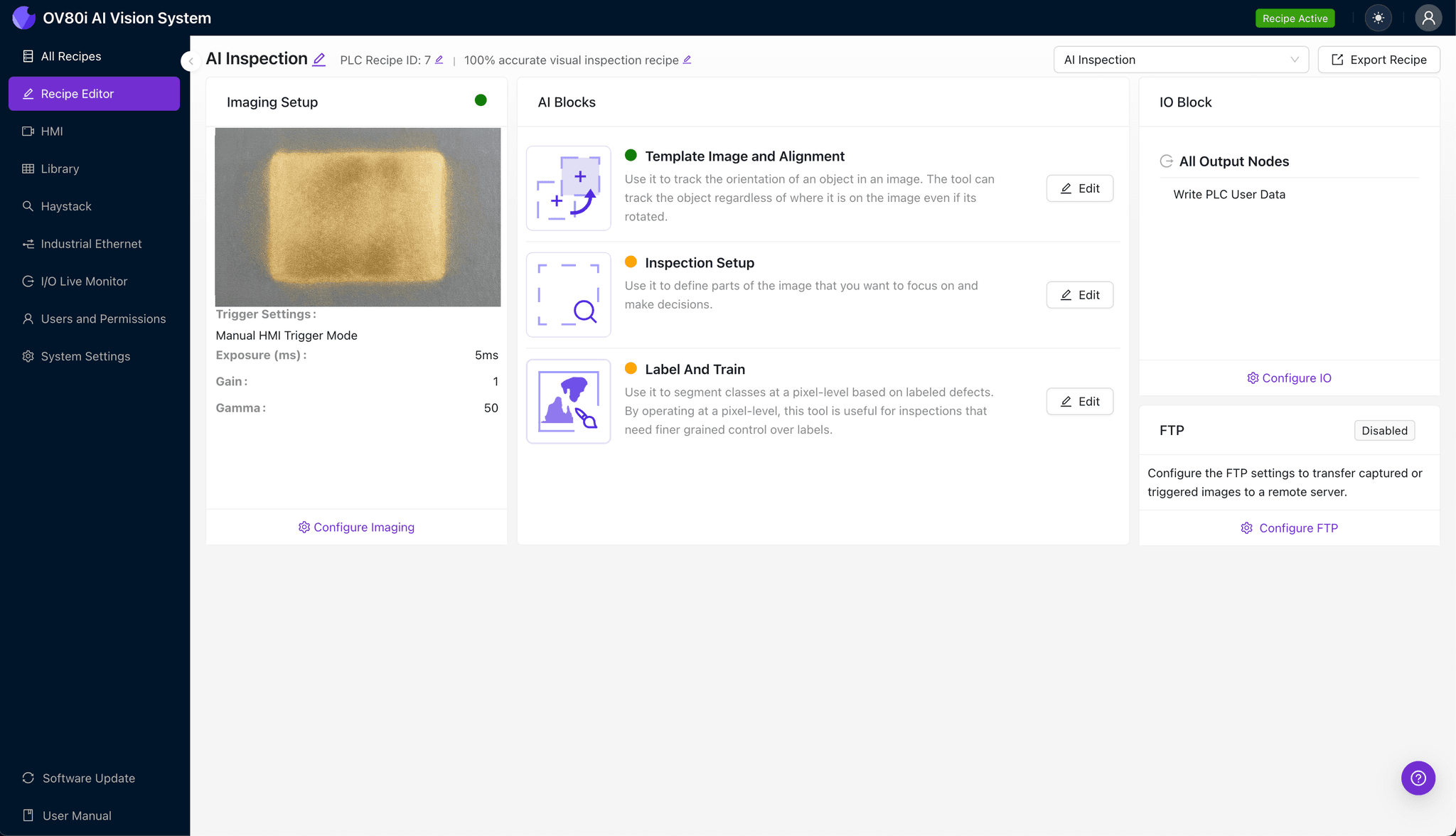
Navigate to "Template Image" in the setup menu. Capture a template of a known-good part positioned in its standard orientation.
Click "+ Rectangle" to add an alignment region around the component's main body or a distinctive feature. This anchor point ensures consistent positioning across inspections.
Set "Rotation Range" to 20 degrees to accommodate minor part orientation variations on the production line.
Step 3: Inspection Region Selection
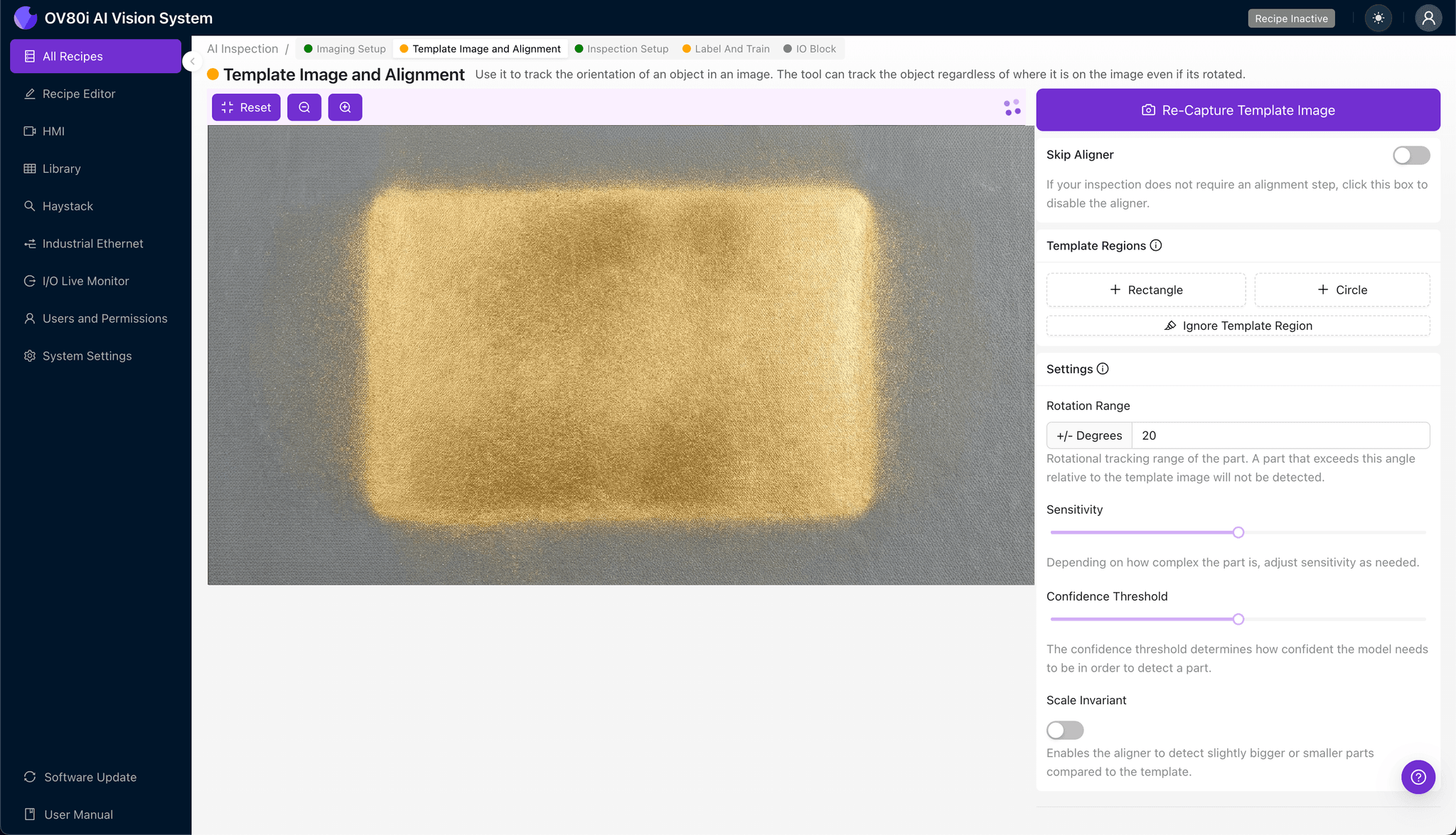
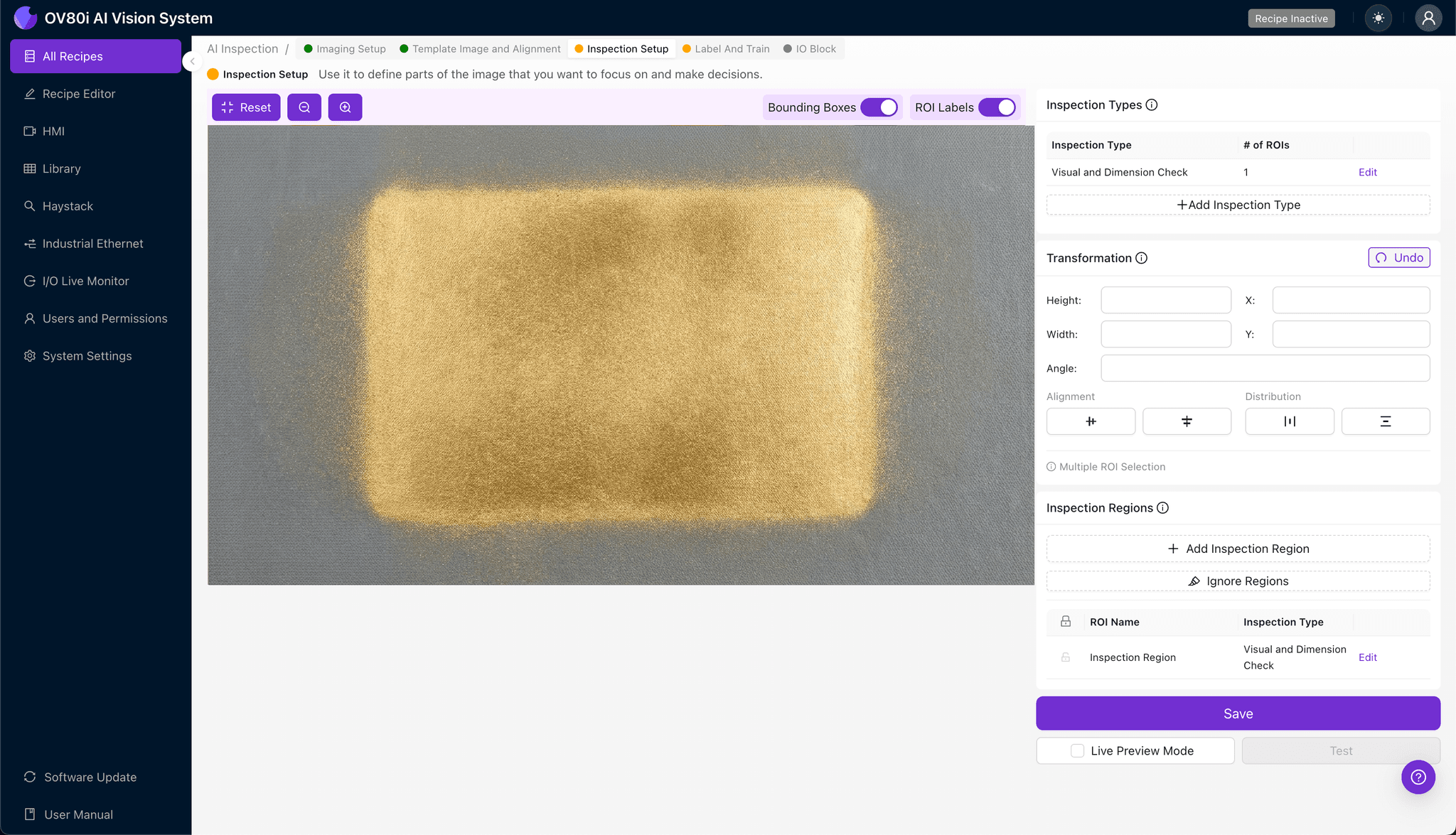
Navigate to "Inspection Setup" to define where the system should focus its analysis.
Rename your "Inspection Types" to reflect the specific checks-for example, "Gold_Boundary_Quality" or "Plating_Coverage_Zone."
Click "+ Add Inspection Region" to create a new analysis area. Resize the yellow bounding box to cover the critical boundary zone where blurring typically occurs.
Click "Save" to lock in your inspection regions.
Step 4: Labeling Data
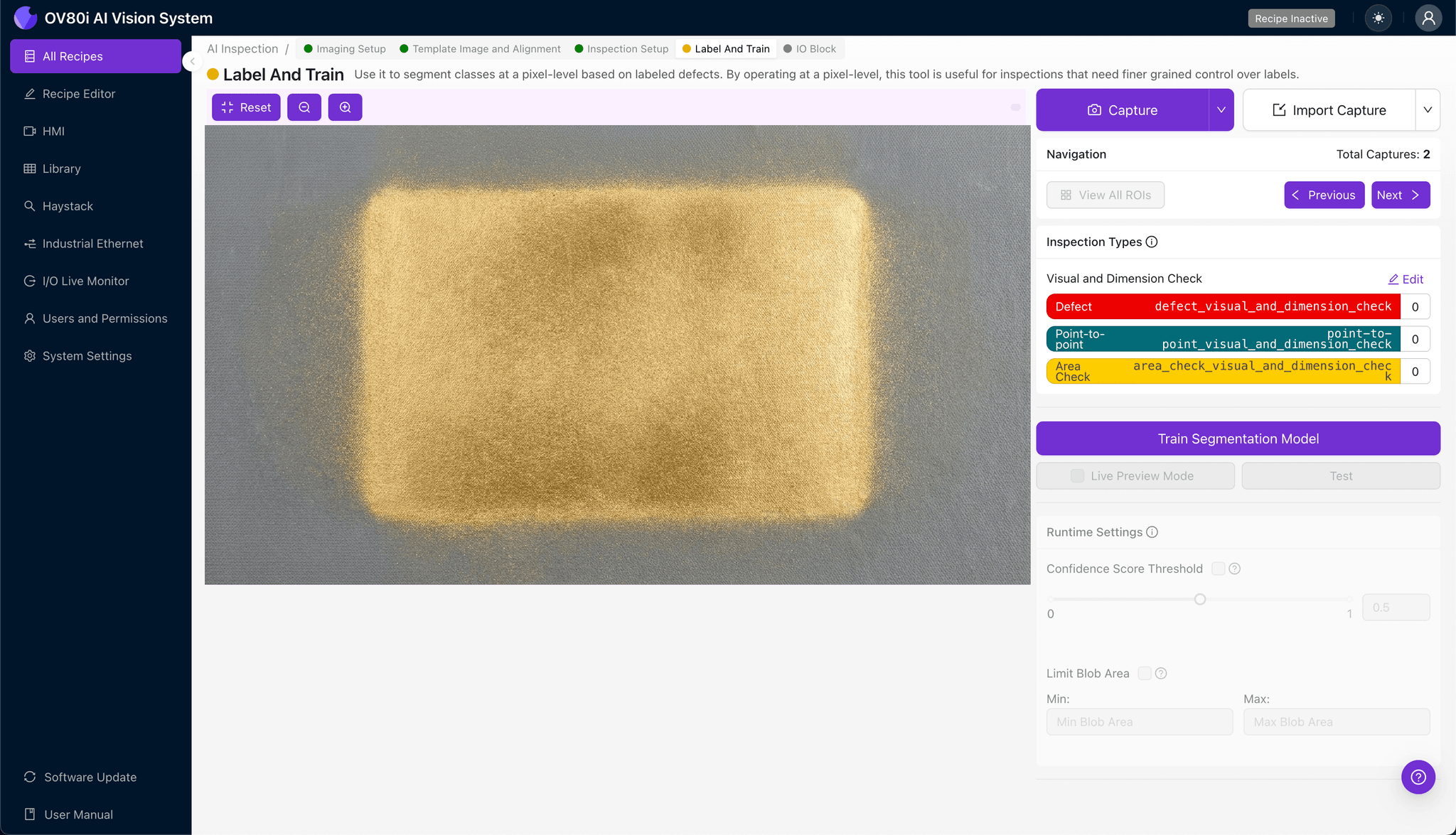
This human-in-the-loop process teaches the AI what acceptable boundaries look like. Review captured production images and label each as Good or Bad based on your quality standards.
Include representative samples across the full range of acceptable variation. Don't forget to add known failure modes-parts with excessive migration, incomplete coverage, or boundary diffusion that exceeded tolerance.
The model learns from this diversity, building robust discrimination between marginal-but-acceptable parts and true rejects.
Step 5: Creating Rules
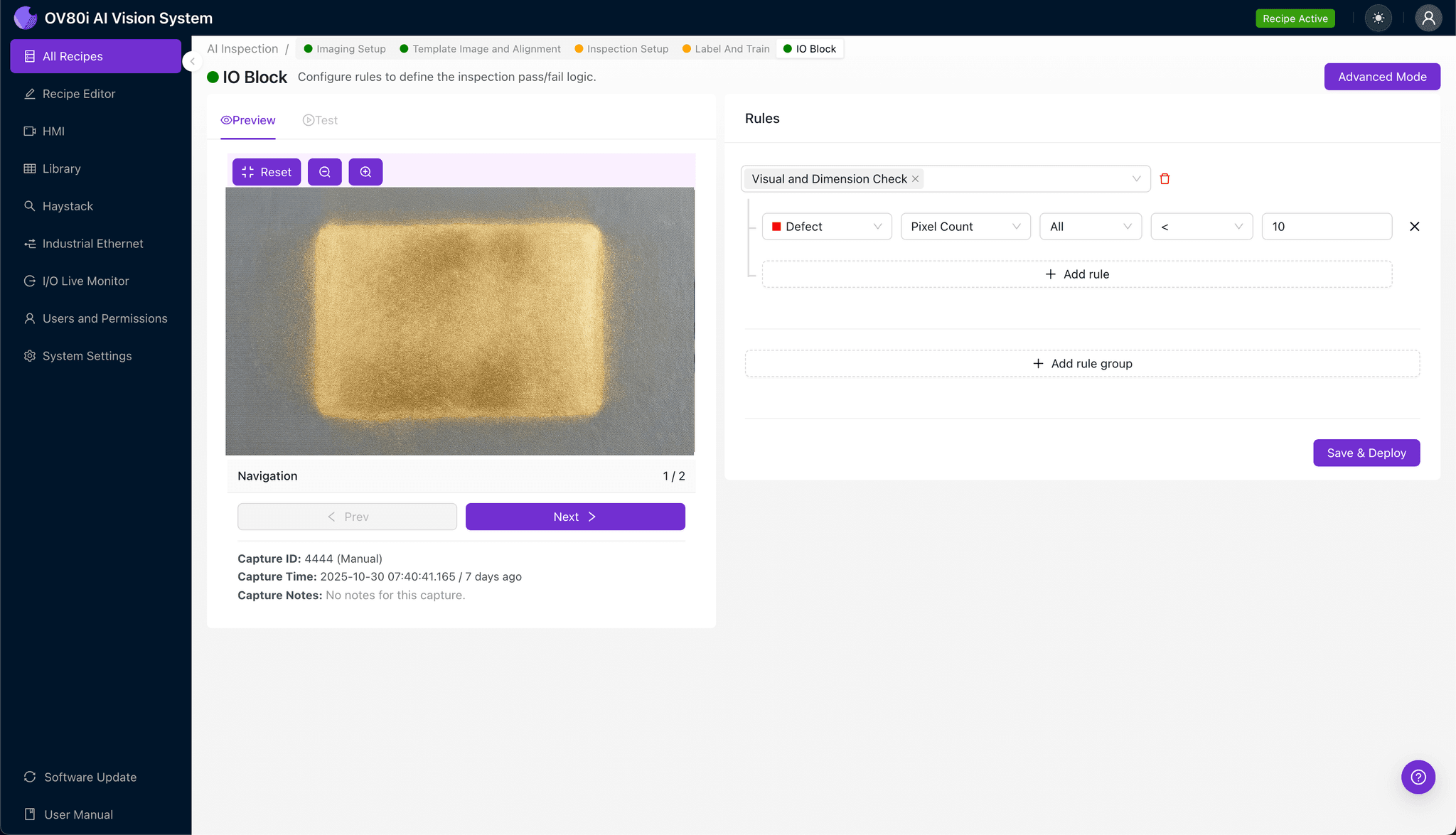
Configure your pass/fail logic based on the trained Inspection Types. Set confidence thresholds that balance escape rate against false rejection.
Gate automated acceptance on the line so that parts flagged as defective route to quarantine or secondary review. This closes the loop between inspection and material flow.
Key Outcomes & ROI
Implementing AI-powered inspection for selective gold zones delivers measurable business impact:
- Reduced scrap - catch boundary defects before downstream assembly adds value to defective parts
- Higher throughput - inspect 100% of production without creating bottlenecks
- Compliance and traceability - maintain complete inspection records for customer audits and quality certifications
- Process improvement insights - analyze defect trends to identify upstream plating process drift before it causes yield loss
Conclusion
Blurred boundaries on selective gold zones no longer need to be a quality control blind spot. With Overview.ai's deep learning inspection, manufacturers gain the consistency and speed that human inspectors simply cannot sustain-turning a subjective judgment call into an objective, data-driven decision on every single part.
Eliminate Gold Plating Defects Today
Stop relying on inconsistent manual inspection for your selective gold zones. Deploy Overview.ai to catch boundary defects instantly.