
Overview AI ·
Can a quality engineer set up AI inspection without a vision specialist?
How a process expert can get started with OV Spark and Sparky, what still needs engineering judgment, and what to validate before the inspection controls production.
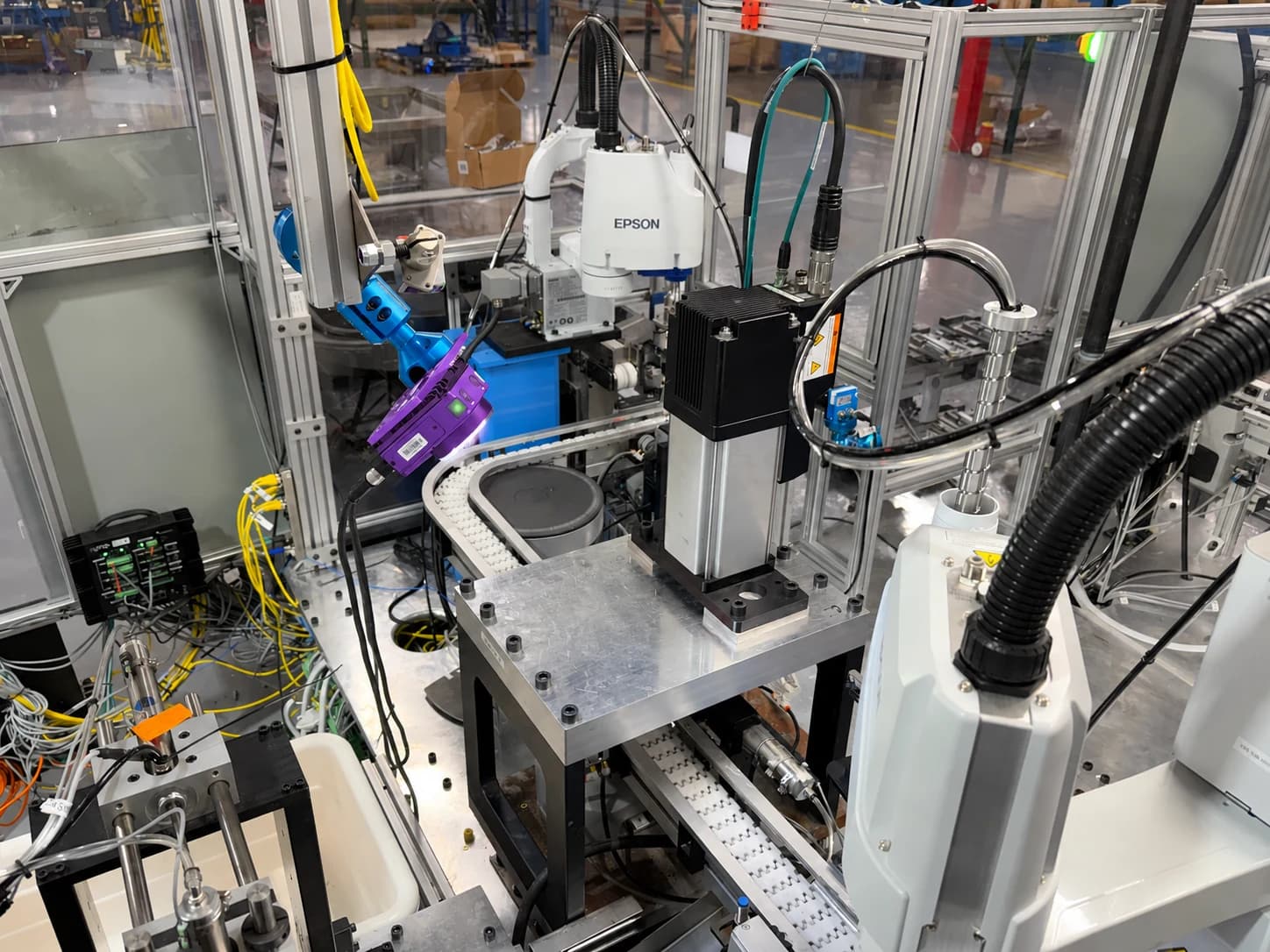
Yes, a quality engineer can take the lead on an AI inspection without first becoming a machine-vision specialist. The strongest starting point is knowledge of the part: what a defect looks like, which variations are acceptable, and where an inspection can reliably see the feature.
At Mansfield Engineered Components, a quality engineer with little prior vision-camera experience built an end-of-line inspection using OV Spark. The application checked hinge assembly features in a process that had relied on an operator’s visual check. That is a useful example of a process expert owning a first vision project, rather than a promise that every application needs the same amount of work.
What changed at the MEC inspection station
The inspection combined part alignment with checks for assembly features such as washers and pins. A missing washer was a recurring concern, and the team used the camera’s inspection tools to check the assembly. The station also used AI Trigger to capture the part without a separate external trigger sensor.
The important outcome is a working production application. The team subsequently moved Spark between two lines. Read the MEC production example in the OV Spark launch story for the customer’s account. Moving an application does not remove the need to check imaging and validate it in the new position.
Start with the decision, then choose the tool
Before opening the recipe editor, write the pass/fail requirement in plain language. “All four washers are present” is a decision. “Use AI” is not. If the requirement includes a dimension, a readable code, or a surface defect, define what the team considers an acceptable result.
Then show the camera both sides of that decision. A single perfect good part is a weak starting point. Include the normal changes in finish, position, and material lot, plus defects near the acceptance limit. This gives the team a realistic basis for selecting a tool and evaluating its behavior.
Where Sparky helps
Sparky is the AI agent built into Spark and Spark Pro. It helps the operator choose inspection tools, work through recipe setup, ask camera questions, and explore saved inspection images and results. That puts assistance beside the controls where the work happens.
The agent assists the person building the inspection. Configured inspection tools make production pass/fail decisions; a conversation does not replace those tools. Sparky’s write actions require approval. Your team remains responsible for the image, the training examples, the decision rules, and the validated production configuration.
A practical first-project sequence
- Make the feature visible. Establish the field of view, part position, focus, exposure, and lighting. Check the most difficult acceptable part and the smallest relevant defect.
- Build the inspection. Use the relevant AI and rules-based tools, then combine their results into the intended pass/fail decision. Keep the first recipe focused on a clear requirement.
- Test unfamiliar examples. Hold back some parts and images from setup. Check false rejects and missed defects, especially borderline examples and allowed variation.
- Integrate the response. Confirm triggering, the PLC result, part tracking, and the available decision time with the controls owner.
- Validate on the line. Run the complete station at production speed, establish the response to missing or late results, and train the people who will use it.
These are distinct jobs. A recipe that looks good on saved images can still fail because a moving part blurs, a trigger arrives late, or a reject signal is associated with the next part.
When to involve a specialist early
Ask for help early when the feature is hard to image, the defect is extremely small relative to the field of view, parts vary in height or orientation, or the decision window is tight. Reflective surfaces, multiple views, and dimensional acceptance criteria can also justify an optics or controls review.
The goal is to let the process expert lead the project with the right support. A straightforward missing-component inspection and a difficult surface-metrology application should not be sold as the same task.
Make the result maintainable
Record the validated recipe and imaging settings, retain a representative test set, and define who can approve a change. Train the shift team on what a failed image means and when to escalate rather than change a threshold. Re-run the test set after a recipe update.
For a first project, bring the parts and the requirement to an Overview engineer. We can help identify a manageable starting application and agree on the evidence needed before you trust the camera with a production decision.
Frequently asked questions
Do I need to be a machine-vision expert to start with OV Spark?
No. OV Spark provides guided workflows, and Sparky helps with tool selection, recipe setup, and camera questions. Your team still needs to establish the acceptance criteria, get a usable image, integrate the station, and validate it on representative production parts.
Does Sparky build and commission the entire inspection station?
No. Sparky assists with the camera workflow; it does not replace the engineering work of mounting, lighting, integration, and production validation. Write actions require approval, and configured inspection tools make the production pass/fail decisions.
What should I bring to a first inspection trial?
Bring good parts that show the allowed variation, defective parts including borderline examples, the smallest defect requirement, and the available decision time. Include the working distance, part presentation, and PLC or reject-system requirements.