Detecting Delaminated Insulation on Power Busbars: A Machine Vision Walkthrough
"Delaminated insulation on power busbars creates serious safety hazards that manual inspection cannot reliably detect. Overview.ai's machine vision platform catches edge lifting, bubble formation, and adhesion failures at full line speed—before defective units reach customers."
The Problem: Why Insulation Delamination Goes Undetected
Power busbars are critical components in electrical distribution systems, carrying high currents across switchgear, panel boards, and industrial equipment. When the protective insulation delaminates, it creates serious safety hazards and reliability failures that can shut down entire production lines.
Common defects found in power busbars with delaminated insulation:
- Edge lifting — insulation separating at conductor corners and termination points
- Bubble formation — trapped air or moisture creating raised pockets beneath the coating
- Cracking and crazing — surface fractures that indicate adhesion failure
- Discoloration zones — thermal damage or chemical degradation weakening the bond
- Incomplete coverage — areas where insulation has peeled away entirely
- Substrate contamination — foreign particles trapped between conductor and insulation layers
Manual inspection of busbar insulation is notoriously unreliable. Inspectors struggle to maintain focus across hundreds of units per shift, and subtle early-stage delamination is nearly invisible under standard factory lighting. The pressure to maintain throughput means defective units inevitably reach customers.
The Solution: AI-Powered Visual Inspection
Machine vision systems equipped with deep learning can detect insulation delamination at a level of consistency impossible for human inspectors. By training neural networks on thousands of labeled images, these systems learn to identify the subtle visual signatures of adhesion failure—even before defects become obvious to the naked eye.
Overview.ai's approach delivers objective, repeatable inspection at full line speed. The OV80i platform integrates directly into existing production workflows, providing 100% inline inspection without creating bottlenecks or requiring specialized operators.
Step 1: Imaging Setup
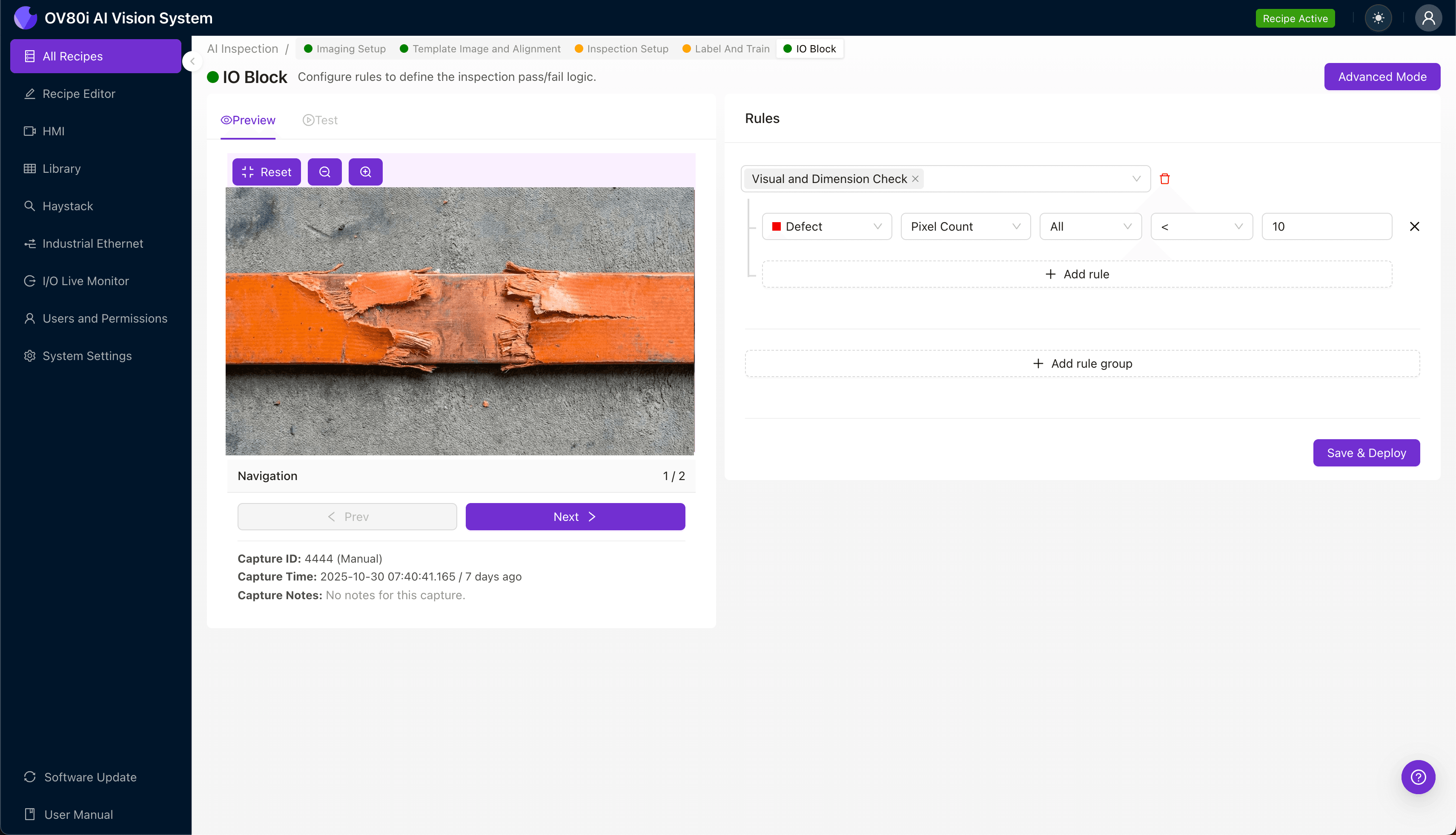
Position the power busbar under the OV80i camera system, ensuring the insulated surfaces are fully visible. Consistent part placement is essential for reliable defect detection.
Click "Configure Imaging" to access the camera settings panel. Adjust exposure to reveal subtle surface variations and set gain to optimize contrast between the insulation and any delaminated areas.
Click "Save" to lock in your imaging configuration.
Step 2: Image Alignment
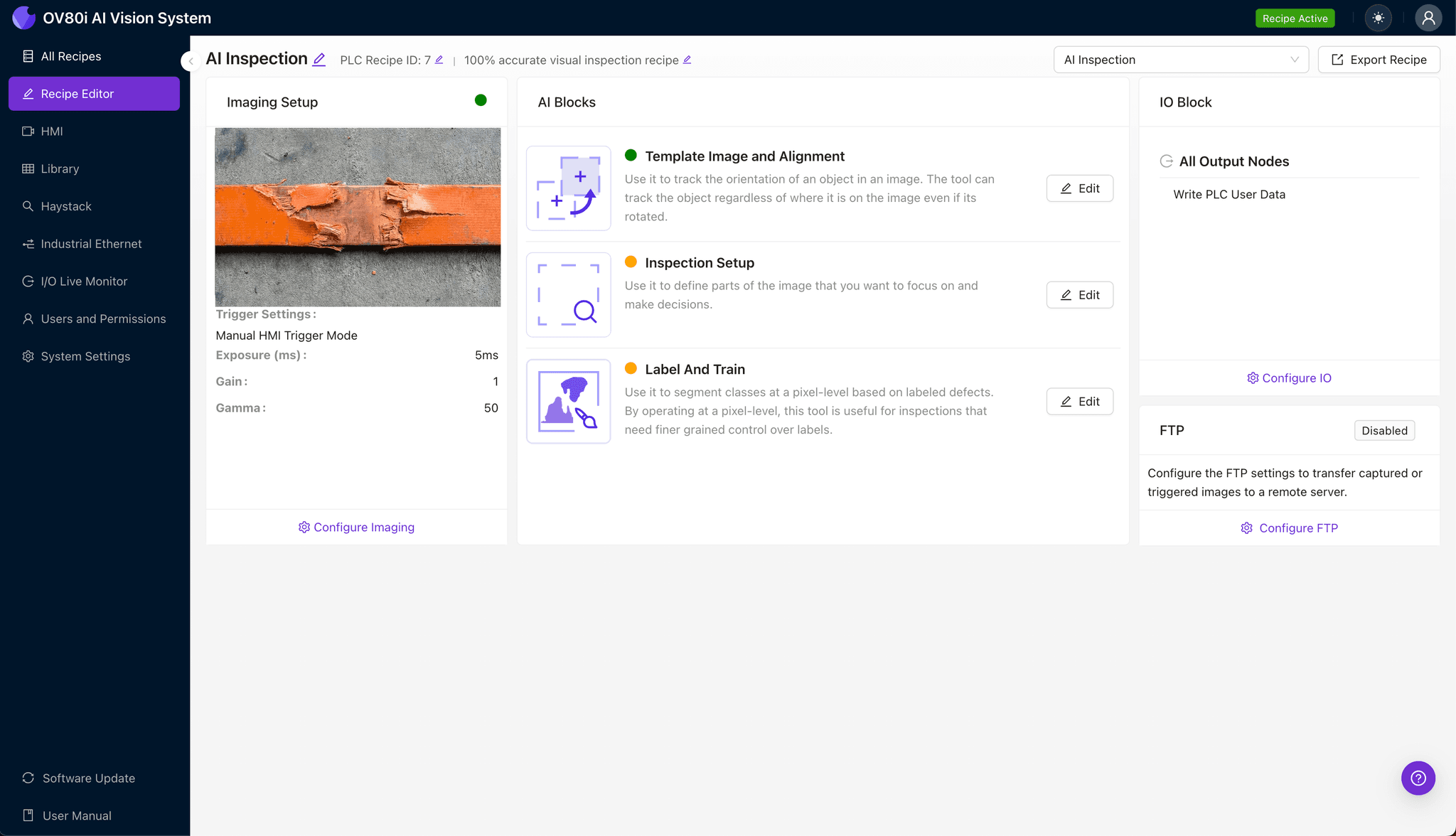
Navigate to the "Template Image" tab and capture a reference image of a properly positioned busbar. This template ensures the system can locate and orient each part consistently, regardless of minor placement variations.
Click "+ Rectangle" to draw an alignment region around the main body of the busbar. Set the "Rotation Range" to 20 degrees to accommodate typical positioning variance on your conveyor or fixture.
Step 3: Inspection Region Selection
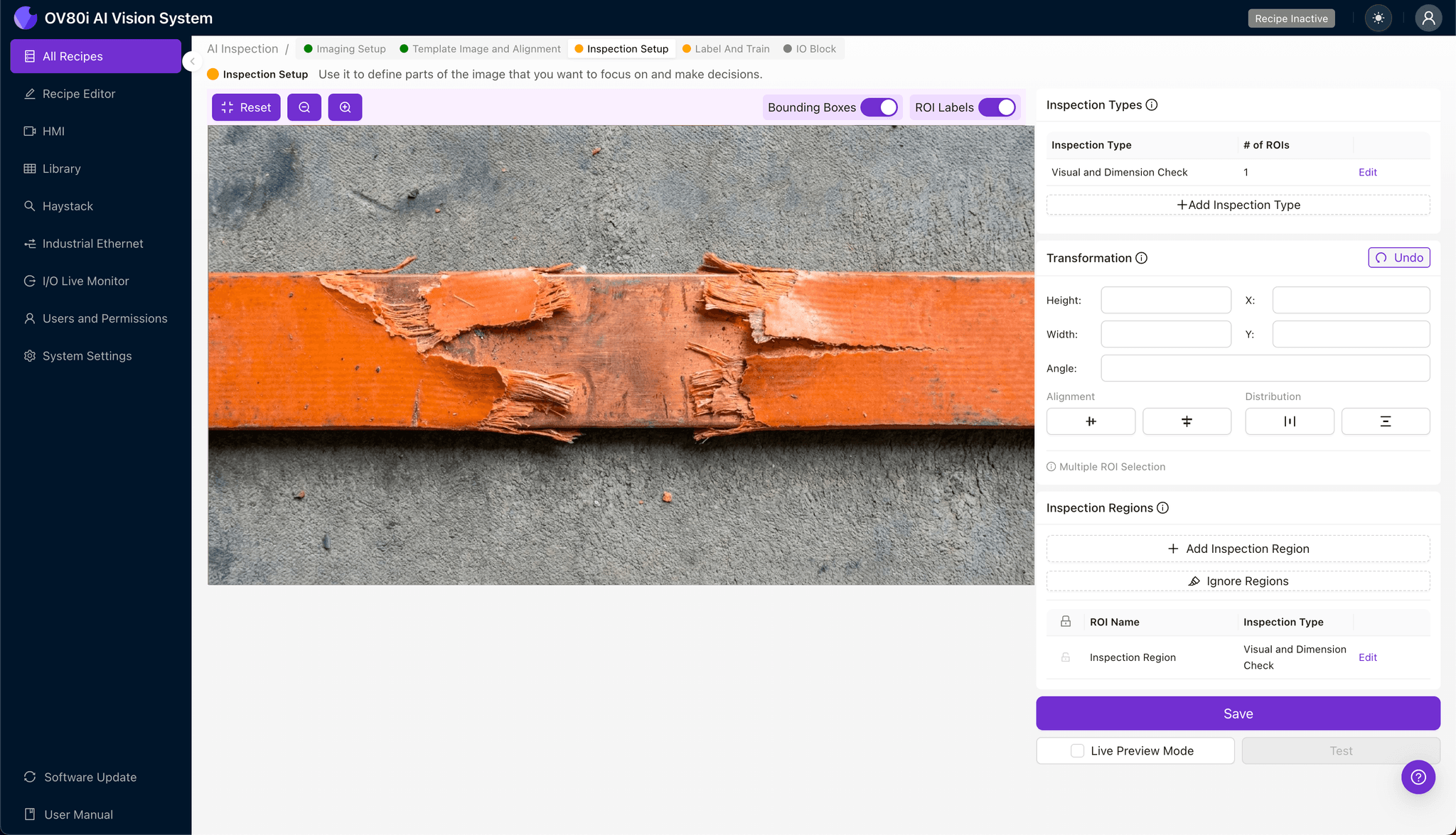
Navigate to "Inspection Setup" in the main menu. Rename your "Inspection Types" to reflect the specific defects you're targeting—for example, "Edge Delamination," "Bubble Detection," or "Surface Cracking."
Click "+ Add Inspection Region" to define your areas of interest. Resize the yellow bounding box to cover critical zones: insulation edges, corner bends, and areas near termination points where delamination most commonly occurs.
Click "Save" to confirm your inspection regions.
Step 4: Labeling Data
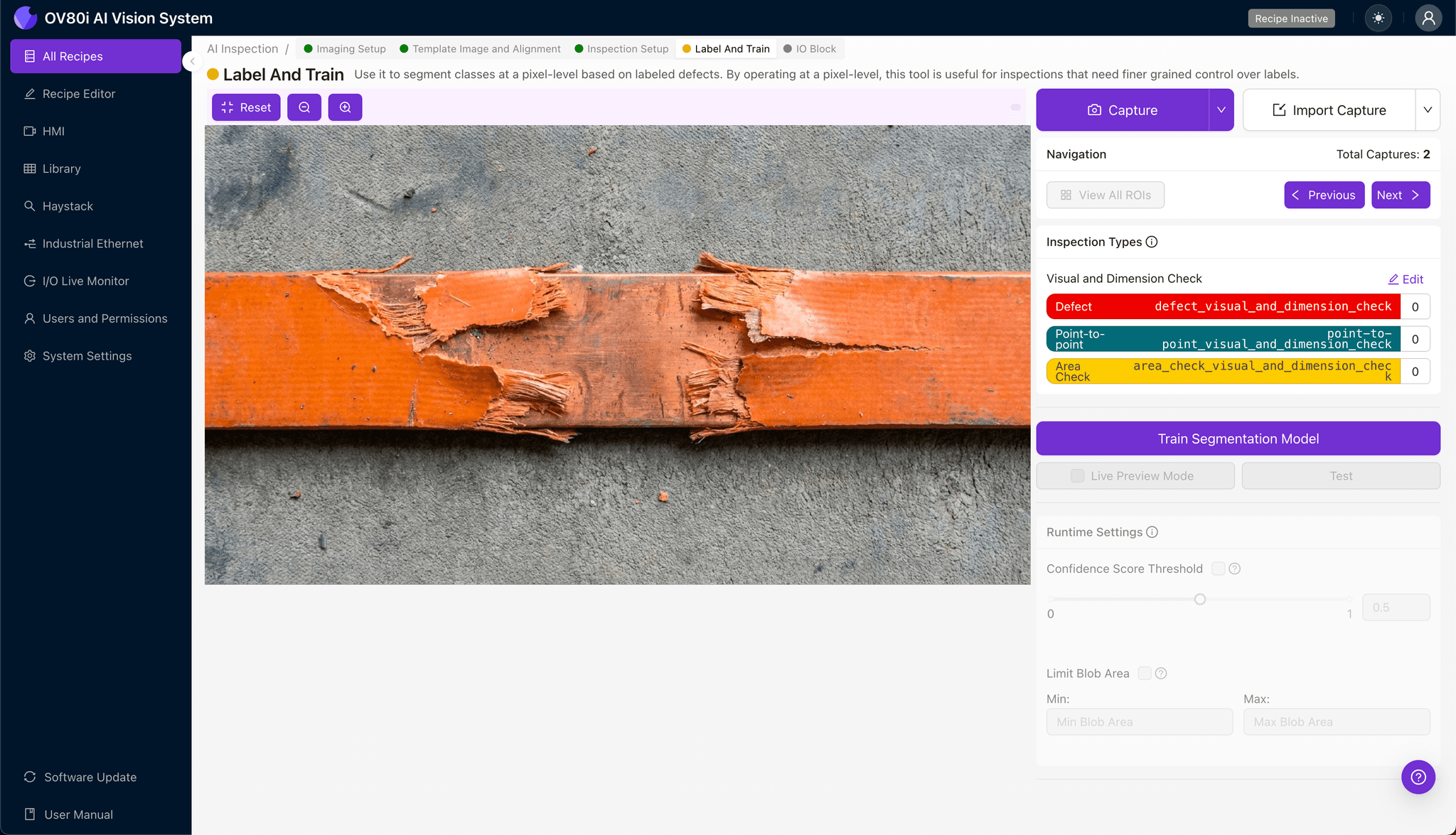
The human-in-the-loop labeling process is where your inspection system learns what matters. Review captured images and classify each as Good (pass) or Bad (fail) based on your quality standards.
Include representative samples across the full spectrum of acceptable variation. Make sure to incorporate known failure modes—units with confirmed delamination, thermal damage, or adhesion defects—so the model learns to catch real-world problems.
Step 5: Creating Rules
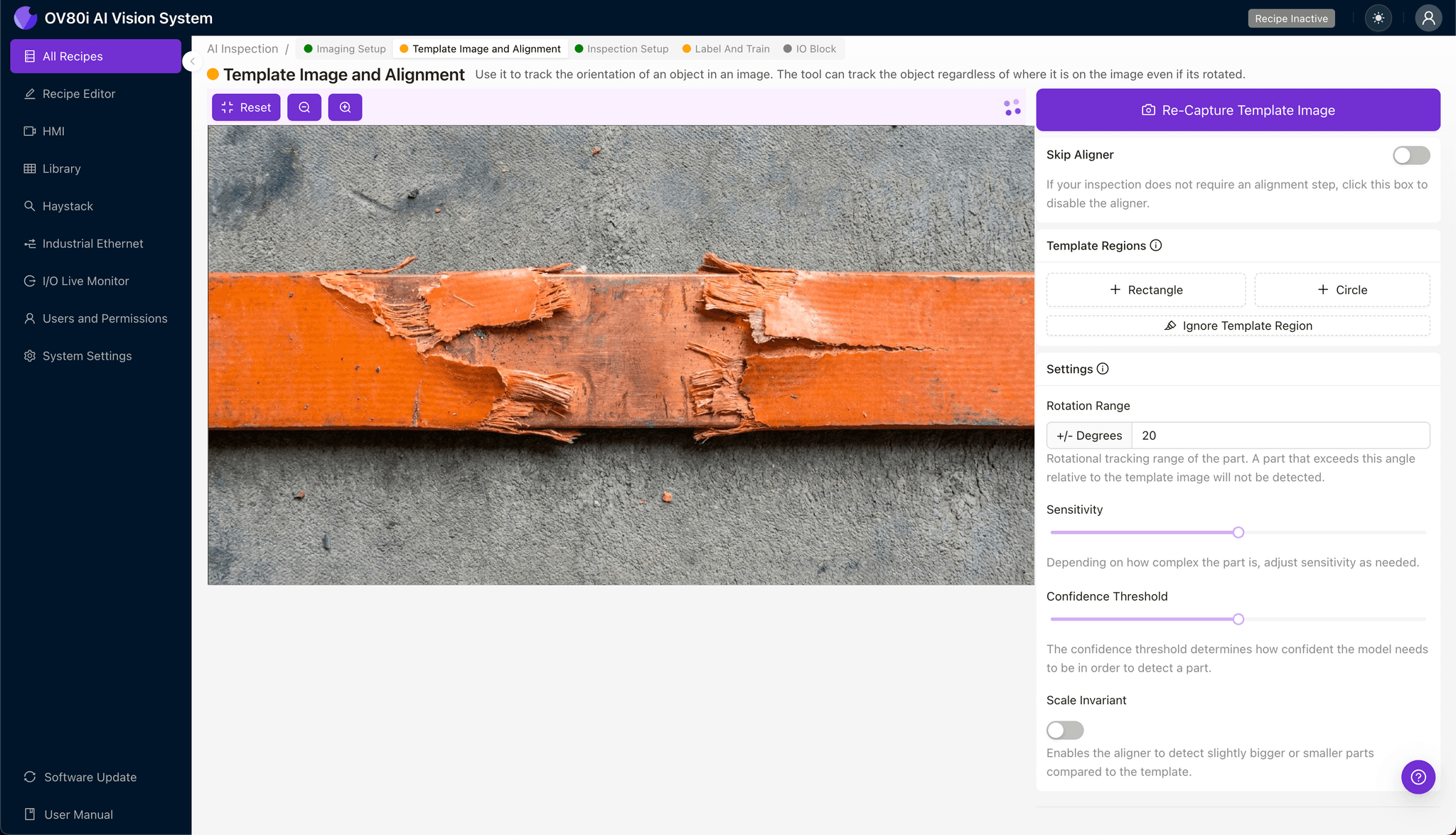
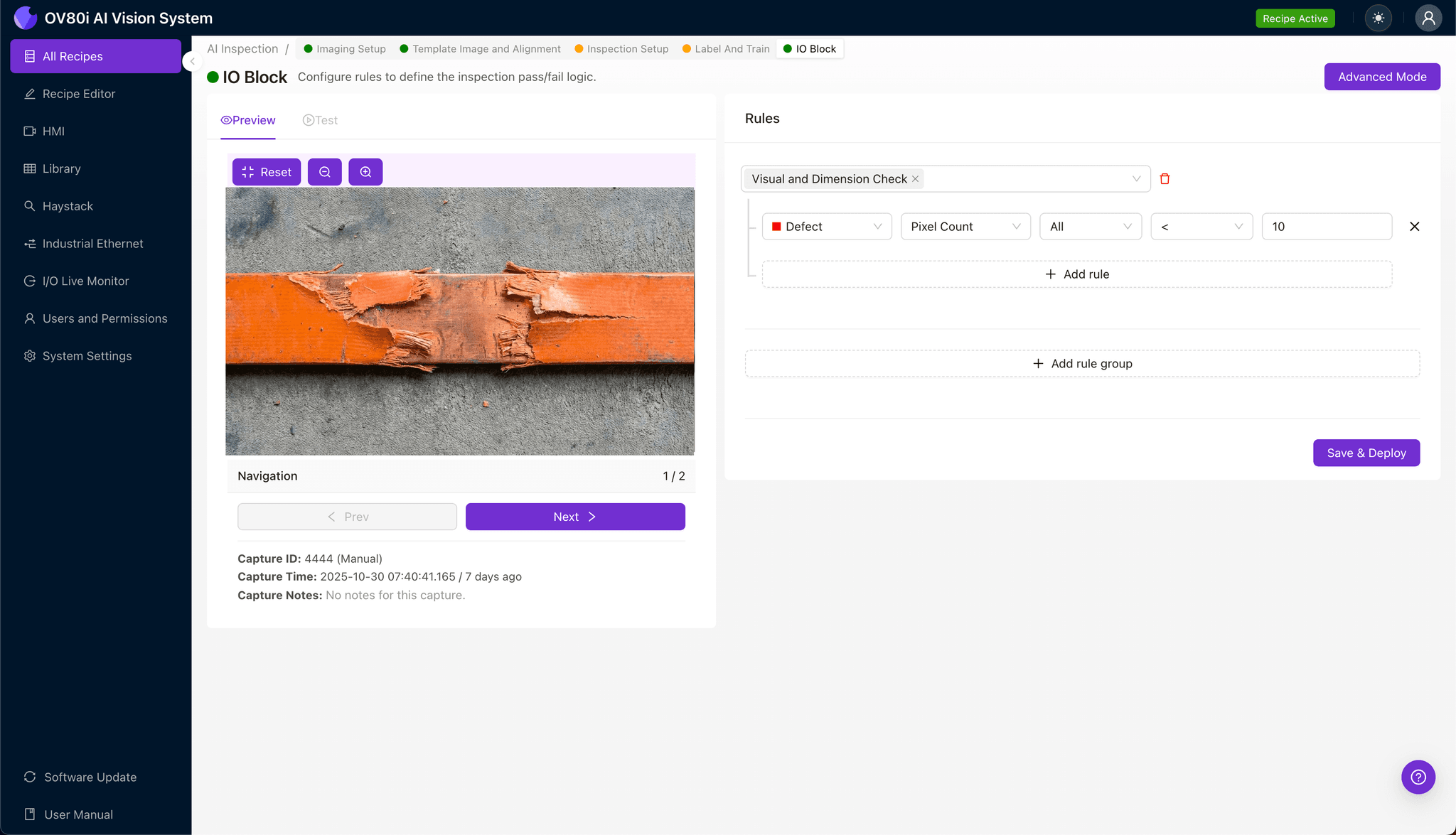
Define your pass/fail logic based on the Inspection Types you configured. For example, you might reject any unit where "Edge Delamination" confidence exceeds 85%, while allowing minor surface blemishes to pass.
These rules gate automated acceptance on your production line. Units that fail inspection are automatically diverted for rework or scrap, ensuring only conforming busbars reach downstream processes or customers.
Key Outcomes & ROI
Implementing AI-powered inspection for busbar insulation delivers measurable business impact:
- Reduced scrap rates — catch delamination early, before defective units consume additional processing resources
- Higher throughput — eliminate manual inspection bottlenecks while maintaining 100% coverage
- Compliance and traceability — automatically log inspection results with timestamps and images for audit readiness
- Process improvement insights — identify upstream causes of delamination by analyzing defect trends over time
Conclusion
Delaminated insulation on power busbars represents a serious quality and safety risk that traditional inspection methods simply cannot address at scale. With Overview.ai's machine vision platform, manufacturers gain the consistency, speed, and detection sensitivity needed to catch these defects before they become costly failures.
Eliminate Insulation Defects Today
Stop relying on manual inspection for critical busbar components. Deploy Overview.ai to catch delamination defects instantly.